Best Clinical Reasoning Apps for Med Students (2026)
A fair 2026 rundown of clinical reasoning apps with vendor facts, strengths, limits, and a quick table of prices and free tiers.
Last updated 19 October 2026

The best clinical reasoning apps for medical students right now are Sketchy Cases for the most complete case workflow with a virtual attending, Full Code for a large simulated case library with real imaging, and Medcases for free-to-start cases that include the physical exam step. Prognosis and Clinical Sense, Neural Consult, and Diagnosica follow. Every app here makes you commit to decisions before showing its reasoning, and every claim comes from the vendor's public page as of October 2026.
We build Diagnosica, one of the six apps below, so we are not neutral.Diagnosica is an AI clinical simulator for medical students and junior doctors: you take a history from an AI patient by voice or text, order labs and imaging, commit to a diagnosis and management plan, and get a competency scorecard.We included case-based apps requiring committed decisions with feedback, excluding flashcards, question banks, and clinician tools; facts from pages read 13 to 19 October 2026.
Clinical reasoning apps compared
The table compares six clinical reasoning apps feature by feature as of October 2026.
App | What you do in a case | How you're scored | Platforms | Free option | Price (as of October 2026) |
|---|---|---|---|---|---|
Sketchy Cases | Talk or type, history and physical, orders, differential, management | Virtual attending corrections, stepwise feedback, peer comparison | Web, mobile app | 7-day trial, card required | $19.99/mo or $119.99/yr (Cases only) |
Full Code | Type or talk history, view imaging, manage | Full case score, AI tutor guidance | Desktop browser, iOS, Android | Free plan, 4 cases | $11.99/mo or $71.99/yr (Pro) |
Medcases | Interview, physical exam, tests, interpretation, treatment | Not listed | Web, iOS, Android | Free to start | Paid limits not listed |
Prognosis and Clinical Sense | Branching diagnosis and management, explanations | Not listed | iOS, Android | Free, limited selection | Free apps |
Neural Consult | Talk or type, request exams, order, diagnose, manage | Feedback and a case score | Web | Free Starter, limited uses | $19.99/mo or $160/yr, US price; varies by country |
Diagnosica | Talk to a video AI patient, order tests, commit | Scores for history, investigations, reasoning, management, with teaching points | Web, iPhone, Android | Free tier, no card | Paid Standard plan, price on diagnosica.com |
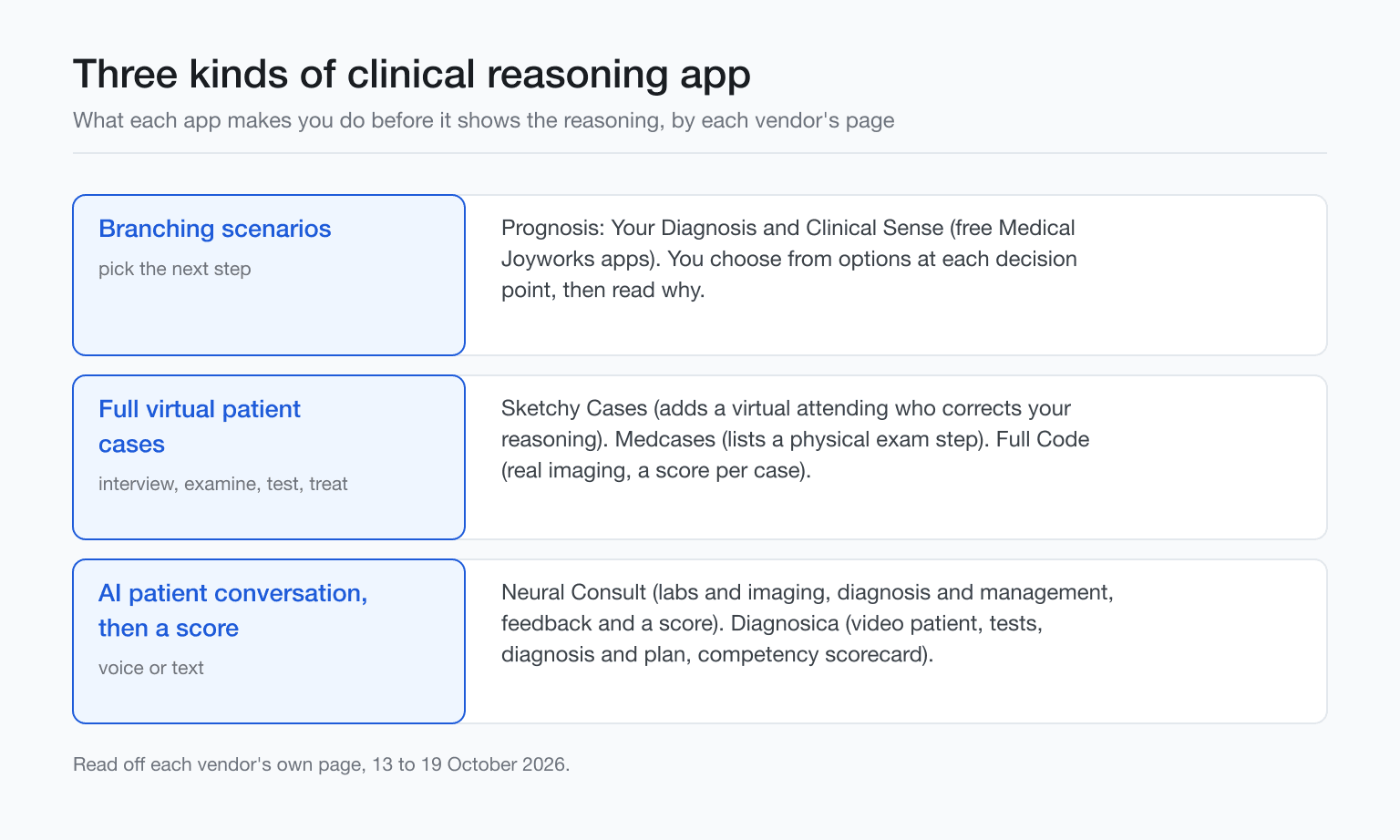
How we picked. An app made the cut only if it forces you to commit to diagnostic and management decisions inside a case, then shows your reasoning or a score. We read each vendor's public pages in October 2026 and didn't access paid tiers. The order reflects how much of a real case the app makes you work, from branching taps to full conversations.
Sketchy Cases
Sketchy Cases is first because it runs the full play: you type or talk with a virtual patient, perform a physical exam, order labs, ECGs and X-rays, then defend your reasoning to a virtual attending who corrects it in real time. You move from history to management without leaving the case.
Sketchy Cases feedback reviews your reasoning step by step, compares your answers with peers, and adds teaching points. Sketchy Cases markets clear phases, from History and Physical to Differential, Orders and Results, Management, then Feedback.
Sketchy Cases pricing lists a Cases-only plan at $19.99 per month or $119.99 for 12 months as of October 2026. Sketchy Cases has no free tier, and the 7-day trial requires a saved payment method.
For a side by side on access, cases and platforms geared to US clerkships, see Sketchy Cases against Full Code.
Sketchy Cases targets US students preparing for shelf exams, USMLE or COMLEX, and ward time, with web and mobile apps. See our Sketchy Cases review for details.
Full Code
Full Code is a clinical case simulator with simulated patients you treat through a case. Patient AI lets you take a history by keyboard or microphone, and you review real medical imaging. An in-app tutor that uses AI and a full score per case track how your decisions held up, across 23 patient models.
Full Code lists 200+ cases across 31 specialties and EMS, with a Free plan offering 4 cases and Pro tiers; pricing on Full Code's plans shows Pro at $11.99 a month or $71.99 a year, and Pro plus CME at $99.99 a year, as of October 2026. Full Code runs on desktop browsers, iOS and Android, and it leans toward acute and emergency care; if you want options, see Full Code alternatives.
Medcases
Medcases is an interactive virtual patient app where you interview, examine, interpret tests, and choose treatments. It is one of the few in this list whose page lists physical exam practice as a core step, framing cases around interview, physical exam, test interpretation, and treatment decisions.
Medcases is free to start in the web app, with paid limits not listed on the homepage as of October 2026, and runs on the web, iOS and Android. Medcases self-reports 1500 clinical case scenarios, and the cases are typing and clicking, not a spoken conversation.
Prognosis and Clinical Sense
Prognosis: Your Diagnosis and Clinical Sense are free Medical Joyworks apps on iOS and Android. Each runs as a branching scenario where you pick the next clinical step, then you’ll read a short explanation of why it was right or wrong. No conversation with a patient.
Prognosis goes deep on one presentation. Clinical Sense walks a patient from admission to discharge, and the free apps carry a limited selection as shown on the Medical Joyworks free apps page. There's no conversation, so you'll get fast reps between rotations, like other diagnosis games sorted by type.
Neural Consult
Neural Consult is an AI case simulator inside a broader study platform. You speak or type with an AI patient, order labs and imaging, and commit to a diagnosis and management. Neural Consult then returns feedback and a case score, so you see where your clinical reasoning held up and where it fell short.
Neural Consult lists a free Starter plan with limited uses. Pro is $19.99 per month or $160 per year at the US price as of October 2026, with pricing that varies by country.
Neural Consult runs on the web, and realistic patient avatars are listed as a future feature. Details live on Neural Consult's case simulator.
Diagnosica
Diagnosica is an AI clinical simulator for medical students and junior doctors: you take a history from an AI patient by voice or text, order labs and imaging, commit to a diagnosis and management plan, and get a competency scorecard.
Diagnosica shows a video patient you can speak to or type to, and there’s a free tier with no card needed. Diagnosica runs on Android, iPhone and the web, and is used in the UK, Canada, Australia, Ireland and elsewhere, with Standard plan details at current pricing.
Diagnosica’s library holds over 130 cases across 18 specialties in three difficulty bands, and every case is written and signed off by a doctor. You get a scorecard on history taking, investigations, diagnostic reasoning and management with teaching points, plus a two-minute quick case with five clues and a guess after each. There’s a no-signup demo that takes about 3 minutes, and there’s no physical exam step, no attending who questions you, and a smaller library than Full Code or Medcases, which is why it sits sixth here.
Which clinical reasoning app should you pick?
The right clinical reasoning app depends on the part of a case you keep missing. If you need pushback on your differential, pick one with an attending critique. If you drift on tests, pick one that forces orders and real imaging. Match the tool to the failure mode.
- Sketchy Cases: attending pushes back on reasoning.
- Full Code: a large library of simulated cases with real imaging, useful if you want repeated case practice where the imaging you see is part of the case material.
- Medcases: physical exam included.
- Prognosis or Clinical Sense: free, quick reps on your phone.
- Neural Consult: if you’re already revising inside one study platform and want cases too.
- Diagnosica: if you want to talk out loud to a video patient and see a competency scorecard.
These clinical reasoning apps only help if you open them. Pick two that offer a free tier or trial, spend a week alternating, then keep the one you return to. You can try a case free and review how to build a differential diagnosis while you compare.
What's the difference between a clinical reasoning app and a question bank?
A clinical reasoning app makes you gather the history, build a differential, order tests, and commit to a plan before you see the teaching. A question bank hands you a prearranged stem with options, so it tests recognition. That difference matters if you want to practice decisions rather than pick patterns.
If you want to broaden beyond question banks, see alternatives to question-bank-only studying.
Which clinical reasoning apps are free?
Free access in clinical reasoning apps, as of October 2026, looks like this. Prognosis and Clinical Sense are free apps with a limited selection, Medcases is free to start, Full Code has a free plan with 4 cases, Neural Consult lists a free Starter plan, Diagnosica has a free tier with no card, and Sketchy Cases offers a 7 day free trial that requires a card.
Which clinical reasoning apps work on Android?
Android support across clinical reasoning apps, as of October 2026, breaks down like this. Full Code, Medcases, Prognosis and Clinical Sense, and Diagnosica list Android apps, Sketchy Cases lists a mobile app, and Neural Consult is web only with no native Android app listed.
Diagnosica is free to start with no card. Work a full case with a video AI patient, order labs and imaging, commit to a diagnosis, then see where your reasoning held on the scorecard. Available on web, iPhone, and Android. Start a free case