Your First FY1 Nights: The Bleeps You'll Actually Get
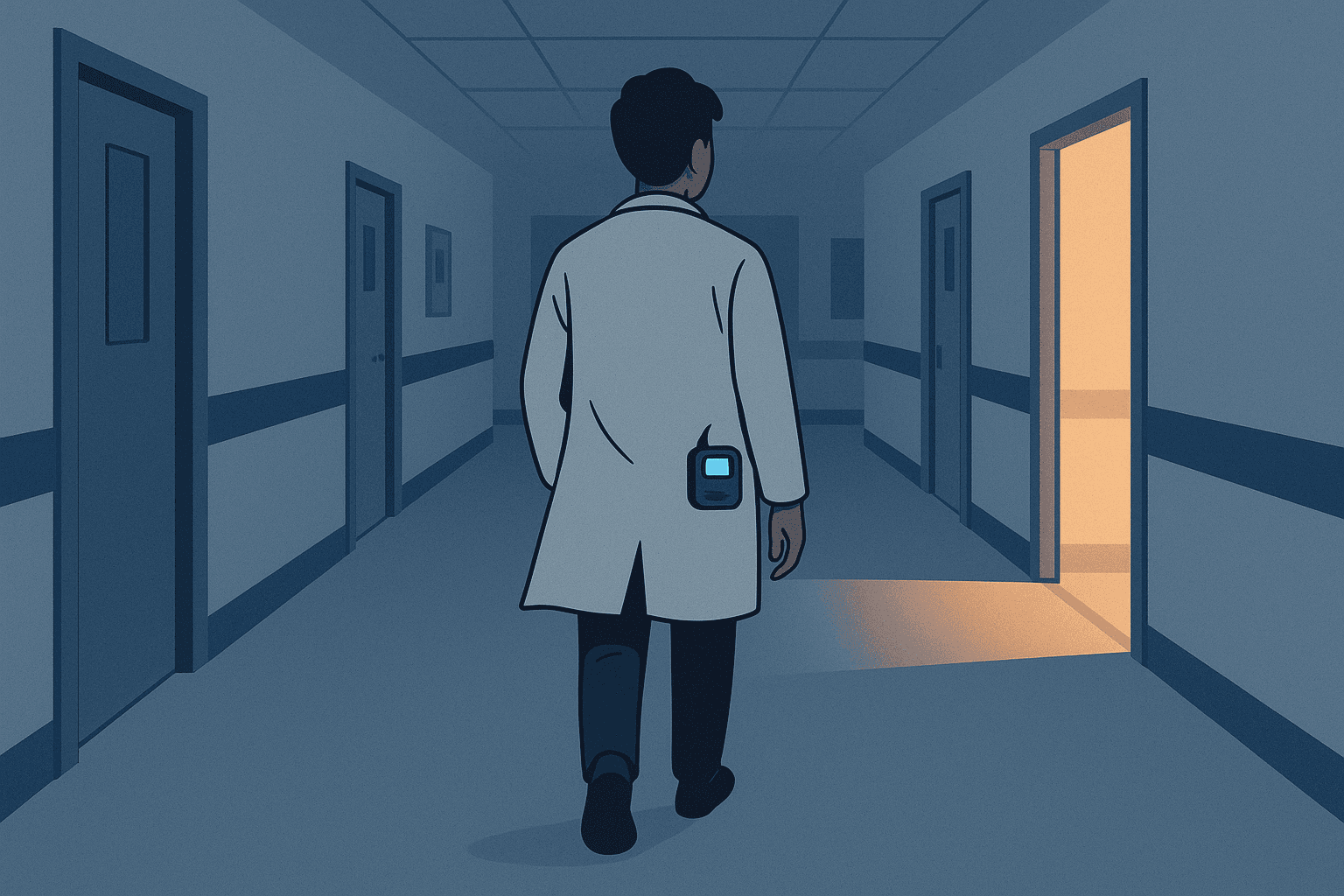
The rota lands. You count forward to your first nights, then back to today. Calendar squares get coloured in. People keep saying you’ll be fine. That rarely helps.
Waiting with half-stories and rumours drags.
You start picturing the bleeps, the corridors, the names you don’t know.
What does a first FY1 night involve? Holding a bleep for several wards, reviewing patients you’ve never met, doing prescribing-level jobs, and deciding what waits for morning versus what needs a senior now. The fear is the unknown patients, not the absolute workload.
Here’s what the common bleeps look like, plus a way to rehearse the talks before August so the first ring is not a free fall. If it helps to hear it from peers, here’s what other new doctors say about their first nights.
Rehearse your first night review Talk or type through a night-shift review with an AI patient, no signup, free case, marked at the end. Start your free case
The bleeps you'll actually get
Nights collapse into a few repeatable bleeps, and the mystery fades fast.
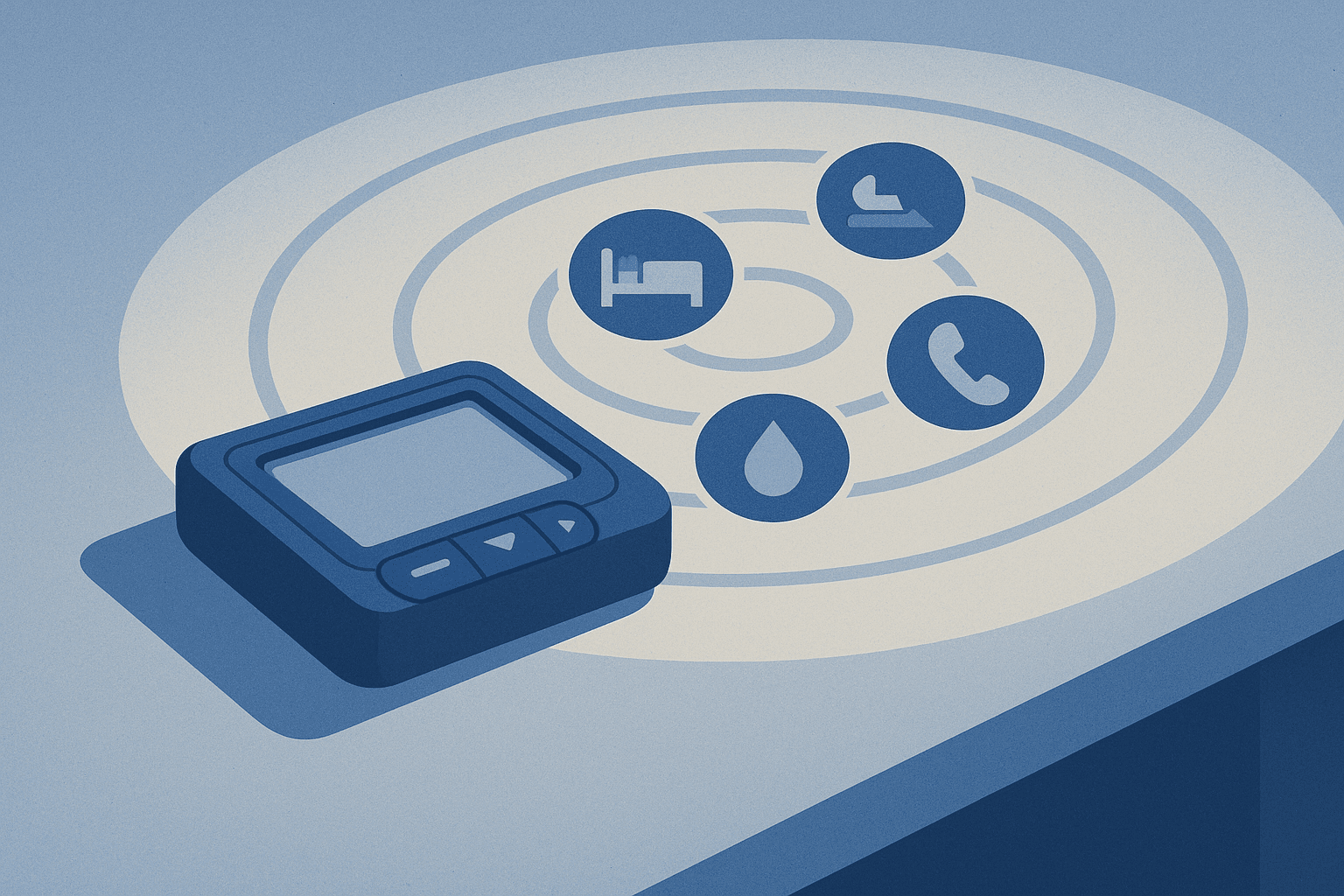
- “Please review, new symptom.” A patient now in pain, breathless, confused, or uncomfortable. Clarify what’s new and when it started, what’s been tried, and whether you need eyes on now or a quick look at notes first.
- Charts and paperwork. Chart rewrites, fluids to re-chart, forms due before morning. Admin, but it keeps the ward safe.
- “Family want an update.” A relative on the ward or on the phone, anxious and wanting a clear plan. Check what’s already documented, what they were told earlier, and whether the right person to update them tonight is you or the day team in the morning.
- “Observations have changed.” A worried nurse calling about a shift in obs or a trend that doesn’t fit the patient. Ask for the figures, how they’ve moved, and what else is going on at the bedside before deciding if you’re coming now or timing a recheck.
- Blocked cannula and practical jobs. Cannula tissued, line won’t flush, bloods needed, NG tube fallen out. You’ll juggle by urgency, location, and whether your hands or someone else’s are best placed to sort it.
- The genuinely sick patient. Less common, very memorable, and usually obvious from the first sentence. You won’t fix anything on the phone, but you can get what you need en route and arrive ready to make sense of what you’re walking into.
The pattern is phone triage; most of the work is deciding what the call is really about.
The problem is the same wherever you qualified. New doctors starting in American hospitals meet it too, and the first week on the wards runs through the presentations that come first.
Reviewing a patient you've never met
Everyone often assumes you know the patient. Saying, "I've not met them before, talk me through it," shows competence, not weakness. It sets the tone and stops you chasing shadows.
Before you leave the desk, get the story from the caller. What changed, when it changed, and what the current observations are. Ask why it’s prompted a call now and whether this is a first concern or a trend across the shift.
If you’re heading up, sharpen what you’ll check first with the end-of-bed look, from obs trends to NEWS2 cues and when to escalate.
Clarify urgency and location, then what’s already been tried. You’re not second-guessing, you’re building a timeline. If you can, scan recent notes or handover entries before you walk.
At the bedside, introduce yourself and your role, then rebuild the story from the top. Short, focused history: presenting problem, onset and course, relevant positives and negatives, brief background. Then an exact, structured exam that does real work.
Keep it calm and visible. You’re rebuilding context the day team had and you don’t. It matters.
Look at the observation chart and drug chart in sequence. Don’t anchor on a single number. What were they 2, 4, 6 hours ago. Same with fluid balance and recorded symptoms. Trend beats snapshot.
Summarise out loud so the nurse hears the same picture you do. Then set your plan in plain language, including what to watch, how often to recheck, and what should trigger another call. Make the “if this, then call me” explicit.
Close the loop before you go: confirm who’s doing what and when you’ll review. If you need to step away for kit or advice, say so and give a time you’ll be back. Brief and predictable works.
Rehearse your first night review Talk or type through a night-shift review with an AI patient, no signup, free case, marked at the end. Start your free case
2am, a 24-year-old who 'seems more drowsy'
The 2am bleep goes: Connor Hughes, 24, clashed heads going for a header about 2 hours ago, hit the side of his head on the way down, now seems more drowsy.
Before you move, you want from the caller: the exact timeline, what “more drowsy” means compared to earlier, who noticed it, whether he’s rousable to voice, any new confusion, any vomiting or seizure-like activity, alcohol or analgesia on board.
You ask for the current observations as they have them: heart rate 88, blood pressure 132/84, oxygen saturation 98 percent, respiratory rate 14. Every time, you want the numbers spoken out.
When you speak to him, he says: “I’m fine, honestly... just a banging headache and I can’t... can’t keep my eyes open.” That line is doing a lot of work.
A young man whose drowsiness is getting worse after a head injury is a story you take seriously and escalate. No drama, no delay.
This isn’t where you decide imaging or treatment; it’s where you clock the trajectory and make sure the right people know. Not ideal, but it’s the job.
The teaching point is boring and reliable: the history did the work. The same questions you drilled for OSCEs surfaced the red flag, and you heard it in his timeline and his own words. Other night calls turn on a single question like that, gathered into five overnight traps.
If you’re doing nights in the US, read the US night float version for the same patterns mapped to that rota.
You can rehearse this exact case as an AI patient conversation; Connor Hughes is a fictional AI patient from Diagnosica’s library.
Ask early, and rehearse before August
In August, your seniors expect calls from new FY1s. The doctors who get in trouble are the ones who didn't call, not the ones who called too often; "I'd like you to see this patient because I'm worried" is a complete sentence.
If something goes wrong despite calling, here’s a practical guide to handling a mistake in the first hour.
Permission, not protocol. So call early even if the story is half-formed, then add detail as you get it. You're not wasting anyone's time by being clear about concern.
The conversations are practisable now: taking a story from a stranger, then presenting it to a senior in a crisp, linear way. Do it out loud, repeatedly, before your first shift (and it sticks). It works.
Diagnosica lets you practise on an AI patient by voice or text, the case is marked when it ends, with feedback against competency-based rubrics. It does not cover physical examination practice, so stay with real patients and tutors for that piece.
If you want a scaffold, start here: practise the conversation structure. When you’re ready to try it for real, there’s an AI patient you can talk to.
You can trial it with a no-signup demo on the homepage that takes about 3 minutes and is marked when the case ends. There’s a free tier with no card needed; the paid Standard plan adds more full cases.
There are over 130 cases across 18 specialties in three difficulty bands, and scoring is competency based across history taking, investigations, diagnostic reasoning and management, not mapped to any exam's published mark sheet. It’s available any hour with no booking or partner needed, plus transcript export and leaderboards by specialty and country. Before August, rehearse common ward conversations and practise decision-making using apps that train clinical reasoning to build confidence for your first FY1 nights. Nights are one slice of the year, so read how to survive FY1 for the whole picture.
Whatever happened overnight has to be handed over in the morning, so it helps to have a presentation structure ready, and to know how the morning round runs.
Quick answers for the anxious
How many patients do you cover on FY1 nights?
There's no single number. It varies by hospital, rota, and site layout. You'll usually cover several wards, field a steady bleep for routine jobs, and sometimes be pulled to review someone unwell. Expect the first hour to feel chaotic while you triage and build a list. After that, a rhythm appears. We can't predict your site, so plan for busy, carry a simple prioritisation rule, and let the quiet nights be a bonus.
Can you sleep on nights?
Sometimes, but not always. It depends on the shift pattern, local policy, and how the site runs overnight. If there’s protected rest, use it without guilt. If there isn’t, micro-rest when safe. Plan sleep around the set: a short nap before night 1, a fixed wake time after each, and guard the first recovery day from admin. The days either side matter more than a nap at 03:00.
What if I miss something serious?
You're not expected to make lone diagnoses at 3am. You're expected to notice, to look, and to call. The system assumes new doctors ask. When you're uneasy, slow down, state the concern, gather what's immediately available, and get help early. Write down times, names, and what was agreed. If it turns out to be nothing, fine. If it isn't, you moved the right levers.
August you’ll still be scared; the version of you who’s run these conversations 30 times out loud will be scared and ready. Practise the words you’ll need at 3am, then trim them to fit you. Go in, be human, and learn from the night.
Two more worth reading before the first set: what to do when you’re bleeped and the apps FY1s actually use.
Rehearse your first night review Talk or type through a night-shift review with an AI patient, no signup, free case, marked at the end. Start your free case