Free Virtual Patient Simulators: 10 Options Compared (2026)
Ten virtual patient simulators you can try free, with what each includes, limits, and trials, checked October 2026.
Last updated 16 October 2026

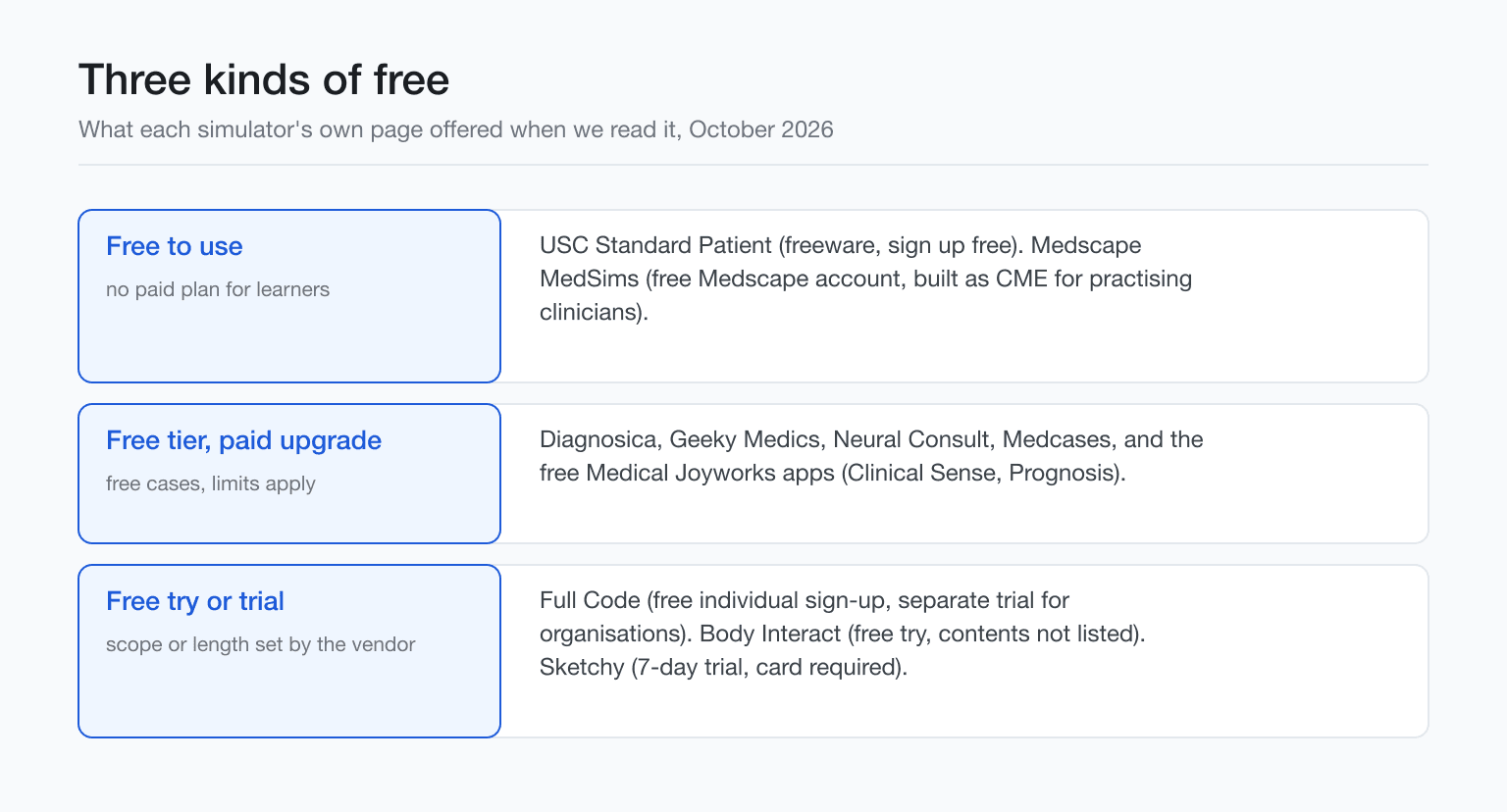
Yes, you can practice with a virtual patient online for free. The offers fall into three kinds: fully free to use, a free tier with limits, and a free try or time-boxed trial that sometimes needs a card. What you actually get and for how long varies a lot.
If you're searching for virtual patient simulation online free, this compares ten providers using the vendors' own pages as of 16 October 2026, and shows what each free offer includes and what it gates.
Diagnosica is our product, and it's listed like the rest. Each free virtual patient simulator markets free differently, so we quote the vendor page and stick to it.
This comparison draws only on public pages, without logging in, and does not assess clinical accuracy or the medical soundness of any case. Product scope and pricing can change without notice, and we could be wrong about edge details.
Free virtual patient simulators at a glance
Here’s a quick scan of free virtual patient simulators, what the free access includes, and whether you can actually talk to the patient.
Tool | Kind of free | Talk to the patient? | Best for |
|---|---|---|---|
Diagnosica | Free tier, monthly free cases | Voice or text | Any-hour scored reps, teaching points |
Geeky Medics | Free selection of AI patients | Voice or text | OSCE checklist practice with AI |
USC Standard Patient | Free signup, small and growing set | Voice or text | Conversational practice on a few cases |
Full Code | Try free, individual sign-up | Voice or text | Real imaging with full case scores |
Body Interact | Free try via app download | Not listed | Real-time physiology practice, competency data |
Medcases | Try web app free | Not listed | Full clinical workflow, incl. exam |
Neural Consult | Free Starter, weekly limited uses | Not listed | Light weekly use across features |
Clinical Sense and Prognosis | Free limited selection of cases | Not listed | Quick mobile cases for breadth or depth |
Medscape MedSims | Free with Medscape account | Decision steps | CME credit simulations with decisions |
Sketchy | 7-day trial, card required | Not listed | Trying content before paying |
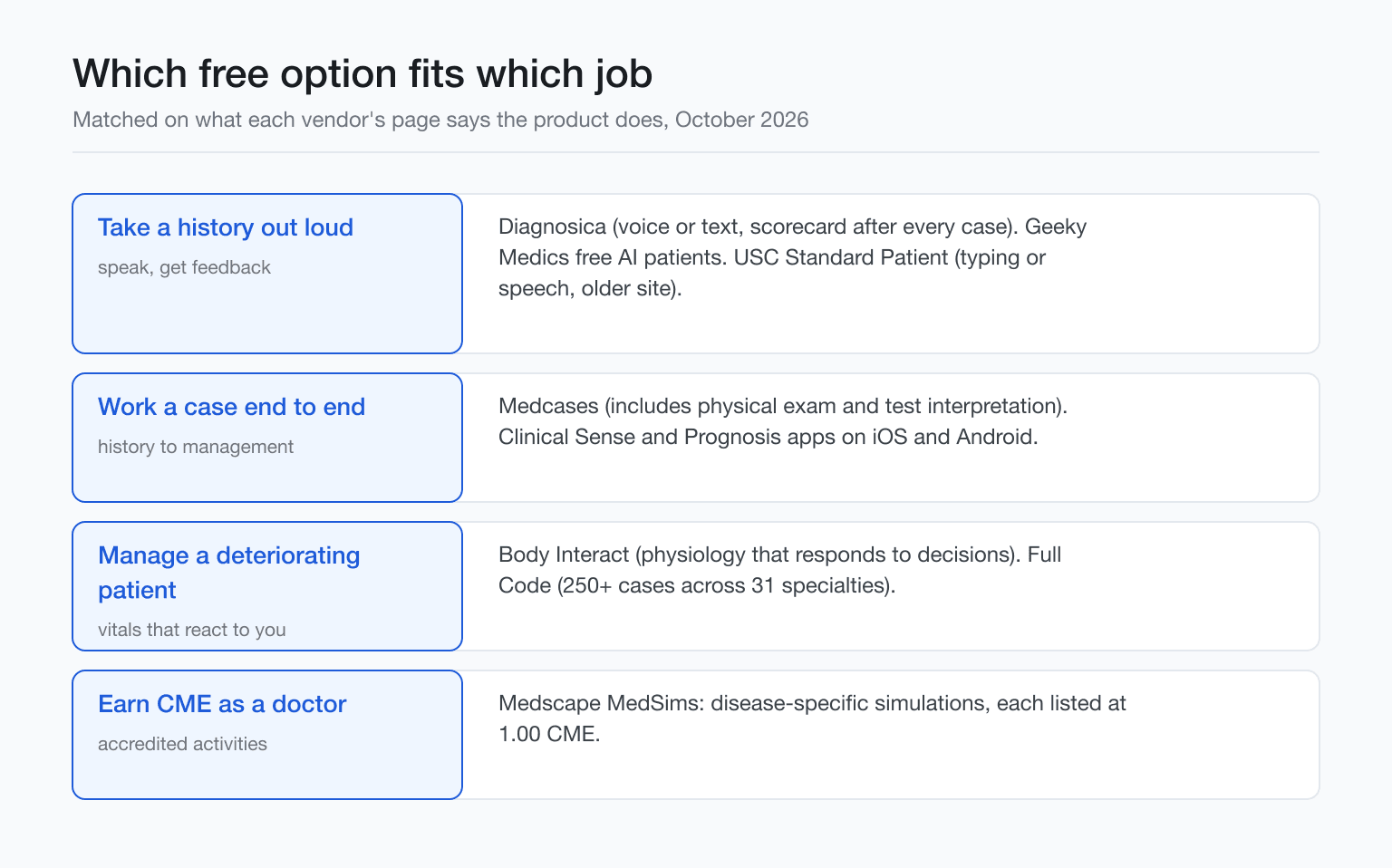
Below, the sections group these tools by the job they do, so you can pick fast.
Free options where you talk to a patient
If you want free virtual patient simulators where you actually speak or type to a patient, these four are live options.
Diagnosica
Free tier, no card, voice or text to an AI patient, plus investigations, imaging, and a scorecard with teaching points after every case. Try it on Diagnosica's no-signup demo. It suits quick reps across 18 specialties when you want competency scores and a transcript. No physical examination practice.
Geeky Medics AI patients
The free plan includes a selection of AI patients with voice or text, and an AI examiner that marks against a checklist, with voice costing AI credits as of October 2026. The full library is the broadest here, over 800 AI patients as of October 2026, but the free slice is small, see Geeky Medics plans. Suits checklist practice and timing reps. Limit, you’ll pace usage because voice burns credits and many patients sit behind paid bundles.
USC Standard Patient
Freeware community site, sign up free, type or speak via Chrome, with a feedback system and a small set of cases plus monthly additions. The footer shows 2014 to 2017 as of October 2026, see USC Standard Patient. Suits warm-ups and basic communication drills when you want zero gating. Limit, the library is small and the project looks older.
Full Code
Individuals can “Try Full Code for free!” with a personal account, with 250 plus cases across 31 specialties and EMS, Patient AI by keyboard or microphone, real imaging, and a full score and debrief per case as of October 2026, via Full Code for individuals. Suits mixed acuity case practice when you want imaging and branching decisions. Limit, the pages we read don’t list individual paid prices or how much content is free on an individual account as of October 2026.
Free case and decision simulators
If you’re comparing free virtual patient simulators that skew to decision steps over open dialogue, these four are worth a look.
Medcases
The free Medcases web app advertises interview, physical exam practice, test interpretation, and treatment inside the same case. That middle step matters, and it’s one voice only tools, ours included, don’t do. They self report 1,500 case scenarios as of October 2026.
Body Interact
Body Interact's free try sends you to its app downloads, and the site doesn’t say what the no cost tier includes. It’s pitched mainly to schools, with patients who breathe, speak, and react in real time to your decisions, ages 6 months to 99 years, plus feedback and competency data, as of October 2026.
Clinical Sense and Prognosis
Medical Joyworks still offers free mobile apps, Medical Joyworks free apps, with a limited selection of cases. Clinical Sense covers a case admission to discharge, and Prognosis goes deeper on narrower problems. The old Clinical Sense web page now redirects to a schools product, so the apps page is the entry point.
Medscape MedSims
Medscape MedSims are free with a Medscape account and are built as accredited CME, each 1.00 CME, with immersive interviews and decision points. The content is disease specific and aimed at practicing clinicians. It’s better suited to residents and beyond than to first history taking practice.
Practice with a free AI patient Sign up free, no card, pick a case, and talk or type to a video avatar. Order investigations, decide on a diagnosis and plan, then get a scorecard with teaching points at the end. Start a free case
Free tiers and trials on study platforms
Neural Consult
Neural Consult has a free Starter plan with a limited number of weekly uses, as of October 2026. It includes case simulations, searches, flashcards, and question sets. If you’re hunting free virtual patient simulators, this is a broader study platform that happens to include a simulator. Details are on Neural Consult's Starter plan.
Sketchy
Sketchy offers a 7-day free trial on every plan, and a credit card is required to start it, as of October 2026. Access is time boxed. If you only want a peek for a week, set a reminder so you decide whether to continue. See Sketchy's trial terms.
A trial that needs a card isn’t the same as a free tier.
What free tiers can't give you
Free tiers exist so you can sample the product, not live on it. Expect volume caps to be the first brake you hit, either on cases per week or on how many times you can speak to a patient before switching back to text.
Feedback usually thins out next. You might get a headline score or a short comment, not a full critique of your reasoning across history, investigations, diagnosis and plan. Enough to see the vibe, not to systematically fix weak spots.
None of this replaces practicing with trained standardized patients or having a supervisor watch you and stop you mid-question. If you need that, read virtual versus standardized patients for what each does well and why they’re different.
Treat the free run as a filter. Do you prefer voice or text. Do avatars talking back help you focus or distract you. Does the case style match how you study, or are you better with shorter, single-decision vignettes.
Time matters. Some tools are built for a two minute hit, others assume a 20 minute grind. If you only have commute windows, choose for that, not against it.
If you want to see what a longer, structured session looks like end to end, here’s a walkthrough of a full AI OSCE simulator session. It shows the pacing and the kinds of decision points to expect, even if you’ll use a free tier elsewhere.
From what we can tell, free virtual patient simulators are best for choosing your lane, then rationing your practice. When a cap bites, switch to another tool and keep your reps going.
Common questions
Is there a completely free virtual patient simulator?
Yes. USC Standard Patient is freeware with a small library, and Medscape MedSims is free with a Medscape account. Most others are limited free tiers or time boxed trials. If you want completely free access, start with those two, then add capped plans if their limits fit your goal.
USC Standard Patient supports typing or speaking in Chrome, has feedback, and a small case set with monthly additions.
Medscape MedSims is free once you make a Medscape account, with accredited simulations aimed at clinicians.
They are the clearest free virtual patient simulators as of October 2026.
Are free AI patients good enough for exam prep?
Yes, for drilling structure. Free AI patients are strong for repeated history taking, signposting, ICE, and safety netting. They won’t teach physical examination or replace supervisory judgment. Use them for reps, then review tricky calls with a human supervisor or faculty when you can.
If you’re starting out, try history taking practice with ChatGPT to build prompt discipline and structure before layering in simulator reps.
What's the catch with free tiers?
The catch is limits. Expect caps on cases or weekly uses, meters for voice or other AI features, partial feedback, or trials that need a credit card. Always check the plan page and its date stamp, because inclusions often shift.
Examples as of October 2026: Geeky Medics uses AI credits for features like voice, Neural Consult’s Starter limits weekly uses, Sketchy’s 7-day trial needs a card, and Body Interact’s free try doesn’t list contents. For a quick scan of current options, see best AI tools for medical students.
If you want to see how a virtual patient feels without paying, take one case from history to diagnosis and then read the scorecard with teaching points. It’s voice or text history taking with investigations and imaging, no physical exam practice, so you can run a free case