How to Interview a Depressed Patient Who Won't Talk


If you're looking up how to interview a depressed patient, guidance often assumes they talk. Then you meet the real thing, low and withdrawn, and feel the pull to tick boxes fast so you can move on.
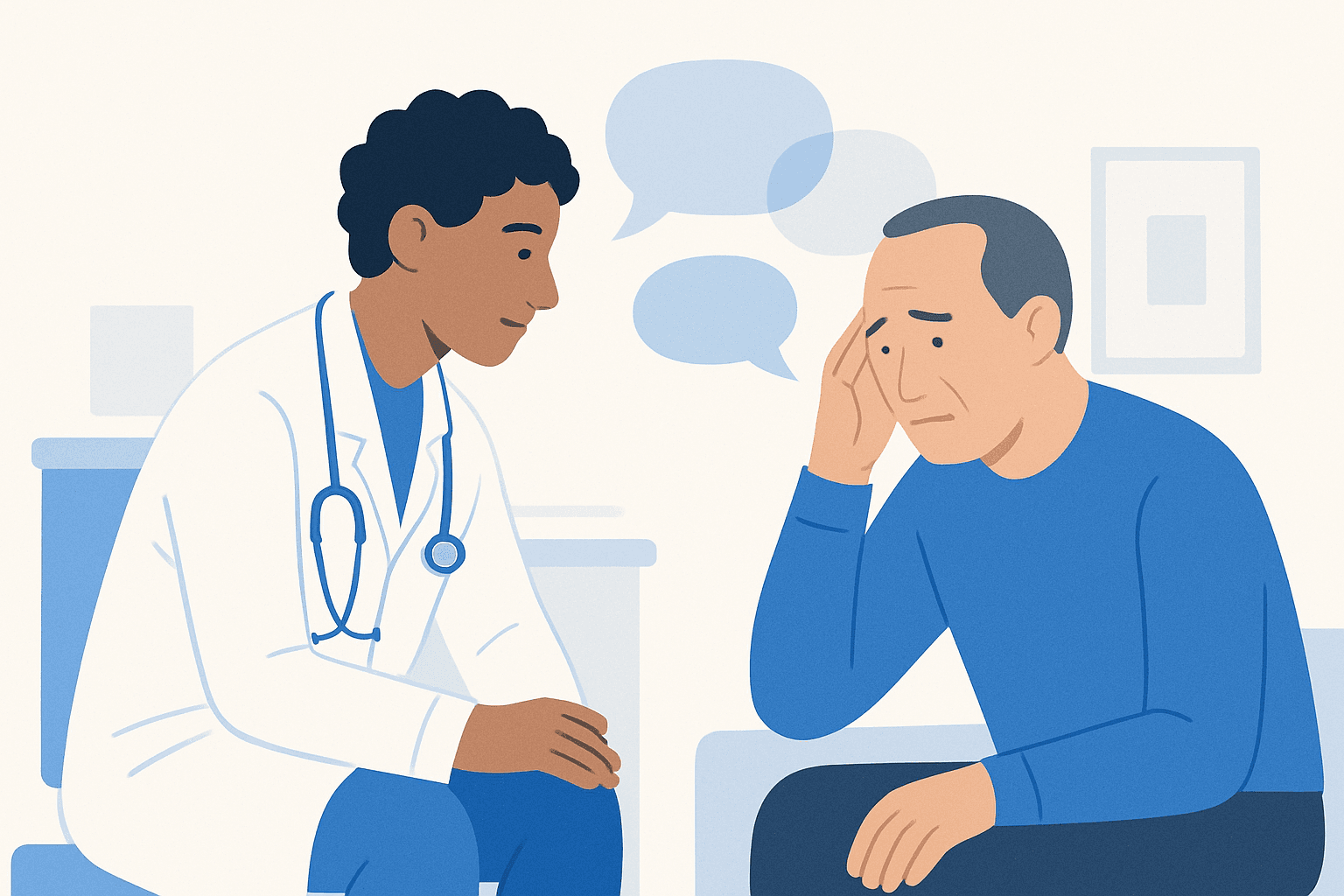
He sits flat, quiet and slow, long pauses before any answer, little eye contact. Short replies, minimises everything, like "it's nothing really" or "I'm just tired". We’ll cover why people go quiet, what helps them talk, and how to ask about suicide directly and kindly.
Why do depressed patients go quiet?
Quiet, slow, one word at a time is usually the illness talking, not rudeness or a lack of cooperation. In low mood, thinking and speech can slow and effort feels huge, so people minimise and retreat. How they speak, pause and avoid eye contact is data you record in the mental state examination.
Slowed thinking shows up as long pauses before answers, a flat, quiet and slow voice, and very little spontaneous speech. You’ll often get short replies to open questions, then nothing.
Shame makes it worse. Many expect to be judged or told to pull themselves together, so they minimise with lines like it’s nothing really or I’m just tired.
Some feel numb rather than tearful. Ask about family and you may see them well up around their children, then shut it down again.
Silence can also be fear of consequences, like being thought weak, losing a job, or what the children will think. The quiet is clinical information, not a vacuum.
The hidden presentation: 'I just can't sleep'
Depression rarely introduces itself by name. It walks in asking for help with sleep, tiredness, or because someone else insisted. Our AI patient opens with: "I've not been sleeping. I was hoping you could give me something for it." Then, "I'm just tired all the time, doctor. It's nothing really, my brother made me come." And, "I haven't been myself for a few months. I think I just need a decent night's sleep."
That is a somatic route in, described in our case as how depressed men most often present, with neither mood nor intent volunteered. Set that next to England and Wales deaths registered in 2024, where the male suicide rate was 17.6 per 100,000 against 5.7 for women, per the ONS figures for 2024.
Early-morning waking gives the game away. Waking at about 4am and not getting back to sleep is a biological feature of depression, not primary insomnia. In our case he also volunteers feeling exhausted and without energy for about four months.
The same thing happens across medicine, a common illness, misleading complaint pattern that repays a calm, curious history before you reach for labels.
Setting up the room and the first minute
Slow your own pace. Sit at an angle rather than across a desk if you can, with your chair low and your phone face down. Leave longer silences than feel comfortable. It tells a shut-down patient you will not rush them.
Open with your time frame and permission. "We have about 15 minutes today. We can go slow, and if any question feels too much, say 'pass' and we can come back."
Explain confidentiality in plain words before anything heavy. "I keep what you tell me private. If I was worried about your safety, I’d need to involve others to keep you safe. I’d tell you what I was doing."
Early on, draw out what they think is going on and what worries them, see asking about ideas and concerns. Try, "What do you think is happening?" and "What’s the part that worries you most?"
Name the emotional weather you can see. In our case he looked numb rather than tearful, welled up when I asked about his kids, and he was ashamed to be here, braced to be told to pull himself together. I say, "People in your spot often fear being judged or thought weak. Is any of that landing for you?"
Questions that work when the answers are one word
1) One open prompt, then wait, longer than feels comfortable. "Take your time, what’s been hardest this past week?" You’re buying space, not filling it.
2) If that stalls, guided choices. "Would you say your mood’s been low, flat, or something else?" He can nod to a bucket even if he can’t paint the picture.
3) Continuers and reflecting back his own words. "You said ‘tired’. Tired in your body, your head, or both?" Small echoes show you heard him and invite a phrase, not a shrug.
4) Plain words beat labels. "Do you feel low or flat rather than ‘depressed’?" In our case, he recognised low and flat before he’d touch the D word.
5) Anchor questions to real events, because concrete is easier. "Since the separation and being signed off work, how are your mornings compared with before?" You can also ground around his children and work days.
You still have to ask the core questions, because he won’t volunteer most of them here. Low or flat mood and loss of interest came only when asked, as did appetite and concentration. Guilt and hopelessness needed a specific probe. Ask about thoughts of death and suicide plainly, and if present, whether there’s a plan and the means or any preparations.
While you listen, keep other explanations in mind and only commit after weighing the other explanations. Thyroid disease, heavy alcohol use, an adjustment reaction, primary insomnia and others can all present quiet and withdrawn.

What not to do
- Stacking two or three questions in one breath. They pick the easiest to answer and you lose the thread.
- A rapid closed checklist. Rattling through 'Sleep OK? Appetite OK? Mood OK?' shuts doors; if you rush or load the suicide question with 'You're not thinking of doing anything silly, are you?', he says 'No, nothing like that' and withdraws for the rest of the consultation.
- Filling every silence. If you jump in at every pause, you teach them you will carry the talk, and the one word answers never get space to grow.
- Reassuring too early. Opening with 'I'm sure it'll be fine' signals you want good news, so risk talk feels unwelcome and the patient stops disclosing anything that might worry you.
- Treating the presenting complaint and closing the consultation. Treat the presenting complaint, then close without asking about mood, and risk gets missed; in our AI patient case the key failure is treating the sleep complaint and never asking the question.
Practise the quiet consult Practise the quiet patient by voice or text with an AI patient, any hour, free to start, no card. Try a case
How do you ask about suicide?
Ask directly, calmly and without judgement, using the word suicide or saying ending your life. Work step by step. Start with how they feel about the future, then whether they feel better off dead, then whether they have thoughts of ending their life, then whether they have a plan, then any preparations.
- How they see the future. "How are you feeling about the future at the moment?"
- Better off dead. "Have you been feeling that you’d be better off dead?"
- Thoughts of ending life. "Have you had any thoughts about ending your life or suicide?"
- A plan. "Have you made a plan to end your life?"
- Preparations or means. "Have you made any preparations, or got anything you could use?"
NICE's depression guideline says to always ask people with depression directly about suicidal ideation and intent, which backs a calm, explicit question over hints or euphemisms.
People worry that asking might plant the idea. The evidence suggests it does not increase risk. In a 2014 literature review, no study found a statistically significant increase in suicidal thoughts among those asked, and the authors suggest talking about it may reduce ideation.
If you’re working out how to interview a depressed patient who barely speaks, the ladder gives you a route without rushing. In our AI patient case, a closed, loaded line, "You’re not thinking of doing anything silly, are you?" gets, "No, nothing like that," and he withdraws for the rest of the consultation.

What changes when the answer is yes
When someone says yes to suicidal thoughts, keep your voice steady and thank them for telling you. Tell them you want to understand and keep them safe, then ask short, open questions that make it easy to answer without pressure.
If there is a plan and the means, or they have made preparations, this is same-day. Tell a senior now, do not leave him alone while help is arranged, and arrange urgent same-day senior or psychiatric review. NICE's depression guideline advises urgent referral when there is considerable immediate risk.
Preparatory acts, such as writing a letter, are not tidying. They signal rising imminent risk.
Ask what has kept him going so far. In our AI patient, he names his two children, a brother who rings every day, and the fact he came in today. Keep these in the room, they matter to what happens next.
Do not be reassured by a low score on a form. NICE's self-harm guideline says not to use risk assessment tools or global low, medium or high labels to predict future suicide or repetition of self-harm.
If you are unsure how to proceed, escalate to a senior early, see getting senior help early. As a student or FY, your job is to recognise and tell someone, and to stay with him while safety planning and urgent help are arranged.
Worked example: our 34-year-old who asked for sleeping tablets
Meet Stuart Ravenscroft, an AI patient, 34. Separated five months, two young children with his ex, signed off work for six weeks, drinking heavily alone, a history of self-harm in his early twenties. Flat, quiet, slow, long pauses, barely any eye contact. Minimises everything.
His request is simple, sleeping tablets and out. Vitals are normal, HR 72, RR 14, BP 118 over 74, SpO2 98%, temp 36.6. Examination and every blood test are normal. The diagnosis and the risk live only in the conversation.
The rushed version looks like this. Closed questions about sleep and stress. He nods, says it is nothing, you address the sleep complaint, he leaves having said nothing. You did not meet the problem he came in with.
The unhurried version starts differently. An open prompt, then guided choices he can point to, and you tolerate the silences. You ask about the children, and he wells up for the first time.
You ask the suicide question directly, without euphemism. He says, quietly, "nobody's asked me that before", and then he answers. He is not offended. He is relieved.
This only lands because you asked. He describes guilt and worthlessness, and a hopelessness where he can't picture next year, adding that he's thought his family would be better off without him.
He also discloses a plan and the means, and I'm deliberately not repeating the detail, in line with Samaritans' media guidelines. He's made preparations.
You round out risk and rule-outs. Past self-harm is there. Heavy drinking alone is there. He has never had a high, which matters for differential thinking.
This is how to interview a depressed patient who will not talk. An open start, choices he can endorse, the thread about the children, then the direct question that lets the truth out.
For contrast, our articulate panic-disorder case has low mood but no thoughts of harming himself, and you only know that because you asked; our bipolar case is the opposite problem, a man who talks over every question.
Practise the quiet patient until it feels normal
Most of this skill is pacing and nerve, and you only grow those through repetitions. A ward bay with a quiet, flat patient is a bad place for your first go. If you freeze on how to interview a depressed patient, reps matter.
In Diagnosica you can run this exact history with an AI patient by voice or text at any hour, then order investigations, commit to a diagnosis and plan, and see a scorecard with teaching points. He stays closed if you rush, opens up if you are gentle and direct.
Build a routine for practising alone, see our piece on solo practice for history stations. It is a simulation, not supervision. It doesn't give advice about real patients, and it's not a diagnostic system. Treat every output as educational.
If this stirred something up for you, you can call Samaritans free on 116 123 in the UK any time, day or night. In the US, call or text the 988 Lifeline any time.
Educational use only, not medical advice. AI-generated; verify clinically against primary sources.
Clinical review pending.
Work the sleeping tablets case Take the history from the AI patient who asked for sleeping tablets and get a scorecard with teaching points. Start now