OSCE anxiety: why reps beat reassurance before stations
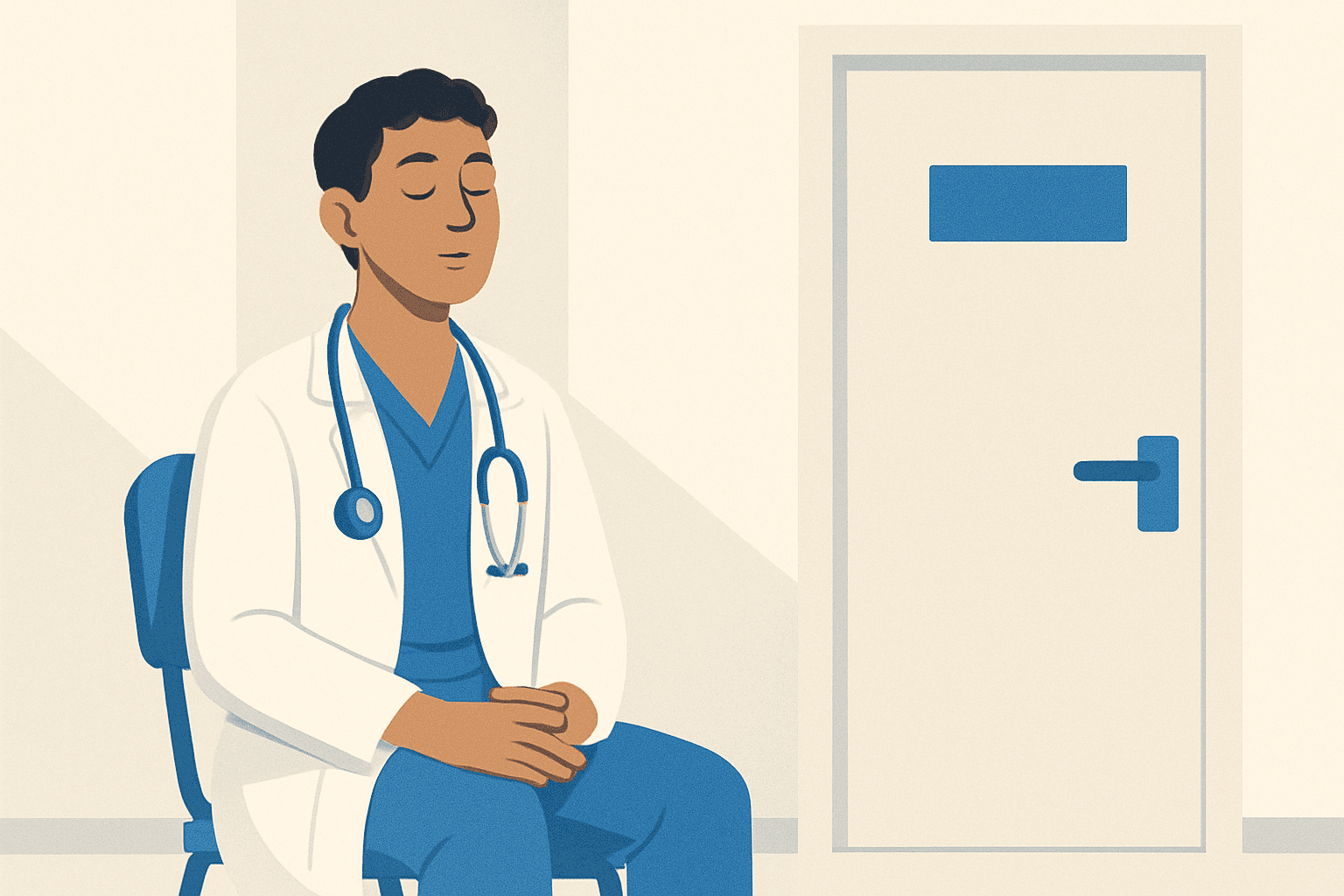
You wait in the corridor outside station one. Palms damp, breath shallow, heart thudding harder than it should.
Your mouth is dry before the bell. You fidget with the name band and wonder if your mind will blank the moment you see the patient and the examiner's clipboard.
This page covers why nerves turn up, what research says about whether they dent your mark, and how to build familiarity so the format feels routine. Call it OSCE anxiety if you like, then treat it as reps, not character. We'll keep it practical.

Is OSCE anxiety normal?
Yes. Nerves before and during OSCEs are common across health students. A 2020 systematic review found test anxiety is higher with OSCEs than with more traditional written assessments. Feeling keyed up in a timed, observed station is the norm, not a personal failing. Most of us feel watched, timed and judged, so nerves show up.
In a 2020 systematic review of OSCE anxiety, test anxiety was higher with OSCEs than with more traditional assessments. From 339 papers screened, 9 studies were included across medical, pharmacy, dental and nursing programmes. Female gender was not associated with OSCE-related anxiety in that analysis.
So call it what it is, state anxiety about a judged performance, not a character flaw.
You can be diligent, kind and competent, and still feel your stomach drop when the examiner starts the clock.
OSCE anxiety is about the format and stakes, not the kind of person you are.
Does anxiety actually lower your OSCE score?
Probably less than you fear. A systematic review found six of eight studies that tested the link between OSCE anxiety and OSCE performance saw no association, and the authors concluded anxiety has minimal to no influence. That does not mean no effect for every person, but the group signal looks small.
Across the review's six of eight studies that assessed it, no association was seen between OSCE-related anxiety and OSCE performance, and the authors' conclusion was minimal to no influence. The caveats matter, the evidence is small at nine studies, methods vary, cohorts mix medical, pharmacy, dental and nursing students, and different anxiety scales were used. From what I can tell, the evidence is limited in quantity and consistency.
For a medical-student example, a Korean medical school study of 94 of 101 Year 3 and 4 students at one school found test anxiety was not associated with OSCE scores (r = 0.09). That is one centre and one snapshot, but it fits the broader pattern.
Feeling terrible and performing badly are not the same thing.

Why the OSCE format makes people nervous
This is about nerves around a test, not an anxiety disorder. OSCE anxiety tracks the format, not your worth as a future doctor, and from what I can tell it often spikes before you've had many reps.
You walk into a room and have to build a rapport with a stranger in real time. It's a standardised patient, it's high stakes for progression, and most students haven't practised that format much before, which the review's authors suggest blends test anxiety with performance anxiety.
There's a clock. Stations are timed, the bell goes, and your brain can feel like it's running in treacle even when you know the content cold.
Someone is watching and marking you as you go. That's different from a written paper, and the visibility can feel like standing on stage.
The unfamiliar pieces are the ones you can change. Get used to timed encounters with a scripted stranger, and learn what examiners are really marking so you're aiming at the right targets when the door closes.
Familiarity is the fix: what mock and peer-led OSCEs did
In a randomised, non-blinded study of 67 fifth-semester medical students at one Brazilian school sitting their first summative OSCE, the intervention group ran a peer-led OSCE with some as examiners and some as examinees. In a randomised peer-led OSCE trial, state anxiety was lower in the peer-led group, 54.8 vs 63.6 on the STAI-S, p = 0.009.
Scores nudged up in the intervention group, 8.60 vs 8.30, but that difference was not statistically significant, p = 0.055. There was no significant correlation between anxiety and OSCE score, so higher nerves did not map to worse marks in this sample.
One signal did stand out. Students who acted as examiners scored higher than controls. If you can arrange it, get into the examiner's chair at least once.
The authors called the limits plainly, single centre, non-blinded, and limited statistical power. That makes the anxiety effect promising, but you would not bet your year on it alone.
There is a plausible mechanism. As that Korean study's author suggested, mock OSCEs may help students lessen anxiety caused by unfamiliarity with the test format. That was speculation in the discussion, not tested.
Practical read for OSCE anxiety, treat it as a repetitions and familiarity problem. Organise mocks where you rotate roles, include timing, and make someone hold a clip-board. The closer it feels to the day, the calmer your body tends to be when it counts.
Building reps when you can't find a partner or an examiner
Mock OSCEs are thin on the ground, friends flake, and clinic runs late. Annoying, and confusing. Treat osce anxiety like a repetitions problem and stack reps you control, so the format feels familiar when the bell goes.
If you want a plug-and-play template for solo work, we wrote a step-by-step solo routine. Use it as your default on nights when no one else is free.
1) Rehearse out loud against a timer. Set your school's station length, speak your intro, gather a focused history, summarise, explain your likely diagnosis and next steps, then close. No pausing to think on paper mid station, make decisions in real time.
2) Record yourself. Phone camera at shoulder height, timer in frame, full run without stopping. On playback, mark three things to fix next time, like pace, filler words, or the summary being too long. Then rerun immediately and check you changed it.
3) When you do find a friend, swap examiner and candidate. The examiner times strictly, keeps a simple checklist, and says nothing until the end. You can both be wrong about content, but you can both recognise structure under pressure.
4) Use an AI patient for history-taking stations. In a session with an AI patient, you speak or type to a video avatar, order investigations, commit to a diagnosis and a management plan, then get a scorecard with competency scores and teaching points. It runs any hour without booking, every case is signed off by a doctor, and it covers history-taking only, no physical examination practice. It isn't proven to reduce anxiety, it gives you more realistic repetitions. It doesn't give advice about real patients, and it's not a diagnostic system. Treat every output as educational.
Get history taking reps Speak or type to an AI patient, get a scorecard after every case, any hour; history stations only. Start a case

On the day: reading time, breathing, and recovering from a bad station
If osce anxiety spikes outside the door, spend the reading minute on two jobs only. Read the task twice, then pick your opening line. You're setting your first 20 seconds, not panic-planning the whole station.
Your opening line should answer the stem. If it says focused history of chest pain, your opener might be, "I'd like to ask about your chest pain and how it started." Then move. You'll fill detail once you're inside.
Breathing helps if you've trained it. The NHS version is simple, and repeatable anywhere: get comfortable, let your breath flow deep into your belly without forcing, in through the nose and out through the mouth, breathing gently and regularly, optionally counting 1 to 5, then letting it out gently, and repeating for at least 5 minutes. It says to practise regularly, so rehearse it in the weeks before, not for the first time at the door. Here's the NHS breathing exercise.
There's also a small nursing study where deep breathing lowered self-reported anxiety before an OSCE. It didn't measure OSCE performance, the sample was small, and the reporting had inconsistencies.
If a station goes badly, treat the bell as a reset. In most centres, from what I can tell, each station is marked separately by a different examiner, but schools differ.
Between doors, drop your shoulders, one slow belly breath, pick the first line for the next task, and go in. No autopsy of the previous station in the corridor.
If the fear underneath is failing, read what actually follows a fail before the circuit. Knowing the worst case is often less frightening than imagining it.
When it's more than nerves: where to get proper support
OSCE anxiety that spikes before the circuit then settles after is common. If you're having panic attacks, anxiety that lingers for weeks, stops you sleeping or eating, or makes you avoid placements, that's something to get help with, not to out-practise. This page cannot assess you.
- Your medical school's student wellbeing or student support service, and your personal tutor. They can help you plan time off if needed and discuss reasonable adjustments at the exam centre.
- Your GP. The NHS says to see a GP if you've been experiencing symptoms of panic disorder, see NHS guidance on panic.
- NHS Talking Therapies. You can self refer for anxiety, including social anxiety and panic disorder, if you're registered with a GP and aged 18 or over, with 16 or over in some areas, through NHS Talking Therapies.
- The BMA's support. The BMA counselling line is a free and confidential 24 hours a day counselling line and peer support service open to all doctors and medical students.
If you're unsure where to start, email your student support inbox today and book the first available GP slot. Two small admin tasks, done, so you're not sitting with this alone overnight.
A two-week reps plan for the run-up
- Days 1 to 4. Do one out loud timed history station each day to your school's station length. Check what each station is scored on, and if you use an AI patient, reps cover history stations only. Keep this inside your wider finals plan.
- Days 5 to 9. Run one mock with a friend where you each sit in the examiner's chair. In a peer-led trial, students who acted as examiners scored higher than controls. On other days, alternate solo reps and an AI patient for histories, and use practising with no partner to structure them.
- Daily habit. Practise the NHS breathing exercise for at least 5 minutes, then again later in the day, practise regularly. Use it before you read a stem and after you leave a station so the cue feels automatic.
- Days 10 to 12. Do full circuits at your school's station length with a bell and no pauses. After a fumble, name it out loud, decide the one recovery line you would use next time, and carry straight on.
- Days 13 to 14. Taper: one light history rep, one short breathing run, then stop. Sort logistics, route to the centre, timing and ID, and protect sleep by organising the boring bits early. Annoying, and fixable.
Educational use only, not medical advice. AI-generated; verify clinically against primary sources.
Clinical review pending.
Build more OSCE reps More repetitions under a bit of pressure, free to start with no card, on phone or laptop. No promises about nerves or scores. Start in app