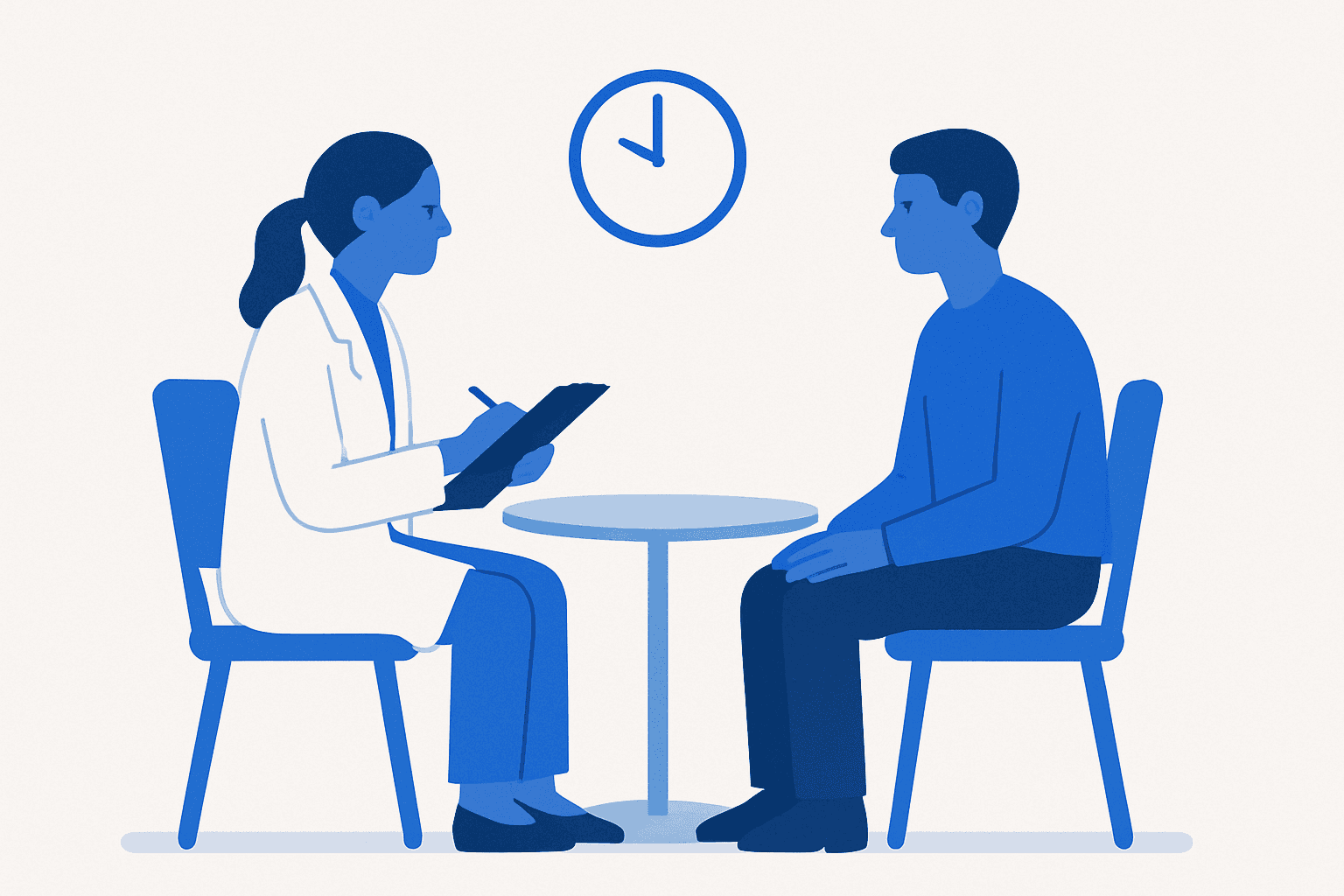
PLAB 2 Station Practice at Home: A Working Setup
Last updated 14 August 2026
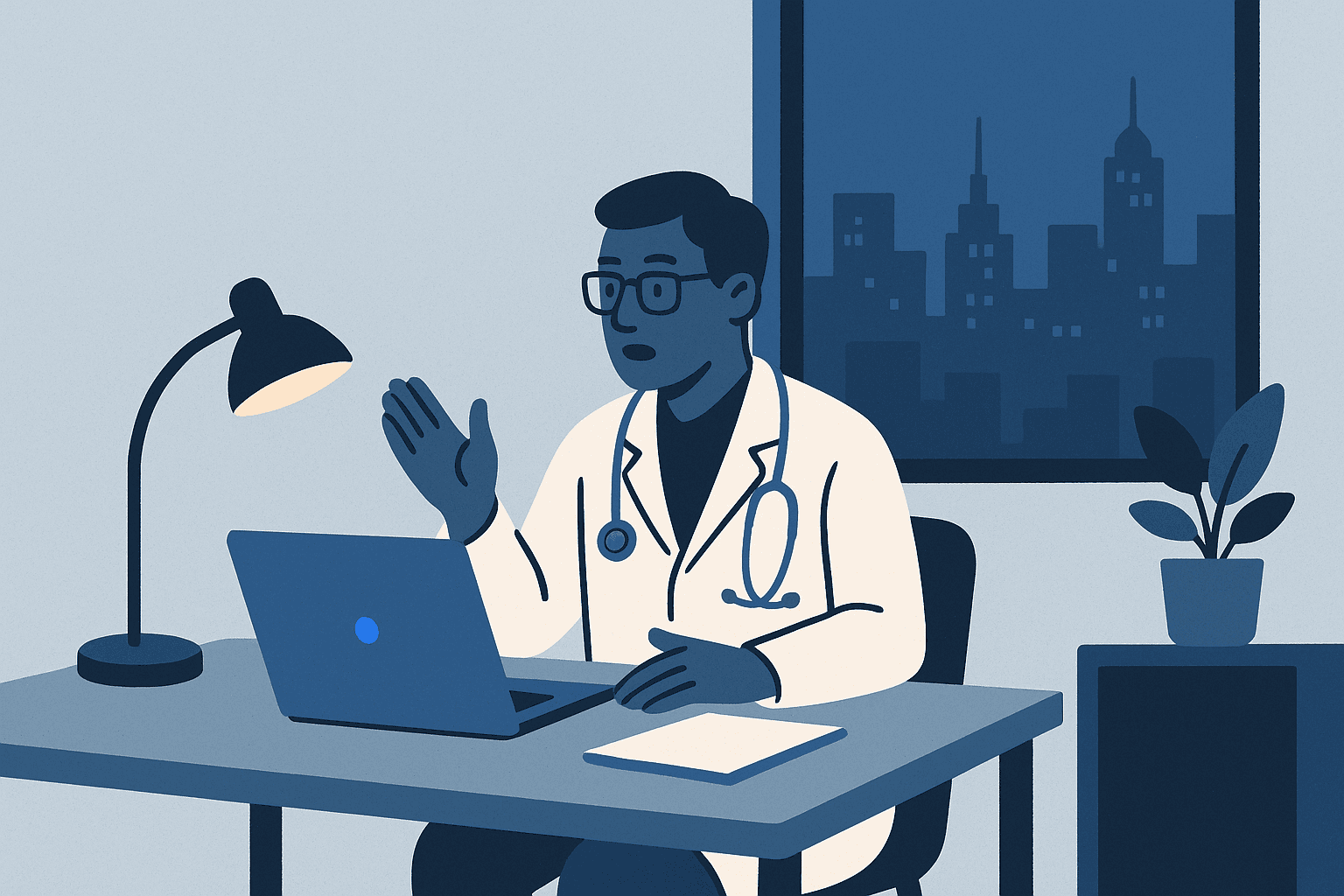
PLAB 2’s on the calendar, or you’re still hammering refresh. The course you want is in the UK right at the end, months from now. Practice partners sit across time zones and night shifts. I’m not sure anyone enjoys this part.
Yes, you can practise PLAB 2 stations at home. Aim at the consultation skills that power most stations: history-taking, explaining, and safety-netting. Speak out loud and repeat, then get feedback whenever you can. It won’t replace in-person work, but it will build fluency. The official exam format lives on the GMC’s pages.
Start by skimming the GMC's PLAB pages for the current format and booking details, then shape your practice around what the exam actually asks of you.
Here’s a home setup that works when partners are asleep and your course is still many months away.
Run a full PLAB 2 case tonight Sign up free, pick a case, get one free case a week, marked at the end. Try a free case
Why at-home practice is the hard part
Preparing for PLAB 2 at home looks sensible, then crashes into people and time. Your best role-play partners are abroad, awake when you’re not, and on shifts when you finally surface.
Facebook and Reddit practice groups help, but turning names into kept slots eats admin you don’t have. Weekly coordination, reminders, and backups drain you fast. Not ideal.
UK courses are usually solid and give focused feedback, but most run close to test dates, when stress climbs and calendar space shrinks. You can’t expect them to build fluency from zero.
Flying early to the UK for in-person practice might help, but costs stack up and logistics bite. For many IMGs, paying rent and living there for months isn’t realistic.
So you face a long middle stretch where preparation is reading and watching, not speaking. Notes pile up. Your voice doesn’t. I’m not sure anyone enjoys this part.
Speaking isn’t the same as knowing. Different muscles. You can hold a clean schema in your head and still trip when a patient answer nudges your plan sideways.
At home, you won’t recreate interruptions, time pressure, or the awkward back-and-forth. You can rehearse structure and openings, but real-time friction is missing.

A daily station rep you can run alone
Set a daily unit: one case, out loud, start to finish. Open Diagnosica at any hour, practise with an AI patient by voice or text, then get marked when the case ends.
No booking, no partner (nice when the bleep’s quiet). No physical examination practice, so it covers the talking stations, not the procedures.
Pick from 50+ cases across roughly 16 specialties, in three difficulty bands. You’ll take a full history, the AI patient replies in a way that lets you progress, and the system gives feedback against exam-style rubrics at the end.
Those rubrics are being calibrated to the published mark sheet for several postgraduate exams, including PLAB 2.
A case like Trevor Walsh, 58, with crushing chest pain, is exactly the sort of consultation you’ll rehearse. Work through presenting complaint, risk, red flags, ideas, concerns, expectations; close clearly. Rotate the complaint as well, so the structure holds on unfamiliar ground; the swallowing difficulty station is a useful one to add.
If you want a quick taste, there’s a no-signup homepage demo that runs for about 3 minutes and gets marked when it ends. I’m not sure anyone enjoys the first few goes, but the rhythm comes quickly.
On the free tier you get one free case a week, free forever. Paid tiers add unlimited cases and full rubric scoring; billing isn’t switched on yet, so every account starts free.
Drill the framework, not a script
Scripts feel safe until one unexpected answer lands, then they unravel. A framework survives that. Let your wording change each run while the structure holds. Not ideal, but it’s what examiners reward.
Open clearly, set an agenda, then build a structured middle: ICE early: ideas, concerns, expectations; focused questions; brief recap for alignment. Signpost shifts. Close with a safety-netting summary that checks understanding and plans next steps in plain language.
Drill it by varying your phrases while hitting the same checkpoints. Swap your opening line each time, rotate how you ask about ICE, practise three different ways to summarise and signpost, then land the same safety-netting close. Every time.
If you want something you can follow tonight, there’s a walk-through of this in a full solo practice method.
A framework won’t give you content knowledge, and it won’t make you sound warm by itself. You still need to practise tone, pace, and how you handle silence. I’m not sure anyone enjoys that bit, but it stops you sounding scripted when the station turns awkward.
Run a full PLAB 2 case tonight Sign up free, pick a case, get one free case a week, marked at the end. Try a free case
When a paid course is still worth it
There’s still a place for a paid course near the end. You’ll get real actors, calibration to UK clinical culture, and examiner-style feedback that catches tone, pacing, and consultation manner you might miss when practising alone.
An AI patient won’t replace that interpersonal nuance or the feel of a live examiner, and it doesn’t cover physical examination by design. It also can’t mimic venue noise, nerves, or a timed bell.
What the at-home layer does is make those expensive days productive rather than remedial. You arrive having done many reps, scored against exam-style rubrics, and you know your sticking points; see how an AI OSCE simulator session works to picture the flow.
Use the course days to polish empathy cues, local idiom, and handling examiner interjections; use the AI patient at home to iterate structure, timing, and signposting. I’m not sure anyone enjoys this part, but the grind at home means the course can stay focused on higher-order work rather than relearning basics.

Quick answers
How early should you start speaking practice for PLAB 2?
Start months before, not weeks. In my view, daily short reps beat weekend marathons: 10 to 20 minutes most days, out loud, focusing on openings, agenda-setting, ICE, summarising, and clear closings. Keep it timed. Rotate case themes so you aren’t repeating the same cadence.
Pair those drills with occasional longer, full-length consults. Record a few and listen back with a checklist; it’s uncomfortable and shows you exactly what to tighten.
Can you pass PLAB 2 practising only at home?
Possibly, but I won’t promise it. Home practice builds the consultation skill, but the exam also rewards UK-context calibration that many candidates get from a course or a well-run study group. Check the GMC for the current format and expectations so you’re aiming at the right target.
If you’re home-only, be strict on timing, structure, and clarity. I’m not sure anyone enjoys this part, but watch a couple of your own consults and critique the pauses, signposting, and explanations.
Do AI patients work for PLAB 2 practice?
They’re useful for volume and feedback on the talking parts. An AI patient lets you rehearse data gathering, ICE, explanation, and closing under time pressure. It won’t cover physical examination, so you’ll need other methods there. Treat any outputs as educational, not definitive. Every time.
Use them to prototype phrasing, compare approaches, and spot patterns. Then stress-test those phrases with peers or tutors to check they land well in UK practice.
Start earlier than feels comfortable, keep sessions short, and vary the scenarios. When you’re ready, combine peer role-plays with an AI patient so you get both calibration and volume. If you're still deciding what to spend on, we compared the AI tools built for PLAB 2. Heading to Canada instead? The counterpart exam there publishes the Canadian NAC OSCE score.
Run a full PLAB 2 case tonight Sign up free, pick a case, get one free case a week, marked at the end. Try a free case
Educational use only: not medical advice. AI generated; verify clinically against primary sources. Clinical review pending.