AMBOSS vs PassMedicine for UK finals and the UKMLA
Disclosure: Diagnosica makes an AI clinical simulator with AI patients and isn't a question bank, so it has a stake in this category. AMBOSS and PassMedicine details are taken from their own public pages, checked on 16 October 2026.
AMBOSS vs PassMedicine: the short answer
Go with PassMedicine if you want cheap, UK-written SBA volume for finals. Choose AMBOSS if you want a reference library sitting alongside a question bank, priced in US dollars. AMBOSS is built around US exams, while PassMedicine is written for UK finals and the UKMLA AKT.
Think about the job you’re hiring it for. If you want volume at low cost, PassMedicine’s finals package sits in the £15 to £30 range as of October 2026; if you want to read around each topic, AMBOSS’s library sits beside its Qbank and is priced in US dollars only.
Both are question tools for the AKT written paper; your CPSA is about talking to a patient. For the rest of your stack, see AI tools for UK finals.
If you want to practise the spoken history, try a free AI patient case.
What each one actually is
AMBOSS is a medical library of 1,400+ articles with a question bank and clinical tools, built around US exams like USMLE, COMLEX and US specialty boards. There’s no UK-specific question bank as of October 2026.
Its UKMLA offer is a structured free UKMLA study plan: 24 blocks pointing to 575 articles and 960 questions, mapped to the GMC MLA content map. The plan sits on the general Qbank, and a standard account only allows 50 questions a month, so working all 960 needs Qbank access; the plan page doesn’t reference NICE or other UK guidelines.
PassMedicine is a finals and UKMLA bank with over 12,000 Single Best Answer and Extended Matching Questions, with teaching notes under each question that double as a reference library. You also get a high-yield textbook mapped to the syllabus and an extended textbook that goes beyond it, plus revision mode, timed tests and mock exams, via the PassMedicine finals package.
The same package bundles an OSCE resource and PSA questions, and there’s a free demo if you want to see the format before you commit. It’s a single place to grind SBAs and read the linked notes.
Side by side: price, question volume and UK fit
Figures are from each vendor's own pages, checked 16 October 2026.
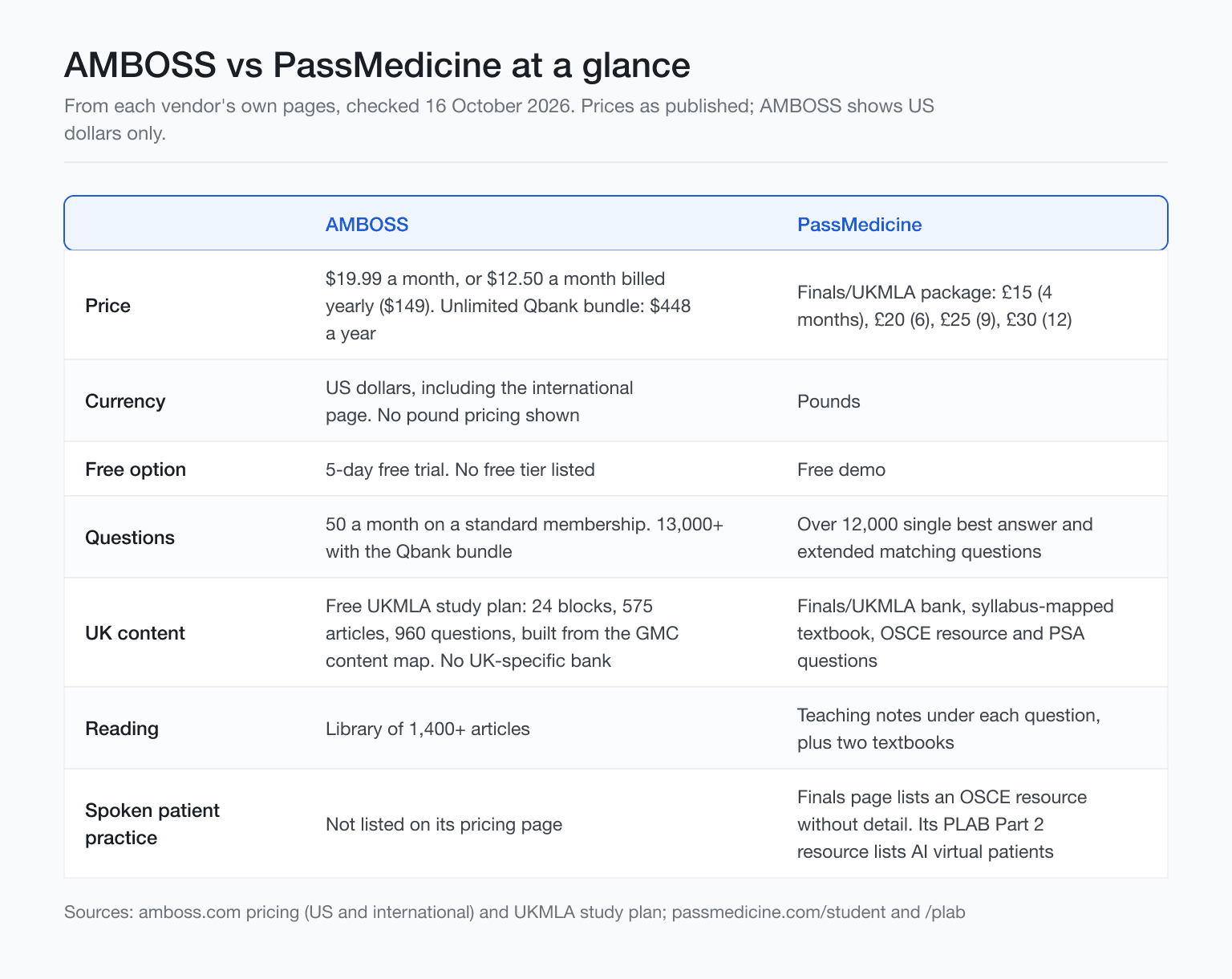
- Price. AMBOSS: Membership with library, $19.99 monthly or $149 yearly; Qbank bundle $448 yearly, unlimited questions; 5 day trial, 30 day refund on direct buys. PassMedicine: Finals/UKMLA package, 4 months £15, 6 months £20, 9 months £25, 12 months £30; free demo.
- Currency. AMBOSS: US dollars only on site, no pound pricing shown. PassMedicine: Pounds sterling on student page.
- Free option. AMBOSS: 5 day free trial, 30 day money back on direct purchases; no free tier listed. PassMedicine: Free demo.
- Question volume. AMBOSS: 13,000 plus Qbank with yearly bundle; standard membership limited to 50 questions per month. PassMedicine: Over 12,000 SBA and EMQ in the finals/UKMLA bank.
- UK-specific content. AMBOSS: UKMLA study plan, 24 blocks, 575 articles, 960 questions from GMC content map, plan page doesn't mention NICE. PassMedicine: Mapped to the finals syllabus with high yield and extended textbooks, PSA questions included.
- Explanations and reading. AMBOSS: 1,400 plus article library, UKMLA plan pulls 575 articles for reading. PassMedicine: Teaching notes under each question form a reference library, plus high yield and extended textbooks.
- Spoken patient practice. AMBOSS: Not listed on its pricing page. PassMedicine: Finals page lists an OSCE resource without detail, and its PLAB Part 2 page lists AI virtual patients for history taking. Finals access to these isn't stated.
Pricing details live on the AMBOSS pricing page, and the spoken part needs a different tool, see rehearse a history out loud.
How much does each cost for a UK student?
PassMedicine’s finals and UKMLA package is £15 for 4 months, £20 for 6, £25 for 9, and £30 for 12. AMBOSS lists $19.99 monthly or $12.50 monthly billed yearly ($149 yearly) with 50 Qbank questions a month, or $448 yearly for unlimited Qbank.
As of October 2026, AMBOSS shows prices in US dollars, including on its international pricing page, so your pound cost will depend on your card and exchange rate.
For a full finals year, PassMedicine is £30 for 12 months. On AMBOSS’s cheapest plan you’re capped at 50 questions a month, so question practice is limited unless you buy the $448 library plus Qbank bundle.
That 50 cap matters for their UKMLA study plan. The plan lists 960 questions across 24 blocks, and at 50 a month you’d need roughly 19 months to work them all, so you won’t clear the plan in one finals term without upgrading.
AMBOSS lists a 5-day free trial and a 30-day money-back guarantee on direct purchases. PassMedicine offers a free demo.
Where AMBOSS is genuinely stronger
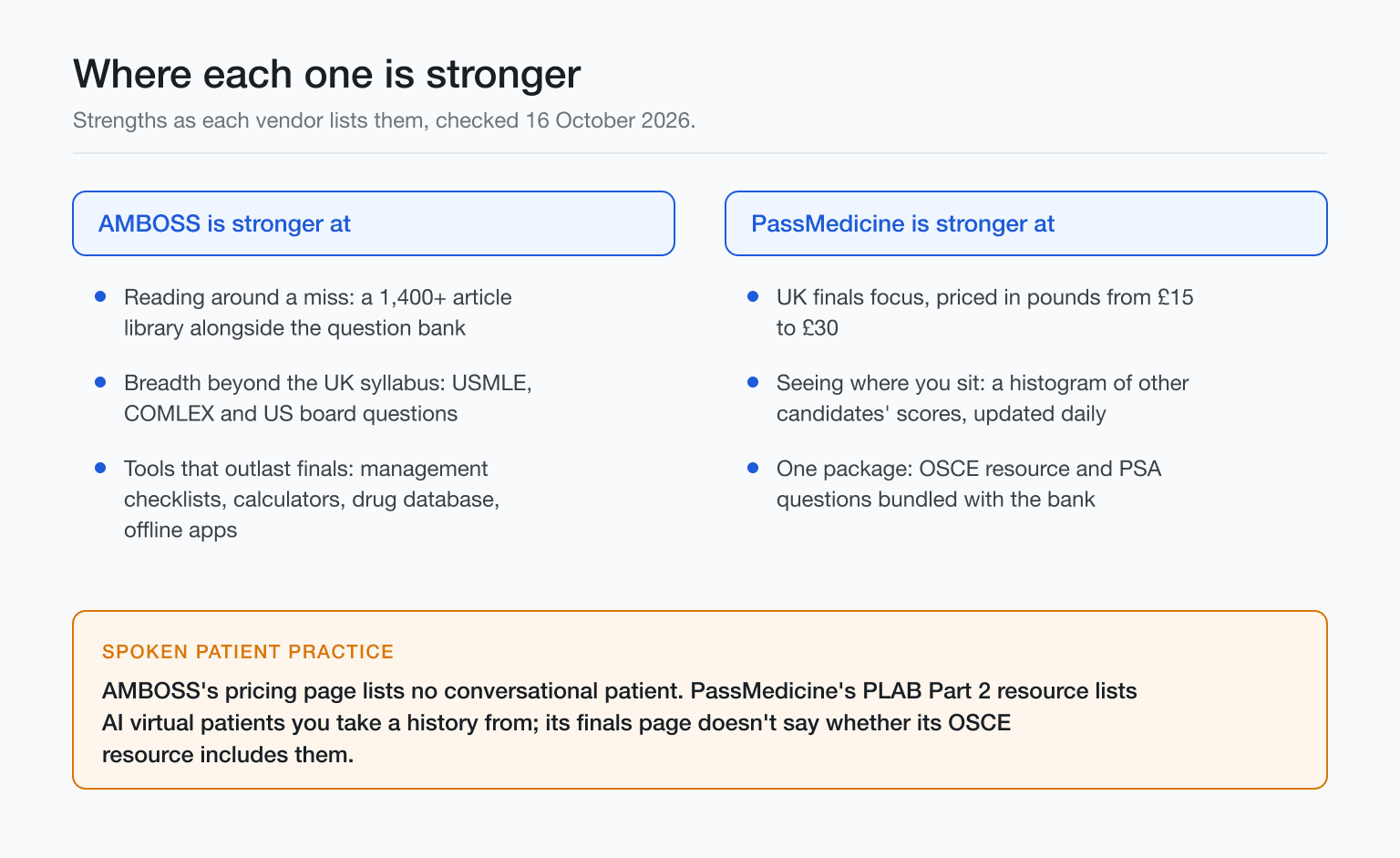
As of October 2026, AMBOSS is stronger on reference depth. The 1,400+ article library sits alongside the questions, so when you miss or guess, you have a structured article to read immediately.
Its breadth goes beyond a UK finals syllabus. The Qbank spans USMLE and COMLEX, plus US board prep for ABIM, ABFM and ABP, so you’ll run into topics that sit outside typical UK finals scope, which can still build understanding.
The clinical tools are useful on day one of the wards. Management checklists, calculators and a drug database give you quick context while you study, then double as quick reference when you start seeing real scenarios.
Offline apps on iOS and Android mean you still have everything when the signal drops. The separate clinician plan keeps the same core library available after finals and into FY1, which matters if you plan continuity.
If you already organise study with Anki, or live in your browser, the Anki and Chrome integrations reduce friction. There’s also a ChatGPT integration from what we can tell, which some students fold into revision.
Where PassMedicine is genuinely stronger
If your goal is UK finals, PassMedicine is built for that use case and priced in pounds. It comes in at a fraction of AMBOSS's dollar subscription as of October 2026, which matters when cash is tight.
The daily updated peer histogram is the standout feature. PassMedicine builds a histogram of other candidates' scores, updated daily, which you can see on the PassMedicine homepage.
Their finals and UKMLA package also bundles an OSCE resource and PSA questions, so prescribing practice isn't a separate purchase or login.
For content learning, the vendor describes teaching notes under each question that form a reference library, plus a high yield textbook mapped to the syllabus and an extended textbook that goes beyond it. That mix fits finals term cramming and later depth reading.
Is 'PassMedicine for questions, AMBOSS for understanding' fair?
It’s mostly fair, with caveats. PassMedicine is built for UK finals question practice, and AMBOSS is the deeper reference you read around a topic. The catch is that PassMedicine also explains through notes and textbooks, and AMBOSS’s UKMLA coverage sits on a US-focused bank and a plan.
PassMedicine isn’t “questions only”. The teaching notes under each item form a reference library, and the paired textbooks map to the syllabus then go further for context you can revisit later.
As of October 2026, AMBOSS labels a free UKMLA study plan built from the GMC’s content map. It sits on their general Qbank, and the plan page doesn’t cite NICE or other UK guidance.
Buying both makes sense if you want heavy SBA practice now and a library you can keep open on the wards in FY1. In the amboss vs passmedicine choice, that combo avoids overlap.
From what we can tell, buying two question banks to drill the same recognition skill in finals term is waste.
If you want alternatives for the question side before you commit, we wrote up other PassMedicine options.
The spoken history: what each one lists
The CPSA is about getting the story from a patient, using open questions, following up, spotting concerns, then reasoning to a diagnosis. The GMC structure is here, in GMC's MLA overview. Marking is station by station, see how CPSA marking works.
A written question sim checks whether you recognise a stem and select the best option. It doesn’t test whether you can earn the history.
If you’re weighing amboss vs passmedicine for spoken history practice, here’s what their pages say. AMBOSS’s pricing page does not list a conversational or voice patient.
PassMedicine’s finals and UKMLA package page lists an OSCE resource and PSA questions. It doesn’t describe what the OSCE resource contains, and it doesn’t mention virtual or AI patients.
PassMedicine’s PLAB page says its PLAB Part 2 resource helps you prepare for the CPSA and “includes virtual patients you can interact with and take a history from using the latest AI technology”, see PassMedicine's PLAB page. That virtual patient resource sits in the PLAB Part 1 and 2 subscription, not the finals package. Whether finals subscribers get those virtual patients isn’t stated on either page, so check with PassMedicine before you buy for that reason.
Where Diagnosica fits, it lets you talk or type to an AI patient who appears on screen as a video avatar, order investigations and view results and imaging, then commit to a diagnosis and a management plan. You get a scorecard after every case with competency scores and teaching points. Over 130 cases across 18 specialties, each written and signed off by a doctor, with iPhone, Android and web apps, and a free tier with no card. It doesn’t do physical examination practice, it’s not a question bank, and its scoring isn’t mapped to the CPSA mark sheet. It doesn't give advice about real patients, and it's not a diagnostic system. Treat every output as educational.
Which should you choose?
- Early clinical years. If you like reading, use AMBOSS’s Library or its free UKMLA study plan, which is built from the GMC MLA content map as of October 2026. If you want to start SBA habits, PassMedicine’s short packages are a low-commitment way to practise. Schools differ.
- Finals term. PassMedicine suits pure volume drilling for the written paper. Pick AMBOSS only if you’ll genuinely use the Library daily, including management checklists and drug lookups, not only the questions.
- The weeks before the CPSA. Questions stop being the bottleneck. Spend time rehearsing spoken histories and data gathering with a partner or a simulator, then tighten presentations and clinical reasoning out loud.
If you’re also comparing beyond amboss vs passmedicine, see how Quesmed compares, the AMBOSS and Quesmed pairing, and OnExamination against PassMedicine.
Practise the spoken history Once your question bank is sorted, rehearse with Diagnosica, talk to a video AI patient, order investigations, commit to a diagnosis and a management plan, then get a scorecard with competency scores and teaching points; free tier, no card. Try Diagnosica free