Best Free Apps for Medical Students 2026: Free vs Freemium

Most “free app” roundups skip the hard bit, they don’t say what the free tier actually unlocks before the paywall, and many don’t even check whether an Android student can install it.
We grade every app on what you get without paying, and each one’s Google Play listing is checked as of October 2026. Diagnosica, which we make, sits on this list under the same rule for the best free apps for medical students.
What counts as free here
We grade each app by what you get without paying, then call it one of three things. Free means everything that matters costs nothing. Free core means the main tool is free, while extras sit behind ads or a paid upgrade. Freemium means you get a genuinely useful slice, but key features live behind a real paywall. We also check Android availability and the Play listing signals, including price line, ads, and in-app purchases, as of October 2026. For a broader sweep, see AI tools ranked for students.
Which free apps are actually free?
Anki on desktop and Android is fully free. MDCalc, Medscape, and the BNF + BNFC app are free references, though the BNF app is limited to UK NHS staff and trainees. Quizlet, epocrates, Geeky Medics, iatroX, and Diagnosica run freemium models where the app installs free but key features sit behind upgrades.
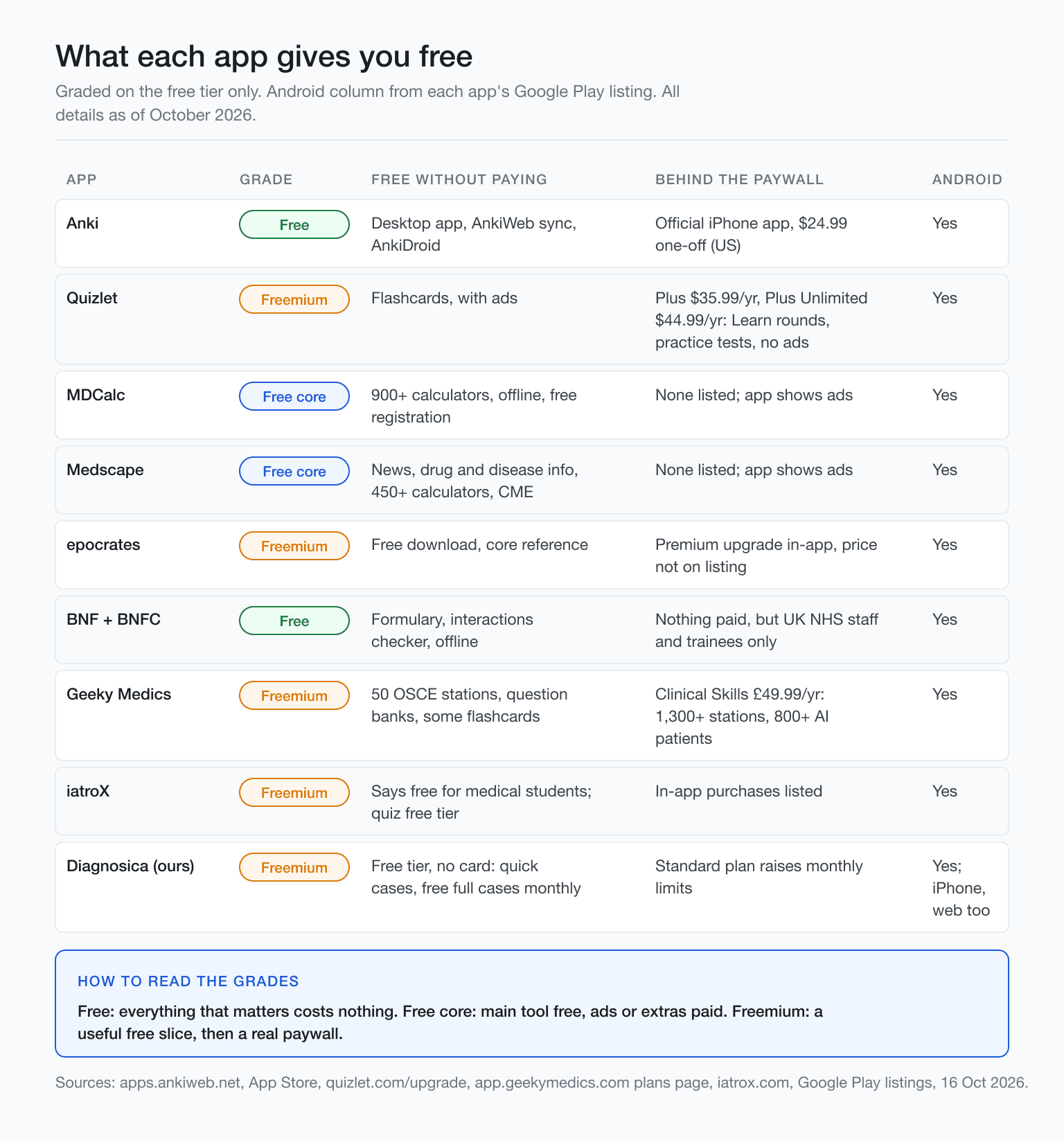
- Anki, graded Free. Free: desktop and AnkiDroid with AnkiWeb sync. Paid: AnkiMobile on iPhone is paid. Android: yes.
- Quizlet, graded Freemium. Free: ad supported, limits not listed on the upgrade page. Paid: Plus adds a limited number of practice tests and Learn rounds, Plus Unlimited removes caps. Android: yes.
- MDCalc, graded Free core. Free: calculators work offline, free registration gives complete access. Paid: none listed. Android: yes.
- Medscape, graded Free core. Free: news, tools, calculators, drug and disease info, CME/CE. Paid: none listed. Android: yes.
- epocrates, graded Freemium. Free: download is free with in-app purchases. Paid: premium upgrade available, price not shown on listing. Android: yes.
- BNF + BNFC, graded Free. Free: UK NHS staff and trainees only, works offline, interactions checker. Paid: none listed. Android: yes.
- Geeky Medics, graded Freemium. Free: OSCE stations, a large free question bank, limited flashcards. Paid: subscriptions add many more stations and AI virtual patients. Android: yes.
- iatroX, graded Freemium. Free: says free for medical students, quiz free tier. Paid: in-app purchases. Android: yes.
- Diagnosica, graded Freemium. Free: free tier with no card, quick cases and free full cases every month. Paid: Standard raises the monthly limits. Android: yes, plus iPhone and web.
Free flashcards and spaced repetition
Anki covers the essentials for free: the computer version for Windows, macOS, and Linux, plus AnkiWeb sync, from Anki's download page. AnkiDroid on Google Play is free and contributor built. On iPhone, AnkiMobile on the App Store is a one off $24.99 as of October 2026. So Android or laptop users pay nothing, an iPhone user who wants the official app pays once.
The catch, you build or import decks yourself. Shared community decks exist, but curation and tagging are on you.
Quizlet is a free download with ads and in app purchases on Android. Its upgrade page lists Quizlet Plus at $35.99 per year with three practice tests a month, twenty Learn rounds a month, and no ads, and Plus Unlimited at $44.99 per year with unlimited Learn and full practice tests, all as of October 2026. The page doesn’t spell out the exact free plan limits, see Quizlet's upgrade page.
Spaced repetition saves time and sticks facts in long term memory, see why spaced recall works.
Free case and history-taking practice
Diagnosica is freemium. The free tier needs no card and includes free full cases every month, and a paid Standard plan raises the monthly limits, with the current price listed on diagnosica.com.
In a free full case, you take a history by voice or text from an AI patient shown as a video avatar, order investigations, see results and imaging, then commit to a diagnosis and a management plan. You get a scorecard with competency scores and teaching points on the free tier too.
The quick case takes two minutes. One patient line, five clues one at a time, you guess after each, then see the answer and a one line teaching point, and it keeps a daily streak.
No physical examination practice. It doesn't give advice about real patients, and it's not a diagnostic system. Treat every output as educational.
Available on Diagnosica on Google Play, iPhone, and the web. To see how it works, try a free case. For other options, see free AI patient simulators compared.
Free clinical references
These are references for placement, not study courses. All four are on Android.
MDCalc is free with ads, and MDCalc's Play listing says 900+ evidence-based calculators, works offline, and that free registration gives complete access, all as of October 2026. Handy for quick risk scores on placement.
Per Medscape on Google Play, the app is free with ads and covers news, drug and disease information, CME, and 450+ calculators, as of October 2026. Treat it as a wide reference, not a question bank.
epocrates is a free download with a premium upgrade sold in app, and epocrates' Play listing doesn't show the premium price, so check before you rely on paid features.
The BNF + BNFC app is free, has no in-app purchases, and works offline. Its BNF + BNFC app listing says use is restricted to UK-based people working or training for the NHS, so a US student can't count on it.
Free OSCE and clinical-skills apps: where the paywall sits
If you're sorting the best free apps for medical students by paywall, OSCE prep has two big entries. Geeky Medics and iatroX both offer real free use, then upsell.
On Geeky Medics' plans page, the free plan lists 50 OSCE stations, clinical, anatomy and basic science question banks, and a limited set of medicine and surgery flashcards. You can also create your own stations and virtual patients, no payment required.
Its Android app advertises 35,000+ free questions and 2,500+ free flashcards, with premium content behind an auto-renewing annual subscription.
Clinical Skills costs £49.99 a year or £29.99 a month as of October 2026, unlocking 1,300+ OSCE stations and 800+ AI virtual patients plus AI credits. The free question bank and stations are a lot for nothing, so grading is Freemium.
Per iatroX's own apps list, it's free for medical students. The Android app lists in-app purchases, so assume some paid features, Freemium.
Is a freemium app worth it if you never pay?
Yes, if the free slice covers a habit you’ll do daily, and no, if the free part is a demo of the thing you need. Free works when it supports a single, repeatable job you care about every day. If core features sit behind a paywall, the habit stalls and the value fades.
Run the free tier for two weeks against one job you care about, like spaced recall. Watch for friction, especially ads that interrupt study or navigation, since Quizlet, MDCalc, and Medscape list ads on their Google Play pages.
Access-based free exists too, the BNF + BNFC app is free for UK-based NHS staff and trainees and works offline. Before paying, ask your school library what it already licenses and whether mobile access is included, schools differ on this.
A short daily loop keeps you opening an app. If that loop is streaked or game-like, you’ll reopen it more days than not, from what we can tell, see game-style study apps.
A zero-cost app stack by year of med school
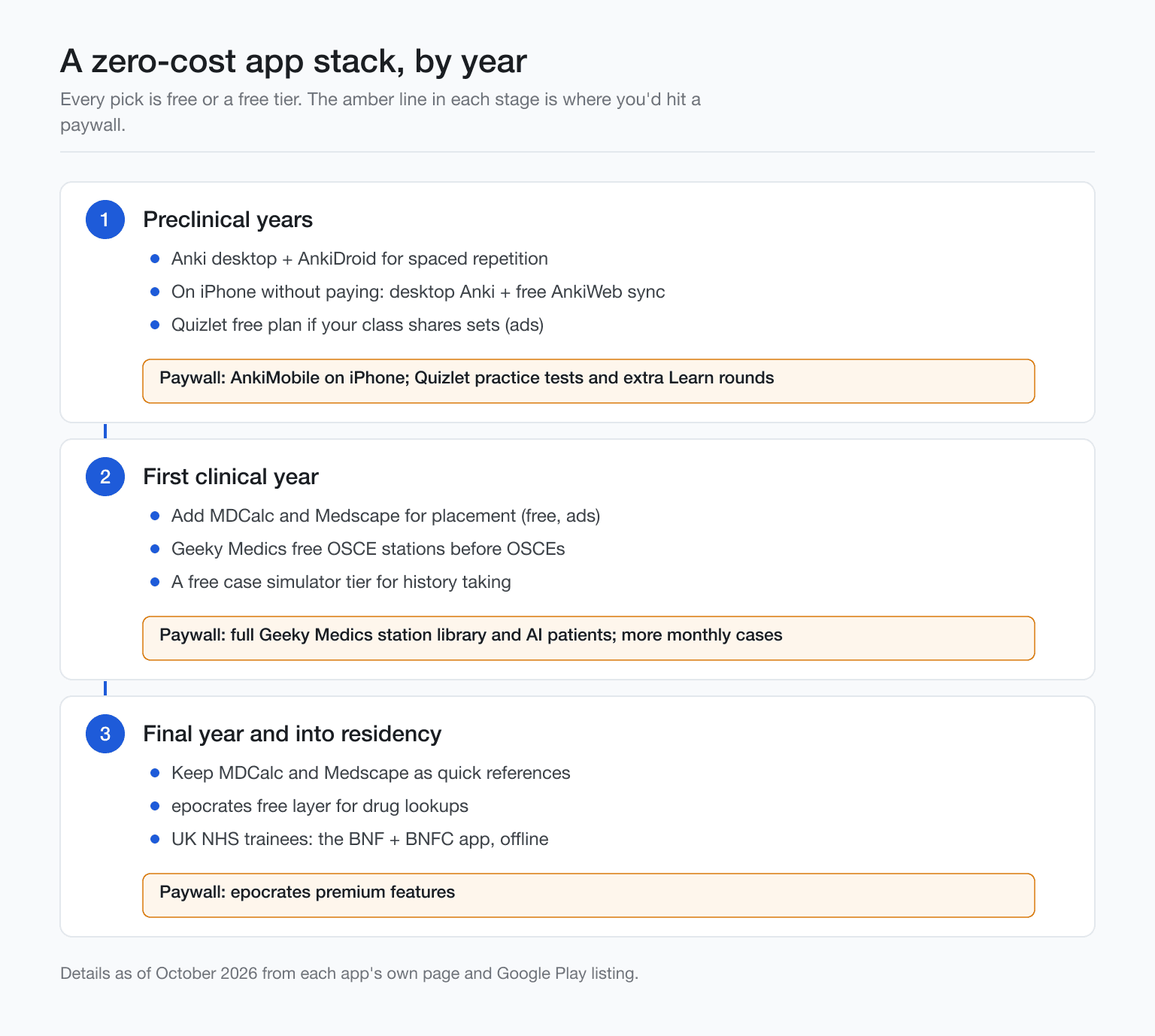
- Preclinical years. Anki on desktop plus AnkiDroid gets you spaced repetition without paying, and AnkiWeb sync is free if you’re on iPhone and won’t buy the official iOS app. If your class shares Quizlet sets, the free plan works, but practice tests and unlimited Learn are paywalled and you’ll see ads.
- First clinical year. Add MDCalc and Medscape on your phone for placements, both free tiers with ads, and MDCalc works offline after free registration. Use Geeky Medics’ free OSCE stations ahead of mocks, but the full OSCE library and AI virtual patients sit behind a subscription. A free case simulator for history taking helps reps, though monthly case limits lift only on the paid plan.
- Final year and the move to residency. Keep MDCalc and Medscape as quick references. For drugs, epocrates’ basic layer is free, with premium upgrades paywalled. UK NHS trainees can use the offline BNF + BNFC app. Read the third-year clerkship advice, then bookmark our sibling guide to apps for residents.
Start with one free case
Try a case on your phone. Diagnosica has a free tier with no card, on iPhone, Android and the web. Take a history from an AI video patient, order investigations, commit to a diagnosis and a plan, then see a scorecard with competency scores and teaching points after each case: Start a free case.