How to Survive Intern Year
Last updated 4 October 2026
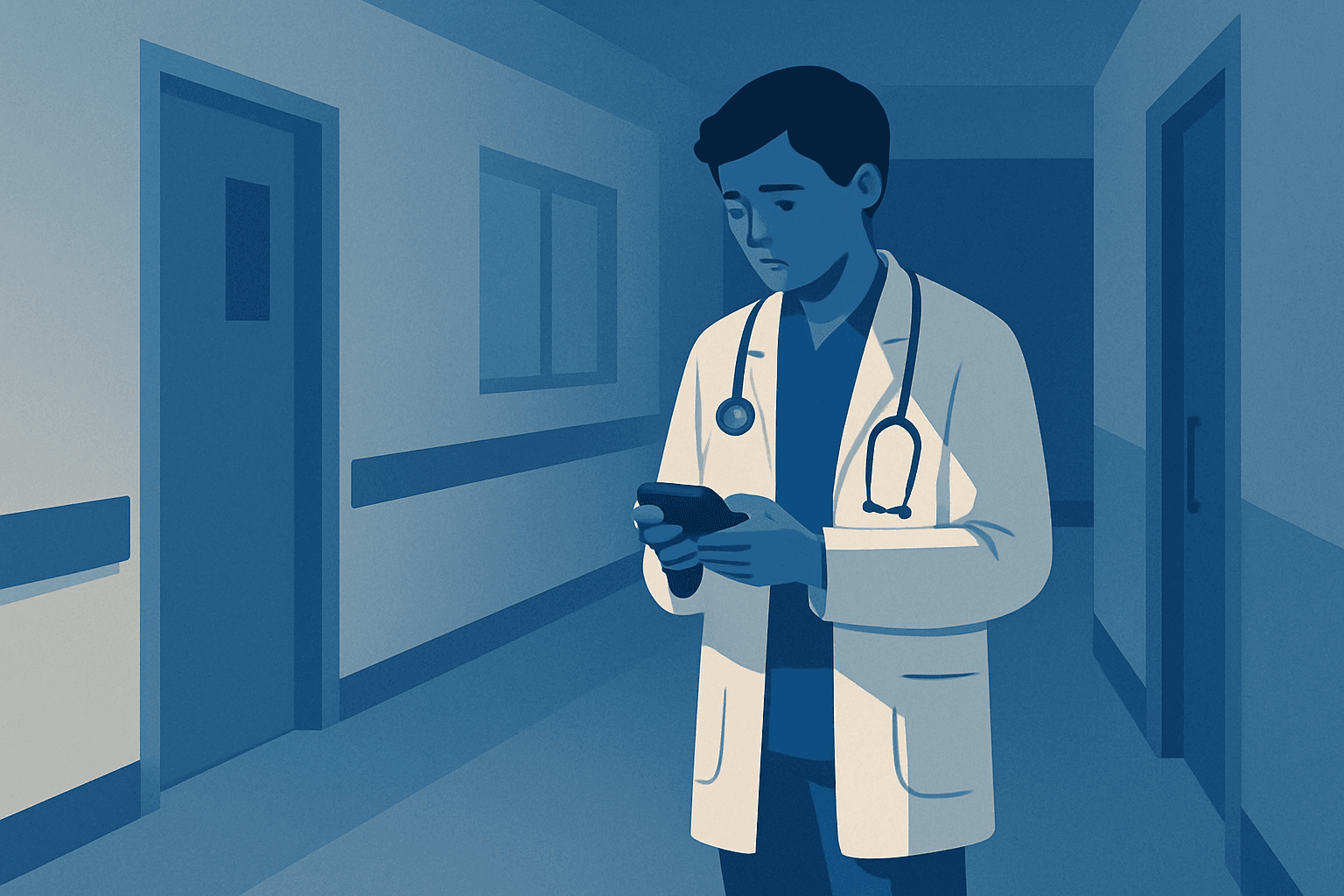
It’s June. Match Day was months ago, the diploma is almost here, and July 1 feels less like a date on a calendar and more like a countdown you can hear from home.
You’re not worried about the hours, and not really about the medicine. You’re worried about the moment the pager chirps, a nurse says your name, and you’re the one standing there in the room.
This is about that fear, and what can be done before July to shrink the unknowns you can shrink. Expectations, sign-out, paging etiquette, order entry, who to call, and how to call early.
What actually makes intern year hard
Intern year feels hard less because of hours or knowledge than because interns are the first person paged about a patient they haven't met. With a partial story and a clock running, they must decide what happens next before a senior resident or attending has seen the patient.
Medical school tested whether you could work out an answer with the whole chart open and no clock. The floor asks something else, decide what happens next now with a partial story.
Your pager goes off about a patient you haven't met, the note is thin, the EMR loads slow, and someone wants a decision. You're deciding while you gather facts, not after every fact is known.
This fear isn't a US only thing. Our UK counterpart, the UK version of this year, covers a different system and titles, and the same first doctor at the door feeling shows up.
Most of the work is judgment, communication, and escalation.
The advice you have already read
You’ve read the greatest hits already, from sleep when you can and eat when you can to be kind to nurses, keep a running list, show up early, know your patients. It’s real and it works. Nobody giving it is wrong.
On the Student Doctor Network, what residents tell you is blunt: "there is very little you can do to prepare for intern year" and you’re "expected to be an absolute idiot when you show up." That lowers the bar so you ask for help early.
Here’s the quiet assumption under it. Only logistics and attitude are preparable, and everything clinical must be learned live on real patients. That’s mostly true and slightly wrong. The gap is the rest of this post.
The study stack that carried you through fourth year was built for exams and recall, not for this. See the tools that got you here. Great at items and vignettes, thin on order entry, page triage, and how sign-out actually reads.
The fear nobody names
Your pager goes off at 3am for a patient on a floor you’ve walked past twice, a name you’re reading for the first time. Someone who’s been doing this twenty minutes longer thinks you’re the doctor. For a few minutes, you are.
Almost nothing written for new interns says this directly. The honest reason is that most of it sticks to parts that are easy to write about.
On SDN, an intern six weeks in wrote, "I'm terrified daily that I'm going to hurt someone and I worry that I'm too slow and too stupid". The reply is blunt: "If you didn't feel this way you'd be horrifyingly dangerous". A physician on the same thread describes the arc cleanly, incompetent through summer and fall, staying late constantly, efficient by winter, and only recognizing the gain in second year.
You’ll see the same thread every spring because the feeling keeps repeating. One reply puts it as an equation, "A little knowledge + A little humility + A healthy dose of fear = Potentially good intern".

What you can rehearse before July 1
You can’t rehearse the responsibility, but you can rehearse the two things that fail first under it. Taking a history from someone who doesn’t present the way the textbook did, and committing to a diagnosis out loud and then being asked why. Both are reps, and reps don’t require responsibility.
Case 1, a 24-year-old man with type 1 diabetes since 14, opens with being really thirsty and breathless for a day or two. He’s drowsy, tires quickly, vomiting, thinks it’s a stomach bug with a sore throat, and only admits he stopped insulin two or three days ago if asked directly.
Case 2, a 55-year-old man, usually fit, is suddenly breathless with chest pain for two days and is convinced it’s a heart attack. Ask and he’ll tell you about a long flight from Australia, recent knee arthroscopy, little movement, and a week of a tight, tender, swollen left calf.
Both patients hand you a confident wrong theory, and the deciding fact sits behind a question you have to know to ask. That’s why reps in building a differential and practicing reasoning on the wards matter, because the pager call won’t wait while you think.
Diagnosica is an AI patient you take a history from by voice or text, then commit to a diagnosis and defend the reasoning to an AI senior, with a score at the end, available any hour without booking.
Rehearse the 3am call Scared of being alone with a patient getting worse? Practice the conversation and your reasoning with a debrief before it's real. Start a case free
What you cannot rehearse, and should stop trying to
There are parts of intern year you cannot simulate now, and pretending you can only burns daylight. Diagnosica is built for history, reasoning, and escalation language, not hands-on tasks or local politics.
- Procedures. Hands are hands. You get them on real patients with someone watching, and no amount of reading substitutes.
- Physical examination. This is a real limit of any voice or text simulator, ours included. Diagnosica does no physical examination practice at all. That stays with real patients, real attendings, and the skills lab.
- The social machinery of your specific hospital. Who wants a call at 2am and who prefers a text at 6. Where the reliable scanner is. Which nurse's concern means drop everything. That is local, it changes two miles away, and you learn it by being there.
You'll spend June trying to read your way out of all three, and it's the least useful thing you could do with the time.
The first week, practically
Your first week is less medicine than access. What slows you is logins, order entry, pager numbers, and who owns what. Bottlenecks are doors and directories.
- Get EMR access working and drill order entry in training until it's muscle memory, because hunting at 3am burns more minutes than uncertainty about medicine.
- Write down who to call by role and hour, and keep it in a pocket, not your head.
- Ask about the local escalation pathway on day one, when asking is free and expected.
- Sign-out is a real skill and the one time your whole list gets handed off, so treat the first few as the hardest thing you do.
ACGME caps clinical and educational work at 80 hours per week, averaged over four weeks, per the 80-hour weekly limit. It's a ceiling, not a description, and a week near it can still be brutal.

Asking for help is a skill, not a failure
Escalation can feel like admitting you’re over your head. It isn’t weakness, it’s learned language, and the program expects you to use it.
The ACGME says: "PGY-1 residents must initially be supervised directly". In what direct supervision means, direct supervision is defined as the supervising physician being physically present with the resident for key portions of the interaction, and as you progress to indirect supervision, the definition still has the supervising physician "immediately available to the resident for guidance". This is on paper. Nobody built a system that expects you to be alone and then wrote that down.
Say the uncomfortable thing early and out loud, then ask for exactly what you need. Try, "I'm not sure what this is and I'd like you to see them." It’s a complete sentence, and reasonable to say at 3am, and there's more on saying you don't know without it landing badly. Calling early isn’t scored against you; the alternative is calling late.
Same problem, UK phrasing: a call about a patient you have not met.
Take the reps before you need them
You can't make July 1 arrive with you already experienced. You can make your first tough history, your first out-loud differential, and your first 'why?' from a senior resident or attending not be the first time.
Diagnosica is an AI clinical simulator. You take a history from an AI patient by voice or text, order investigations, commit to a diagnosis and a plan, then defend your reasoning to an AI senior and get scored.
It doesn't give advice about real patients, and it's not a diagnostic system. Treat every output as educational. It's available any hour without booking, so you can get reps when you want. Free cases every month, plus a no-signup demo that takes about three minutes.
Educational use only. Not medical advice. AI-generated; verify clinically against primary sources.
Clinical review pending.
Run one before July Run a case tonight so the first hard history and the first out loud differential are not both happening in July. Start free