MS3 Clerkship Survival Guide: The Encounter Part
Last updated 4 October 2026
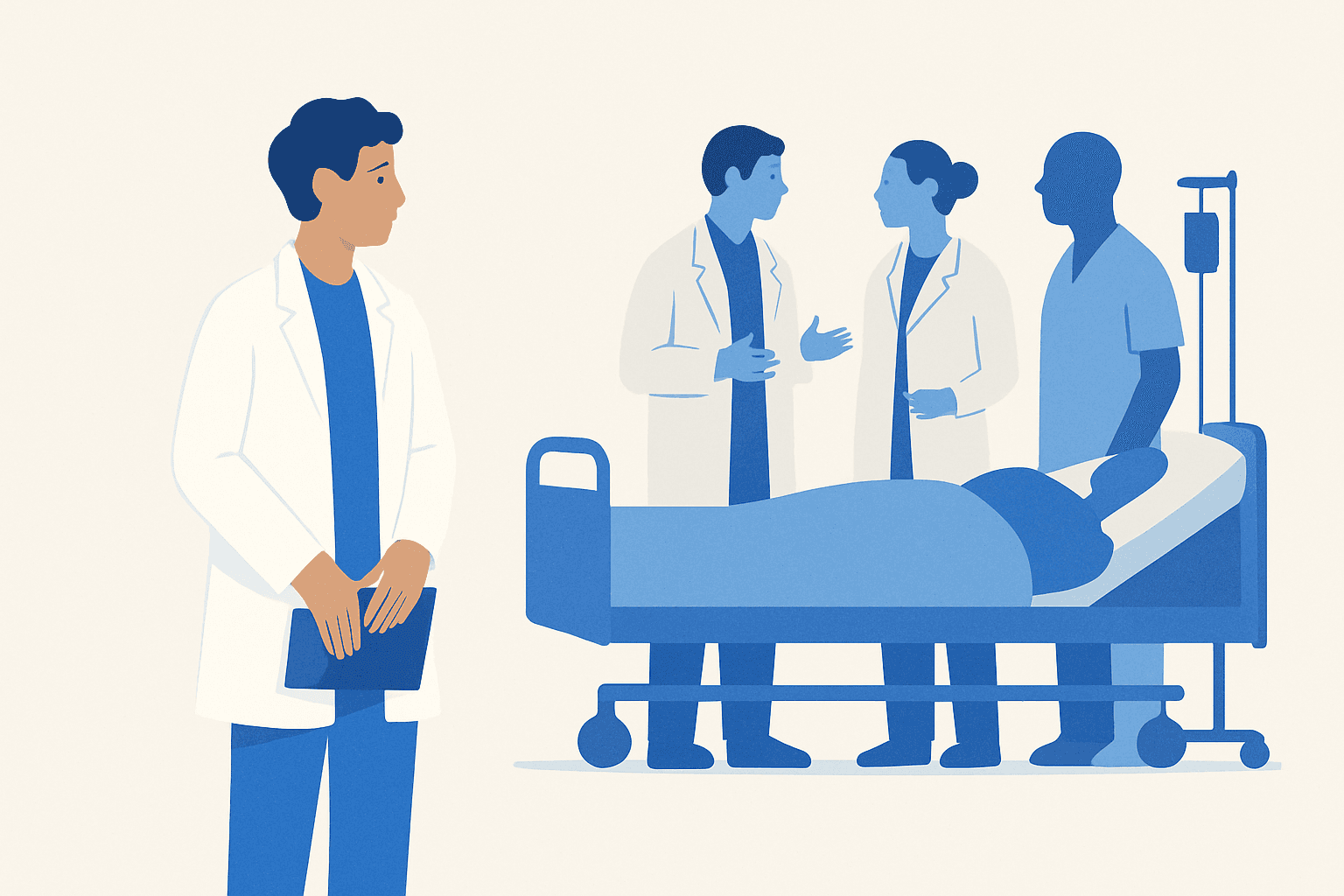
A few weeks out, you’ve read the guides, know the schedule, the grading, the shelf plan. Your bag is ready, your stomach isn’t.
What’s keeping you up is smaller, and sharper. Being sent into a room alone to meet someone new, then saying something useful about it to a team that’s already moving.
This piece is about that encounter. It’ll also be plain about what it can’t help with, like the shelf, team politics, or the physical exam.
What an MS3 clerkship survival guide usually leaves out
Most clerkship guides tell you the schedule, grading, hours, and how to study for shelf exams, but they skip the encounter itself. You're sent alone to take a history from a stranger, then you come back and present it, and almost nobody practices that piece before day one.
From what I can tell, the strongest single overview is the best general clerkship guide from Med School Insiders, titled "What Are Clinical Rotations? Medical School Clerkships Explained"; it maps the year and the seven cores, internal medicine, family medicine, pediatrics, neurology, obstetrics and gynecology, general surgery, psychiatry. Read for coverage, that page is logistics, expectations, grading and exam preparation, with minimal guidance on taking a history or presenting a case.
This post is about that one missing part, the encounter. One rung up the ladder, in life as a new doctor, the questions you didn't ask start to matter more. On the wards, that gap shows up fast.
What actually happens when you're sent to see a patient
Here is the loop. A resident sends you to the new admit, you go alone, and the clock is already ticking. For a sense of what the days feel like, see what the hours look like, and, as Med School Insiders puts it, "Students typically work 12-14 hours a day or more, often including weekends or call shifts, all while finding time to study for shelf exams and USMLE Step 2 CK."
You ask why they came, the timeline, red flags, meds and allergies, past history, social context, and a quick focused review of systems.
You have maybe fifteen minutes, you form an impression, then you say it out loud to people who are busy. That is clerkship work, and it repeats several times a day for a year.
The part where you're actually judged is the presentation. As a student writing for AMBOSS in November 2024 put it, "Your team is often so busy that the only time their undivided attention is on you is during your presentation." See one student's clerkship writeup.
For structure, read presenting on rounds.

The half of the history nobody volunteers
Half the useful history never walks in on its own. Patients give you a trailer, not the director's cut. The detail that changes what you do next shows only if you ask, and if you don't, nothing flags the gap.
Cameron Hayes, 24, is an AI patient in our case library, not a real person. He volunteers a neat sequence, vague colicky ache at the umbilicus that moved to the right lower abdomen over hours, heart rate 98, temp 37.8C.
Only if you ask does he add that earlier the pain felt like it spread across his whole abdomen for a while, while his own theory is food poisoning that then settled in one spot and worsened.
Ryan Docherty, 24, type 1 diabetic since 14, is another AI patient in our case library. He volunteers two days of extreme thirst and large urine volumes, with heart rate 118 and respiratory rate 30, and he thinks he has a bad stomach bug with a sore throat.
Only with a direct probe does he admit he stopped his insulin two or three days ago because he was not eating and felt too sick, and thought he did not need it.
Both of these patients arrive with a theory already formed, and it is the wrong one. If you take the volunteered version and stop, you walk back carrying the patient's theory with your name on it.
Treat the volunteered facts as the opening hand, then spend your time fishing for the missing cards, the specific questions that surface the piece that actually changes what happens next.
You can try one of these encounters right now. The free tier gives you free cases every month, no card needed to start, so you can run one case free between study blocks. It's live and early, so expect a few rough edges.
Four encounters you will be sent to see
You’ll be sent these four on medicine or surgery. Each one splits into what the patient hands you and what you have to go and get.
- Cameron Hayes, 24, belly pain and fever (surgery, easy) What he offers unprompted: The pain started around the umbilicus and moved to the right lower abdomen · What comes only if you ask: That for a while it felt like it was spreading across his whole abdomen · An alternative that catches people: Testicular torsion
- Ryan Docherty, 24, thirsty and breathless (acute medicine, intermediate) What he offers unprompted: Two days of extreme thirst and passing very large amounts of urine · What comes only if you ask: That he stopped his insulin two or three days ago because he was not eating · An alternative that catches people: Viral gastroenteritis
- Martin Rowe, 55, sudden breathlessness (respiratory, intermediate) What he offers unprompted: Sharp right-sided chest pain that is worse on breathing in, and breathlessness that started at the same time · What comes only if you ask: That his left calf has been swollen, tight and tender for a week, and that he has coughed up small amounts of blood twice · An alternative that catches people: Acute coronary syndrome
- Ryan Coles, 35, fever and back pain (urology, intermediate) What he offers unprompted: Two days of fever with shaking chills, and right flank pain radiating toward the groin · What comes only if you ask: That he has known kidney stones on a previous scan · An alternative that catches people: Acute cystitis
The last column is the one that costs you, because it tempts an early anchor. Each is named in that case’s own differential list, not invented here; keep them alive by ranking rather than picking, see ordering your differential. Martin Rowe, who gives up the knee surgery and the flight only on a direct question while worrying about a heart attack, is the pattern to remember.

What none of this can rehearse
Diagnosica does not rehearse physical examination at all, and your clerkship year is heavy with it. Not one case in the library has an examination component. What the cases do have is examination findings written into the history, so you reason from signs you're told about. Being told a patient lies rigidly still is not the same as putting your hand on an abdomen. A screen cannot give you the feel of guarding or of a tense abdomen, and pretending otherwise would be useless to you.
The library is 74 cases, and 73 of the 74 are male. There is no psychiatry case, no family medicine case, one obstetrics and gynecology case, and two pediatric cases. Set that against the seven core clerkships you face this year: internal medicine, family medicine, pediatrics, neurology, obstetrics and gynecology, general surgery, psychiatry.
The signal here is simple, the internal medicine and the surgical encounters are where this helps. Psychiatry, family medicine, obstetrics and gynecology, and pediatrics are not this tool's lane, and a guide that told you otherwise would be selling you something.
What to do in the weeks before day one
There is a defined standard you’ll be measured against eventually, and it’s not a mystery. The AAMC published 13 core entrustable professional activities in May 2014, described as tasks every student should be able to do on entering residency, see the AAMC's core activities list.
- Pick five presentations you’ll actually be sent to see on medicine and surgery, and for each one write the two or three questions that change what you do next. Not the whole template, the decision changers you don’t want to miss.
- Say the history out loud instead of reading it. Silent reading hides how long you take, where you meander, and what you skip when you’re under time and a nurse is asking for the chart.
- Rehearse the awkward probe, on purpose. Asking a young man about his testicles, asking a diabetic whether he actually took his insulin, asking about sex or drugs without flinching. The first time shouldn’t be in front of a patient.
- After every real patient in the first weeks, write the one question you didn’t ask, then read the answer that night. If you want a scaffold for closing those gaps, try thinking through an unclear case.
- Read one rung ahead so the year after this one is less of a surprise. A quick skim of the first week of residency helps you see what handoffs, notes, and calls will feel like when you carry the pager.
Where a simulator fits, and where it doesn't
Diagnosica is a clinical simulator you can run on your phone or laptop. In one session, you take a history from an AI patient by voice or by text, you order investigations, you commit to a diagnosis and a plan, you defend the reasoning to an AI senior, and you get a scorecard at the end. It’s live and early, so you should expect rough edges.
There are 74 cases across 14 specialties in three difficulty bands, and every case is written and signed off by a doctor. There’s a free tier with free cases every month. Standard is a paid monthly or annual plan; the current price is on diagnosica.com. There’s a demo on the landing page with no signup, you can talk or type, it takes about three minutes, and it’s marked when the case ends.
"It doesn't give advice about real patients, and it's not a diagnostic system. Treat every output as educational."
Educational use only. Not medical advice. AI-generated; verify clinically against primary sources.
Clinical review pending.
If you're going to rehearse anything before day one, make it the medicine and surgery encounters. You can start a case tonight on the free tier, or go Standard, priced on diagnosica.com, if you want more reps. It doesn't give advice about real patients, and it's not a diagnostic system, so treat every output as educational.