MRCEM OSCE pass mark: how RCEM sets the cut score each sitting

You searched for the MRCEM OSCE pass mark and want a number. There isn’t a fixed one. RCEM sets the pass mark for each sitting from examiner data on the day. This page explains how that cut score is set, using RCEM’s own pages.
Scope check, we’re not examiners. On resus rules, RCEM’s FAQ states a must-pass resuscitation station rule for the FRCEM OSCE. RCEM’s MRCEM pages don’t mention that rule for MRCEM.
What is the MRCEM OSCE pass mark?
There isn’t a fixed MRCEM OSCE pass mark. RCEM sets it fresh for each sitting using the borderline regression method, then adds one standard error of measurement. That means the number out of 160 can move between sittings.
RCEM describes domain-based marking and confirms this standard setting approach on RCEM's MRCEM exams page.
Your feedback letter shows your score, the exam pass mark, the daily cohort average, and a breakdown by station. See the results and awarding page for how this is presented.
So any fixed percentage or single permanent number you see online is describing something RCEM does not publish.
How RCEM sets the cut score
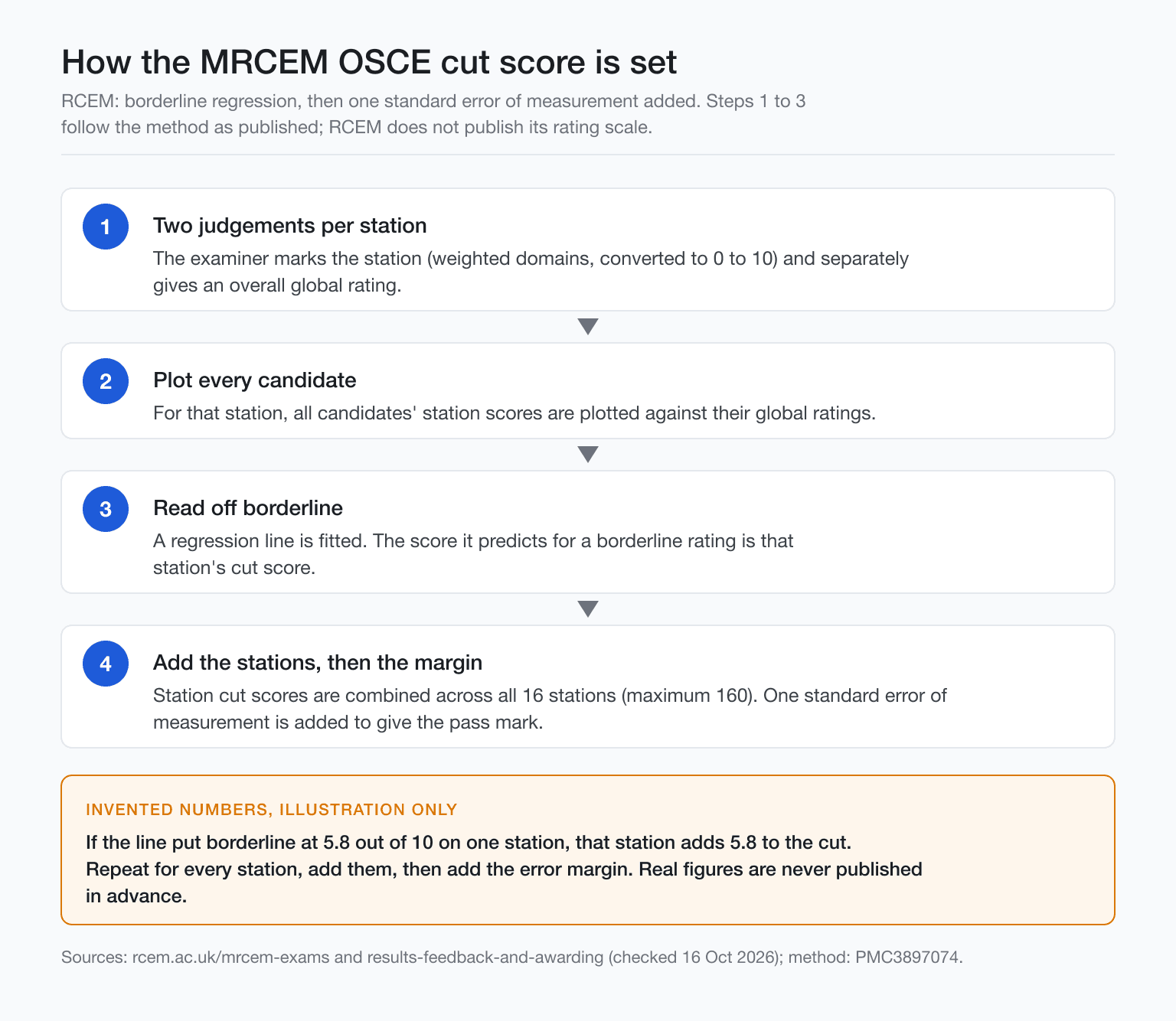
RCEM sets the MRCEM OSCE pass mark with borderline regression. Examiners’ judgements of what a borderline performance looks like on that day’s stations are converted into a cut score, then one standard error of measurement is added. That margin means candidates on the line need to clear a small buffer.
The general approach is detailed in a published method, see a published study of the method. RCEM does not publish the exact global rating scale it uses, but here’s how global ratings work in this context.
- In the method as published, the examiner scores the station and also gives a separate overall global rating of the candidate’s performance for that station.
- Across all candidates for that station, the station scores are plotted against the global ratings.
- A regression line is fitted, and the score predicted for a borderline global rating is read off. That predicted value is the station’s cut score.
- The station cut scores are combined across all stations to generate an exam cut score, and then one Standard Error Measurement is added to set the final pass mark.
Standard error of measurement is an estimate of how much a score could wobble by chance.
Invented numbers for illustration only, not real RCEM data. If the regression line put a borderline performance at 5.8 out of 10 on a station, that station would contribute 5.8 to the cut. Add the borderline scores from all stations, then add the error margin. Real figures are never published in advance.
The MRCEM regulations pack also uses the word conjunctive. RCEM does not define that term further on its public pages.
The current MRCEM OSCE format
The MRCEM OSCE has 16 stations of 8 minutes, with one minute reading time before each and two rest stations. The circuit runs 2 hours 42 minutes. There are no double stations.
Per the MRCEM OSCE regulations pack, the current blueprint is:
- Complex stable patient: three stations.
- Answer questions: two stations.
- Resus: two stations.
- Injured patient: two stations.
- Paediatric emergency medicine: one station.
- Procedural skills: two stations.
- Complex challenging situations: two stations.
- Supervise and teach: two stations.
The exam covers adults and children in the Emergency Department.
AI patient practice Rehearse unscripted history taking and clinical reasoning out loud with an AI patient, scorecard after every case, free tier with no card, no physical examination or procedures. Try Diagnosica
How each station is marked
RCEM moved all MRCEM OSCEs to domain-based marking from September 2022, replacing checklists in UK and international exams after GMC approval. Stations are scored on domains, not on tick lists, which RCEM says improved station discrimination and reliability.
RCEM’s domain-based marking guide lists seven MRCEM domains:
- clinical reasoning and decision making
- communication skills, including conflict
- history taking and information gathering
- clinical examination skills
- practical and pinnacle skills
- teaching skills
- organisation and prioritisation
Each station assesses one to four of these, weighted by importance in that station. The examiner judges each domain on a scale from well below to well above the minimum level of competence, and those judgements are converted using the weights into a station score from 0 to 10.
The briefing sheet at the door shows the scenario, the task, the domains assessed as a pie chart, and the examiner’s role. RCEM’s own FAQ example is blunt, if a station is 90 percent practical skills, don’t spend five minutes taking patient history. There’s no countdown timer, you’ll see an analogue clock, and time management is part of the assessment.
Because the examiner is judging competence levels within weighted domains, covering every question on a prep checklist won’t automatically convert into marks the way an old checklist might have. From what we can tell, that’s the practical shift. This station scoring then feeds the sitting’s MRCEM OSCE pass mark.
Do you have to pass a resuscitation station?
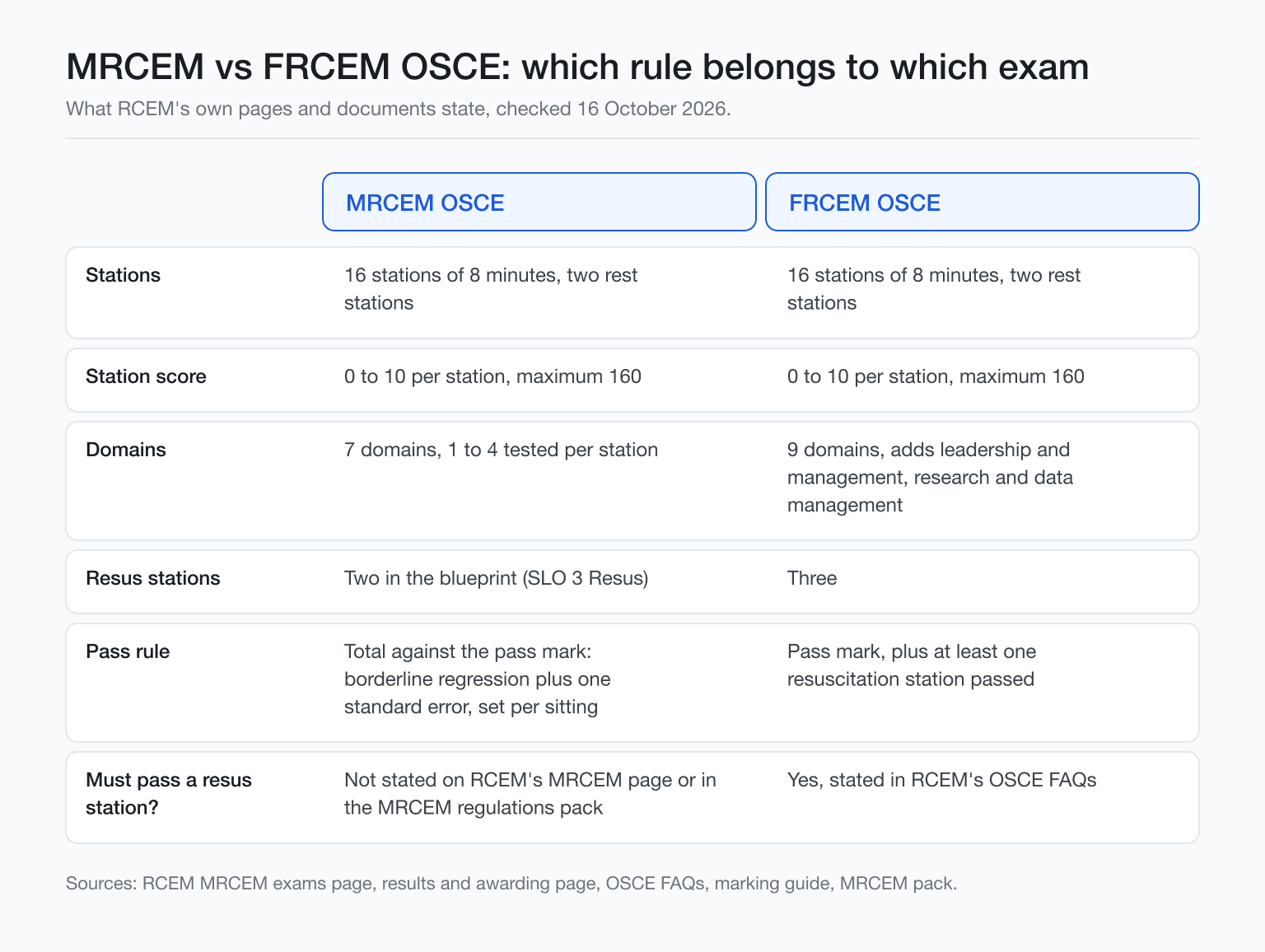
RCEM’s FAQ states a must-pass-one-resuscitation-station rule for the FRCEM OSCE, which has three resuscitation stations. RCEM’s MRCEM exam page and regulations pack do not mention that rule. For MRCEM they describe an overall MRCEM OSCE pass mark set using borderline regression with one standard error added.
RCEM’s own wording on RCEM's OSCE FAQs is: “The FRCEM OSCE will include three resuscitation stations. Please note, in addition to achieving the pass mark, candidates will be required to pass at least one of the resuscitation stations in order to achieve a pass overall.”
The MRCEM blueprint lists two resus stations, and the FAQs list SLO 3 Resus among the learning outcomes assessed in MRCEM. So resus stations matter, and heavily.
Because the two exams share an FAQs page and both use domain based marking, it’s easy for rules to get blended in conversation. If you’re unsure for your sitting, check RCEM’s current documents for MRCEM or ask RCEM directly.
Why fixed percentages you see online are out of date
Fixed targets you’ve seen in old handouts don’t map to the current MRCEM OSCE. Since September 2022 the OSCE has used domain-based marking worldwide, replacing checklist schemes. A single percentage can’t be right for every cohort.
So sanity check any number you see. Look for a date and whether it cites RCEM’s current pages. Older posts may describe checklist marking or fixed percentage rules that RCEM doesn’t use now. As a parallel, see how other UK exams publish their own methods in our piece on MRCP PACES pass rates.
What a borderline performance looks like
RCEM doesn’t publish a worked description of a “borderline” MRCEM OSCE candidate. What you can read, and rely on, are the marking rules and how the cut score is set at each sitting.
Your total is compared with the sitting’s pass mark. One weak station on its own isn’t automatically fatal under those rules.
Reading the pie chart on the station brief matters. If a station is mostly assessing practical skills and you spend most of the time on history, you’re working against the weightings and leaving marks on the table.
Your feedback letter shows your score, the pass mark for that day, the daily cohort average, and a breakdown by station or learning outcome. That’s how you see how close you sat to the borderline.
RCEM allows a maximum of six attempts. Here’s what happens after a failed sitting.
What this means for how you prepare
Treat every station as a chance to sit comfortably above borderline in the domains that station weights most, not to scrape a number.
Train the clock. Set up timed solo station practice that forces you to read, decide, then act inside those limits.
Decide where the marks are in that 1 minute, then go there. If the pie points to practical skills or organisation, don’t burn time on a full history. When history is the point, practise out loud until you can deliver tight, focused histories that surface red flags and management pivots fast.
Keep your talk track flexible. Switch between open and closed questions without breaking rapport, then summarise and signpost your plan. You’re being judged on communication and decision making as much as content.
Get hands on for the stations that need it. Clinical examination and procedural skills are real people and real kit problems, not app problems. Book time with manikins, colleagues and an analogue clock, then make your movements deliberate and your talk-through clean.
Diagnosica helps with the talk and thinking parts. It’s a general clinical reasoning simulator where you take a history from an AI patient by voice or text, order investigations, commit to a diagnosis and plan, and get a scorecard with competency scores and teaching points. It isn’t built around the MRCEM mark sheet or RCEM’s domains, has no physical examination or procedural practice, and makes no pass-rate claim. It fits the history, reasoning and communication slice only.
If you want more scored reps of history taking and reasoning between study sessions, try a case or the two-minute quick case. It’s free to start, no card required. Try a case