Open and Closed Questions History Taking: When to Switch
What's the difference between open and closed questions?
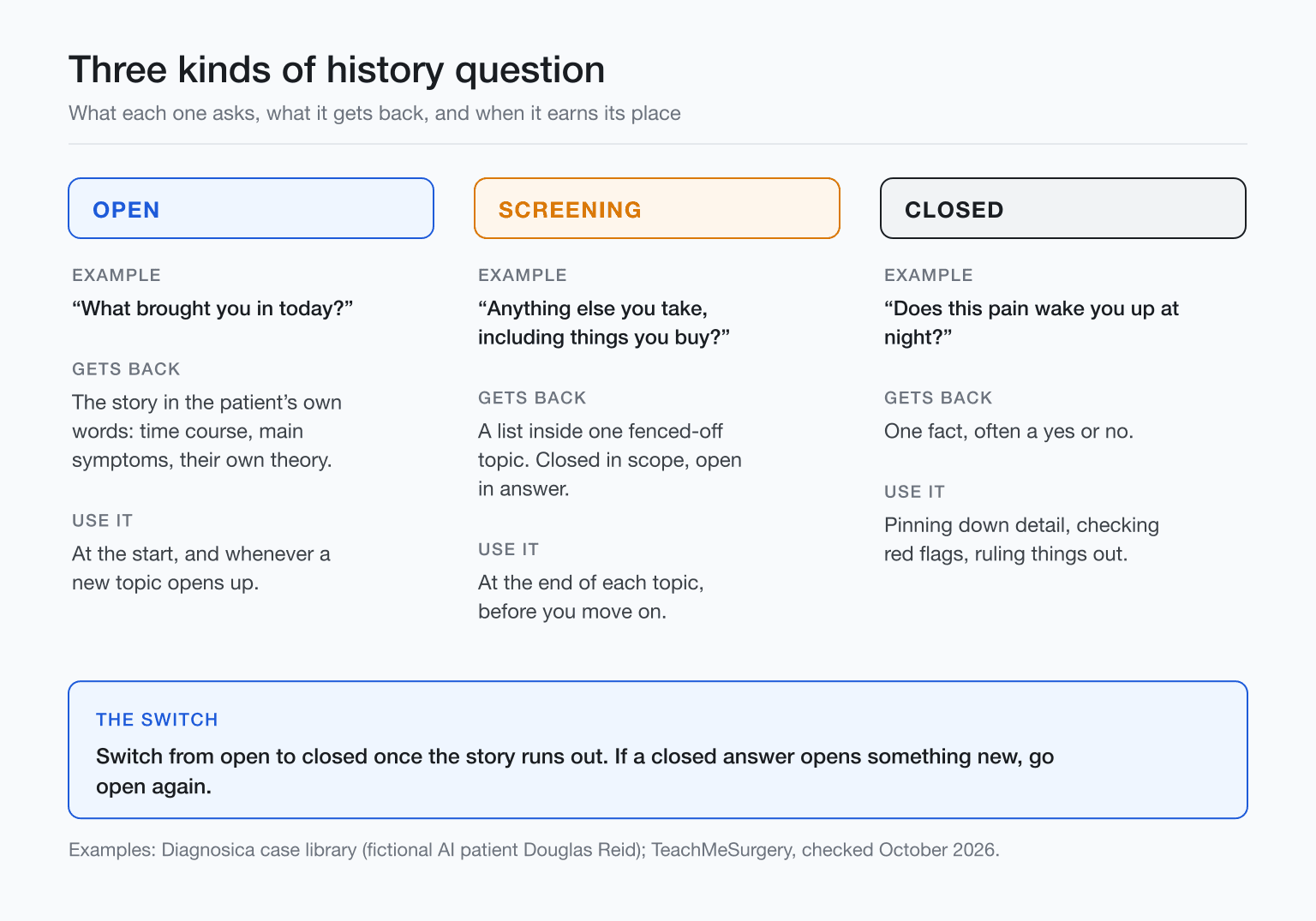
Open questions invite the patient's story in their own words and cannot be answered with yes or no. Closed questions invite short, specific answers, often yes or no, or a single fact. Use open to start wide, then closed to clarify. There is a middle type too.
Patient.info puts it plainly, an open question should not be answerable with yes or no, with examples like "What's been bothering you?" and "Tell me about your cough" in Patient.info's history guide.
Closed questions ask for a defined point, like a time, a number, a name, or a confirmation. A common teaching example is, "does this pain wake you up at night?" which pins down a feature without reopening the whole story.
Functionally, open questions surface concerns in the patient's words, and help you learn what they think is happening. Closed questions then pin down onset, pattern, red flags, and checks patients rarely volunteer. There is a third kind that sits between them, a focused prompt that narrows without dictating an answer, covered later.
You get better at the switch by saying it out loud, not reading about it, so rehearse history stations alone.
Why start open: what the patient volunteers when you let them talk
Start open because patients pack time course, functional impact, and fears into their first answer. In open and closed questions history taking, that first unhindered minute often yields more clinical signal than three quick yes or no items.
Every patient below is a fictional AI patient from Diagnosica's case library, and every case is written and signed off by a doctor.
Douglas Reid, 72, retired postman, starts with, "I've had a bad stomach for three days and now I'm hardly passing any water at all." Left to talk, he volunteers diarrhoea and vomiting for three days, keeping almost nothing down, tiny dark urines, and feeling weak and dizzy when he stands.
He also gives his own theory and worry that it's a bug but his kidneys have "packed up" and he fears dialysis.
Other openers are just as dense. A 35-year-old man says, "I've had high fevers and sweats for about five days since I got back from a trip." Neil Ashworth, 45, "I hurt my back a few weeks ago and now both my legs have gone weak." Owen Fairbanks, 40, "I've had double vision for months and now I'm choking on my drinks."
Each contains a timeline and a change point that a closed opener would have skipped. In one university hospital setting, open-ended questions were 26.4 percent of opening questions, a study of Japanese clinics reports, fetched October 2026. One setting, not a universal rate.
A brief open invitation also buys rapport in the opening minute, which makes the later focused bits land better.
When should you switch to closed questions?
Switch to closed questions once the patient's own story tails off and you have a short working list to test. Closed prompts then check specific possibilities, confirm timelines and risks, and catch details people rarely volunteer. If a closed answer opens something new, switch back to open to fill in the context.
That flow matches the advice to start open, then move to closed to clarify specifics, see TeachMeSurgery's history guide. One Japanese outpatient study found 75.0% of closed questions were confirming questions about symptoms, one study and one setting, but it fits closed prompts as confirmatory checks. For the pivot pattern, see narrowing to a focused history.
- The patient starts repeating themselves.
- You have the time course and main symptoms.
- You need a specific detail, for example when, how much, which side.
- You need to check a red flag or rule something out.
- You're under time pressure in a station.
The switch isn't one-way, if a closed reply opens new ground, go open again with "tell me more about that".
Worked example: from 'what brought you in?' to a focused history
Douglas Reid shows how open and closed questions history taking moves from broad to focused in minutes.
1) Open question. You start with, "What brought you in today?" He answers, "I've had a bad stomach for three days and now I'm hardly passing any water at all."
2) Open continuation. "Tell me more" or "What else have you noticed?" He volunteers vomiting and diarrhoea with almost nothing kept down, small dark urine twice yesterday and almost none today, and dizziness on standing.
3) Open on his view. "What do you think is going on?" He calls it "just the bug", but says he’s worried about dialysis.
4) Closed on intake. Targeted questions confirm he has eaten almost nothing for three days and thinks he has lost about 3 kg. He is very thirsty, but drinks come straight back up.
5) Closed on the stream. When he does pass urine the stream is normal, no trouble starting, no dribbling, no straining, no feeling of not emptying. That’s closed questions for negatives in action, and in this case it argues against a blockage. Acute urinary retention and post-renal kidney injury sit on the distractor list.
6) Then the medicines. This is where a narrow question misses an over the counter painkiller, and we show the trap next.
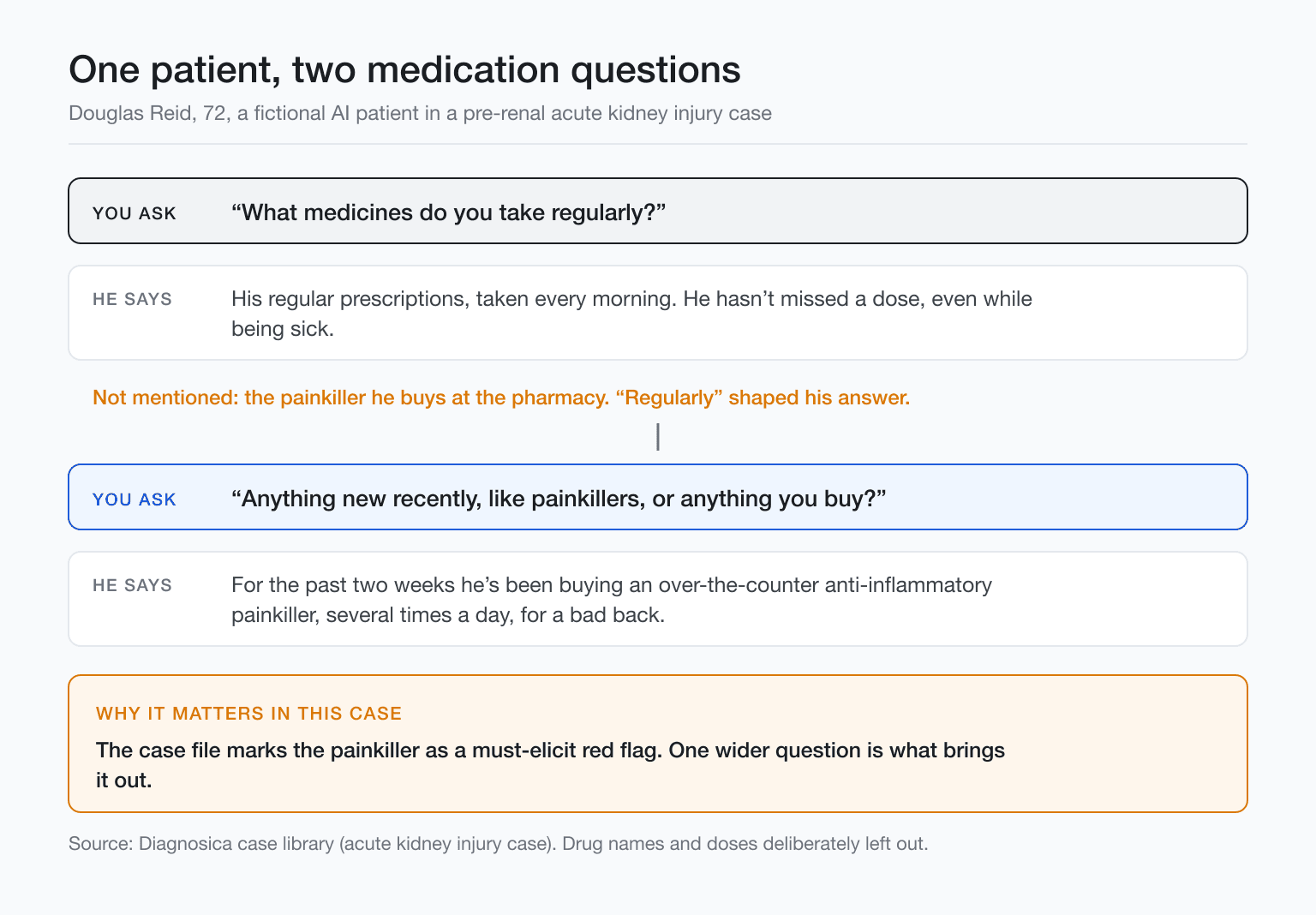
When a closed question gets the wrong answer: 'what medicines do you take regularly?'
Closed questions are precise, fast, and can still miss the thing that matters. The word "regularly" is doing the damage here, because patients often don’t count new or occasional tablets as regular medicines.
Asked "What medicines do you take regularly?", Douglas lists his regular prescriptions, taken each morning, and adds that he hasn’t missed a dose even while unwell. That’s an accurate and complete answer to the literal question.
It’s also too narrow for the clinical task at hand. He doesn’t include the painkiller he picked up at the pharmacy, because in his head "regular" means long term, prescribed, stable. Your wording defined his answer.
On a targeted follow up he discloses the missing piece, for the past two weeks he’s been buying an over-the-counter anti-inflammatory painkiller, several times a day, for a bad back. It comes out when asked about painkillers, anything bought over the counter, anything new recently, or "anything else you take".
The case flags that painkiller as a must-elicit red flag, and the case diagnosis is pre-renal acute kidney injury. The closed question wasn’t wrong, it was too narrow.
Douglas is one of the AI patients in Diagnosica's library, and he only mentions the painkiller if you ask the right way, so if you want to see where you switch, take Douglas's history yourself.
Screening questions that sit in between: 'anything else you take, including things you buy?'
Screening questions are closed in scope and open in answer. You fence off one domain, like medicines or symptoms, then invite the patient to list whatever fits. They stop a narrow closed question from clipping useful detail, without turning the floor into a ramble.
- Anything else you take, including things you buy from a pharmacy or shop?
- Anything new recently, like painkillers, antibiotics or herbal remedies?
- Is there anything else you’ve noticed that we haven’t covered?
- Anything else you’re worried about?
These broader wrap ups work because they widen the net without putting words in the patient’s mouth, and they sit well at the end of a domain before you move on. Douglas, a fictional AI patient from Diagnosica’s case library, mentions the painkiller only after a prompt like this, which a narrower medication question would have missed.
Leading and double questions to avoid
In open and closed questions history taking, the trap is loading the question so the answer echoes your guess. Patient.info on leading questions says they’re best avoided because they steer the patient. Its example: “Is it worse when you’re walking?” Better: “Have you noticed anything that makes your pain worse?”
Offering options tilts the field too. Patient.info warns you can get the answer you wanted rather than what the patient meant, and prefers an open form like “What colour was the vomit?”
Double questions blur what was actually asked. “Any chest pain, breathlessness or palpitations?” often gets a “no” that covers all three, or the patient answers the last one and leaves the others hanging. Fix it with one question at a time, or a quick screen followed by one by one checks.
Douglas’s case shows how a nudge can bury the painkiller. “You haven’t been taking anything else, have you?” invites “no” and misses the painkiller. Better: “Do you take anything else, including things you buy?”
Practise the switch out loud with a patient who answers back
The open and closed questions history taking switch is a spoken skill. Reading about it helps, but you only feel the edge when a patient answers exactly and only what you asked.
In Diagnosica you take a history by voice or by typing, with a video avatar replying. Case facts are set so some are volunteered and others appear only if you ask specifically, which is how Douglas’s painkiller behaves when your medication question is too narrow.
After the history you order investigations, commit to a diagnosis and a management plan, and get a scorecard with competency scores and teaching points, on the free tier too.
The library has over 130 cases across 18 specialties, every case reviewed and signed off by a doctor. No physical examination practice. Available any hour without booking, on iPhone, Android, or the web.
It doesn't give advice about real patients, and it's not a diagnostic system. Treat every output as educational.
Try the switch See how a narrow medication question can miss the painkiller, then practise widening and tightening in seconds. Start a free case