How to Present a Patient on a Ward Round
Last updated 4 October 2026
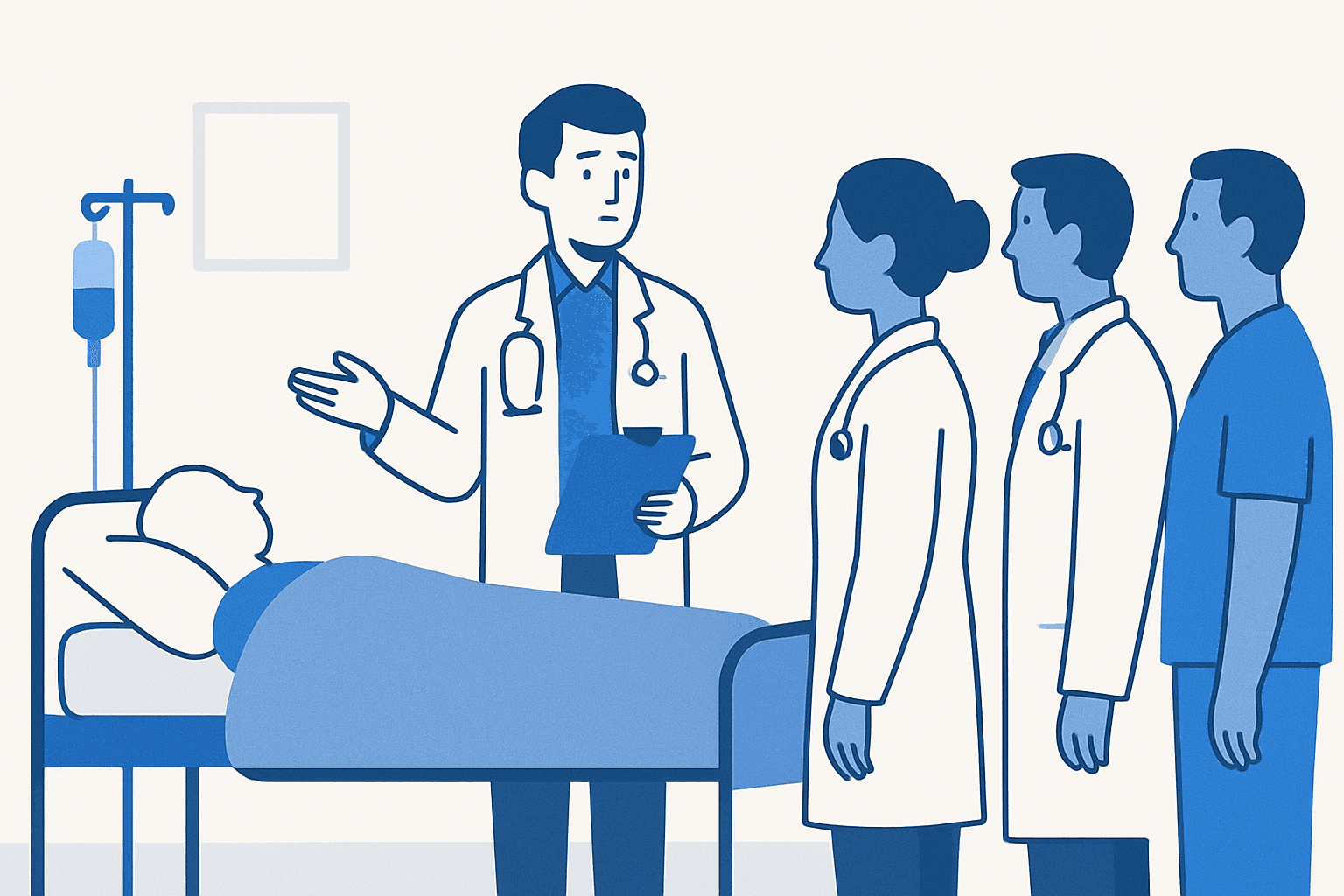
You get thirty seconds. Six people are listening.
Take a breath. Presenting on a ward round is mostly format. Your knowledge is usually fine. Headline-first delivery and tight order are the wins you can learn fast.
Here’s a default thirty second structure for tomorrow, a longer version for new or messy patients, what to cut, and how to handle interruption or uncertainty. Keep the plan at what you’d like to do and what you need a decision on. This won’t teach you to examine or write a drug chart. For wider context, see surviving your first year on the wards.
What is the consultant actually listening for?
The decision they have to make. Who is this, why are they here, how sick are they now, and what you need from me. Completeness isn’t the goal. A full history recited from the notes is usually the wrong answer.
Your job is to move one patient to a decision, not to prove you took a thorough history. Think who, what, so what, now what.
Give a one line ID and reason for admission, then the current state with the few data points that change today’s decision. Add one line on what’s changed since yesterday, then your proposed next step and the question you need answered. Stop there.
Detail-dense talks fail because the listener is holding many patients in their head and will lose the thread after the third date or obscure lab. Every extra detail that doesn’t affect today’s decision adds cognitive load and reduces signal.
Tune your bandwidth to the room. At 9 am with two patients ahead, add a line of context or a key differential. At 11 am with eighteen behind, that extra line costs attention you won’t get back.
Be brave and commit to a headline. Then ask for the decision you need.

The thirty-second version
Use this spine when the consultant is already turning the page. It keeps you honest and the team moving.
- Who the patient is and why they came in: name, age, and the presenting problem in one line.
- What has changed since yesterday: events, symptoms, results, or escalation, one headline only.
- How they are now, including observations and the NEWS2 early warning score.
- What you think: your working diagnosis or main concern, with one-liner justification.
- What you’d like to do or need a decision on, stated as a question or proposal.
Here’s how that compresses in practice. Keep it spoken, not read. Don’t stuff every result in.
This is Trevor Walsh, a 58-year-old AI patient from a Diagnosica practice case, who came in with sudden crushing central chest pain at rest with sweating and breathlessness. He has type 2 diabetes and high cholesterol, a 30 pack-year smoking history and is still smoking, and his father had a heart attack at 60. Right now his observations are: heart rate 102, respiratory rate 22, oxygen saturations 95 per cent. I’m concerned about a cardiac cause given the character of the pain and his risk profile, and what I’d like to do is discuss immediate priorities and agree the next steps with you.
If you don’t know yesterday’s change, say so and move on. From what I can tell, that honesty saves you from guessing and signals what you still need to find out.
The two-minute version, and when to use it
Use the two-minute version for most routine reviews. One line of identification, overnight events, today’s problem, key numbers, and your proposed plan framed as what you’d like to do and what you need a decision on.
Switch to the longer version when the team has no shared context or the situation has shifted. That means:
- A new admission the team hasn’t heard about.
- A patient who has deteriorated since yesterday, and you’ve assessed them in a structured way with the ABCDE approach.
- A case where the diagnosis is genuinely unclear.
What gets added in the longer version is deliberate. Give the relevant history in time order, the examination findings that change the answer, the results that are back so far, then your differential with one or two lines for and against each option.
What still doesn’t belong is the full past medical history read aloud, or every normal result. Pull in comorbidities only when they influence your thinking or the plan you want senior input on.
Keep the plan at the level of intent and decisions. What you want to do next, and what you need agreement or guidance on. No shopping lists.
Most people default to the long version out of anxiety. I’ve done it too. Glance up early, check for nods or a hand raised, and trim or expand in real time.
If you’re unsure, ask at the start, do you want headlines or the full version. Then commit.
What to leave out
The biggest fixable mistake is reciting the clerking. Nobody needs a verbatim history once the diagnosis or working problem is clear. They need what has changed since yesterday and what you want to do next.
Cut the normal results that change nothing. A normal ECG, stable CRP, or a chest X-ray re-reported as unchanged doesn’t earn airtime. Say what is abnormal or new, and move on.
Cut background history that is irrelevant to today’s problem. Longstanding psoriasis with no treatment implications in an acute cholecystitis presentation, leave it in the notes. Prior admissions eight years ago for something unrelated, also notes.
Cut the narrative of how you found the information. People don’t need the story of three phone calls and a missing set of obs. They need the facts you verified.
Rule of thumb: if a fact wouldn’t change what happens next for this patient today, it doesn’t belong in the spoken presentation. It belongs in the notes. Every time.
One counter-case does matter. Social circumstances, when discharge is the question. Lives alone on a third-floor flat, no lift, carers twice daily, daughter away until Friday. That decides today’s plan, so surface it early and tie it to the decision you need.

Handling the interruption
Interruptions are normal on ward rounds. They’re usually not a criticism. Consultants interrupt to get to the decision faster, to check a single data point, or to move the list on. Expect it and plan for it.
When you’re interrupted, answer the question asked. Then check whether they want the rest. Clean pattern: give the fact, pause, then say, Do you want the rest of the summary, or the plan next. Don’t restart from the beginning.
If you’re asked something you haven’t checked, say so and say when you’ll confirm. For example, I haven’t rechecked the urine output yet this morning, I’ll confirm before the end of the round. Don’t guess, and don’t pad with related but irrelevant facts. From what I can tell, clear and time-stamped beats confident and wrong every time.
A quick scenario. Consultant: What’s his oxygen requirement right now. Student: So, the presenting complaint was breathlessness, he came in five days ago with, and then we did a CT, and overnight the nurse said he was a bit, and he’s, and, and. At sentence three, the room switches off. The better version is one line: He’s on 2 litres via nasal cannula, saturating 95 per cent. Then: Would you like the rest of the update.
What if you are not sure what is going on?
Say so. Then state what you’ve ruled out and what you’re worried about. Uncertainty declared clearly is safe and normal. It lets the team target the next step. Uncertainty hidden behind a confident presentation misleads and causes harm. Don’t fake certainty.
Use plain phrasing. I think it might be X because of Y. I’m worried it could be Z because of A and B. I’ve ruled out red-flags C and D from the history, observations, and exam. I need a decision on E. Short, checkable statements.
What counts as ruled out? The time-critical harms you checked for and didn’t find, tied to your observations and exam. For example: airway patent, breathing unlaboured, oxygen saturation stable on air, blood glucose normal, no new focal neurology, abdomen soft. That level.
Give the plan as what you’d like to do, and where you need senior sign-off. For example: I’d like to send X and consider imaging Y, and I need a decision on whether we do that now or watch and review this afternoon.
Why do juniors hide uncertainty? Fear of looking slow, a sharp senior from last week, all those eyes on you. Wrong instinct. Nobody expects a first-year doctor to have the answer every time, and the team is calibrating how much to check behind you. That calibration shifts when you start stepping up to SHO and hold the undifferentiated patient for longer before anyone else sees them.
The same honesty makes escalation work. I am not sure, here is what I have ruled out, here is what worries me, I need X. See when you get bleeped about a patient. From what I can tell, the clearer the worry, the faster the help.
Write one line you can say under pressure: I am not sure, here is what I think, here is what I am worried about, here is what I need. Then use it.
Practise the history behind it The presentation is only as good as the history. Rehearse that on an AI patient. Start a case free
Practising it before the round
Do a 30 second out-loud run after you clerk someone, before the round. Set a timer and speak it, start to finish, without stopping. Silent rehearsal tricks you into thinking it’s fine.
Keep it tight. Lead with who, what changed, and what matters today. One headline per system. If you overrun, cut adjectives, cut repetition, keep the signal. Record yourself once, then trim the hesitations you hear. Have the apps FY1s actually use to hand on the round so you can time yourself and check key notes quickly.
A worked example, opening only, from an AI patient in a practice case: This is Raymond Pickering, 70, with a week of worsening breathlessness, now breathless walking to the bathroom, and bilateral leg swelling to the knees. Today his observations are heart rate 112, respiratory rate 24, oxygen saturations 91 per cent on air.
Say it at the pace you’ll use in front of the consultant. The cadence matters. If your first sentence is clear, the rest is easier. I still write the first five words sometimes.
You won’t always know the patient well. On your first set of nights you’ll often present patients you’ve only just met. Students in the US meet that jump earlier, when they are first sent in on their own. The 30 second drill keeps you from rambling while you’re still piecing the story together.
The presentation is only as good as the history behind it. Diagnosica is a place to rehearse taking that history from an AI patient by voice or text, any hour of the day, with free cases every month. It doesn’t simulate the ward round itself. It gives you realistic histories to practise on, so your openings land when it counts.
Common questions
How long should a ward round presentation be?
Aim for thirty seconds if the team already knows the patient, and up to two minutes for a new admission or someone deteriorating. Keep it short: headline problem, relevant vitals, overnight events, and a plan question. For new admissions or the unwell, add a history line and key results. If you’re creeping past two minutes, you’re almost certainly reading the clerking aloud rather than presenting a focused summary, then pause, refocus, and tighten. Stop and summarise. Then ask what the consultant wants next.
Should I present from notes or from memory?
Notes are fine and normal. Use them as prompts, not a script, and keep glancing down for dates, numbers, and names before looking up to speak naturally and clearly. Don't read word for word. A presentation read word for word is hard to follow and hard to interrupt cleanly, so bullet the structure on the top of the page if you like, and one trick I use is to underline the headline problem and today’s decision point.
What if I get the diagnosis wrong in front of everyone?
It happens to everyone, and it matters less than you think. Being wrong out loud is how the team corrects you safely, which is the point of the round. Say what you know, then what you think, then what you want to check. Invite correction early. If you can, ask for a thirty second debrief after, so the learning sticks.
How do I get better at this quickly?
Rehearse out loud after clerking while the story is fresh, and time yourself. Aim for one clean sentence per section, then the ask. Record a voice note if you need to hear the flow. Then pick one registrar and ask for thirty seconds of feedback on your next two presentations. From what I can tell, most people will give it if you ask directly.
Educational use only. Not medical advice. AI-generated; verify clinically against primary sources.
Walk onto the round having done it once Run a free case, take the history, then say it out loud in thirty seconds. Start free