Occupational History Taking: The Question Most Skip
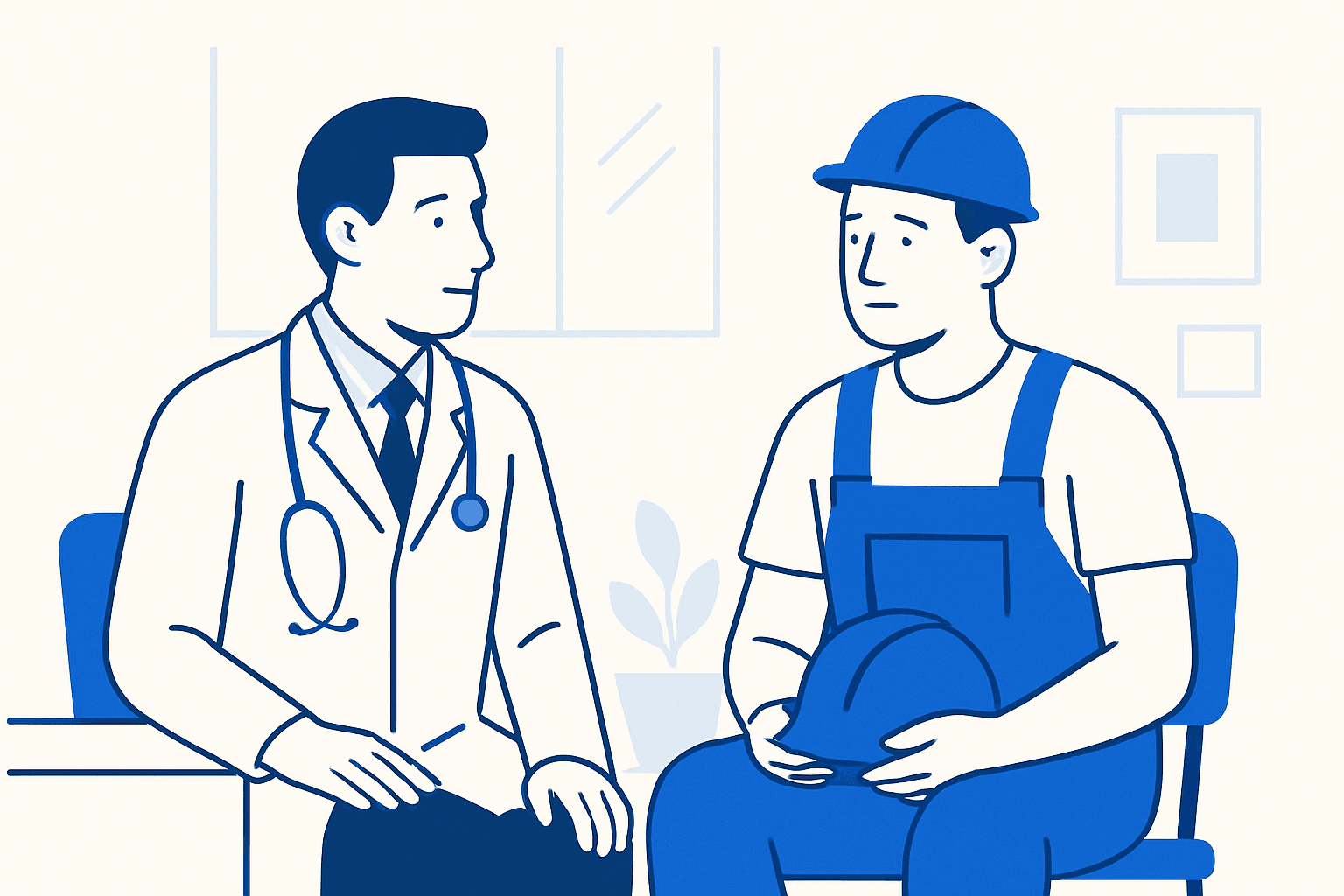

Occupational history taking is asking what a patient does or did for work, what it exposes them to, and what their illness means for that work. Most of us give it one rushed line in social history, written as 'retired' or 'office'.
We’ll show the three payoffs, with cases: exposure, fitness to work or drive, and livelihood. Worked AI-patient cases from Diagnosica’s case library, fictional personas, every case reviewed and signed off by a doctor.
What is an occupational history?
An occupational history is a focused inquiry into a person’s work and how it intersects with their symptoms. It asks what they do day to day, where they do it, any exposures, whether symptoms vary with work or driving, and how illness affects the ability to earn a living.
Occupational history taking covers current and past roles. Capture employer names, dates, job titles and the major duties, with emphasis on what tasks are actually done. Duties matter more than titles, as set out by Lax et al., American Family Physician, 1998.
Probe the real work, not the badge. What they lift, clean, type, breathe, wear, and for how long.
The job question does three jobs at once: exposure, fitness to work or drive, and livelihood. You are learning what might cause or worsen disease, whether the person can safely keep working or driving, and what the illness is doing to their income.
Timing is the hinge clue. Are symptoms better or worse at work, on the commute, or on days off.
If driving is relevant, check the DVLA guidance.
Why it gets skipped, and what that costs
People skip the job question because it sits at the end of the social history, the clock's against you, and 'retired' feels like a full answer. A 2013 letter cites a study of 69 physicians: 43.9% did not take an occupational history at all, and only 22.7% took a detailed occupational history from all patients. On a busy take, it's the first thing to go.
The same letter points to time, effort and cost as barriers, says teaching's often lacking, and says work-related diseases are underdiagnosed when the occupational history is deficient.
The price on the ward is simple: exposures get missed, fitness to work or drive goes untested, and the livelihood piece never gets heard.
Gordon Reeve, 68 (AI patient), retired after about thirty years in a textile dye works.
The five questions to ask every patient about work
For occupational history taking, start with five quick screens from a 1998 American paper, still useful in UK clinics. They are set out in the American Family Physician review and catch exposure, temporal patterns, and clusters before you wander into detail.
- "What type of work do you do?" Job role and core tasks flag potential exposures and physical demands.
- "Do you think your health problems might be related to your work?" Patient attribution steers you to suspected occupational links you can test.
- "Are your symptoms different at work and at home?" Patterns by place or shift hint at work-aggravated illness or a non-work trigger.
- "Are you currently exposed to chemicals, dusts, metals, radiation, noise or repetitive work?" Targets common hazards, and you should ask about past exposure too.
- "Are any of your co-workers experiencing similar symptoms?" A cluster among colleagues suggests a shared exposure.
The same paper also asks about ventilation and protective equipment and whether they are used consistently, which helps you judge likely dose and control.
If any answer is yes, take a fuller job history.

Exposure: the dye worker with blood in his urine
In Diagnosica, Gordon Reeve, 68, an AI patient, opens with: "I've had blood in my urine on and off for a few weeks." It is painless visible haematuria, he feels otherwise fine, and two GP courses for a "water infection" brought no benefit despite urine tests showing no infection.
A little unintended weight loss.
He volunteers nothing about work until you ask directly. "I worked thirty years at a textile dye works, mixing the dyes and chemicals. The ventilation wasn't always good. I retired three years ago."
He also smoked twenty a day for about forty-five years.
Why does the job matter? Aromatic amines in dye, rubber or textile work are linked to bladder cancer, workplace chemicals account for around 5 in 100 UK cases, and it can take around 30 to 40 years or more to develop, per Cancer Research UK, which also notes that around half of UK bladder cancers are caused by smoking.
From what I can tell, many of us stop at "retired" and move on. Retired is not an occupation, ask what they did before.
The other teaching point in this case, painless bleeding in an otherwise well patient often gets mislabelled as infection, which is what happened here twice.
Timing: symptoms that improve at work (or away from home)
Kevin Marsh, 30, AI patient in our case library, has a week of headache, dizziness, nausea and tiredness. He thinks a virus, a tension headache or stress. The distractors in the case are migraine, influenza, acute coronary syndrome and depression.
His job answer is the turn: "I'm a quantity surveyor, so I work in an office. No chemicals or fumes at work, and I feel better there." Nobody at work is ill. It is a negative that points elsewhere.
Worse in the flat, better at work. Jess, his partner, has headaches too. The dog is off its food and sleepy. Old gas boiler, not serviced for two years, midwinter, windows shut. The case diagnosis is carbon monoxide poisoning. His job did not cause it.
This is why occupational history taking always asks whether symptoms change between work and home. Different in different places, or times of day, is a clue.
The NHS carbon monoxide page says symptoms may get worse in an affected room or building and improve when you leave, and that gas boilers are among household sources.
In Kevin’s case teaching there are no reliable physical signs and a pulse oximeter reads falsely normal, so the history carries it.
Take Kevin's history yourself. Talk or type to the AI patient, ask about work and home, then commit to a diagnosis and get a scorecard. Try a free case
Fitness to work and drive: the van driver with vertigo
The job question changes the stakes. It tells you who else is on the road with this symptom, and it often brings out the fear that shapes what the patient tells you in the first place.
Raymond Fletcher, an AI patient in Diagnosica’s library, drives a delivery van for a living and had one attack while turning his head to reverse. That single detail flips the risk picture, and it only lands if you ask about work.
Adrian Fenwick, another AI patient, also drives a van for work and is frightened of losing his licence, which is why he nearly did not come in. Naming that openly links the symptom to the patient's real worry, and your history immediately gets cleaner.
On fitness to drive, I do not guess. I check the DVLA guidance for the condition and the licence group, then frame the next steps with the patient.
Wesley Yarrow, 74, retired postman, still drives in daylight, and nobody has ever asked him whether he should. He adds, "I was out in all weathers and bright sun for forty years, and I never wore sunglasses."

Travel and livelihood: work trips abroad and the sole earner
Work trips change both the exposure story and the stakes. Ask the job, then the travel. In Adam Whitfield, 35, an AI patient in Diagnosica, there are high swinging fevers, sweats and headache for five days. He returned from Ghana two weeks ago after ten days on site.
He is a sales manager for a mining equipment supplier, spent days on site in Ghana, bitten by mosquitoes constantly. He took his antimalarial tablets only a few times and used no bed nets, and a colleague who took his tablets is fine. Diagnosis in the case is falciparum malaria.
A business trip is travel exposure by another name, so take a proper travel history as seriously as you would for backpacking. The job question and the travel question collapse into one.
Livelihood matters too. Reece Vance, 24, a scaffolder and the only earner at home with his girlfriend and baby daughter, said, "I'm the only one earning in our house, so I'm terrified of losing the use of the leg."
Alan Prescott, 62, a self-employed right-handed carpenter with a wrist injury, put it bluntly: "I'm self-employed, so no work means no pay." Livelihood shapes fear, negotiating positions and timing. It belongs in your summary.
Where occupation sits in a UK clerking, and how to write it up
In a UK clerking, occupation sits in the social history alongside smoking, alcohol, living situation and driving. If you want the sequence, see the full clerking order.
Write it up with the job, employers, dates, major duties and exposures, plus whether they drive for work and whether others rely on the income. The AAFP breaks job history into employers, dates, titles and major duties, and duties matter more than titles.
- Gordon: Retired 3 years. Previously about 30 years in a textile dye works, mixing dyes and chemicals, ventilation poor. Smoker, 20 a day for about 45 years.
- Raymond: Delivery van driver for a parcel firm. One attack while turning his head to reverse. Worried about driving and his job. Lives alone.
How do you practise asking it naturally?
Ask it early and plainly: what do you do for work? Follow with what does that involve day to day. If they say retired, ask about past jobs. Ask whether symptoms differ at work and at home. Then practise on patients where the answer genuinely changes your differential.
On Diagnosica, AI patients appear as a video avatar, and you can talk or type. Almost all have an answer ready for the job question, and often it is a real clue you only get if you ask. Every case is written and signed off by a doctor. You get a scorecard after every case with competency scores and teaching points.
For reps without a partner, try a solo rehearsal routine, then use the two-minute quick case to keep a daily streak going. No physical examination practice. "It doesn't give advice about real patients, and it's not a diagnostic system. Treat every output as educational."
Ask the job question on a patient who answers. AI patients by voice or text, a scorecard after every case, free tier with no card needed. Start a free case
Educational use only: not medical advice. AI generated; verify clinically against primary sources. Clinical review pending.