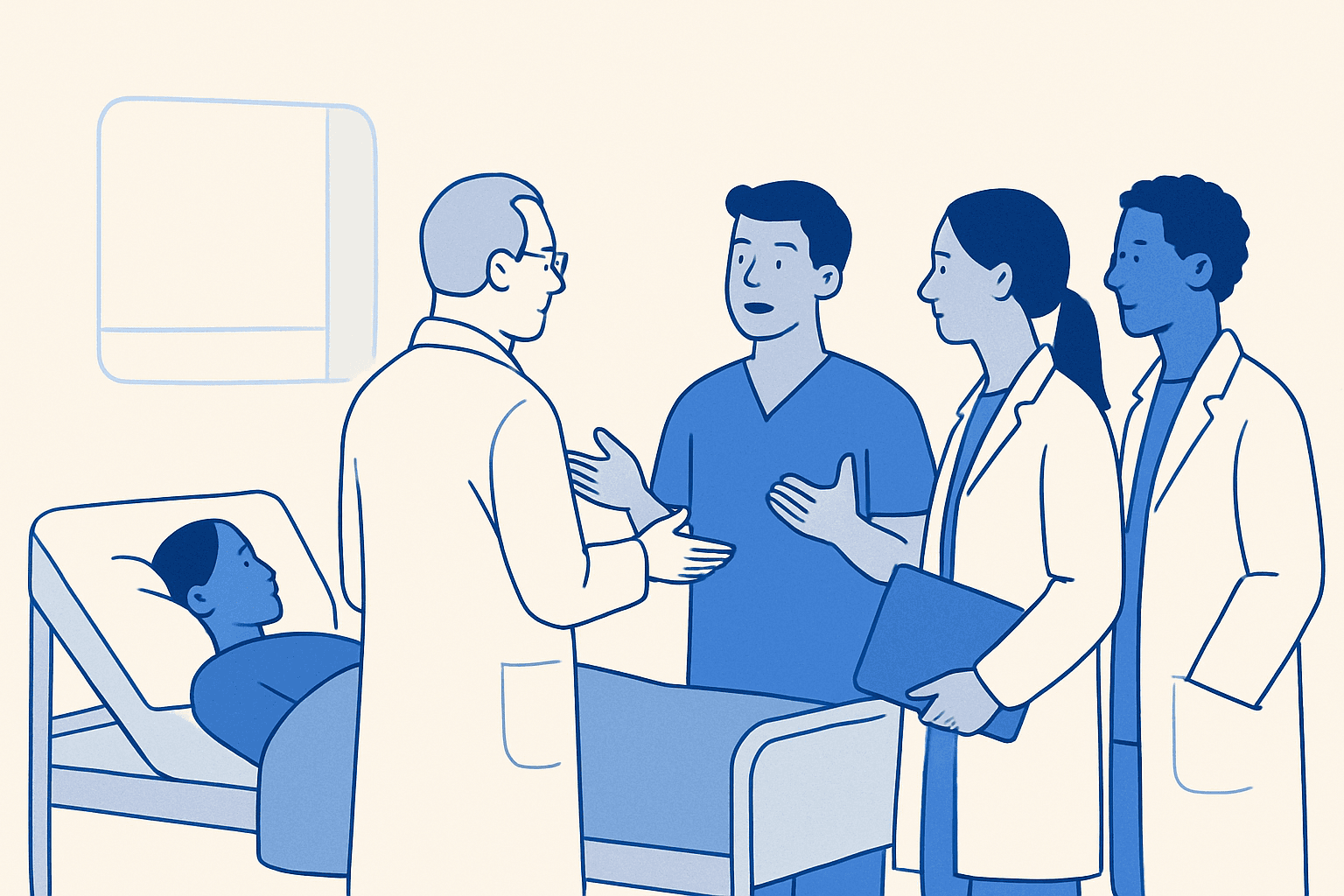
How to Clerk a Patient on Take: An FY1 Guide


The first patient on the take list is yours. The clerking document is blank. The registrar will ask what you think.
You need a clean process, not a glossary. You'll use your trust's document.
This post shows how to clerk a patient, from history to plan, through one worked case. You'll see what to capture, in what order, and where uncertainty lives.
What does clerking a patient mean?
Clerking a patient is the admission assessment and the document it produces. You record the presenting complaint and background, take a history, examine, then write an initial impression with a working differential and a plan. On the acute take it is usually done by the take team’s juniors once the patient is accepted.
It is the first written reasoning a patient gets in hospital, and later teams will read it and act on it. One surgical audit defines clerking as "the exchange that results in a provisional diagnosis and management plan".
On the medical take, the take team clerks new patients accepted by the medical registrar, then marks them ready for post take review with the consultant, per one trust's F1 survival guide.
Clerking is gathering the facts and putting your reasoning on paper. Presenting is telling it on the round, see telling the story on rounds.
Use your trust’s clerking document, formats differ.
Before you see the patient
- Read the referral source and reason, usually the ED or GP letter, and note the specific ask.
- Skim previous discharge summaries for diagnoses, procedures, and follow-up plans.
- Pull old bloods and any imaging reports that might anchor today’s problem.
- Check the GP record or repeat prescription list for long-term conditions and drugs.
- Look at anything they brought, letters, blister packs, a written symptom timeline.
As shown in a Medway surgical audit, "First admission to hospital is usually the easiest time to take a complete history, as patients often come in with relatives, prescription sheets, and letters from GPs".
The Medway survival guide tells take doctors to 'use the multiple systems to collect information about the patient's history' before finding the patient. Clerking formats are trust specific, use your trust’s document.
The history, section by section
- Presenting complaint and history of presenting complaint. Start with the patient's words, then a timeline of onset, progression, and what changed today.
- Past medical and past surgical history. List long term conditions with dates if known. Separate and label past surgical history, including procedures and implants.
- Drug history and allergy status. Copy current medicines from the patient's list, record doses and frequency, and check adherence. Document allergy status with the reaction described.
- Social and functional baseline. Record who they live with, stairs, aids, carers, and who notices if they're unwell. Smoking and alcohol amounts, and baseline independence.
- Family history and systems enquiry. Write relevant family conditions and ages if offered. Then a brief systems enquiry to catch missed positives and negatives.
- Ideas, concerns and expectations. Ask in their words what they think, fear, and hope. If you’re learning how to clerk a patient, practise this cadence early, or see asking about ideas and concerns.
In a vascular surgery audit of 32 FY1 clerkings at one tertiary centre, presenting complaint and HPC were "absent in 19% of clerkings"; past surgical history "absent in 45% of cases" while past medical histories were well recorded; "Only 72% of patients had a drug history taken, 41% had the drug doses and frequency recorded, and only 75% of patients had their allergy status documented"; 53% had been asked who lived with them; 48% asked about previous independence and carers; family history in 19%; systems enquiry in 12%.

What goes in the examination and observations
Write the latest set of observations, the early warning score, and the time they were taken, right at the top of the clerking. If there are no observations on the chart yet, do a set yourself and document them. In one hospital's vascular audit, only 31% had observations recorded in the clerking, which rose to 62% after a pro forma and asking FY1s to record them; the authors thought nursing staff had often not yet done them and doctors were unwilling to do them themselves.
Then examine the systems the history points to, focused and done on the ward with your hands. We won't teach examination technique here, you learn it at the bedside with seniors, not from a blog or an app, and Diagnosica doesn't rehearse the physical examination.
Investigations: order what the history asks for
Every test should answer a question your history raised. Start there. It either confirms or refutes your working diagnosis, rules out a named alternative you have actually considered, or looks for a trigger within the story you have already heard, and it should be linked clearly to a decision you plan to make next. For the 24-year-old with type 1 diabetes who’s thirsty and breathless, here’s what earns its place.
- Capillary glucose, capillary ketones and a venous gas: does this confirm or refute ketoacidosis?
- Salicylate level: could salicylate poisoning explain the same acidosis with fast breathing?
- Urea and electrolytes: what is the potassium?
- ECG: what effect has the potassium had on the heart?
If infection feels like the trigger, CRP, a urine dip, a chest X-ray and blood cultures hunt for it. Amylase is often mildly raised in this condition without true pancreatitis, so don’t over-read it.
Resist reflex “send everything” panels. If a tube goes off, know the question it answers, or skip it. See the case against reflex bloods.
The impression and plan
1) Impression. Write a one line summary and a working diagnosis. Use your trust’s clerking document, it defines the boxes and where the impression lives.
2) Differential. Name two or three alternatives and say why each is less likely. Keep it tight, anchored to timeline, risk and red flags, and see our guide on turning findings into a differential.
3) Investigations. List what you have sent and what is pending. Pair each test to the question it answers, so seniors can see signal from the noise at 3am.
4) Plan. Write what you want to know next, what you will monitor, and who you will tell. The Medway survival guide says, 'Formulate a plan based off your impression'; if worried or unsure 'contact the registrar'. A vascular audit found a plan was clearly written in 97% of clerkings, so the plan is rarely the missing part, what feeds it is.
5) VTE assessment. Tick that it is completed. After an admission clerking proforma, completion of VTE risk assessment increased by 62% at an audit at St Helier (Clinical Audit, 2013).
6) Escalation. Record when you discussed with the registrar, the time of senior review, and whether the patient is ready for post take. The Medway survival guide sequence matches this.

What clerkings most often miss (and how to stop)
In published single site audits, the usual gaps are basics you can control, not rare diagnoses. Observations, past surgical history, drug doses with allergy status, social baseline and demographics, and the VTE assessment often go missing. The plan is rarely the problem. A tight end of clerk check before you sign catches most of this.
- Observations recorded and dated from source.
- Demographics present, legible and correct.
- Past surgical history captured.
- Medicines with doses and frequency listed.
- Allergy status and reaction stated.
- VTE assessment completed and filed.
- Social baseline and next of kin.
In one tertiary centre's FY1 clerkings, that FY1 vascular audit found observations in 31%, past surgical history missing in 45%, drug doses and frequency in 41%, allergy status in 75%, VTE assessment in 73%, and it "performed very poorly in documenting the patients' demographics"; the plan was written in 97%. The authors write that "doctors admit they forget important parts of clerking when tired or under pressure." Four FY1s were partially aware and two not aware of what was expected. These are one hospital's figures, your trust will differ.
A worked clerk: thirsty and breathless, 24M
Fictional AI patient from the Diagnosica case library, every case written and signed off by a doctor.
1) PC: “I’ve been really thirsty and breathless for the last day or two.”
2) HPC, volunteered: two days of extreme thirst and weeing very large amounts; vomiting repeatedly, can’t keep fluids down.
3) HPC, on question: deep sighing breaths and short of breath; sore throat and flu-like illness a few days ago; dull diffuse abdominal pain.
4) HPC, only on a specific probe: very drowsy, hard to stay awake; stopped his insulin two to three days ago because not eating and felt too sick; girlfriend noticed sweet fruity pear-drop breath; denies chest pain, palpitations, or high fever with shaking chills (worth recording the pertinent negatives); not abroad; no excess tablets, only a couple of paracetamol; nobody ever told him what to do with his insulin when ill.
5) PMH: type 1 diabetes since age 14.
6) DH: only regular medicine is his insulin, which he stopped; no allergies.
7) ICE: thinks it’s a bad stomach bug on top of the sore throat; worried about exhaustion, drowsiness, and the heavy breathing; wants to stop vomiting, feel less awful, and understand what went wrong.
8) Obs: HR 118, RR 30, BP 104/64, SpO2 98 percent, temperature 37.4.
9) Impression: diabetic ketoacidosis on type 1 diabetes, triggered by stopping insulin during an intercurrent illness.
10) Differential: hyperosmolar hyperglycaemic state, older type 2 with minimal ketosis; sepsis, no high fever with shaking chills and 37.4; salicylate overdose, denies excess tablets.
11) Investigations: as in the investigations section, bedside capillary glucose and ketones plus a venous blood gas, which in this case returned glucose 32, ketones 5.6, pH 7.10, bicarbonate 8.
12) Plan, what you’d want to know and who you’d tell: clarify last insulin taken, ongoing vomiting, urine output, contact for girlfriend, any source of intercurrent infection, and whether he is protecting his airway; the medical registrar hears about him now.
Clerk this patient yourself. Take the history by voice or text from the AI patient, order the tests, commit to a diagnosis and plan, get a scorecard; examination is not part of it. Start a free case
How long should clerking take, and how to get faster?
There’s no national standard for clerking time. In one vascular audit survey, six of nine responding FY1s typically spent 15 to 30 minutes, and one spent 30 to 45. You get faster by running a fixed order you repeat, not by skipping sections that bite you later.
Scan triage and obs before you walk in, then use the same order every time. If you’re asking how to clerk a patient faster, write your impression before ordering tests, and know when to bleep the registrar, see handling a bleep mid-clerk.
On nights, pace and triage matter, see clerking on a night take.
Diagnosica covers the reps. You can rehearse the history, investigations and plan at any hour, with a scorecard after every case. The quick case is two minutes with five clues. You cannot rehearse the examination here, that is done on the ward. It doesn't give advice about real patients, and it's not a diagnostic system. Treat every output as educational.
For broader tactics on workload and headspace, read the wider FY1 survival guide.
Rehearse the history and plan. Practise any hour on AI patients with a scorecard after every case, free tier, no card needed. Start a free case
Educational use only: not medical advice. AI generated; verify clinically against primary sources. Clinical review pending.