Best Apps for Residents 2026, Sorted by the Job
What are the best apps for residents?
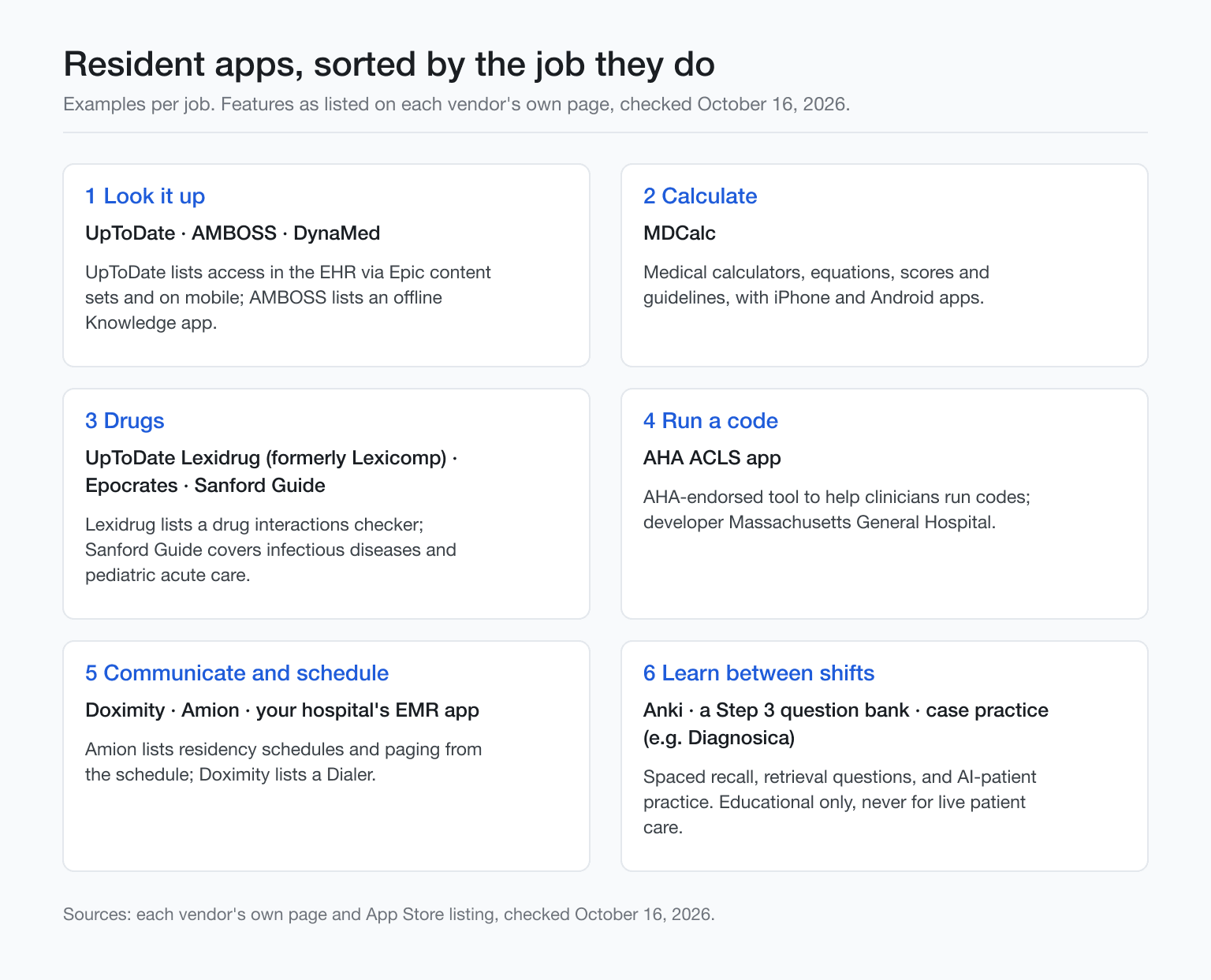
The best apps for residents sort by job: a clinical reference like UpToDate, or AMBOSS or DynaMed; a calculator like MDCalc; a drug reference like UpToDate Lexidrug or Epocrates; a code tool like the AHA ACLS app; communication and schedule like Doximity and Amion; and a learning tool like Anki, a question bank, or case practice.
- UpToDate for clinical reference.
- AMBOSS or DynaMed for clinical reference, and the AMBOSS app works offline.
- MDCalc for calculators, scores and guidelines.
- UpToDate Lexidrug for a drug reference with an interactions checker.
- Epocrates for a drug reference for the prescribing moment.
- Sanford Guide for an infectious diseases and pediatric acute care reference.
- AHA ACLS app for help running codes.
- Doximity plus Amion for calling back and on-call schedules.
- Anki for spaced-repetition flashcards.
- Diagnosica for practicing the history-to-plan decision on an AI patient between shifts, not at the bedside.
Most existing lists skew reference heavy. Rosh Review's January 2024 list picks five, including AHA ACLS, MDCalc, UpToDate, Lexicomp and Doximity, see Rosh Review's 2024 list. AMN Healthcare's December 2025 roundup lists seven, including Medscape, VisualDx and Calm or Headspace, see AMN Healthcare's roundup, and neither includes a case-practice app.
In the UK? Try the UK intern-year guide.
Look it up: UpToDate, AMBOSS and DynaMed
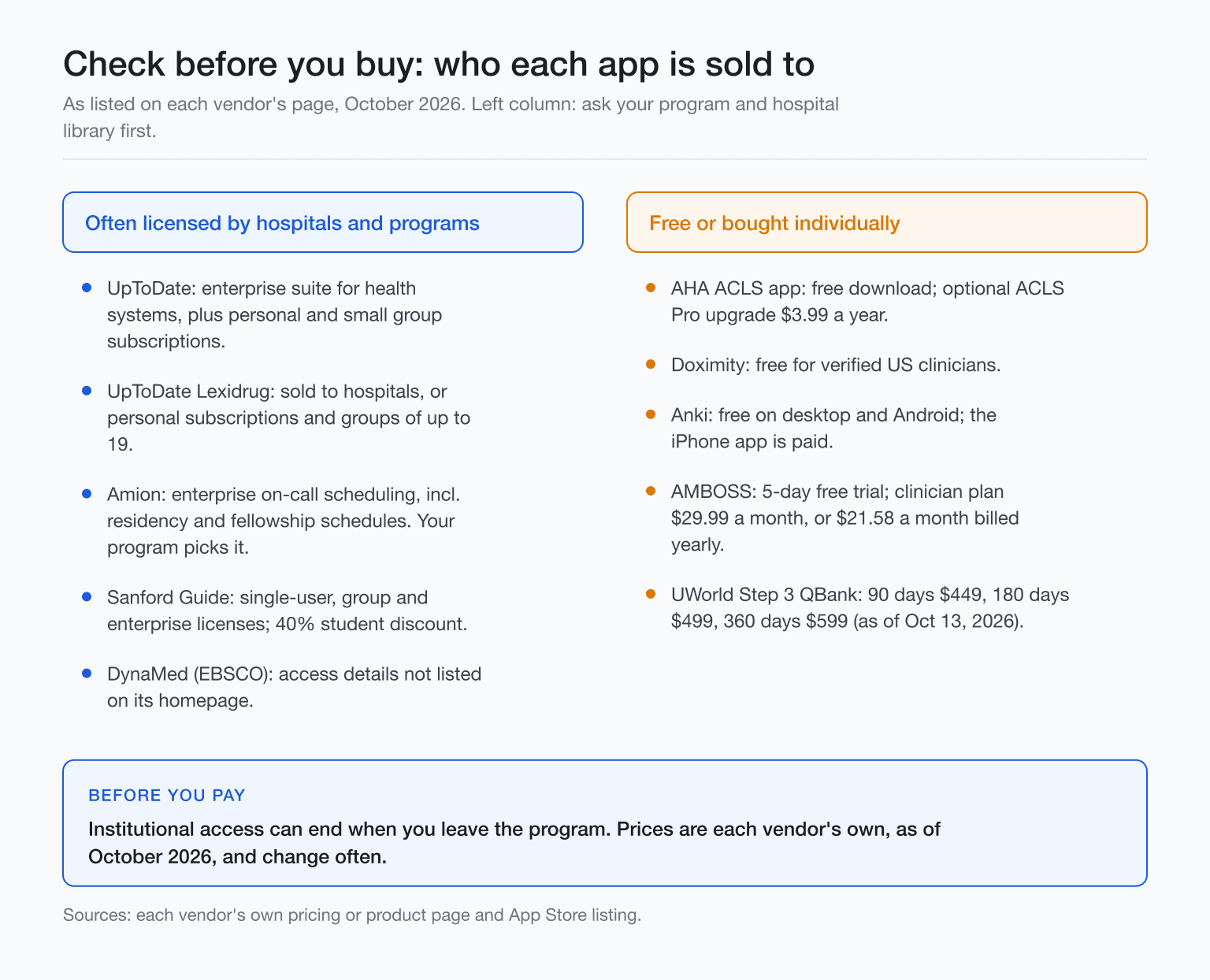
This is the two minute question job. If your program covers it, UpToDate is usually the quickest route from question to a cited answer. Most residents get it through their hospital or program, so don't buy it until you've checked.
Wolters Kluwer says UpToDate is sold as personal and small group subscriptions Pro Suite and an enterprise suite, available in the EHR through Epic content sets, on mobile devices and in remote locations. Users can earn CME while researching topics, and it lists an UpToDate Expert AI generative tool, as of October 2026.
If you want an all in one reference with offline mode, the AMBOSS pricing page lists unlimited library access with 1,400+ articles and a Knowledge app that works fully offline. It shows a 5 day free trial and a clinician plan at $29.99 monthly or $21.58 monthly billed yearly, as of October 2026.
DynaMed is an EBSCO product whose site links mobile apps. Access details are not listed on its homepage, as of October 2026.
Calculate and dose: MDCalc, Lexidrug, Epocrates, Sanford Guide
The scores and drugs job, fast and unforgiving when a page hits at 3 am.
For risk scores and formulas, MDCalc titles its homepage "Medical calculators, equations, scores, and guidelines" and links iPhone and Android apps.
UpToDate Lexidrug, formerly Lexicomp, lists mobile access and a drug interactions checker among its content sets, and sells to hospitals and as personal subscriptions or groups of up to 19, as of October 2026. If your program pays for UpToDate it often bundles Lexidrug, so search the old Lexicomp name if you can't find it.
Epocrates describes its tools as clinical decision support that saves time "in the prescribing moment", and its homepage also runs a medical news feed.
Sanford Guide calls itself "the point-of-care clinical reference for infectious diseases and pediatric acute care", sells single-user and group or enterprise licenses, and lists a 40% student discount, as of October 2026.
Codes and emergencies: the AHA ACLS app
The AHA ACLS app is described on the App Store as "the American Heart Association's (AHA) officially endorsed digital health solution to assist clinicians in running codes." It supports, and does not replace, your certification training or your hospital's code protocol.
The developer is Massachusetts General Hospital, and it's a free download with an optional "ACLS Pro" upgrade listed at $3.99 a year as of October 2026.
It tops Rosh Review's January 2024 list of five apps.
Practical tip, open it and learn where things are before your first code, not during it.
Communicate and schedule: Doximity, Amion and your EMR app
For the best apps for residents on the who’s on, calling back, paging job, start with Doximity. It calls itself “the largest verified network of healthcare professionals in the U.S.” and lists Dialer, Scribe and Ask, free for verified U.S. clinicians on mobile and desktop, as of October 2026.
Amion is the on-call scheduling system many programs use. Its site lists residency and fellowship schedules, web and mobile access, plus messaging and paging straight from the schedule, as of October 2026, and the Amion site is run by Doximity.
Your program picks Amion or something else, not you. Rosh Review also tells residents to get the mobile version of their hospital’s EMR, which is the one app that will match your local paging and messaging rules.
If the schedule has you on nights, here are fast tips on surviving night float.
Learn between shifts: Anki, question banks and case practice
This slot is about turning today’s patients into tomorrow’s judgment. You’re looking for spaced recall that sticks, banks that force retrieval, and simulations that make you pick a path when you’re tired and second guessing.
Anki describes itself as a “flashcard program that helps you spend more time on challenging material.” Desktop and AnkiDroid are free, the iOS app is paid, as of October 2026. Spaced recall is the point, and there’s a quick primer on why it works in why spaced recall works. Decks help, but the lift is daily reps.
For Step 3-style retrieval, UWorld’s Step 3 QBank lists 90 days at $449, 180 at $499, and 360 at $599, as of October 2026. AMBOSS bundles a Step 3 Qbank too, as of October 2026. Pick based on explanations you’ll actually read after a shift, not on question counts alone.
For case practice, Diagnosica is one option. You take a history from an AI patient who appears as a video avatar, by voice or typing, order investigations and see results and imaging, then commit to a diagnosis and management plan, with a scorecard and teaching points after. Over 130 cases across 18 specialties, each signed off by a doctor. There’s a two-minute quick case for a phone break, one line from the patient, five clues, guess after each, then the answer with a one-line teaching point. iPhone, Android and web. Free tier, no card. It doesn't give advice about real patients, and it's not a diagnostic system. Treat every output as educational.
Practice between shifts. You can practice a case on an AI patient between shifts, free tier, no card. Educational only, not a diagnostic system or advice about real patients. Start a free case
Scope callouts matter. Diagnosica doesn’t teach physical exam, and nearly all cases are male patients, so it’s not a women’s health resource. Other apps built around reasoning exist, and they’re worth comparing. The real gain here is practicing committing to a plan when no attending is looking.
Which apps does your program already pay for?
Before you buy anything, check what you already get. Many programs and hospital libraries license UpToDate, often bundled with Lexidrug, or DynaMed or similar. Schedules and paging usually run through whatever system your program chose. Ask your program coordinator and the hospital or medical school library first.
- Ask your program coordinator during orientation what’s covered, how to enroll, and how to access off campus.
- Check the library’s databases page for UpToDate, DynaMed, Lexidrug, mobile app steps, and remote access notes.
- Sign in through hospital SSO or use the EMR link to auto-create accounts. UpToDate is available inside the EHR per its page.
- Keep your student AMBOSS or question bank only if it still earns its place for how you learn now.
Institutional access may end when you leave the program, switch sites, or lose affiliate credentials. Don’t build your whole setup on licenses that can turn off the day you graduate.
A minimal intern-year phone setup
Start lean so you can move fast on day one. Install these, then reassess after your first stretch.
- Your program's reference, UpToDate or whatever they license.
- MDCalc.
- A drug reference, Lexidrug via the program or Epocrates.
- The AHA ACLS app.
- Whatever your program uses for schedules and calls, Amion, Doximity, the EMR app.
Everything else, including Anki, a question bank, and case practice like Diagnosica, can wait until you survive the first stretch and see what gaps are real. If you want a blueprint for that opening week, read our guide on surviving week one.
When you do start filling the learn-between-shifts slot, keep it light and habit-forming, and if you want a quick rep today you can try a case between shifts.