How it works
How Diagnosica works
Talk to a patient, order tests, diagnose and manage, then see how you did.
Inside a case
Everything you do in a case, step by step
Tap a tab to see each step: ask, investigate, diagnose, manage, then your score.
Voice patient
Practise history taking by voice: the patient answers back
Ask out loud or type, and the patient replies in their own words.
Diagram of one question in four steps: you speak a question, the patient replies, a finding appears on your notes, and then you get help if you want it, or you keep asking your own questions.
-
1You speak
"When did the headaches start?" -
2The patient replies
"A few weeks ago. Mostly in the morning." -
3A finding appears
FindingMorning headaches -
4Help if you want it
We can help if you need it, or you carry on with your own questions.
Stuck? Tap HintAsk your own next question
Voice minutes: 10 a month on Free, 90 on Standard.
Investigations
Order what you would order. See what comes back.
Choose from 685 blood tests, scans and bedside checks. Results come back with their normal range, and scans come back as real images.
These are samples to show how results look. Every case has its own results.
Say what you think it is. Then lock it in.
Give your leading diagnosis, add up to three differentials, and commit before you see the answer.
-
Pick your leading diagnosis
Search the list and tap the one you think fits best.
-
Add up to three differentials
The other things it could be. The screen tells you skipping them can lower your score.
-
Commit before you see the answer
Your diagnosis and plan lock when you score, so the answer is honestly yours.
Say what you would do. Build your plan.
Add the steps you would take for this patient.
-
Add the steps you would take
Tap a shortcut to start your plan.
-
Choose from a deep list
Pick from the list or search for the exact step.
Case scoring and feedback
How a case is scored: four areas, 100 points
Each area is worth 25 points. You see what went well first, then one thing to try next.
Where the 100 points come from
Tap an area to see how it is judged
- Safety points are flagged
- Mini cases get a shorter scoresheet
Every case gives you feedback and a score. Both come from AI, are made to help you practise, and have not been validated against human examiners.
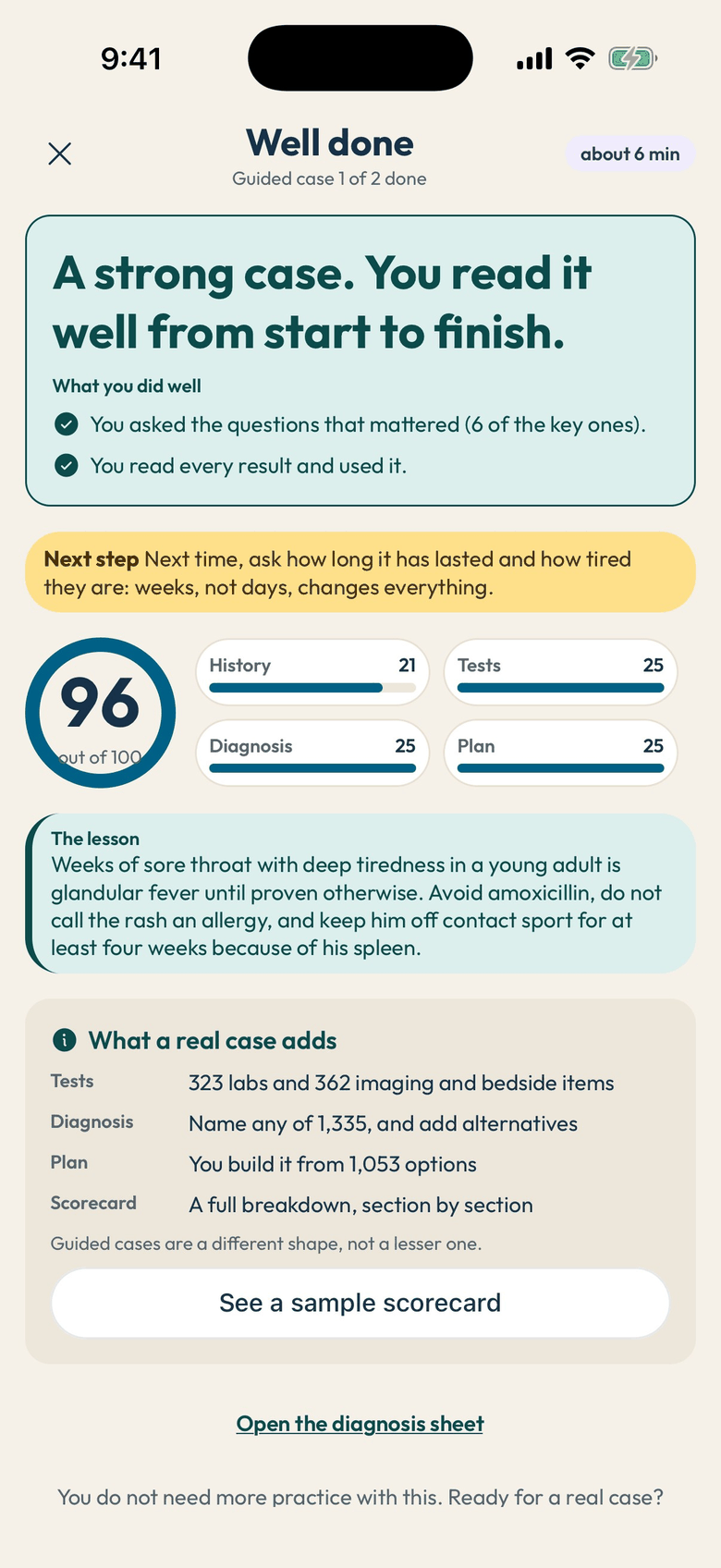
- A score for each area, out of 25
- What you did well, in plain words
- One next step to try
See each game before you play
Pick a game to see its screen, its basic rules and the skills it trains.


Full case
Basic rules
- Talk to the patient and take a history.
- Order tests and read what comes back.
- Give your diagnosis and treatment plan.
TrainsHistory takingChoosing testsDiagnosingTreating

Quick case
Basic rules
- You start with one clue.
- A guess that misses shows the next clue.
- After clue five, you get one last guess.
TrainsDeciding with less

Clue Market
Basic rules
- Eight sealed cards. Tap one, then Buy.
- Cards cost 1 to 3, so choose well.
- Commit when ready. You get two tries.
TrainsChoosing tests

Top Three
Basic rules
- Choose three of eight diagnoses.
- Order them with the up and down arrows.
- Re-rank after each of three reveals.
TrainsDiagnosing

Read It
Basic rules
- Pick what each picture shows.
- Read the lab report, pick its pattern.
- Pick the result that matters most.
TrainsReading results

First Moves
Basic rules
- Read the patient and the diagnosis.
- Swipe each action: Do or Don't.
- Then pick which Do comes first.
TrainsTreating

The Shift
Basic rules
- Ask, examine and order tests; each costs minutes.
- Results come back later, so plan ahead.
- Choose where each patient goes next.
TrainsFollowing rules

Night On-Call
Basic rules
- Take handover, then ask up to 3 questions.
- Answer each page: read, ask, then choose.
- Phone, visit, call senior, or defer.
TrainsPrioritising
1 of 8
25 levels that build clinical skills step by step
Four stages, one path: tap a stage to see what it trains.
25 levels in each stage
Foundations trains History taking, choosing tests, reading results and diagnosing.
Practise it in Full case and Clue Market.
Clinical years trains Choosing tests, reading results, diagnosing and treating.
Practise it in Top Three and Read It.
First posts trains Safety and escalation, prioritising, following rules and treating.
Practise it in The Shift and First Moves.
Senior practice trains Safety and escalation, deciding with less and prioritising.
Practise it in Night On-Call and Top Three.
- Cases that fit you
- Skills that rise
- Games that open
Ten clinical skills, eight games
Tap a skill to see which games train it, or a game to see its skills.
| Best | Not trained here | A little | Not trained here | Not trained here | Not trained here | A little | A little | |
| Not trained here | Not trained here | A little | Not trained here | Not trained here | Not trained here | A little | Not trained here | |
| Best | Not trained here | Best | Not trained here | Not trained here | Not trained here | A little | Not trained here | |
| A little | A little | A little | A little | Best | Not trained here | A little | A little | |
| Best | A little | A little | Best | Not trained here | Not trained here | Not trained here | Not trained here | |
| Best | Not trained here | Not trained here | Not trained here | Not trained here | Best | Not trained here | Not trained here | |
| Not trained here | Not trained here | Not trained here | Not trained here | Not trained here | Not trained here | Best | Best | |
| A little | Not trained here | A little | Not trained here | A little | A little | Best | Best | |
| Not trained here | Not trained here | Not trained here | Not trained here | Not trained here | Not trained here | Best | A little | |
| Not trained here | Best | Best | Best | Not trained here | Not trained here | A little | A little |
Best A little Blank: not trained here
A table of ten skills against eight games. A filled dot means the game is built around the skill, a ring means it trains it a little, blank means not trained. Choose a skill or a game to highlight matches.Our own design estimates, not test results.
Ready to try it on a patient?
Your first guided case is free. No card needed.