What if you could practise on a patient right now?
Take a history from a patient who answers back, order the tests, and commit to a diagnosis. Practise any time, even at 2 a.m., with no partner to find. Your first case takes about 5 minutes.


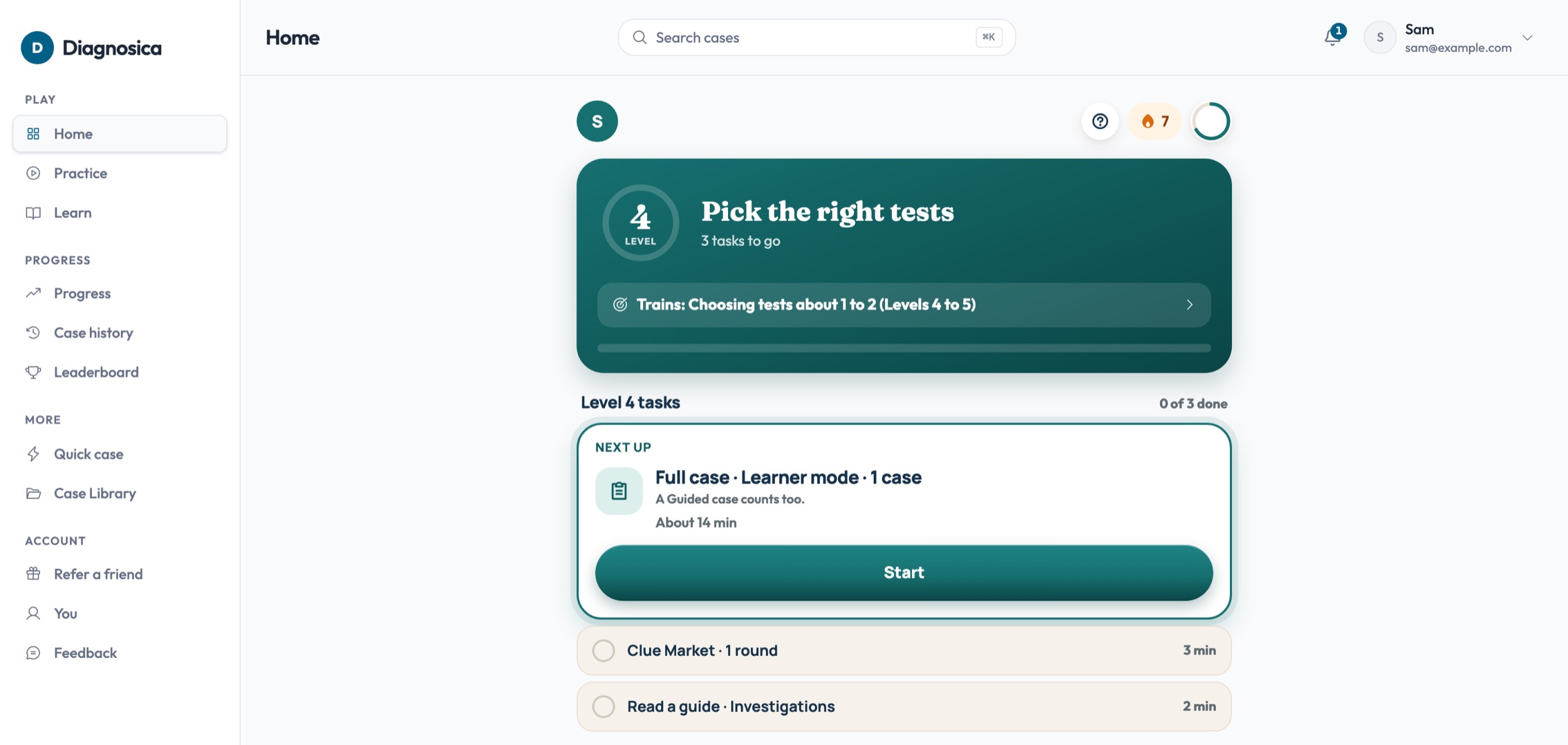
How it works
One case, start to scorecard.
Take the history, order the tests, commit to a diagnosis, get marked. Four steps, the same shape as a real encounter.
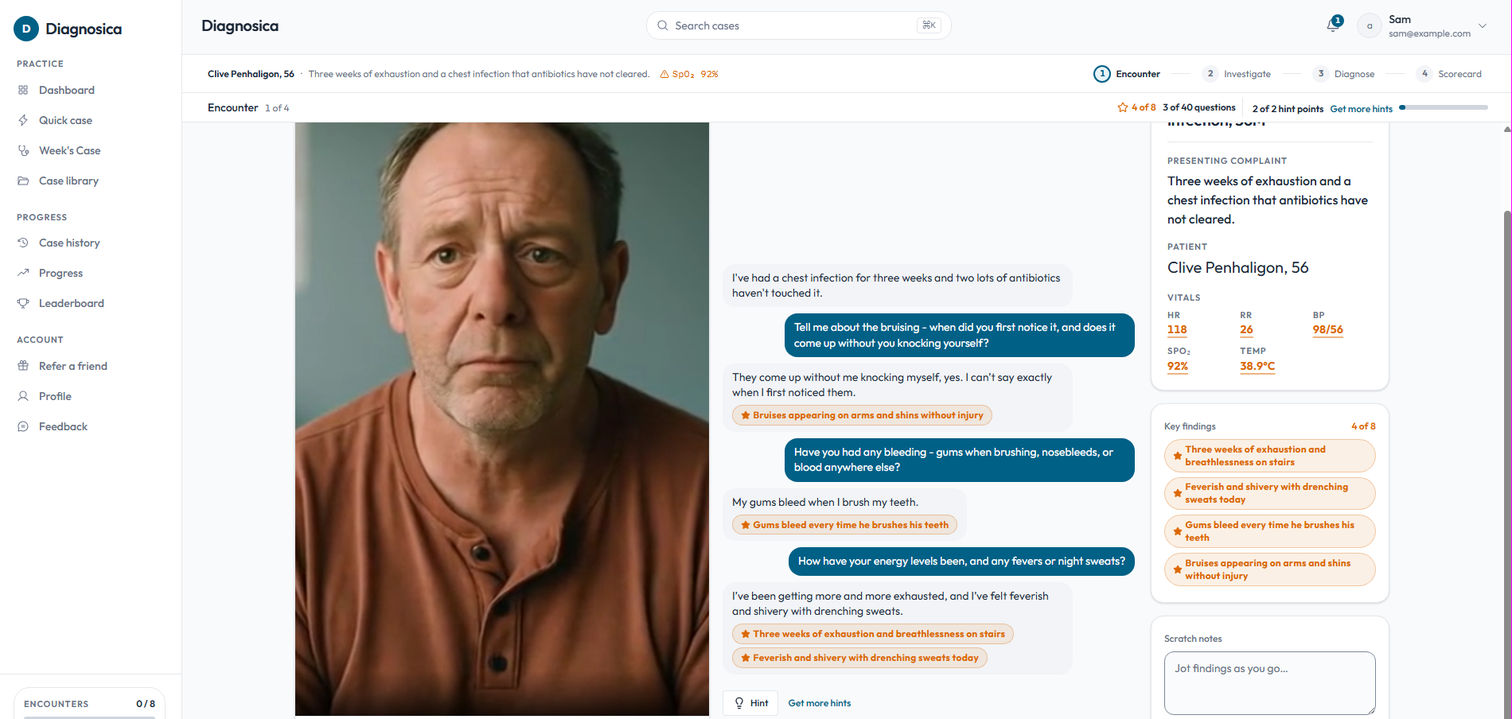
Take the history, in your own words.
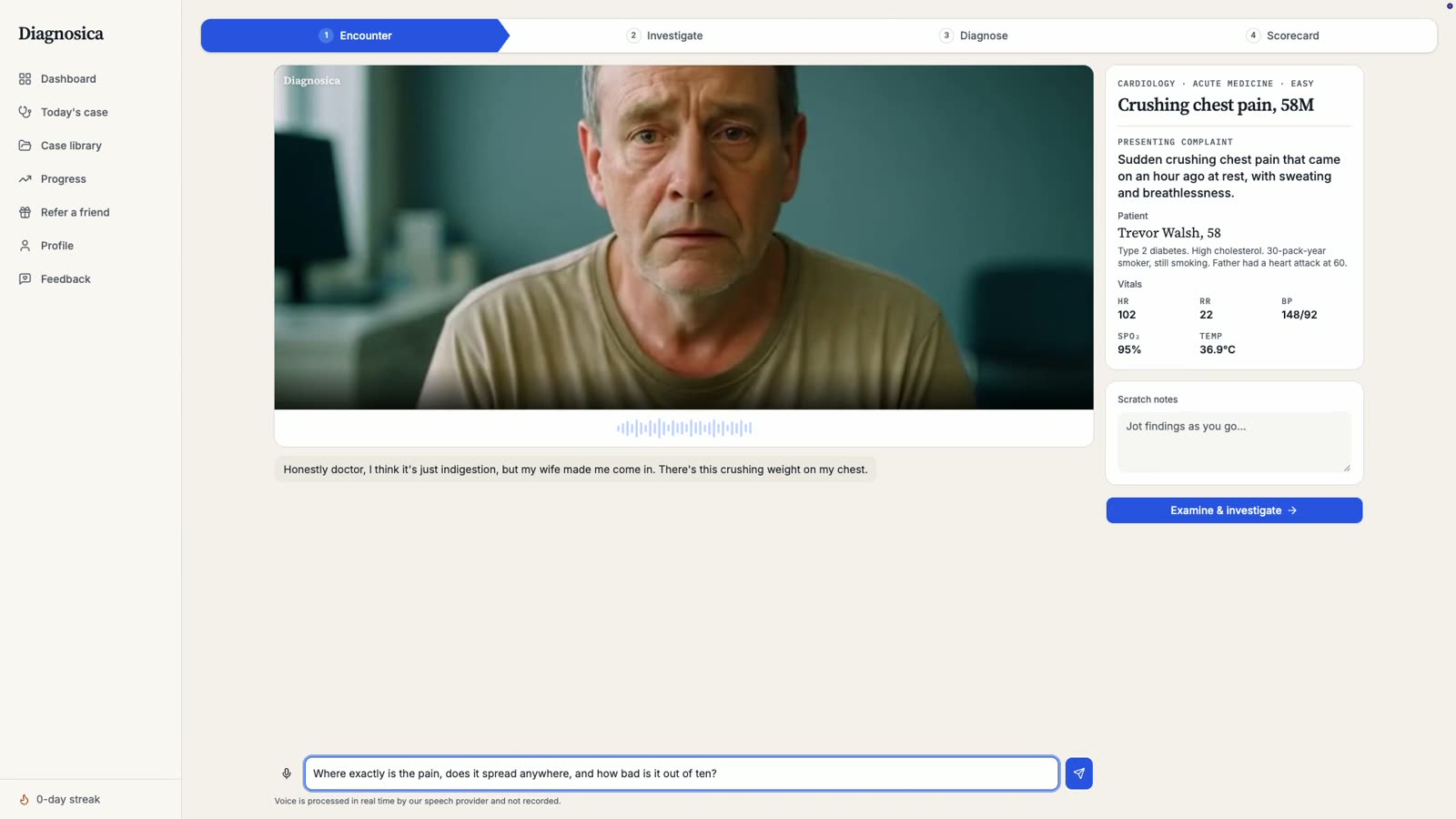
A real-feeling patient sits in a video tile. You ask by voice or by text, and they answer in their own words without volunteering what you forgot to ask. Key findings light up as you uncover them, the vitals are one tap away, and a hint is there if you get stuck.
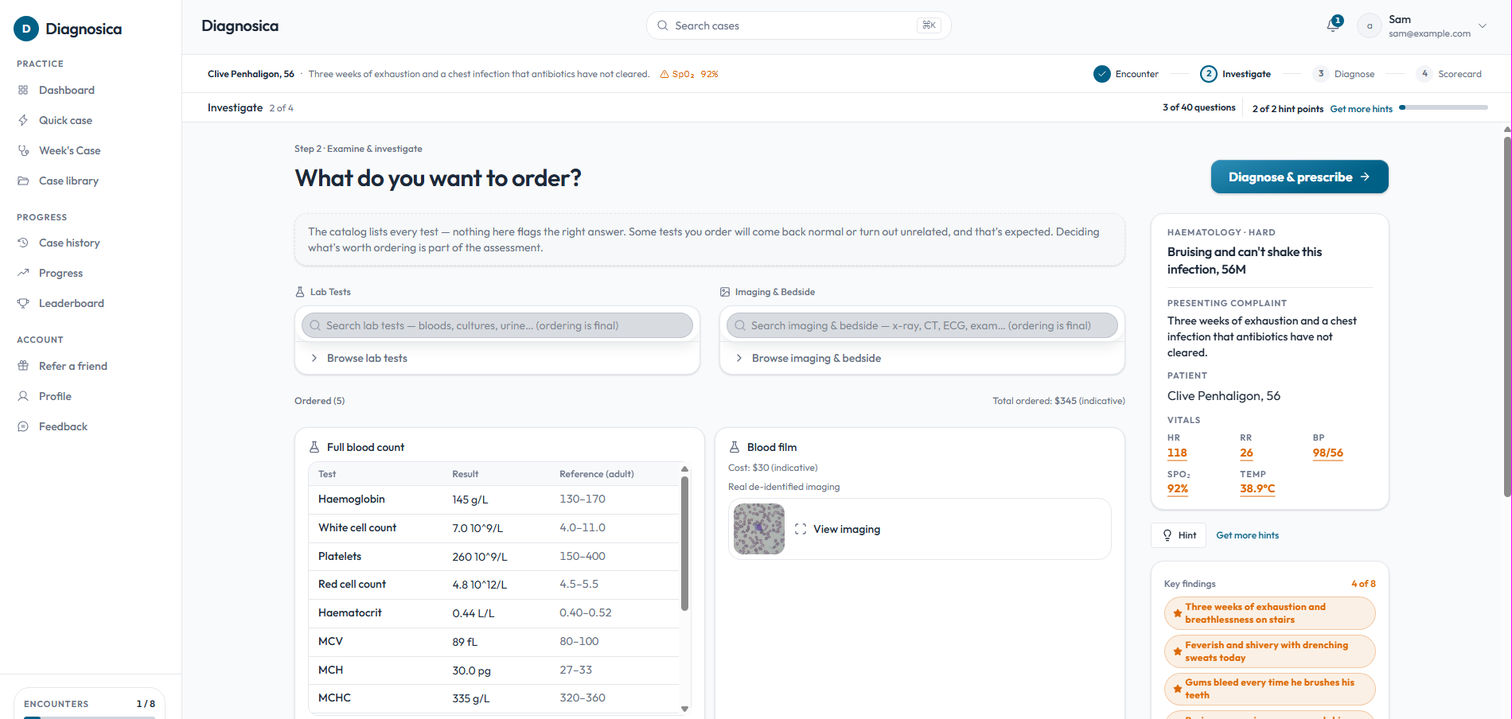
Order the tests. Read what comes back.
Search more than 300 labs and 360 imaging and bedside studies and order what you need. Nothing tells you which ones matter, and you are judged on what you spend. Results come back with abnormal values flagged, and real, de-identified images open full screen for you to read.
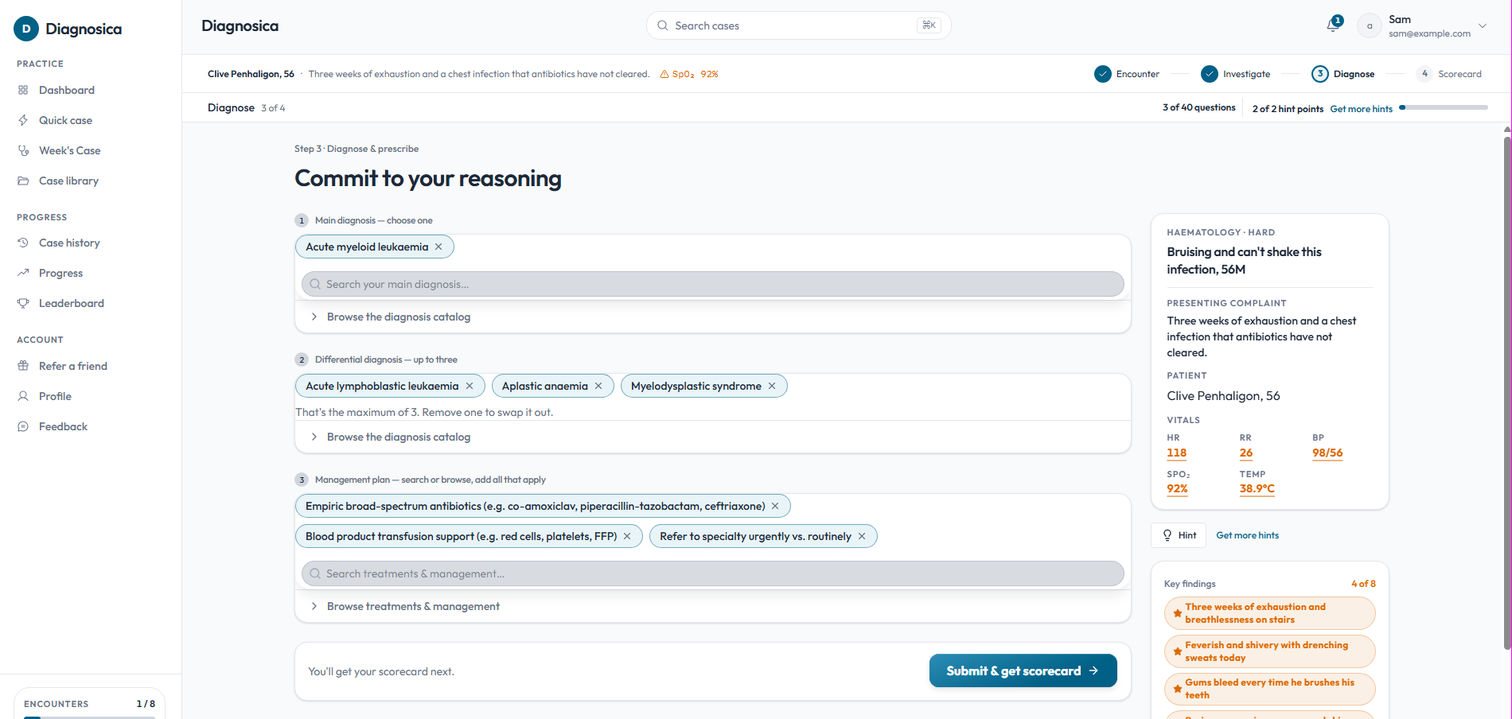
Commit to a diagnosis and a plan.
Put your working diagnosis, your differentials, and a management plan on the line before anyone tells you the answer. Committing is the point: it is the difference between watching a case and running one.
When you wrap up, the rubric shows you what you missed.
A score out of 100 across history, investigations, diagnosis and management, 25 points each. Every line says what you earned and what you missed, and a study guide and your next patient are waiting underneath. Points, badges and your streak count up too.
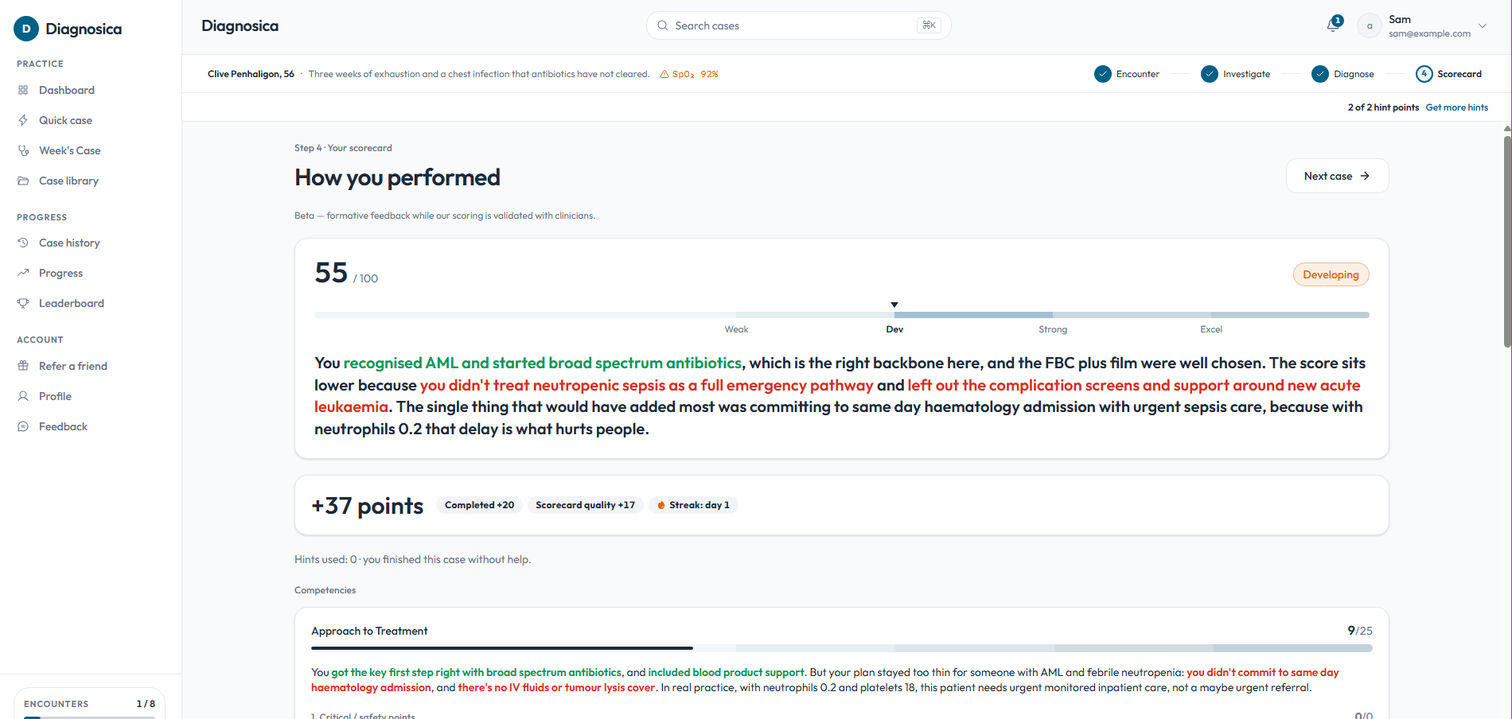
Ranked alongside everyone at your stage of training, anywhere in the world. Overall, and broken out by specialty.
LEADERBOARD · THIS WEEK
Who’s putting in the reps.
Overall
1,712 trainees this week
#
Trainee
Avg
Cases
#1
Dr Hannah
UK · IM
9.4
11
#2
Dr Praveen
IN · IM
9.2
14
#3
Dr Sara
US · GP
9.1
8
#4
Dr Felipe
BR · IM
9.0
10
#5
Dr Eleni
GR · Surgery
9.0
9
#6
Dr Akari
JP · Peds
8.9
12
#7
Dr Kofi
GH · EM
8.8
11
#243
Dr Aisha
YouUK · IM
6.8
9
By specialty
#1
Dr Hannah
UK · IM
9.4
11
#2
Dr Praveen
IN · IM
9.2
14
#3
Dr Felipe
BR · IM
9.0
10
#4
Dr Wilhelmina
DE · IM
8.7
13
#5
Dr Tomas
CZ · IM
8.6
12
#14
Dr Aisha
YouUK · IM
6.8
9
96 trainees in Internal Medicine this week.
The four screens above are real captures from the app, taken with a demo account. The leaderboard is illustrative.
Watch a full case
The whole thing, start to scorecard.
About a minute through one real case, so you can see exactly how it plays before you start your own.
Who trains here
Same patients, different stages of training.
Pre-clinical student
Years 1 and 2, before the wards

You are learning the conditions from lectures and books. A two-minute quick case between lectures, a guided case when you have fifteen minutes, and the shape of a real consultation becomes familiar long before your first placement.
"Clinical skills sessions come round once a fortnight. I want more practice than that."
Start a case freeClinical student
Clinical years, anywhere in the world
You have read the conditions. You have barely said them out loud to a patient. Take a couple of full histories a week, in the gaps between placements, until the words come without thinking.
"I've been in lectures for two years. I need to start talking to patients."
Start a case freeNew doctor
Foundation · Intern · House Officer · JMO

One case before the shift, one after. The same conversations you will have for real next week, run enough times that the real one is just another rep.
"First on-call is in three weeks. I want to have these conversations a hundred times before the real one."
Start a case freeWhat’s behind the cases
Real cases. Honest feedback.
No invented experts and no fake reviews. Just real clinical cases, and a scorecard that is honest about being AI while we validate it with clinicians.
136
Real clinical cases
Every case is built from a real presentation and current clinical guidelines, across specialties and difficulty.
Scoring you can learn from
Your scorecard is AI feedback, marked while we validate the scoring with clinicians. It shows you the gaps, it does not certify you.
Kept current
Each case is versioned. When guidance moves or a reviewer spots something, the case is corrected, not left to drift.
Every case is marked against the core clinical competencies you are assessed on.
More on the way.
History taking
Investigations
Diagnosis
Management
The alternatives
You’ve had three ways to practise.
Now there’s a fourth.
The question bank
Reading another vignette is not the same as saying it out loud. You know the theory. The words still come out wrong the first ten times.
Reading, not talking
Role-play with a friend
Needs a willing friend, a free evening, and someone who can actually mark you. Most weeks you get none of the three.
Scheduling, no scoring
Wait for the wards
Real patients are the best teachers and the scarcest. The registrar takes over, the shift ends, and the reps go to someone more senior.
Slow, high stakes
Your AI patient
A patient who answers back, any hour, marked against the rubric when you wrap up. Get it wrong safely, then try again.
Live now · free tier
Try the live demoThe detail, feature by feature.
The shape of the problem is, “I need to say it out loud and have someone respond.” The shape of most existing products is, “read another vignette.”
CAPABILITY
Diagnosica
Pastest
Geeky Medics
AMBOSS LiSA
Voice-first practice (you speak, the patient answers)
Video patient avatar
Rubric scoring after every case
Available at any hour without booking
International postgrad exam coverage
Specialty + body-system + difficulty browse
Leaderboards across specialty and country
Physical examination practice
Out of scope for any voice product. Stay with real patients and tutors.
Comparison reflects publicly visible product capabilities as of May 2026. Pastest, Geeky Medics, and AMBOSS are independent companies; this is not a competitive endorsement of Diagnosica by any of them.
Pricing
Two tiers. Simple pricing while we’re early.
Start on Free without a card. Upgrade when three cases a week stop being enough.
Free
$0
forever
5 cases your first week, then 3 a week
Unlimited 2-minute quick cases
Full scorecard after each case
Public leaderboards
No card required
Standard
$14.99
per month
50 full cases a month
Full scoring after every case
All specialties and body systems
120 voice minutes a month
Or $119.99/year
Pricing shown in USD; you’re billed in your local currency at checkout, with tax added where it applies. UK cards pay £14.99 a month or £129.99 a year. Cancel any time from your profile. Quick cases are unlimited on every plan.
FAQ
Questions we get a lot.
Four steps, in the order a real encounter runs. You take a history from a patient who answers in their own words and does not volunteer the thing you forgot to ask. You order the labs and imaging you want, from the full catalogue, and read what comes back. You commit to a main diagnosis, your differentials and a management plan. Then you get marked. Around 15 to 20 minutes end to end.
Across four areas worth 25 points each: history taking, investigations, diagnosis and management. You get a score out of 100, a breakdown by area, and a line on the single thing that would have moved your score most. It is labelled formative for a reason: the scoring is AI feedback while we validate it with clinicians, so treat it as a training signal, not a result.
It helps with the part of an exam that is a conversation with a patient and a decision you have to commit to, which is the part most people get least practice at. It is not an exam simulator, it does not predict a mark, and it is not affiliated with any exam board. If you want question banks and mark schemes, keep using those; this is the reps you cannot get from reading.
Yes, and without a card. Free gives you 5 full cases in your first week, then 3 a week, each with a full scorecard, plus as many two-minute quick cases as you like. Standard is US$14.99 a month or US$119.99 a year for 50 full cases and 120 voice minutes a month; UK cards pay £14.99 a month or £129.99 a year. The annual plan starts with a 14-day free trial, and a 3-month plan (US$34.99 / £34.99) is one payment that never renews. Cancel any time from your profile. Every plan is listed at diagnosica.com/pricing.
Because we would have to fake them. A simulator cannot fairly reproduce a heart murmur, a tender abdomen or a subtle neurological sign, and pretending otherwise would teach you to trust a signal that is not there. Examination stays with real patients and real tutors. We would rather be short a feature than wrong about one.
They are yours. We never accept real-patient identifiers, and the cases are written, not drawn from anyone’s records. UK GDPR and the equivalent regional rules apply. Deleting your account removes them, without being asked why.
Yes. Diagnosica runs in any browser and there are native apps on iPhone and Android. Your cases, streak and progress are the same account on all of them, so a case you start on a laptop is waiting on your phone.
Get started
It’s live. Run your first case tonight.
No demo call, and no card to start. Sign up, pick a case, and you are talking to a patient within a couple of minutes.
Or take it with you. Diagnosica runs on iPhone and Android.