A&E tips for FY1s: the clinical half nobody writes
What does an FY1 actually do in A&E?
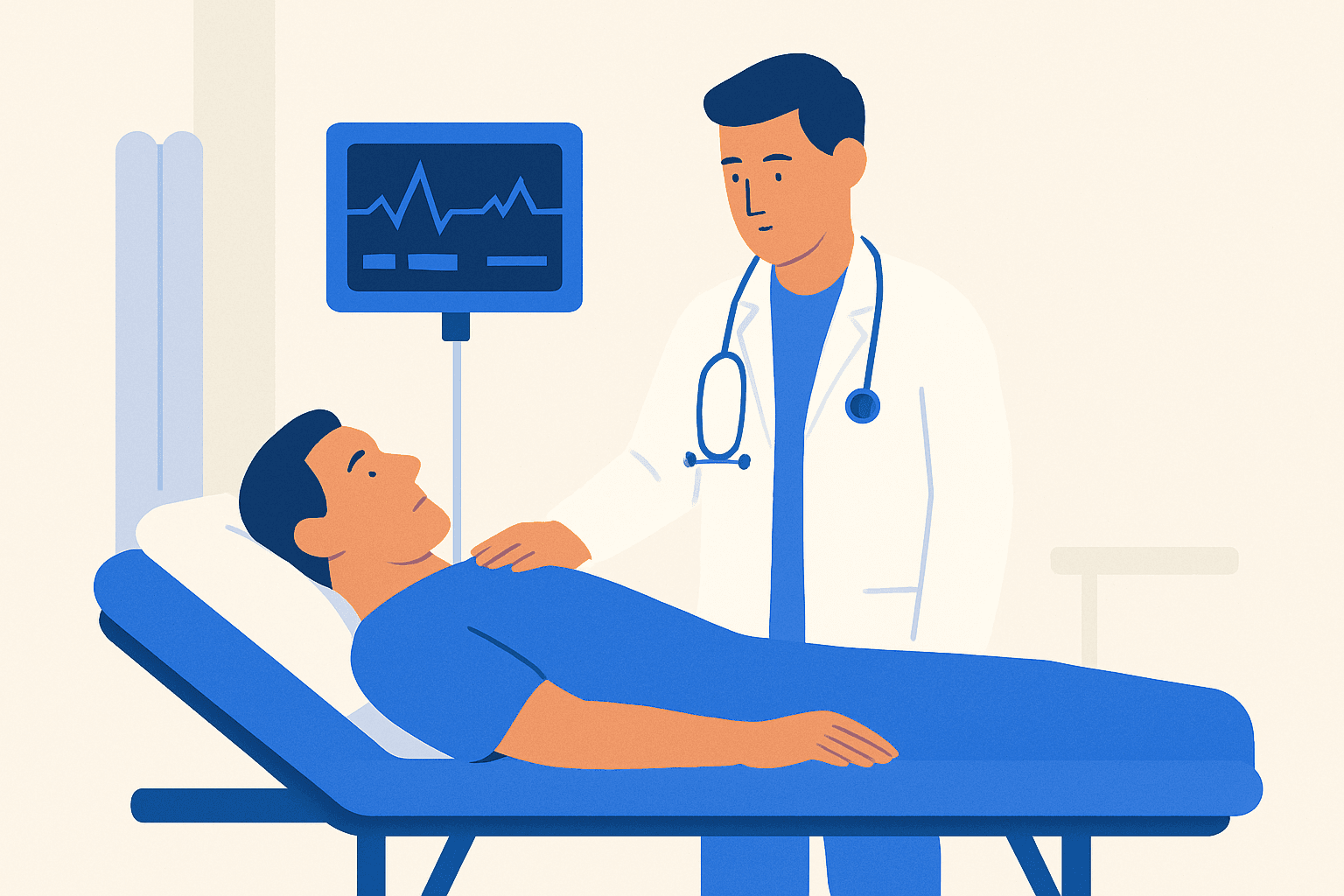
An FY1 in A&E sees undifferentiated patients, takes a focused history, orders initial investigations, builds a working differential and presents to a senior who confirms or redirects the plan. You'll start the work-up, document clearly, and escalate when you're unsure.
You'll mostly sit in ambulatory care and majors, sometimes help in resus, with minors usually covered by emergency nurse practitioners, and whether you're supernumerary or on the rota varies by trust and rotation. That's straight from Mind The Bleep's specialty guide, which also repeats the point to escalate early and often: seniors are there to sanity check decisions.
You're not here for hydration tips. This post tackles the bit people avoid, the clinical half, so we'll focus on first five minutes with an undifferentiated patient, worst first thinking, the one question patients don't volunteer, and how to present to the registrar. It sits alongside the wider series in the FY1 pillar, see the FY1 survival hub.
The first five minutes with an undifferentiated patient
If one of these A&E tips for FY1s sticks, make it this: decide sick or not sick before the story, and frame everything with the ABCDE approach. Act on airway or breathing threats before chronology or red flags.
Every case below is an AI patient from the Diagnosica library, not a real person.
Worked example from the library: Jamie Ellison, 28. Known nut allergy with only mild hives before. Within minutes of dessert, widespread itchy hives and flushing, swollen lips and tongue, throat tight with a hoarse voice, chest tight and whistly, feels faint. Vitals on arrival: HR 124, RR 28, BP 86/52, SpO2 91%. Opening line: "I've suddenly swollen up and I can't catch my breath right after eating." Sick. Airway risk, breathing failing, shock physiology.
This is the patient you hand to a senior immediately. You don't take a full history first. Get help now and run ABCDE with life threatening problems treated first, then reassess. Treatment detail sits with national guidance, use Resus Council UK guidance.
Worst-first thinking: back pain and a blackout
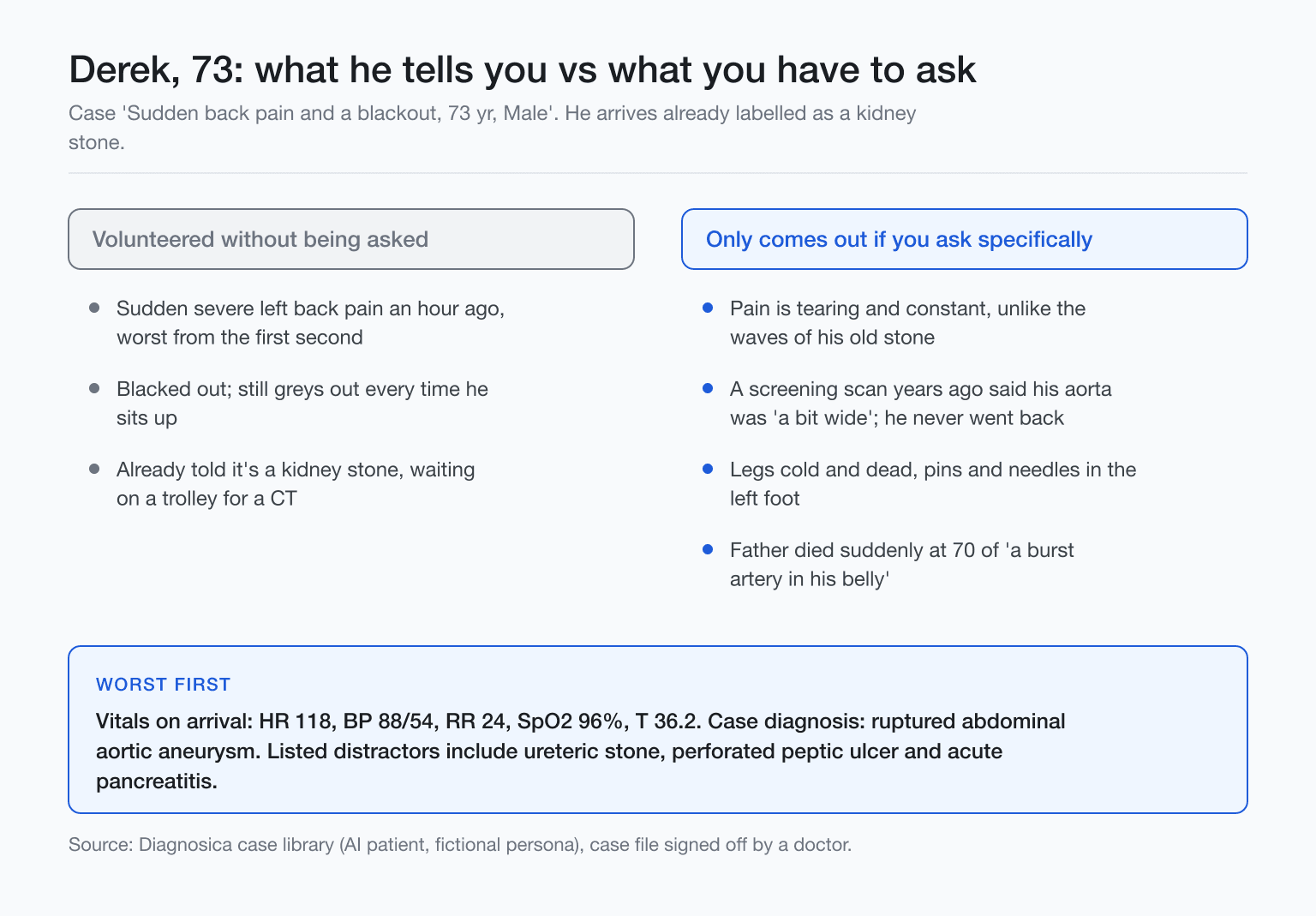
Start with worst-first. With undifferentiated back pain plus a collapse, think ruptured abdominal aortic aneurysm before a ureteric stone, even if triage has already labelled it.
In a Diagnosica case, Derek Aldridge, 73: "I got a pain in my back getting out of the car and the next thing I was on the floor." Vitals: HR 118, RR 24, BP 88/54, SpO2 96 percent, T 36.2. He's been told it's a kidney stone, awaiting CT on a trolley.
Pain maximal from the first second, tearing and constant, overturns that label and points to a vascular catastrophe, not an obstructing stone. Collapse plus back pain signals bleeding. He lies very still, not rolling like with his prior stone.
Years ago, screening found his aorta "a bit wide," and he skipped the repeat; men are invited for the NHS screening programme in the year they turn 65 in England. His legs are cold and dead with pins and needles in the left foot. His father died at 70 of "a burst artery in his belly."
Case diagnosis, ruptured abdominal aortic aneurysm, with distractors including ureteric stone and aortic dissection. If you keep getting bitten by triage labels, scan through classic diagnoses that hide.
Breathless with chest pain: holding three diagnoses open
The move that saves time in A&E is to hold acute coronary syndrome, pulmonary embolism and pneumothorax open at once, and force your history to try to falsify each.
In the Diagnosica library case, Martin Rowe, 55, says, "I've suddenly gone short of breath with chest pain over the last two days." Vitals on arrival: HR 112, RR 24, BP 120/78, SpO2 91 percent, T 37.1.
He volunteers a sudden sharp right-sided chest pain two days ago, worse on a deep breath, with sudden breathlessness. He's worried it's a heart attack. Keep all three open anyway.
When you ask directly, out comes a long-haul flight from Australia about five days ago, keyhole knee surgery three weeks ago, and less mobility since. Only on a specific question: streaks of blood in his spit twice, and a left calf that's swollen, tight and tender for a week. The pain is not heavy, central or crushing. His breathing has worsened over the last few hours.
For the diagnostic pathway on suspected DVT and PE in adults, follow your local policy and see NICE guideline NG158.
You can take Martin's history as an AI patient now, pressure free, and see what you'd have missed, here: take Martin's history yourself.
The history question patients won't volunteer
Some patients will leave out the one fact that explains everything. Ask it outright, early: since you became unwell, what have you done with your regular medicines.
Worked example from the library: Ryan Docherty, 24, type 1 diabetes since 14, on insulin. He opens with, "I've been really thirsty and breathless for the last day or two," labels it a bad stomach bug with flu-like symptoms and a sore throat, and volunteers extreme thirst, passing large volumes of urine for two days, repeated vomiting, can't keep fluids down. Vitals: HR 118, RR 30, BP 104 over 64, SpO2 98 percent, T 37.4.
He's very drowsy with deep sighing breathing. His girlfriend says his breath smells sweet and fruity like pear drops.
Only when asked directly does he say he stopped his insulin two to three days ago because he wasn't eating and felt too sick. Nobody ever told him what to do with insulin when ill. That flips the frame from his stomach bug label to diabetic ketoacidosis versus lookalikes like hyperosmolar hyperglycaemic state, sepsis or salicylate overdose. The case's diagnosis is diabetic ketoacidosis.
How do you present a patient to the A&E registrar?
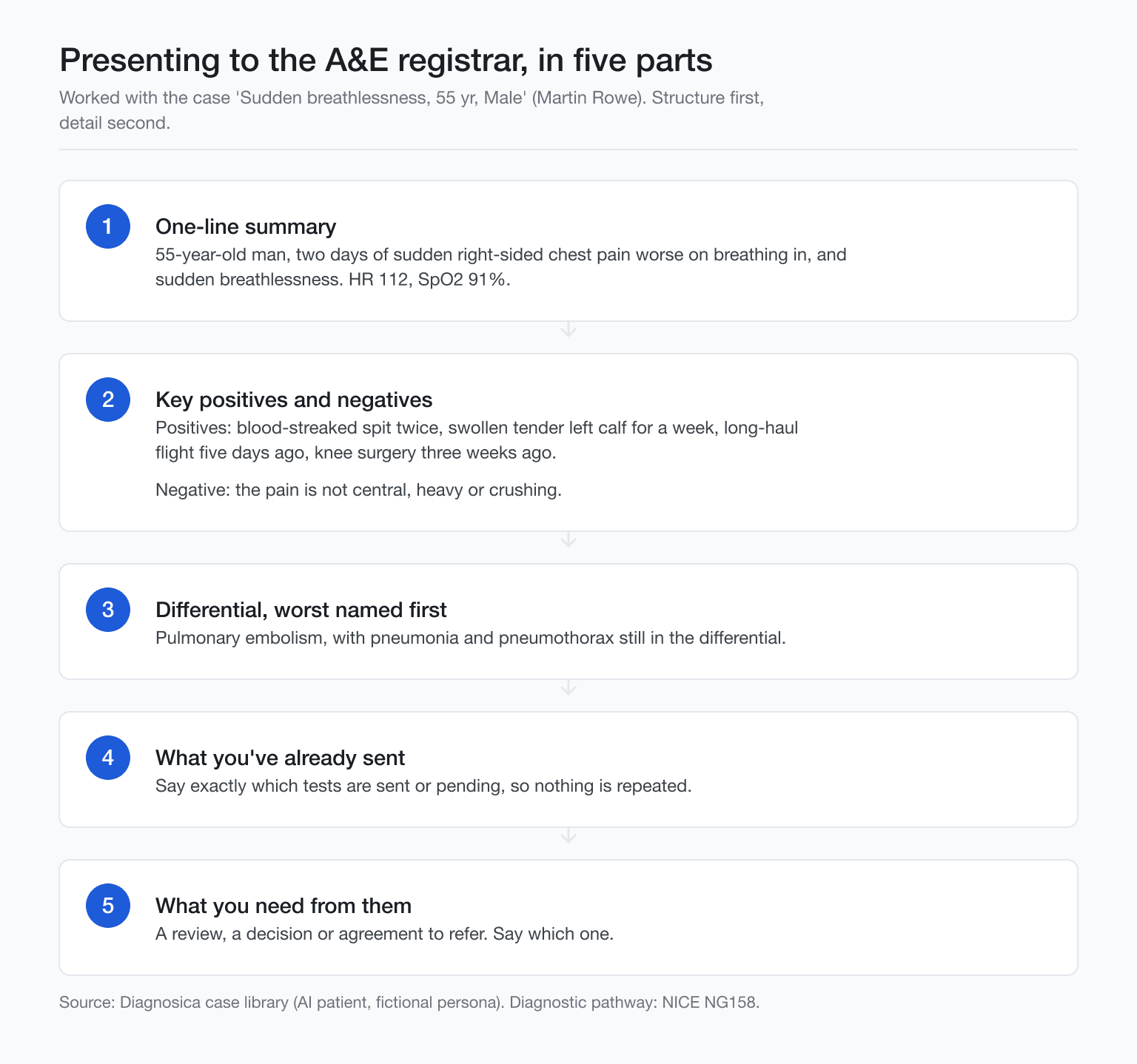
Lead with a one-liner: age, key complaint, and how unwell. Then give key positives and must-have negatives. State your differential and name the worst one. Say what you've already sent or started, and end with what you want from them, a decision, a review, or a referral.
A&E presentations are tighter than ward rounds, and you should front-load your worry. If you want the longer structure used on inpatient reviews, see the ward-round version.
For Martin Rowe, your one-liner could be: 55-year-old man, 2 days of sudden pleuritic right-sided chest pain and breathlessness, tachycardic 112, RR 24, SpO2 91%. Recent long-haul flight and knee arthroscopy, swollen tender left calf, and two episodes of blood-streaked sputum. Pain not crushing. I'm worried about pulmonary embolism, with pneumonia or pneumothorax in the differential. Initial investigations sent and monitoring started. Can you review for a decision on imaging and onward plan?
Referring, discharging and safety-netting
Write the senior discussion in the notes, every time. Name and grade, time, how you contacted them, what was agreed, what to watch, and any plan B. Mind The Bleep advises documenting thoroughly and escalating when unsure, which saves pain later.
Order targeted tests that answer a question. Decide what you are trying to confirm or exclude, then pick the minimum investigations that move you. Skip the reflex full panel.
Safety-netting means the patient leaves knowing what would make them come back, when to seek help, and who to contact. Local trust policy governs who can discharge.
Referral calls go better when you use the presentation structure above.
Surviving the A&E rota
Emergency medicine rotas can be punishing, and feeling tired is normal, as Mind The Bleep points out. Seniors are there to check decisions, so you're not meant to white-knuckle it alone.
Take your breaks, and say when you're stepping off the floor.
On nights, know who to call, how to escalate, and where to find them fast. If you've not done nights before, read first nights as an FY1.
Your pager will chirp at the worst moment. Acknowledge, prioritise, and close the loop. If it's relentless, see handling a bleep well.
How do you prepare before your A&E block?
Rehearse undifferentiated presentations before you meet them. Speak out loud, practise a worst first screen and a tight registrar handover. Read your trust induction and the national guidance you'll be using. You're aiming for pattern recognition plus a safe opener, not a script you can't flex inside a real department.
Diagnosica is one way to rehearse before a shift. An AI patient appears on screen as a video avatar. You talk or type, order investigations, commit to a diagnosis and plan, and get a scorecard. The four cases in this post are in the library, each written and signed off by a doctor.
There are over 130 cases across 18 specialties. The quick case takes two minutes: one line from the patient and five clues, one by one. You guess after each, then see the answer and a one line teaching point. It keeps a daily streak going.
It won't teach physical examination or the feel of a busy department. "It doesn't give advice about real patients, and it's not a diagnostic system. Treat every output as educational."
If you want to try it, you can start a case free. There's a free tier with no card, on iPhone, Android or web.