Neurology Rotation Tips: Think in Time Course, Not Tracts
What do attendings actually want from a student on neurology?
They want you to say where the lesion probably is, what it probably is, and how fast it arrived, in that order. Keep it short, commit, and flag danger. If it sounds time critical, escalate early and tell a senior now. Don't hedge when safety is on the line.
Per the AAN's student advice, "neurology is a very logical discipline that emphasizes first localizing the lesion based on the clinical history and physical exam, and then determining the most likely diagnosis"; it notes most neurology clerkships last four weeks, with some two or three and a few longer.
Osmosis puts it as "localization first, diagnosis second," and says you're there in emergencies to recognize them early, communicate concerns, and alert the team. See Osmosis's neurology guide.
Our add, aimed at a student under time pressure, is to lead with time course from the history. Sudden, days, weeks, months. This post works that idea through fictional AI patients from a case library.
For year-wide habits, see your clerkship year basics.
Time course is the first question to ask
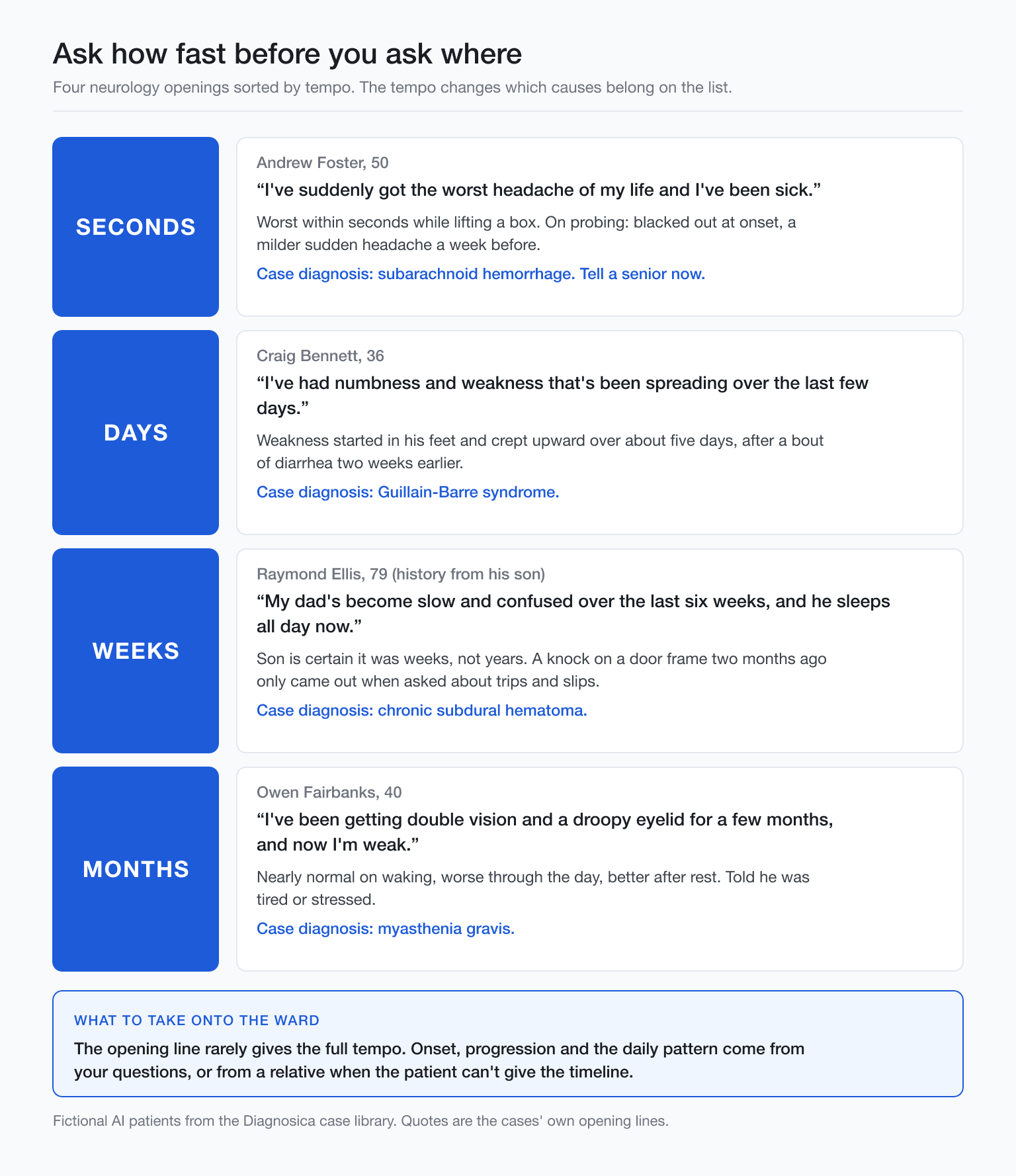
- Seconds: "I've suddenly got the worst headache of my life and I've been sick." Andrew, 50: it peaked within seconds while lifting a heavy box, a hyperacute pattern that points to instant causes, not ones that build over days or months.
- Days: "I've had numbness and weakness that's been spreading over the last few days." Craig Bennett, 36, had weakness starting in the feet and ascending over about five days, a tempo that fits Guillain-Barre over CIDP.
- Weeks: "My dad's become slow and confused over the last six weeks, and he sleeps all day now." Raymond Ellis, 79: his son insists it’s weeks, not years, after the family was told it was “his dementia coming on.” Cognitive decline over weeks is structural until a CT head proves otherwise.
- Months: "I've been getting double vision and a droopy eyelid for a few months, and now I'm weak." Owen Fairbanks, 40, wakes nearly normal, worsens through the day, and improves with rest, a months long fluctuating course that points to fatigability, not steady deterioration.
These are fictional AI patients from a case library. The opening line rarely gives the full tempo. You'll still need onset, progression and daily pattern with open and closed questions, and collateral history when the patient can't supply the timeline.
The headache history you'll take every day
On a neurology clerkship, you’ll take headache histories daily.
Two fictional AI patients from a case library show the split cleanly.
Ryan Bennett, 30, says, “I keep getting these really bad headaches every few weeks.” Two years of one-sided, throbbing pain with 20 minutes of zig-zag visual lines that clear completely. Builds over an hour, never in an instant. Teaching point here, a build over an hour, never thunderclap, excludes subarachnoid hemorrhage.
Andrew, 50, had worst pain within seconds while lifting, back of the head, vomited at onset, stiff neck, and light hurts his eyes. On probing, he briefly blacked out as it hit, had a similar milder sudden headache a week earlier, a maternal aunt with an aneurysm, ongoing drowsiness, and he’s never had migraines. The differential his case lists, intracerebral hemorrhage, ischemic stroke, meningitis, migraine.
Ask these, in this order:
- Onset speed.
- Worst ever or different from usual.
- Blackout at onset.
- A similar milder sudden headache before.
- Neck stiffness and light sensitivity.
- Drowsiness.
- Past headache pattern.
If a patient says seconds to worst, your job is to tell a senior now, nothing more. For a worked example, see the full SAH case.
Practice both headache histories.
Weakness: the history questions that narrow it before you touch the patient
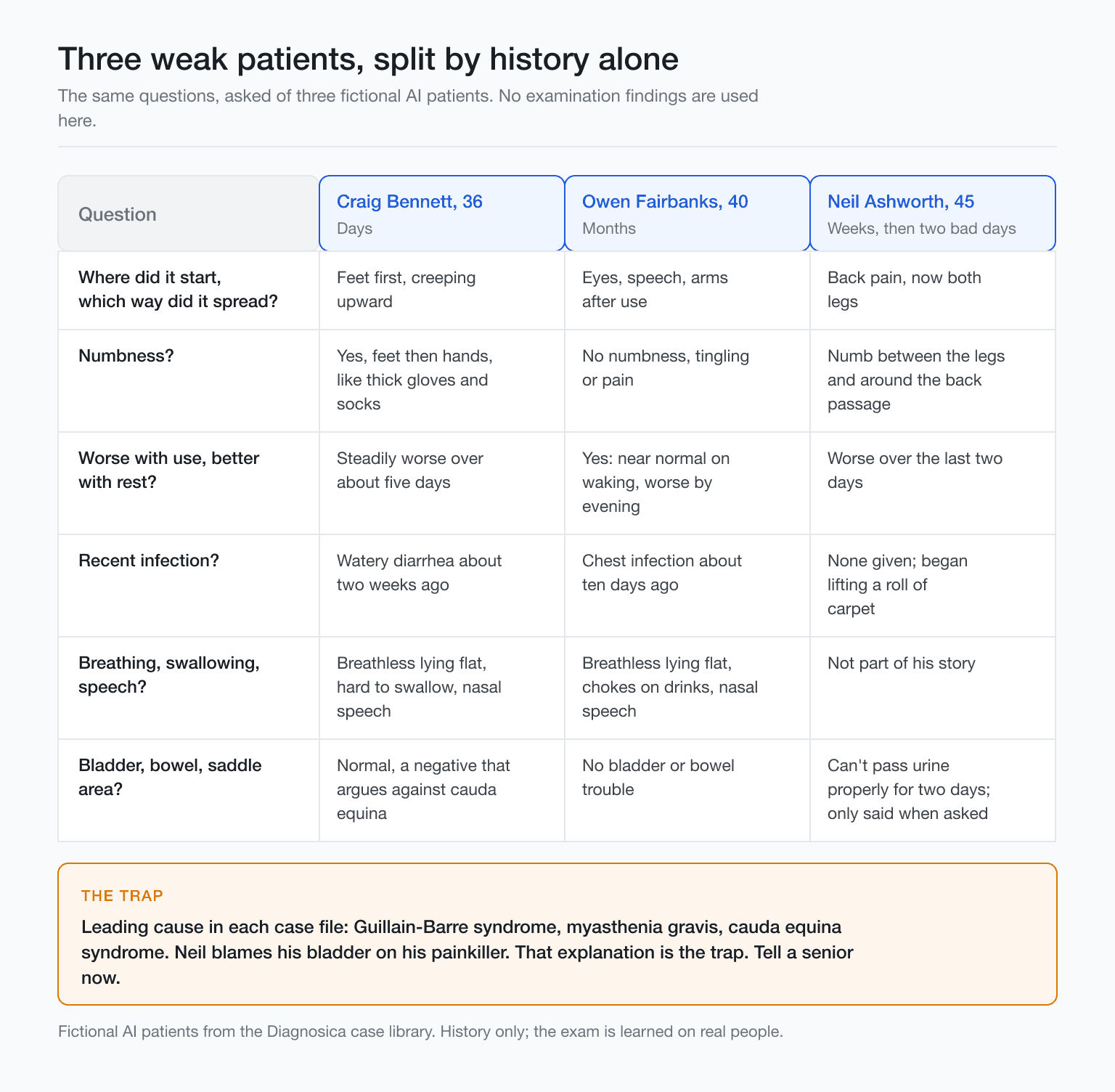
Organize weakness by time course and a few focused questions, and it splits fast on history; three fictional AI patients from a case library show how far you can get on questions alone.
Craig’s story runs in days. Tingling in feet then hands like thick socks and gloves, legs weak from the feet upward, a gut bug about two weeks earlier, short of breath lying flat, swallow effortful, speech slurred and nasal. No bladder or bowel loss, and normal feeling around his bottom and groin, the negatives that rule things out for cauda equina.
Owen’s story runs in months. Weakness that worsens with use and recovers with rest, voice goes nasal the longer he talks, has choked on drinks, got worse after a chest infection about ten days ago. No numbness or pain, which keeps this a pure motor problem and makes Guillain-Barre less likely by history alone.
Ask these, in order, when someone says “I feel weak.”
- Which part weakened first, and which way did it spread.
- Numbness or not.
- Does it get worse with use, and recover with rest.
- Any recent gut or chest infection.
- Breathing lying flat, swallowing, speech.
- Bladder, bowel, and saddle sensation.
- Erections, in men.
Neil is the trap. He volunteers, “I hurt my back a few weeks ago and now both my legs have gone weak,” and blames new urinary trouble on codeine. Only if you ask do you get numbness between his legs, two days of not passing urine properly, no sense of bladder filling, and new erection problems. That is cauda equina by history. Tell a senior now. For a worked example, see the cauda equina case.
How do you present a neuro patient on rounds?
Lead with a one line summary that includes age, tempo, pattern, broad localization, and your leading cause. Give two to four pertinent positives and negatives from the history and exam. State your assessment in one sentence, then your immediate plan in one sentence. Keep it under 90 seconds.
Osmosis’s structure fits neurology, and Osmosis's presentation advice explains under 90 seconds; Med School Insiders frames rounds as SOAP, so start with the standard rounds presentation and add tempo plus localization.
Craig Bennett, 36, five days of symmetrical weakness climbing from the feet with glove and stocking tingling, diarrhea two weeks earlier, now breathless lying flat and struggling to swallow, bladder and saddle sensation normal. The history suggests peripheral nerves, leading cause Guillain-Barre. I’d like a senior to see him now.
Raymond Ellis, 79, on warfarin, six weeks of slowing, confusion and sleepiness per his son, a right hand gone clumsy, and a minor head knock two months ago that surfaced only when asked about trips and slips. The history suggests a structural brain problem, leading cause chronic subdural hematoma against dementia and delirium. I’d like a senior to see him now.
The neuro exam: rehearse it on people
You learn the neuro exam on real people, with a resident watching and correcting. An app can't teach you to elicit signs, Diagnosica included; its fictional AI patients from a case library state findings as facts, so you can reason from them, not practice finding them.
Osmosis pushes a boring but high-yield rule, do the neuro exam exactly the same way every time until the sequence is second nature. Practice on every patient you see, even on other services.
Ask a resident to watch one full exam per day and give two or three notes. Repetition builds speed, and a fixed sequence saves you when you're busy on rounds.
Shelf studying and reading without burning out
You won’t cover everything on a clerkship that often lasts four weeks, per the AAN. So pick a small stack and stay consistent.
- Med School Insiders' clerkship guide calls the UWorld Step 2 CK QBank "the main study resource" for boards and the shelf, with Blueprints Neurology "a good companion," and lays out how to use both in its 2025 guide.
- Osmosis pushes 30 to 45 minute sessions, active recall like drawing localization diagrams from memory, then board-style questions. Each day, review the conditions you actually saw on the service.
- The Neurology Resident and Fellow Section’s first edition 2025 guide, the Neurology clerkship guide, is a free case-based reading list, 12 chapters, one per subspecialty. It’s a good way to assign yourself one focused case a night.
- If you’re neurology bound, Med School Insiders’ scheduling tip is, don’t put the rotation last. Aim for second or third of four quarters so you can still get letters and momentum.
Let the patients you saw that day pick tonight’s reading.
Practice the history before day one
Before your clerkship starts, run four histories with fictional AI patients, one that began in seconds, one over days, one where a relative reports weeks of change, and one with months of drift, training your ear for tempo.
Speak or type to an AI patient who appears as a video avatar, order investigations and see results and imaging, commit to a diagnosis and management plan, then see a scorecard with competency scores and teaching points. Free tier, no card needed. Over 130 cases across 18 specialties, every case written and signed off by a doctor. It doesn't give advice about real patients, and it's not a diagnostic system. Treat every output as educational.
There’s no physical examination practice, and every neurology patient in the library is a man. That’s a limitation, so don’t expect broad coverage of women’s neurologic presentations.
On your commute, use the two-minute quick case. The patient says one line, you get five clues one at a time, guess after each, then see the answer and a one-line teaching point. It keeps a daily streak on iPhone, Android and web.