Night Float Tips: Surviving and thinking clearly at 3am

What is night float, and why is it harder than days?
Night float is a block of consecutive overnight shifts where a small team, often one intern and one senior resident, covers patients they didn't admit and takes new admissions while the day teams are home. It's harder because staffing is skeleton, you don't know the patients, and problems arrive one page at a time with less backup.
This guide spends little time on sleep and snacks, because every other guide covers them, and most of its time on the first overnight calls you'll meet and what to have ready before you call your senior.
If you're in the UK, see the UK FY1 version and surviving UK foundation year.
Before your first night: sign-out you can act on, and what to pack
Start the night with sign-out you can use. A KevinMD guide by hospitalist Farzana Hoque, MD, July 2023, flags that the day intern is tired and may skip details, so listen closely and ask about the sickest patients even if no problem is mentioned.
For each high-risk patient, ask: what’s the worry tonight, and what would you want done if it happens?
Build a checkbox to-do list at sign-out and keep adding to it through the night. Include pending labs and imaging, review it every hour or two, and note every order you place so you can follow up, per the Student Doctor Network advice.
Packing is boring, and it helps. The same KevinMD guide, July 2023, recommends snacks from home, a blanket if the call room runs cold, and a portable charger.
If you’re sorting your setup for week one, see starting intern year. For timers, references, and calculators you’ll actually open, see apps residents keep handy.
The calls you'll get first, and how to think through each
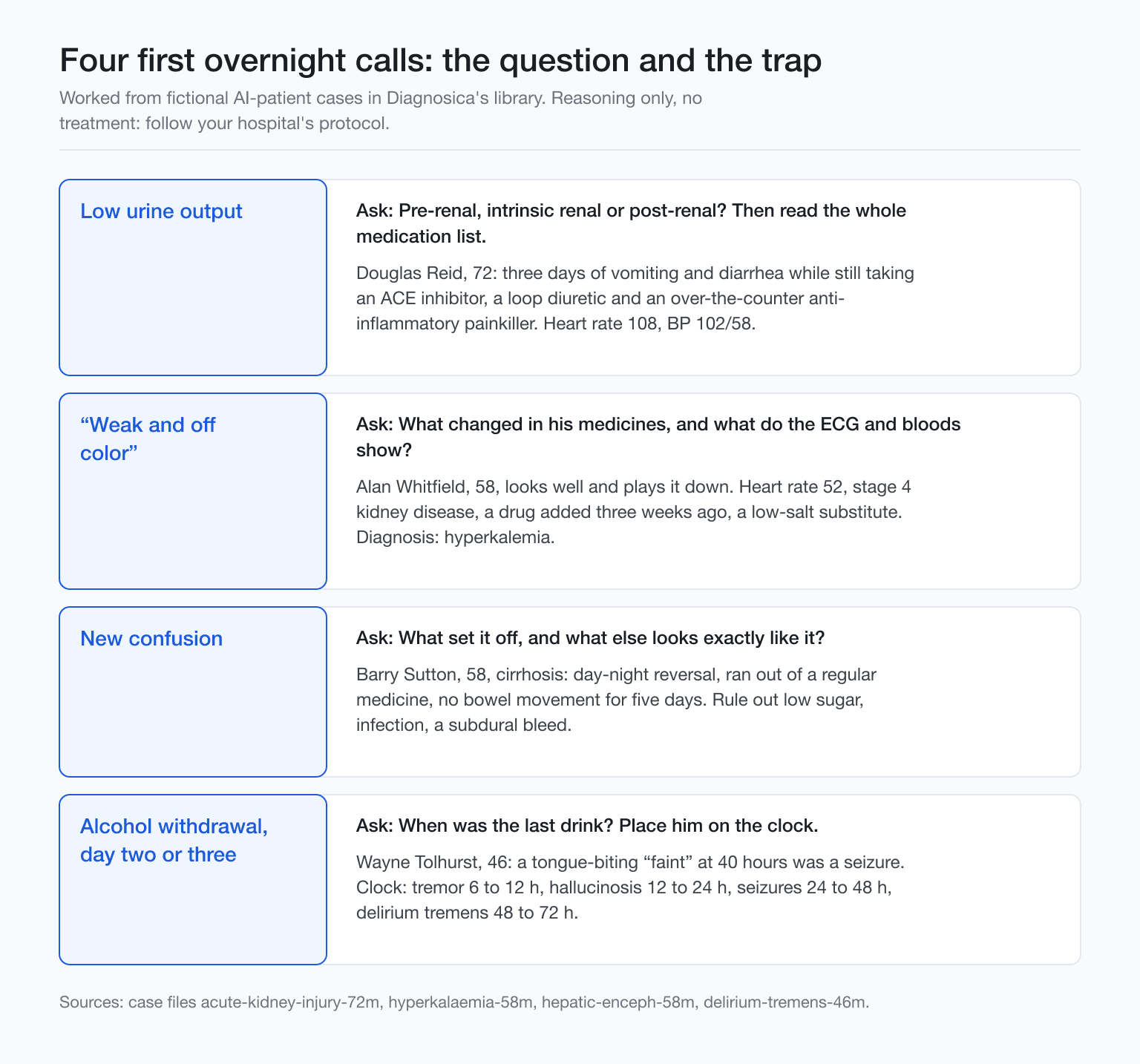
Student Doctor Network’s intern advice says to carry simple algorithms for fever, chest pain, low urine output, and tachycardia. Expect curveballs at 3 am. These four appear early, and match presentations that hide overnight.
The four patients below are fictional AI patients from Diagnosica's library, and every case is written and signed off by a doctor. These examples cover reasoning only, not treatment, and any treatment follows your hospital's protocol.
Low urine output
Think in three buckets, pre-renal from poor perfusion, intrinsic renal, and post-renal obstruction. Douglas Reid, 72, had three days of vomiting and diarrhea while taking an ACE inhibitor, a loop diuretic, and an over-the-counter anti-inflammatory painkiller. Heart rate 108, BP 102/58. A normal urinary stream argues against obstruction. Kidney labs were normal a few months earlier, so acute. Read the med list and ask about over-the-counter drugs.
A patient who feels weak and off color
Alan Whitfield, 58, says, 'I've just felt weak and off color the last day or two, I probably shouldn't have come,' and minimizes symptoms. Heart rate 52. Stage 4 kidney disease, an ACE inhibitor and a potassium-sparing diuretic, with a second potassium-sparing drug added three weeks earlier, plus an over-the-counter anti-inflammatory painkiller and a low-salt substitute. Hyperkalemia is the diagnosis, and the danger is invisible until the ECG and blood test.
New confusion
Barry Sutton, 58, with alcohol-related cirrhosis, is brought because 'he's got confused and drowsy over the last few days.' There’s day-night reversal, fluctuating confusion, and he ran out of one of his regular medicines a week ago, with no bowel movement for five days. He’s harder to rouse. Think hepatic encephalopathy, while ruling out low blood sugar, infection including spontaneous bacterial peritonitis, a subdural bleed, Wernicke's, and stroke.
The alcohol-withdrawal patient on day two or three
Wayne Tolhurst, 46, two days into admission shouts, 'Get them off, there's things crawling all over this bed.' Heart rate 124, BP 172/98. Drinks 10 to 12 cans of strong lager a day; had a tongue-biting faint at 40 hours that was a seizure; no day-one intake history. Withdrawal clock: tremor at 6 to 12 hours, hallucinosis at 12 to 24, seizures at 24 to 48, delirium tremens at 48 to 72. Don’t anchor, consider head injury, sepsis, low sugar, and liver encephalopathy.
Sick or not sick at 3am: what to look at before you decide
Start by seeing the patient. SDN's intern advice is blunt about nights, go see every patient you’re paged about, don’t ignore abnormal vital signs, especially the respiratory rate, and take nurses’ concerns seriously because they often know when something is wrong.
Build your own baseline early. Chen Zeigerson, DO, a family medicine PGY-3, checks her “watchers” at the start of the night to get a baseline for the sickest patients, “so that if they decompensate, I have a point of comparison” (a family medicine resident's night, August 2026).
Beware the patient who looks fine but isn’t. Alan Whitfield looked well with a heart rate of 52, which should still make you open the chart, pull the trend, and ask why tonight is different from 10 am.
Terence Havelock, 48, on a ward after six weeks of barely eating while drinking heavily, said “I’ve gone downhill since they started the feed,” and his numbers were heart rate 124, respiratory rate 28, oxygen saturation 91 percent, with new leg swelling and 4 kg gained on the ward; the case diagnosis is refeeding syndrome, which began within 72 hours of the feed starting.
Trend against the baseline you set, look at the numbers yourself, and ask what changed and when. If you want to rehearse the refeeding or withdrawal patient as an AI patient you can question by voice, question an AI patient tonight on Diagnosica.
When should you call your senior?
Call early whenever you're worried, unsure, or the patient is getting worse. The usual advice is a low threshold, but see the patient first so you can describe what you found, and have the story ready. If the patient is deteriorating, do not wait for every lab to result before you escalate.
Student Doctor Network says the threshold for calling your senior should be low, after you have laid eyes on the patient and can report what you saw.
A hospitalist writes in a hospitalist's KevinMD guide not to hesitate to wake your senior resident if you are uncertain, and that interns are not expected to lead rapid responses or codes.
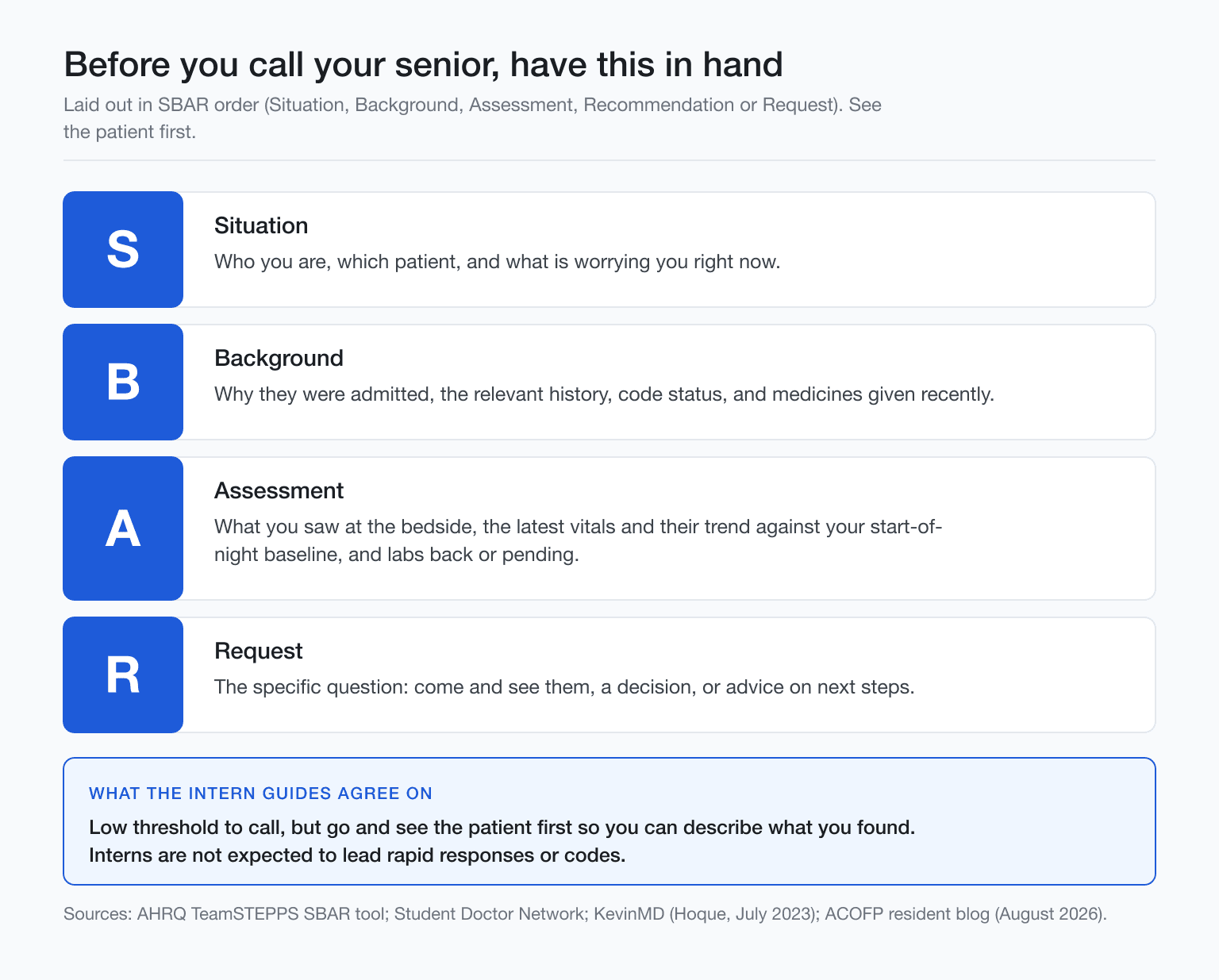
For structure, use AHRQ TeamSTEPPS SBAR, which is Situation, Background, Assessment, and Recommendation or Request. Start with AHRQ's SBAR tool.
- Latest vitals and the trend over time.
- What you saw at the bedside, in plain words.
- Relevant labs, both pending and back.
- Meds given recently, including time and response.
- Code status, confirmed in the chart.
- The specific question or decision you are asking for.
It is also fine to tell a nurse you are the night doctor and leave non-urgent decisions for the primary team, per SDN's intern advice.
Admitting overnight: a history that holds up at morning handoff
The admission history is what the day team inherits.
Start with alcohol. The withdrawal patient's real miss in the Wayne Tolhurst case happened on day one when nobody asked what he drank, so record quantity in units or cans.
Medications can be the whole story. In Alan Whitfield, the tipping points were a drug added three weeks earlier, the painkiller, and a low-salt substitute, all the things a hurried history skips, so capture the full list and any recent changes.
Anchor the problem to a baseline. Douglas Reid had normal kidney bloods a few months earlier, which turned "kidney failure" into an acute, recoverable problem once that context was known.
Pin down the timeline in plain words. First abnormal, first symptom, and why tonight.
SDN's advice for the note is plain and holds up: document what you saw, what you thought, and what you did. Then write a tight assessment and plan.
Sleep, food and the flip back to days: what published guides say
Anesthesiologist Alexandra Ruan, MD on KevinMD advises a quiet, dark, warm bedroom, limiting bright light and screens before bed, caffeine early in the shift with a cut near the end, and avoiding high fat and high sugar snacks that can make you sleepy. She also cites a 10 to 20 minute nap for a short alertness boost, taking a hospital taxi or rideshare voucher home rather than driving drowsy, and using days off after the block to shift back like jet lag, all in an anesthesiologist's seven tips.
An ACOFP family medicine resident describes her own routine, with a 30 to 90 minute nap the afternoon before the first night and blackout curtains for daytime sleep.
The NYU Bellevue interns’ write-up on Clinical Correlations went the other way on naps, reporting they skipped overnight naps to keep a consistent sleep schedule and favored small frequent snacks over big meals, in the NYU Bellevue night float routine.
A KevinMD hospitalist guide by Farzana Hoque, MD adds a simple cue when you wake, get outside into sunlight, which she says can lift mood and energy.
The guides disagree on naps and schedules, so pick the approach your program allows and that you can sustain. From what we can tell, even services within one hospital differ.
Rehearsing overnight presentations before you start
Use Diagnosica to rehearse the admits you’ll see overnight. It doesn’t simulate a pager or nurse calls for cross-cover, cases are new presentations where an AI patient tells their own story, and it can’t teach physical examination.
You talk or type to a video avatar, order investigations, see results and imaging, commit to a diagnosis and management plan, then get a scorecard with competency scores and teaching points.
Over 130 cases across 18 specialties, each written and signed off by a doctor, plus a two-minute quick case for a break. Use it on iPhone, Android, or web, and there’s a free tier with no card. "It doesn't give advice about real patients, and it's not a diagnostic system. Treat every output as educational."