Virtual Patient vs Standardized Patient: What Evidence Says
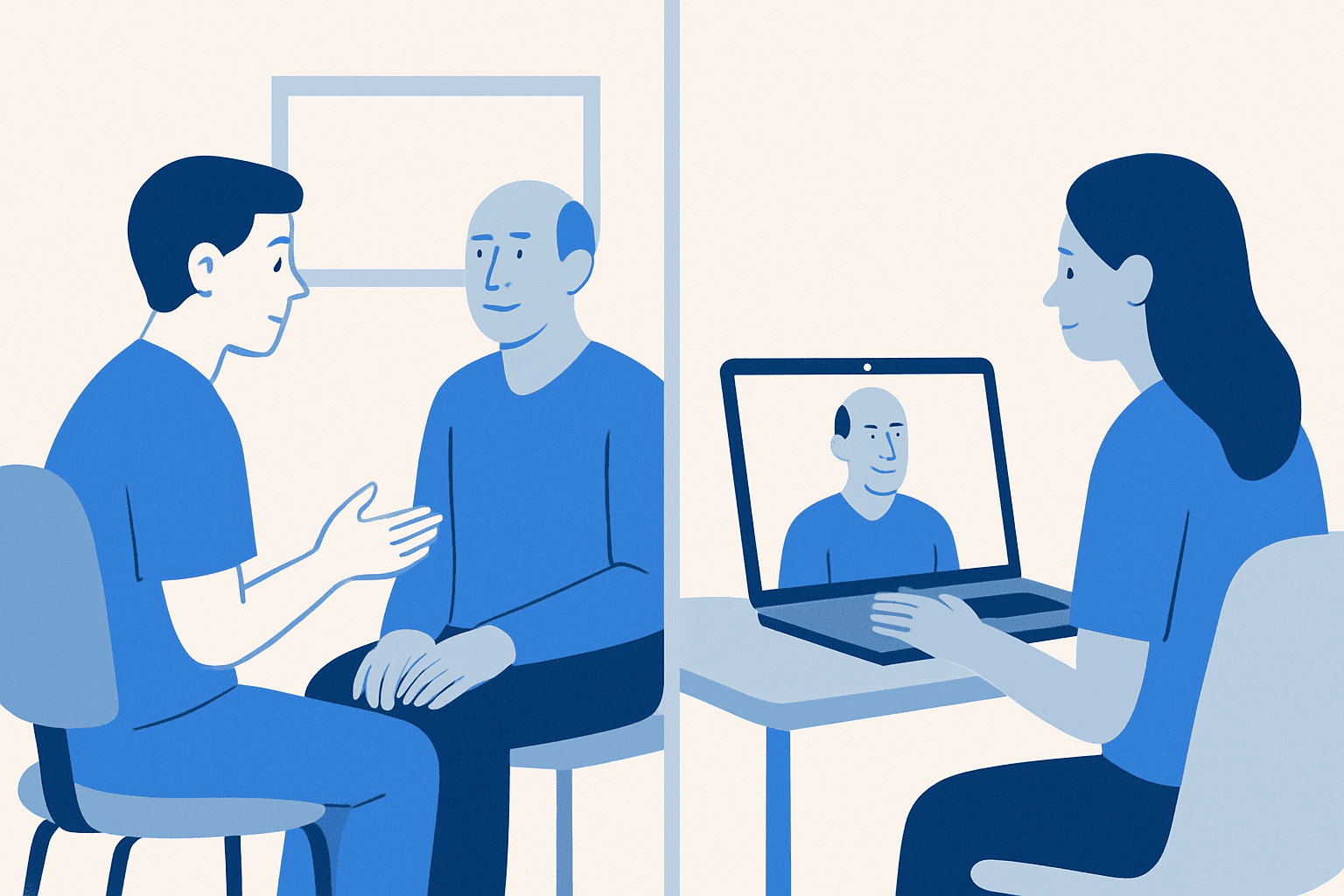

What is the difference between a virtual patient and a standardized patient?
A standardized patient is a trained human actor who plays a patient to a script and rubric. A virtual patient is software that simulates a case, whether menu-driven, video, VR, or an AI or LLM you chat with or speak to.
AI or LLM patients sit inside the virtual patient family. They answer free form questions and respond by text or voice, which makes them feel closer to a ward conversation than the old menu trees. You can ask follow ups the way you do on call, and they reply in plain language.
AI patient apps, Diagnosica included, are virtual patients.
This post reads the head to head studies on virtual patient vs standardized patient and gives you a practical split for your study time, so you know what to book with an SP and what to run on your phone when you’ve got 20 minutes.
What the head-to-head studies actually measured
Fink et al. ran a head-to-head virtual patient vs standardized patient setup with 86 German medical students doing history taking for shortness of breath. Each student did three cases with standardized patients and three with virtual patients, order varied, and assignment was not fully random.
In the standardized patient arm, trained actors played cases in a simulated emergency room and students asked questions freely. In the virtual patient arm, students used CASUS, choosing from a menu of up to 69 history questions, with answers delivered as short actor videos, all per the 2021 history-taking experiment.
- Authenticity. SPs: 4.02. VPs: 3.23. On a 1 to 5 scale, P<.001.
- Cognitive load. SPs: 2.88. VPs: 2.90. Statistically equivalent.
- Diagnostic accuracy. SPs: 0.51. VPs: 0.41. On a 0 to 1 scale, P=.01, a small effect.
- Information gathering. Pieces gathered, SPs: 29.01, VPs: 17.34. Quality score, SPs: 0.37, VPs: 0.43.
Actors felt more real, and students got slightly more diagnoses right with them. The authors add a caution though, writing that “we cannot rule out that this finding may be explained by additional support from the actors,” and authenticity did not track accuracy at all, r=0.05.
One other design call matters. The virtual patient was a fixed menu, not free conversation, which likely shaped how many data points students could collect and how they chose them. From what I can tell, that constraint is part of what you are testing in any virtual patient vs standardized patient comparison.

Where standardized patients still win
If you need believable emotion, rich body language and tone that a text or menu patient can't give, motivation that rises when a human is in front of you, and any real physical examination, standardized patients still win.
In a 2026 child psychiatry comparison of 50 fifth-year students, only 9 did the interviewing, 41 observed. Students rated perceived learning 4.50 vs 2.50 on a 1 to 6 scale, believability 5.73 vs 3.13 on a 1 to 7 scale, affective empathy 3.48 vs 2.57, and cognitive empathy 4.23 vs 3.51, all p<.001.
81.4% preferred the conventional SP unit, and the authors write that the virtual patient cannot yet match the standardized patient on self-estimated learning, motivation, believability and empathy.
That study used a VR headset prototype with pre-recorded answers, and 57.3% of 1,037 questions were misallocated by the system, with 75% of those errors from speech recognition, which the authors call the most significant limitation, so treat those scores as a ceiling on that prototype, not on every VP.
A 2023 literature review of 40 articles concluded SPs increase student confidence, but it also flagged small samples and unreliable instruments across many studies, so keep the signal, and the caveats, in view.
For difficult emotional conversations, a human face helps, including when interviewing a quiet, flat patient. You feel the pauses and the effort.
Diagnosica has no physical examination practice at all, so you will not practice live exams here.
Where virtual patients win
You can open a virtual case at 2 am, no booking, no back and forth with schedules, no room setup. Several tools offer this always-on practice, see other virtual patient simulators.
On costs, a not yet peer reviewed arXiv preprint from one institution reported about $0.725 per LLM session versus $52.95 per human SP session in their setting.
You can run the same scenario ten times and it will be the same difficulty on the eleventh, so you can compare attempts cleanly. No waiting for actor availability, and repeating a case does not exhaust anyone.
Serious or rare presentations that placements might never surface can be staged safely and repeatedly without risk to patients or staff time.
It is also a lower pressure room to make mistakes, pause, reread a stem, or rewind your own reasoning without burning a scarce slot.
On Diagnosica, you talk by voice or text to an AI patient in a video avatar, order investigations, commit to a diagnosis and management, then see a scorecard, and you can do that at any hour without booking.
On information quality, a peer reviewed study by Fink et al. with 86 students found higher quality of information gathering with computer cases, 0.43 versus 0.37, even though the actors felt more authentic.
Between actor sessions Run a virtual history between actor sessions with an AI patient, marked at the end. Try a case
Are AI (LLM) patients as good as human actors?
Not proven yet. One small, not-yet-peer-reviewed study found comparable OSCE gains and lower anxiety with a text-only LLM patient, but it cannot settle the question. Fourteen students were analyzed, there was no voice or video, and no between-group significance test was reported.
Zhang et al.'s 2026 LLM patient preprint studied EasyMED, a text-only system, in a four-week crossover at a single institution, and it is not yet peer reviewed. Twenty were recruited, 14 analyzed, groups set by pre-test ranking. Three human SPs participated, and blinded examiners scored OSCEs. Gains were close, 16.89 LLM-first vs 15.36 SP-first, labeled comparable, with no significance test. Anxiety was lower with the LLM patient, p less than .01. Helpfulness 4.5 LLM vs 4.7 human.
Limits matter here, a small and homogeneous cohort and text-only chats without nonverbal cues. The authors conclude LLM patients are a practical, scalable complement to SP programs, not a replacement. That frames the virtual patient vs standardized patient tradeoff right now. What remains unproven are larger samples, peer review, voice and video with tone and body language, empathy, and transfer to real patients.
You can also try a ChatGPT role-play patient for quick reps. On anxiety, see nerves before live stations.

How to combine both in your own prep
- Use standardized patients (SPs) in school sessions, mocks, or peer role-play for communication, empathy, body language, and examination. Virtual patients (VPs) won't teach hands-on exam, so do the people work with people.
- Between SPs, stack reps with VPs for focused histories, choosing investigations, and committing to a diagnosis. In Diagnosica you'll speak or type to an AI patient and get a scorecard.
- Right after an SP, pick one weak spot and drill it virtually. If ICE was thin, read exploring a patient's concerns, then run VP histories with that single aim.
- Before you return to a human, run a solo station routine to tighten your opener and data gathering. Then test it with an SP or peer.
- Keep a steady cadence, VPs most weekdays and SPs when you can. Set one target you're aiming for in the next human session, like naming risks early, and let VP reps pressure test it between.
What one virtual-patient rep looks like
- Pick a case by specialty, body system, or difficulty. Over 130, each written and signed off by a doctor. Available any hour without booking on web, iPhone, and Android.
- The AI patient opens as a video avatar that moves and talks. Not a real person.
- Take the history by voice or text. The patient answers when you speak or type.
- Order investigations and see results and imaging.
- Commit to a diagnosis and a management plan.
- Get a scorecard with competency scores and teaching points. Export the transcript if you want.
- No physical examination practice. Diagnosica was not in the studies above. It doesn't give advice about real patients, and it's not a diagnostic system. Treat every output as educational.
- On days without time for a full case, use the two-minute quick case, one line then five clues, guessing after each.
- For a taste first, try the no-signup demo, a short talk-or-type case of about 3 minutes.
- Comparing tools, see how AI case tools differ.
Bottom line
Human actors feel more real. In a repeated-measures study of 86 students, authenticity ran higher with standardized patients than with software cases, and diagnostic accuracy was slightly better too. In a psychiatry comparison with 50 students, only 9 interviewing, SPs also beat a VR patient on believability and both affective and cognitive empathy.
Virtual and AI patients scale. In a small, single-institution arXiv preprint, not yet peer reviewed, 14 analyzed students saw OSCE gains the authors called comparable and reported lower anxiety with a text-only LLM patient than with human SPs.
The AI evidence is early and small. That preprint is tiny, and a separate VR prototype struggled with speech recognition while students preferred the conventional SP unit.
For the virtual patient vs standardized patient decision, keep SP time for empathy-heavy encounters and nonverbal nuance. Use VPs for low-anxiety reps, anytime access, and daily streaks before you face an actor.
Educational use only. Not medical advice. AI-generated; verify clinically against primary sources.
Clinical review pending.
Start for free Start a free case on the free tier, no card, and get a scorecard. Start now