How to revise for UKMLA: AKT and CPSA

Revise for the UKMLA by building one plan from the GMC content map that trains both parts: AKT questions and spoken CPSA practice. AKT is two 100-item papers on sequential days, per the Medical Schools Council.
Key takeaways
- AKT: 2 x 100 items on sequential days, 2 hours per paper, practise timed sets.
- Local CPSA format and marking vary, ask school.
- Use questions with feedback; Larsen RCT showed 39% vs 26% retention at >6 months.
- Say one history out loud once a week alongside AKT question sets.
What does the UKMLA test?
The UKMLA tests across two parts, the Applied Knowledge Test and the Clinical and Professional Skills Assessment, and both draw their content from the GMC content map. The AKT is a written exam of applied knowledge, and your medical school runs the CPSA as a clinical assessment.
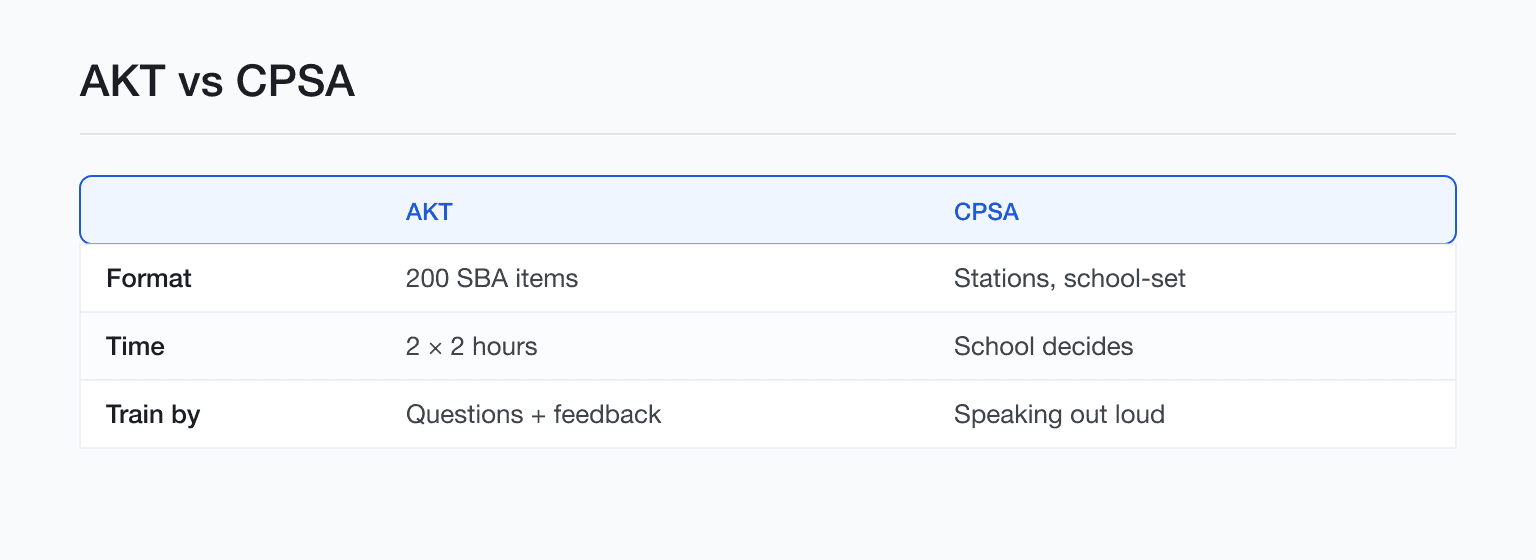
Credit: Medical Schools Council AKT handbook and GMC.
For the AKT, students sit two 100-item papers on sequential days, in Single Best Answer format with five options. Papers are not negatively marked. Each paper lasts two hours, as the AKT student handbook sets out. It’s a test of applied knowledge rather than recall. For how the pass works, see the AKT pass mark.
For the CPSA, each school runs its own assessment and may call it an OSCE or OSLER. Each school maps content to the GMC content map, which applies to MLA exams and assessments from September 2026.
As a small daily habit to keep presentations fresh, play one quick case a day.
Your UKMLA revision map
This UKMLA revision map gives one plan for both parts. It points you to guides that answer each decision, from tool choice to CPSA scoring, and helps plan your revision for the UKMLA with weekly habits.
Each guide below answers a different question you will face:
Guide | The question it answers | Level |
|---|---|---|
which AI and revision tools fit UKMLA prep | Start here | |
where AI helps and where it does not for finals | Core | |
how CPSA marking works, school by school | Core | |
domains, checklists and global ratings in a station | Core | |
practising stations with no partner | Going deeper | |
what forgetting studies say about spaced recall | Going deeper |
How long should you revise for the UKMLA?
There is no official revision time for the UKMLA. Your school sets your AKT and CPSA dates; plan backwards from them. If your school holds written finals in the penultimate year, students sit the AKT that summer. Anchor your timeline there and space the work.
It’s a pass/fail assessment, see the Medical Schools Council FAQs. In 2024-25, AKT pass rates were 96.4% in penultimate-year sittings and 98.3% in final-year sittings, per the AKT board reports. Use that to steady your nerves, not as a promise.
An AKT pass is normally valid for two years while at medical school, per the AKT Student Handbook. So an early AKT usually won’t expire before graduation. That means the real question is spacing, little and often, with weekly CPSA practice baked in. Schools differ on this.
Build the plan from the content map, not the question bank
The GMC content map is the shared syllabus for both AKT and CPSA, so make it the spine of your plan. It defines what must be assessed, not how, across written and clinical prep.
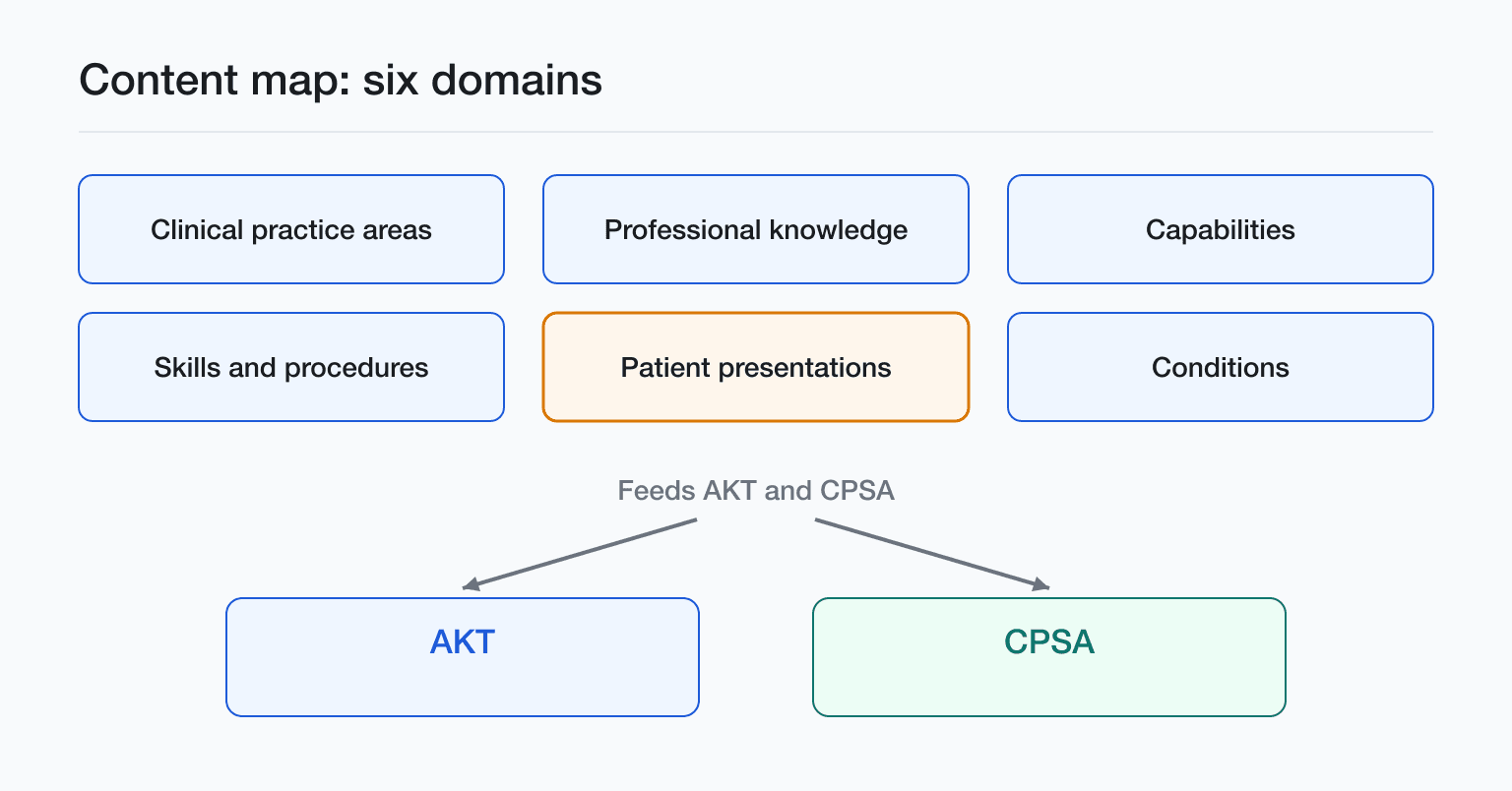
Credit: GMC.
The GMC organises the MLA content map into six domains. They are areas of clinical practice, areas of professional knowledge, clinical and professional capabilities, practical skills and procedures, patient presentations, and conditions. These domains form the basis of AKT and CPSA content. The GMC says the domains are interconnected, so work across them, not in silos.
Use the patient presentations domain as your weekly checklist. For each presentation, do a question set for AKT thinking, then say a history out loud for CPSA practice. The GMC requires every CPSA to map to the same domains and three themes. It must show candidates can identify and interpret clinical findings, per the GMC's CPSA requirements.
Example. Example. Patient presentation: thirst and passing a lot of urine, simulated patient Oscar Bexley, 50, in Diagnosica's case library. AKT angle: separate type 2 diabetes from type 1, diabetic ketoacidosis, diabetes insipidus, and hyperosmolar hyperglycaemic state. CPSA angle: ask to surface weight loss, about four kilograms, and recurrent thrush, twice in two months, which he only mentions when asked.
The AKT half: questions with feedback, spaced out
For the AKT half, the cleanest approach when revising for the UKMLA is to answer questions with feedback. Then revisit those topics on a schedule. Spacing beats cramming for recall, and reading explanations beats rereading notes.
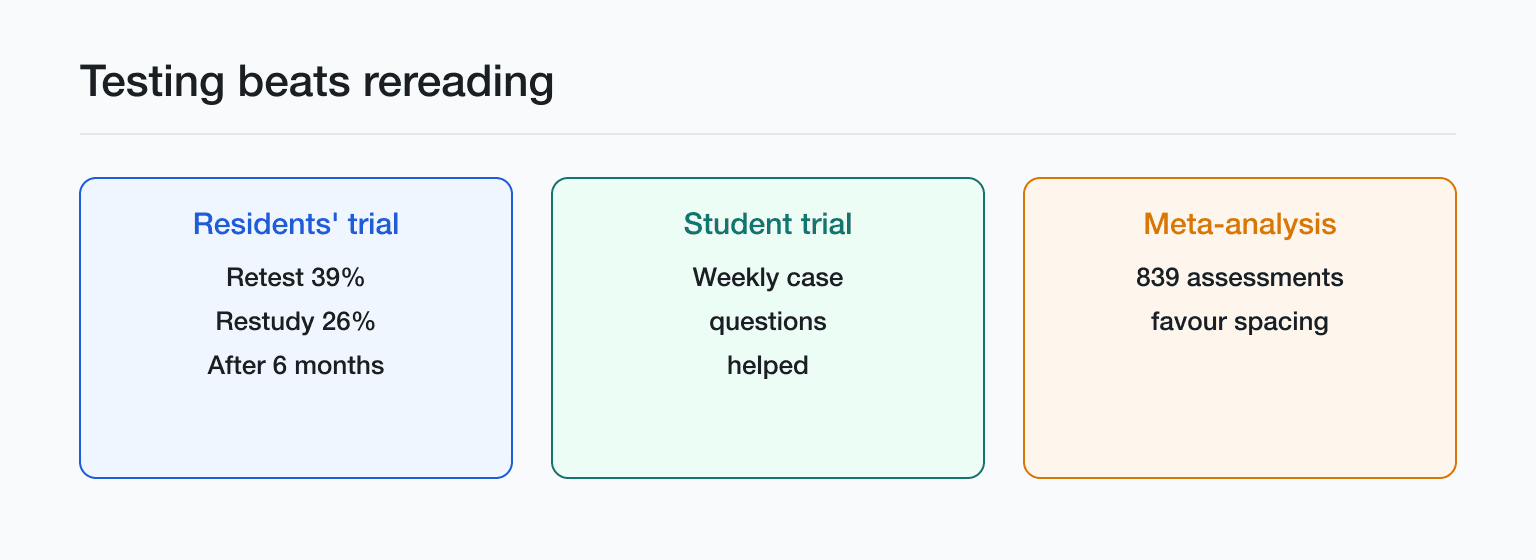
Larsen 2009, Kerfoot 2007, Cepeda 2006.
Testing with feedback beats rereading. In a residents' trial, repeated testing with feedback scored 39% versus 26% at more than 6 months for 40 residents, split 19 and 21. In a medical student trial, weekly emailed case questions improved end of year scores, and 95 of 133 completed.
Spacing helps retention across domains. In a spacing meta-analysis, 839 assessments from 317 experiments showed the best gap grows with the retention interval. These were other settings, not the AKT, but the mechanism is the same: retrieval then feedback.
Do this each week:
- Sort question sets by content map presentation, not source, to mirror AKT topic mixing.
- Read every explanation, right or wrong, and write one takeaway in your own words.
- Revisit missed topics after a gap, mixed with new ones to force recall.
- Sit the official practice exam (200 items, two 100-item papers) under timed conditions, two hours a paper.
The CPSA half: give it the same weight
Your school sets and marks the CPSA in the UKMLA. Train it by doing and speaking out loud, not reading. It may have a different name, so know your school's version and give it focus with AKT work.
The GMC sets requirements but leaves testing time, number and duration of stations, and whether stations score by domains, checklists or global judgement to schools. Simulated patient marks may count. Schools also assess professionalism, and candidates must identify and interpret clinical findings.
If you're serious about the CPSA, build weekly habits you can start tomorrow:
- Ask your school for its format and mark scheme.
- Say histories out loud, timed, most weeks.
- Practise interpreting findings you are given, not elicited.
- Rehearse explaining and checking understanding with a person.
Watch out. Watch out. Physical examination stations need hands-on practice with a partner or on placement. An AI patient app, including Diagnosica, cannot rehearse examination.
A weekly UKMLA revision plan that trains both parts
A repeating week works better than a giant timetable. Pair each AKT block with a CPSA block on the same presentations so knowledge and behaviours grow together.
Use this weekly rhythm to cover both parts without slipping one:
When | AKT work | CPSA work |
|---|---|---|
Most days | a timed question set from this week's presentations | one quick case or one presentation said out loud |
Once a week | revisit the misses from the week before | one full history out loud, timed, then self-mark |
Every few weeks | a mixed set across domains | a mock station with a friend, including examination |
Final weeks | the official practice papers, timed | your school's own CPSA format, rehearsed |
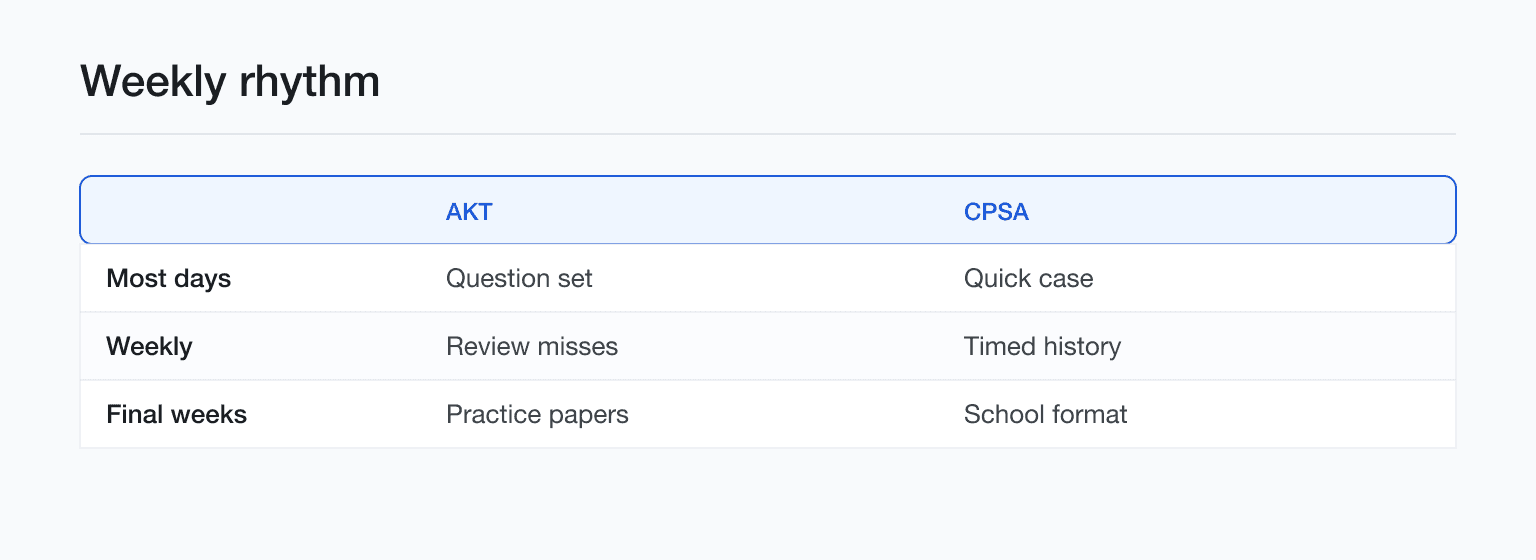
Most days pair AKT questions with a quick case; finish with official papers and your school CPSA format.
The daily quick case suits the "Most days" CPSA cell because it is two minutes and keeps a streak going; it is not AKT practice.
How Diagnosica helps with this
Two-minute quick case: five clues, guess after each, then see the answer.
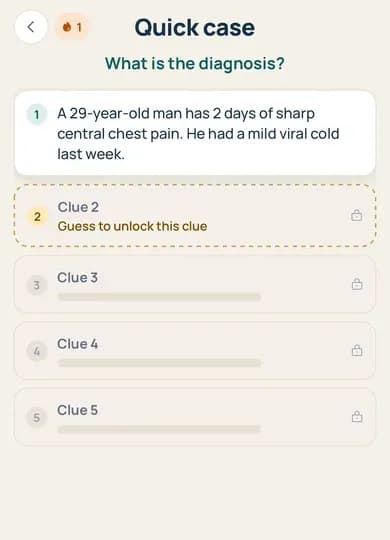
Diagnosica app, quick case screen, as of October 2026.
- Patient gives one line as first clue
- Wrong guesses open the next clue
- After clue five, see the answer and teaching point
Simulated patient. Screenshot from Diagnosica, October 2026.
One presentation, both papers: a worked example
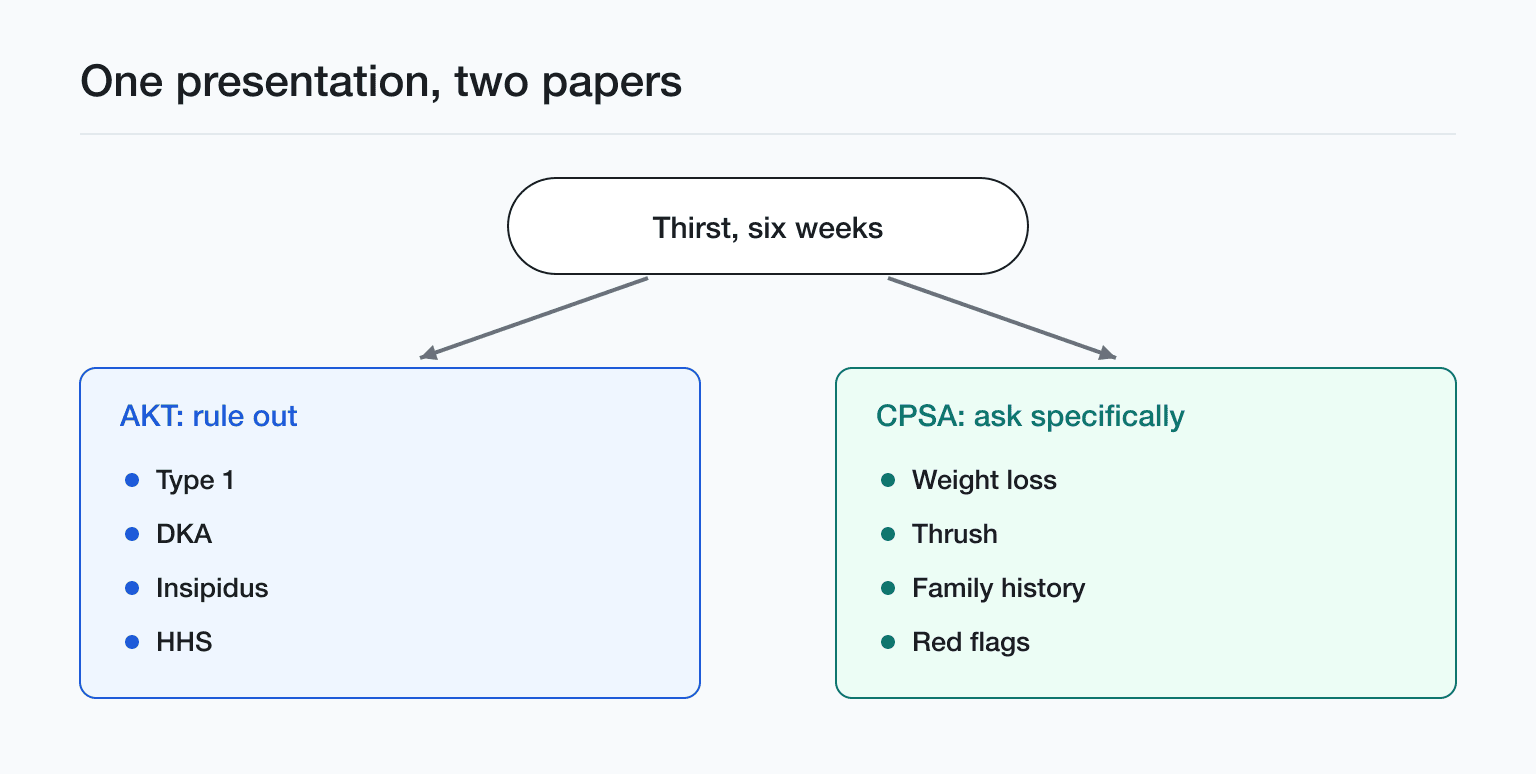
Simulated patient from Diagnosica's case library.
One presentation can drive both parts: the same simulated patient trains the AKT and the CPSA. In the AKT you choose the diagnosis among distractors; in the CPSA you ask the questions that surface the facts.
Oscar, 50 (simulated): what he said, and what we had to ask
Chip | Question | Answer | Why it mattered |
|---|---|---|---|
Volunteered | "Tell me what's been going on." | thirsty and weeing all the time for about six weeks, up three or four times a night | Polyuria and polydipsia for weeks point to diabetes with osmotic symptoms. |
Asked | "Any fatigue or changes to your vision?" | tired all the time, vision goes blurry now and then | Fatigue and intermittent blurring fit hyperglycaemia, support diabetes mellitus. |
Only if asked specifically | "Any changes to your weight recently?" | lost about four kilograms without trying | Unintentional weight loss keeps type 1 diabetes in the differential. |
Only if asked specifically | "Had any infections, like thrush or skin issues?" | thrush twice in two months | A commonly missed presenting feature of hyperglycaemia. |
Only if asked specifically | "Anyone in your family with diabetes?" | father and brother have type 2 diabetes | Raises the likelihood of type 2. |
Only if asked specifically | "Any vomiting, breathlessness, drowsiness, or tummy pain today?" | none of these | No features of diabetic ketoacidosis. |
Four of the six facts appeared only when asked specifically. AKT distractors here are type 1 diabetes, diabetic ketoacidosis, diabetes insipidus and hyperosmolar hyperglycaemic state.
Simulated patient. Case file type-2-diabetes-50m. Questions written by us as a model, not a learner session.
The final weeks before the UKMLA
The final weeks before the UKMLA are when you switch from learning to rehearsing the real conditions of both parts. Simulate exam day in each block with timed AKT papers, CPSA station run-throughs, and passes over the GMC content map.
Per the Medical Schools Council, the practice exam is 200 items in two papers, and each paper's standard time is two hours:
- Sit both official practice papers timed at two hours each.
- Go back over the content map presentations you keep missing.
- Rehearse your school's CPSA format with a partner, including examination.
- Practise spoken histories under time.
To end each day, practise a CPSA-style history. You can take a CPSA-style history, an AI patient answers by voice or text and a scorecard follows.