AMC Clinical Exam Pass Mark: 9 of 14 Explained

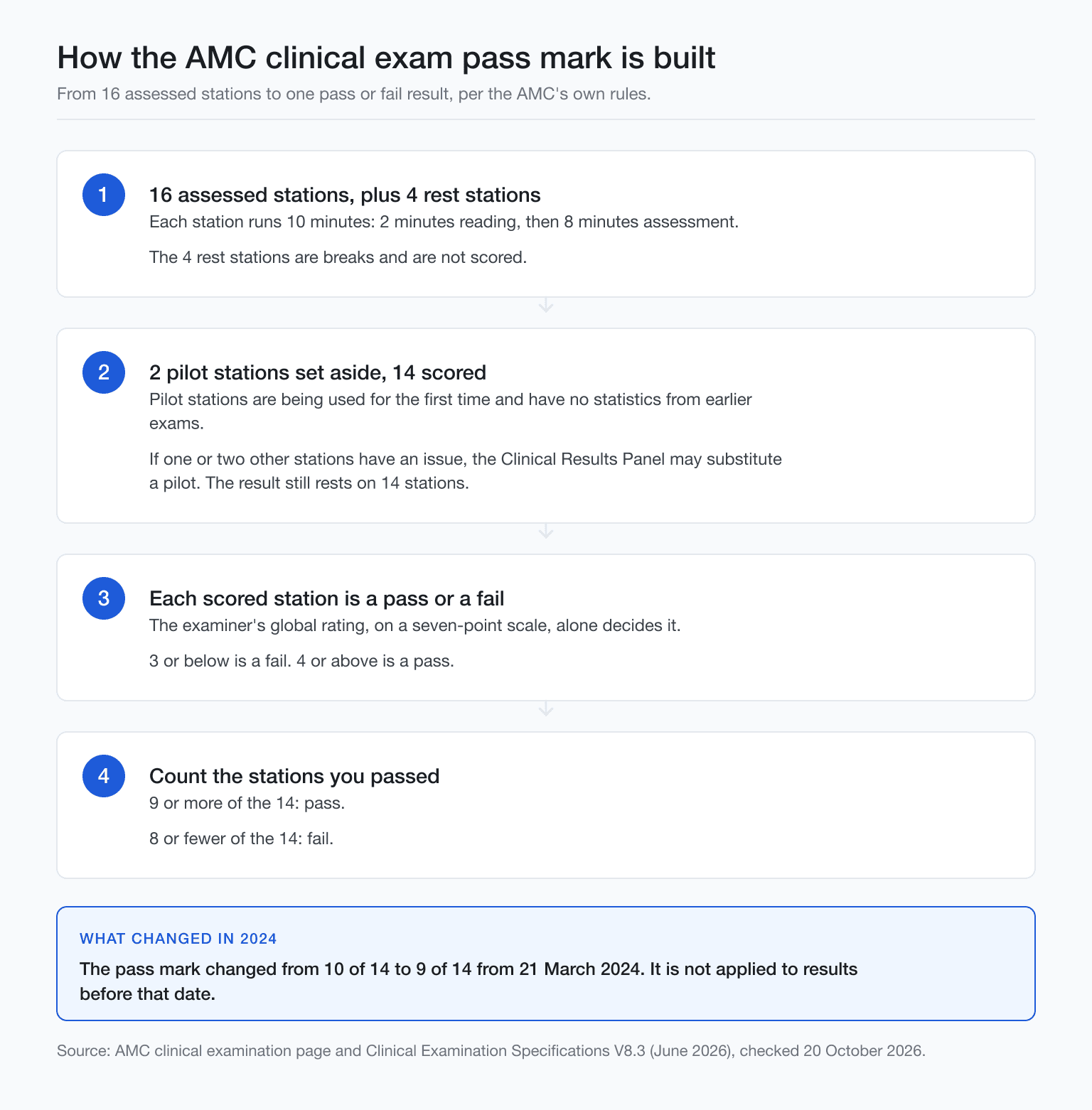
The AMC clinical exam pass mark is a pass in 9 or more of the 14 scored stations (16 assessed stations, 2 are pilots).
It’s 4.00pm on a Friday, three weeks after your exam, and you’re about to download your result. You’re working out how close you were, and how many stations you likely passed.
This page explains how the 9 is built, how each station is marked, what changed on 21 March 2024, and which kind of station can’t be rehearsed with software.
What is the AMC clinical exam pass mark?
The AMC clinical exam pass mark is passing 9 or more of the 14 scored stations, and failing is 8 or fewer. It’s a count of stations passed, not a percentage or a total. Each station’s result comes from the examiner’s global rating, where 4 or above on a seven point scale is a pass.
AMC states there are 16 assessed stations plus 4 rest, but your result is based on 14 scored. Two of the 16 are pilot stations, usually not scored, though they can be substituted if a scored station has an issue, per the AMC’s rules on the AMC structure outlined on the AMC clinical examination page.
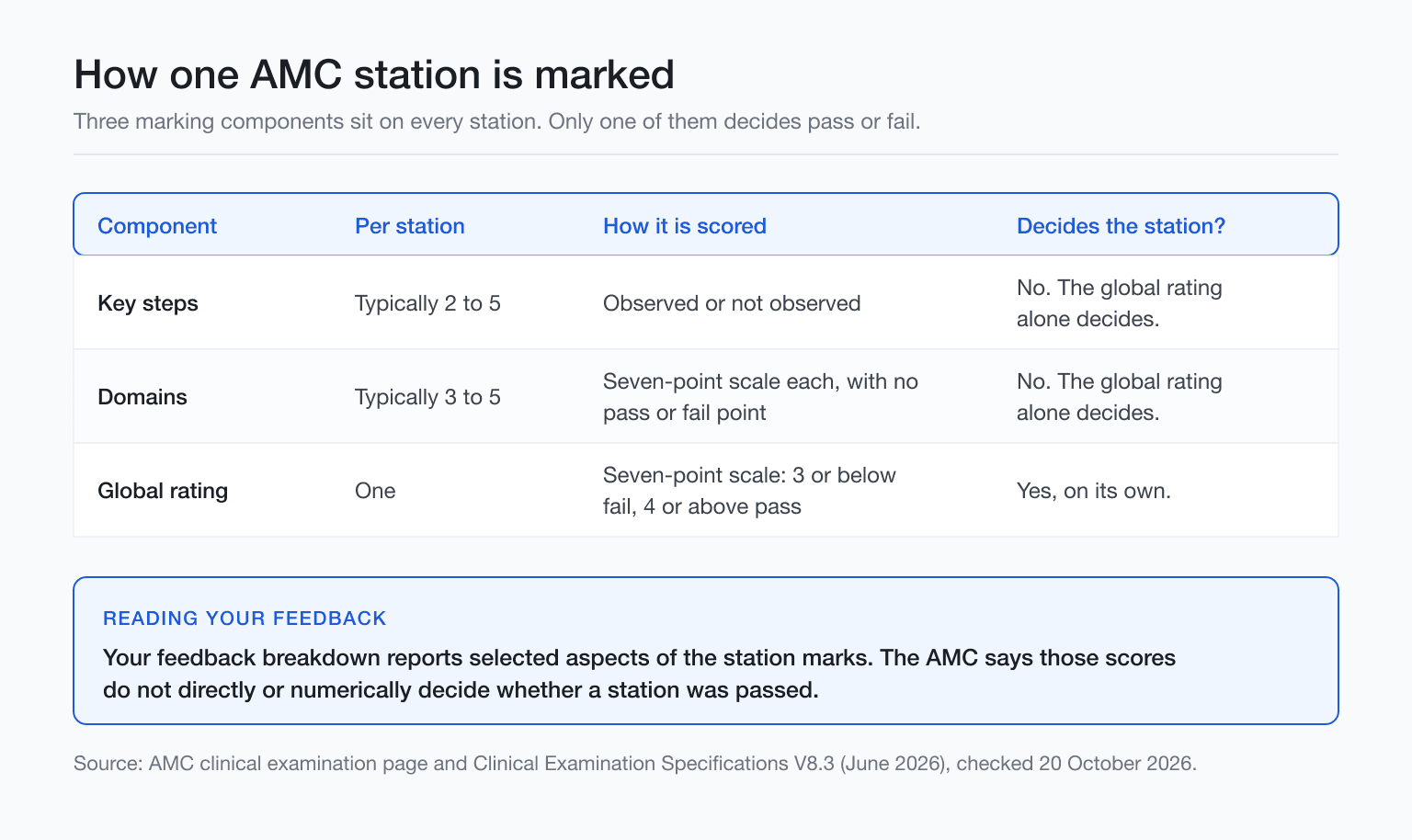
Examiners record key steps and rate domains, but those don’t decide the pass on their own. The global rating alone decides pass or fail for a station. For a short primer, see OSCE global ratings explained.
There’s no limit on attempts, and your result is only the count of stations with a global of 4 or higher, not an average of domain ratings or a tally of key steps.
Last checked 20 October 2026.
16 stations, 14 scored: why two don't count
The AMC clinical exam has 16 assessed stations plus 4 unscored rest stations. Two are pilots used for the first time, with no earlier statistics, so 14 stations decide your result; if a non pilot station has an issue, a pilot may be substituted and it still stays 14. Each station is 10 minutes, 2 reading, 8 assessment, with a predominant area, history, examination, diagnostic formulation, or management, counselling and education across medical, surgical, women's health, paediatrics and mental health.
The AMC states your pass or fail is determined by 14 scored stations, with pilots usually unscored, and substitution only if one or two non pilot stations have issues, in the AMC exam specifications.
The specifications do not state whether candidates are told which stations are pilots. You can't plan around them. Treat every encounter as if it will count, hold pace to the 2 minute read and 8 minute assess cycle, and keep performance consistent against the stated predominant area.
Talk it out You can rehearse history taking and counselling out loud with an AI patient that answers by voice, with a scorecard after every case, free to start no card needed, and no physical examination. Try a case
What changed in March 2024?
The AMC clinical exam pass mark changed from 10 out of 14 scored stations to 9 out of 14, effective 21 March 2024. AMC Directors unanimously agreed the change at their 21 March 2024 meeting after an extensive review supported by the Assessment Committee, with the notice published on 25 April 2024. Earlier results before that date were not affected.
Details of the change and its timing are set out in the AMC's change notice, published on 25 April 2024, which records the Directors' unanimous decision on 21 March 2024 and confirms the new 9 of 14 rule applies to results from that date.
The notice gives the stated rationale as continuous review of assessment and maintaining "the highest possible standards in line with international benchmarks". It doesn't publish a standard setting method or any data, so anyone offering a more specific reason is guessing.
Practical point if you're comparing notes, if a forum thread or a coaching page still says the AMC clinical exam pass mark is 10 of 14, it's describing the pre 21 March 2024 rule.
How is each AMC station marked?
Each AMC clinical exam station is marked using three components: key steps, domains, and a global rating. Examiners mark whether key steps were observed, rate domains on a seven point scale, then give a single global score. The global score alone sets the station outcome, with 3 or below a fail and 4 or above a pass, per the AMC specifications.
1) Key steps: typically 2 to 5 per station, each marked observed or not observed.
2) Domains: typically 3 to 5 per station, each rated on a seven point scale with no pass or fail point. Examples include approach to the patient, history taking, choice and technique of physical examination, accuracy of physical examination, differential diagnosis, choice or interpretation of investigations, management, and patient education or counselling.
3) Global rating: a single rating on a seven point scale that takes into account the predominant assessment area and all aspects of performance. The global rating alone decides pass or fail, with 3 or below a fail and 4 or above a pass.
An examiner may be in the room, or the station may be marked remotely. If the examiner could not observe properly, a recording may be used for marking.
The practical takeaway if you’re checking your feedback later, ticking key steps and scoring well in domains isn’t the same as passing. The global judgement decides.
What the pass mark does and doesn't tell you
The AMC clinical exam pass mark is a station count, not a single scaled total. You pass if at least 9 of the 14 scored stations are passed, and the result releases at 4.00pm on the Friday three weeks after your exam through your AMC account.
That decision is made station by station via the examiner’s global rating, 4 or above passes and 3 or below fails. Key steps and domain ratings sit underneath, but they don’t set a station’s pass or fail on their own.
It doesn’t tell you much about the why. The AMC provides a computer-generated breakdown against selected aspects of the station marks to guide future study, and states those feedback scores don’t directly or numerically decide a station outcome. You can’t use them to reconstruct which stations you passed.
The Canadian exam reports one scaled total. That total aggregates stations, and if you want to see how that looks in practice and get a feel for the single-number format, here’s the NAC OSCE pass rule.
If your outcome is a fail, there’s no limit on attempts for the clinical exam. Read this next if a sitting goes badly.
What you can't rehearse without a person
Examination stations in the AMC clinical exam sit under one of the four predominant assessment areas, examination, with domain ratings that can include your choice and technique of physical examination and the accuracy of that examination. In person, these can involve actual patients, simulated patients, models or equipment, with the same 10 minute timing as other stations.
Software, including Diagnosica, cannot rehearse physical examination technique, and Diagnosica has no physical examination practice; the platform does not simulate hands-on manoeuvres or instrument handling.
Those skills need a partner, a study group, or a supervised setting with real hands.
You can still practise the parts that don’t require touch, like history taking, selecting and interpreting investigations, diagnostic formulation, and management counselling, which appear as domains across stations. Save examination technique for live practice, then bring the reasoning pieces online.
Rehearsing the talking stations
The talking stations in the AMC clinical exam are history taking, diagnostic formulation, and management, counselling and education. Each runs to 2 minutes of reading time followed by 8 minutes of assessment time, and the examiner’s global rating weighs the whole performance. On the AMC scale a global rating of 4 or above passes a station, and 3 or below fails it.
If you’re tuning your timing and structure without a partner, these solo station practice routines fit the 8 minute assessment window and force a clear summary and a committed impression.
Diagnosica is an AI clinical simulator for medical students and junior doctors: you take a history from an AI patient by voice or text, order labs and imaging, commit to a diagnosis and management plan, and get a competency scorecard. The patient appears as a video avatar, it’s free to start with no card needed, and there are apps on iPhone and Android plus the web. It’s built for learners well beyond the US. It’s a general clinical reasoning simulator, not built for or calibrated to the AMC mark sheet, and its scorecard is competency based. It doesn't give advice about real patients, and it's not a diagnostic system. Treat every output as educational. It won’t let you practise physical examination technique, but it does let you rehearse talk-first stations on scenarios curated for reasoning, including our focused AMC clinical exam practice.
Common questions
These common questions about the AMC clinical exam pass mark are answered from AMC pages checked on 20 October 2026. The AMC clinical exam result is based on passing at least 9 of 14 scored stations, with pass or fail on each station set by the examiner’s global rating on a seven point scale.
Is the AMC clinical exam pass mark a percentage?
No, it isn't a percentage. The AMC clinical exam uses station outcomes, not a raw total or percentage. You pass the exam by passing at least 9 of 14 scored stations, a threshold based on discrete passes, not an aggregate score. A station is passed when the examiner’s global rating is 4 or higher on a seven point scale.
Do pilot stations count toward my AMC result?
Pilot stations are part of the 16 assessed stations, and the overall result is determined from 14 scored stations. Usually pilot stations are not scored. If there is an issue with one or two non pilot stations, the Clinical Results Panel may substitute one or both pilots. Your result still rests on 14 stations either way.
When do AMC clinical exam results come out?
AMC clinical exam results are available to download from your AMC account at 4.00pm on the Friday, three weeks after the clinical exam. You also receive a computer generated feedback breakdown. Those feedback scores do not directly or numerically determine whether a station was passed, and you cannot infer pass or fail from them alone.
How many times can you sit the AMC clinical exam?
There is no limit on the number of attempts at the AMC clinical exam. Eligibility requires a pass in the AMC CAT MCQ examination. Each sitting is judged on its own 16 assessed stations with 14 contributing to the result, and the overall pass requires passing at least 9 of those 14 scored stations.
Is the AMC clinical pass mark still 10 out of 14?
No. The AMC clinical pass mark changed from 10 of 14 to 9 of 14, effective 21 March 2024, following a unanimous decision by AMC Directors supported by the AMC Assessment Committee. The change is not applied to results before 21 March 2024. The AMC cites ongoing review and international benchmarks for the change.