MRCS Part B pass mark, stations and how it is set

There is no single MRCS Part B pass mark. You have to clear a Knowledge pass mark and a Skills pass mark in the same sitting, and both are set for your circuit using borderline regression.
This page covers how each station is marked, how the cut is built and adjusted, the two hurdles, the 17 nine minute stations, and where your marks go.
Every ICBSE document quoted on this page, January 2025 regulations, standard setting paper and August 2021 candidate guide, was last checked on 20 October 2026.
What is the MRCS Part B pass mark?
The MRCS Part B pass mark isn't a single published number. You must reach two pass marks in one sitting, one for Knowledge and one for Skills, with no banking across diets. Thresholds are set after each diet and appear on your feedback report, which shows PASS or FAIL and the minimum needed for each.
Stations are marked out of 20 with an overall Pass, Borderline or Fail, consistent with how OSCE mark sheets typically work in OSCE mark sheets explained.
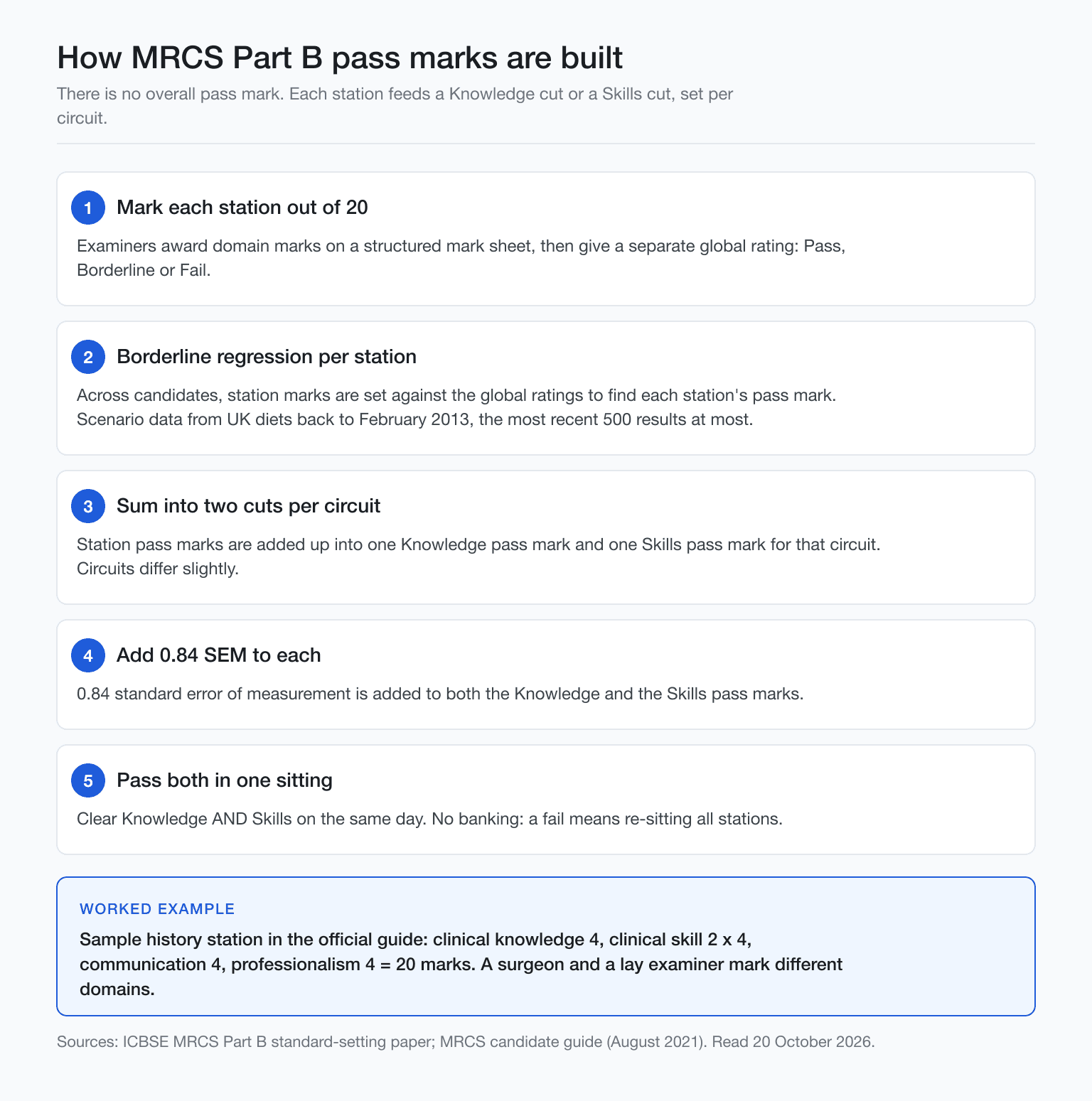
Pass marks use borderline regression, are summed into Knowledge and Skills, with 0.84 standard error of measurement (SEM) added to both, as set out in the ICBSE standard-setting paper. After each diet a standard-setting meeting sets different per-circuit pass marks, similar across circuits but unlikely to be identical.
Some OSCEs report one scaled score, like Canada's NAC OSCE scoring.
How is each MRCS Part B station marked?
Each MRCS Part B station is marked out of 20 with domain-based scoring, plus a separate global judgement. The four domains are clinical knowledge and its application, clinical and technical skill, professionalism, and communication. Examiners award domain marks using generic descriptors, then record an overall Pass, Borderline or Fail, consistent with the MRCS candidate guide.
The guide’s sample history-taking station on obstructive jaundice splits the 20 marks like this:
- Clinical knowledge and its application, 4
- Clinical and technical skill, 2 x 4
- Communication, 4
- Professionalism, 4
That station’s double manned. A surgeon examiner marks clinical skill and clinical knowledge, and a lay examiner marks communication and professionalism.
Borderline regression in plain English
Borderline regression for MRCS Part B turns each station’s raw marks into a station pass mark. Across all candidates, examiners’ 0 to 20 marks are plotted against global ratings of Pass, Borderline or Fail, and a best fit line gives the expected Borderline mark.
ICBSE's own wording is that “the marks and global ratings are employed to construct the pass mark for each station using borderline regression methodology.” That’s the same family as the MRCEM OSCE standard setting.
The calculation uses scenario totals across UK diets from February 2013. If a scenario has been used more than 500 times, only the most recent 500 count.
ICBSE adds 0.84 SEM to Knowledge and Skills pass marks ‘to maintain the standard of the exam’, and notes because both must be passed in one sitting, the OSCE’s SEM may be considered in excess of 1.0, widely accepted as the desirable minimum.
Per circuit pass marks have been used since the October 2014 examination. On a given day the circuit is identical across all UK and Ireland centres.
A harder circuit gets a slightly lower cut, a gentler circuit a slightly higher one, so you can’t reverse engineer a fixed percentage.
Two hurdles: Knowledge and Skills in the same sitting
MRCS Part B has two hurdles, Knowledge and Skills, and you must pass both in the same sitting. Each station contributes to a section result judged against the day’s standard, and there’s no banking. You don’t carry section passes forward, so a good Skills performance won’t offset a Knowledge miss on another day. Fail either section and the sitting fails.
If you fail Part B, you re-sit all stations under MRCS regulations, January 2025, 3.9, and the practicalities are covered in failing an OSCE sitting.
You get up to four attempts at Part B, plus one additional under the Additional Attempt policy, regulations 3.10.2 to 3.10.3. An attempt is any occasion you commence the exam, even if you don’t complete it, regulations 3.10.4.
You must pass Part B within seven years of Part A, regulations section 4.
Parts A and B are expected before higher specialty training, per MRCS exam overview.
The Skills section includes 2 history-taking stations, and you can practise history and reasoning with an AI patient by voice or text, free to start, no card needed, at rehearse a surgical history.
How many stations are in MRCS Part B?
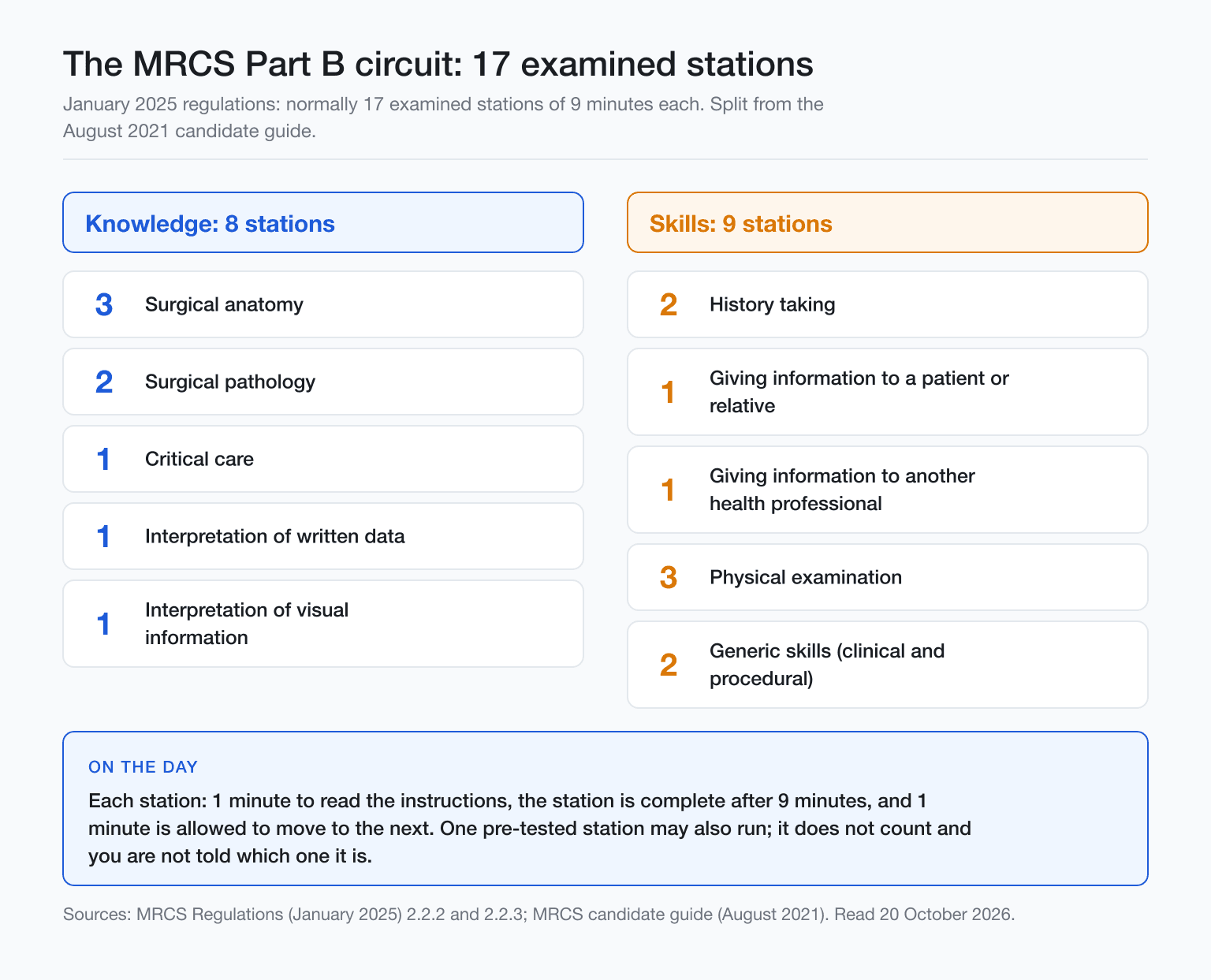
MRCS Part B normally has seventeen examined stations, each nine minutes long. You rotate through knowledge and skills stations, and only marks from examined stations count towards your overall result. Circuits can include preparation stations and one pretested station that doesn't count, and you're not told which.
That format is set out in the January 2025 MRCS regulations.
- Knowledge, 8 stations:
- 3 surgical anatomy
- 2 surgical pathology
- 3 applied surgical science and critical care: 1 critical care, 1 interpretation of written data, 1 interpretation of visual information
- Skills, 9 stations:
- 4 communication skills: 2 history taking, 1 giving information to a patient or relative, 1 giving information to another health professional
- 5 clinical and procedural skills: 3 physical examination, 2 generic skills
You get 1 minute to read the instructions at the start of each station, the station is complete after 9 minutes, and 1 minute is allowed between stations. Those timings are from the August 2021 candidate guide.
In the October 2020, November 2020, May 2021 and July 2021 diets, the circuit was 13 stations with a single pass mark for the circuit and 1.64 SEM. The January 2025 regulations describe seventeen examined stations.
Where do candidates lose marks in MRCS Part B?
Candidates lose marks in MRCS Part B because examiners only credit what the station asks for and how you communicate it. The official guide says that marks relate only to the task required at that station, so following instructions precisely matters.
- Doing the task you weren’t asked, as marks cover only the set task.
- Skipping the universal basics, since you must introduce yourself, explain your purpose, confirm identity and consent, and clean your hands before and after patient contact.
- Missing the second worry, as simulated patients have detailed briefs and many histories add anxieties you’re expected to detect and address unprompted.
- Summarising by reciting, as the sample history station shows the lay examiner wants synthesised, prioritised feedback, not a verbatim replay.
- Communication that feels closed, since descriptors list checks for understanding, adjusted questions, active listening, empathy and closure.
The regulations recommend Part B in ST or CT2, and warn Foundation trainees are highly unlikely to have the necessary experience and may disadvantage themselves by premature attempts. Use this surgical rotation advice to make it count.
Rehearsing the history and communication stations
Rehearsing the history and communication stations for MRCS Part B means matching the exam timings and practising your handover. You get up to 6 minutes for history, then 3 minutes for a spoken summary, your differential and immediate next steps.
Practise to that clock using summarising a history aloud and read examples in the official candidate guidance.
Diagnosica is an AI clinical simulator for medical students and junior doctors: you take a history from an AI patient by voice or text, order labs and imaging, commit to a diagnosis and management plan, and get a competency scorecard.
Patients appear as video avatars, with apps on iPhone and Android. It’s free to start, no card needed, available any hour without booking, and learners in the UK and elsewhere use it, not only in the US.
Cameron Hayes, 24, previously well: "I've had belly pain since yesterday and I feel feverish." The pain began around his belly button and moved to the lower right side, now sharp and worse on movement.
Peter Hughes, 55, a plumber and smoker: "I got a sudden, severe pain in my belly a few hours ago." It started in the top middle of his tummy and spread across his whole belly, movement makes it worse so he lies still.
There’s no physical examination practice, so the 3 physical examination stations and procedural skills can’t be rehearsed here. Scoring is competency based and not mapped to the MRCS mark sheet, and there are no pass promises. It doesn't give advice about real patients, and it's not a diagnostic system. Treat every output as educational.
Common questions
The common questions about MRCS Part B cover how the pass mark is set, how the OSCE is scored, whether sections can be banked, what a pre-tested station means, whether overseas centres differ, and what feedback arrives after results. Here are answers candidates can use.
Is the MRCS Part B pass mark a fixed percentage?
No, the MRCS Part B pass mark isn't a fixed percentage. There is no overall OSCE pass mark. Stations are marked out of 20 plus Pass, Borderline or Fail. Borderline regression builds cut scores, sums to Knowledge and Skills, then adds 0.84 SEM for each circuit.
Can I pass Skills and resit only Knowledge?
No, you can't bank Skills or Knowledge between sittings. You must pass both sections in one sitting, failing one doesn't let you keep the other. Candidates who fail Part B resit all stations, returning to the full OSCE with both sections examined.
Does the pre-tested station count towards my result?
No, a pre-tested station doesn't contribute to your result. Regulations 2.2.3 allow one pre-tested station in a circuit, and you're not told which it is. Only examined stations count, each marked out of 20 plus Pass, Borderline or Fail, feeding borderline regression cut scoring.
Is the pass mark different at overseas centres?
No, overseas MRCS Part B centres use cut scores from the UK or Ireland exam that supplied scenarios. Scenarios come from a UK or Ireland centre, and that exam's Knowledge and Skills cut scores are used for that circuit, maintaining alignment despite borderline regression for each circuit.
What feedback do I get after MRCS Part B?
You receive a breakdown of your marks, and no further feedback. The report shows PASS or FAIL, your Knowledge and Skills marks with minimums for each, and tables by content area and domain with the circuit mean. Those tables don't indicate pass or fail, they're descriptive.
Practise surgical history Rehearse a surgical history with an AI patient, free to start, no card needed. Start now