How to Summarise a History in an OSCE: the 30 second script

How do you summarise a history in an OSCE?
An OSCE history summary is a short spoken recap in a fixed order: who the patient is and why they came, the key features of the presenting complaint, the positives and negatives that point to or away from serious causes, background, then your working impression and what you'd do next. Aim for 30 seconds by default, longer only when asked.
You've taken the history, the examiner says 'summarise for me', the clock is low and you're staring at scribbles. This is the exam version of the ward-round presentation: headline first, tight order, and only the findings that matter.
Thirty seconds is our target, not an exam rule; schools differ on this.
What is the examiner listening for?
The examiner listening to an OSCE history summary is checking whether you can turn a conversation into a working diagnosis with a next step, not whether you can recite everything you asked. Lead with the headline, give the findings that shifted your thinking, then state what you'd do to confirm or refute it. Concise, and directed.
In an OSCE the time may be limited, for example 1 to 2 minutes, so you prioritise the information that led you to your differential and plan. Geeky Medics' own full example presentation takes about 2 minutes, and presentations elsewhere can run from a few minutes to more than 10 minutes for complex patients, per the Geeky Medics presenting guide.
Have a reason for each sentence. Avoid long lists of negatives, report positives and red flags. Never guess a negative you didn't ask; if you're unsure, say so and why.
For context, see how OSCE examiners mark.
The 30-second summary script
The 30-second OSCE history summary is a headline-first script for the moment the examiner asks you to summarise and the clock is red. It's a suggested target, not a rule. Your job is to give the diagnosis-defining features, the red flags, and only the background that changes risk, then your working impression and the next thing you want to do. If you need a quick way to summarise a history in an OSCE, start here.
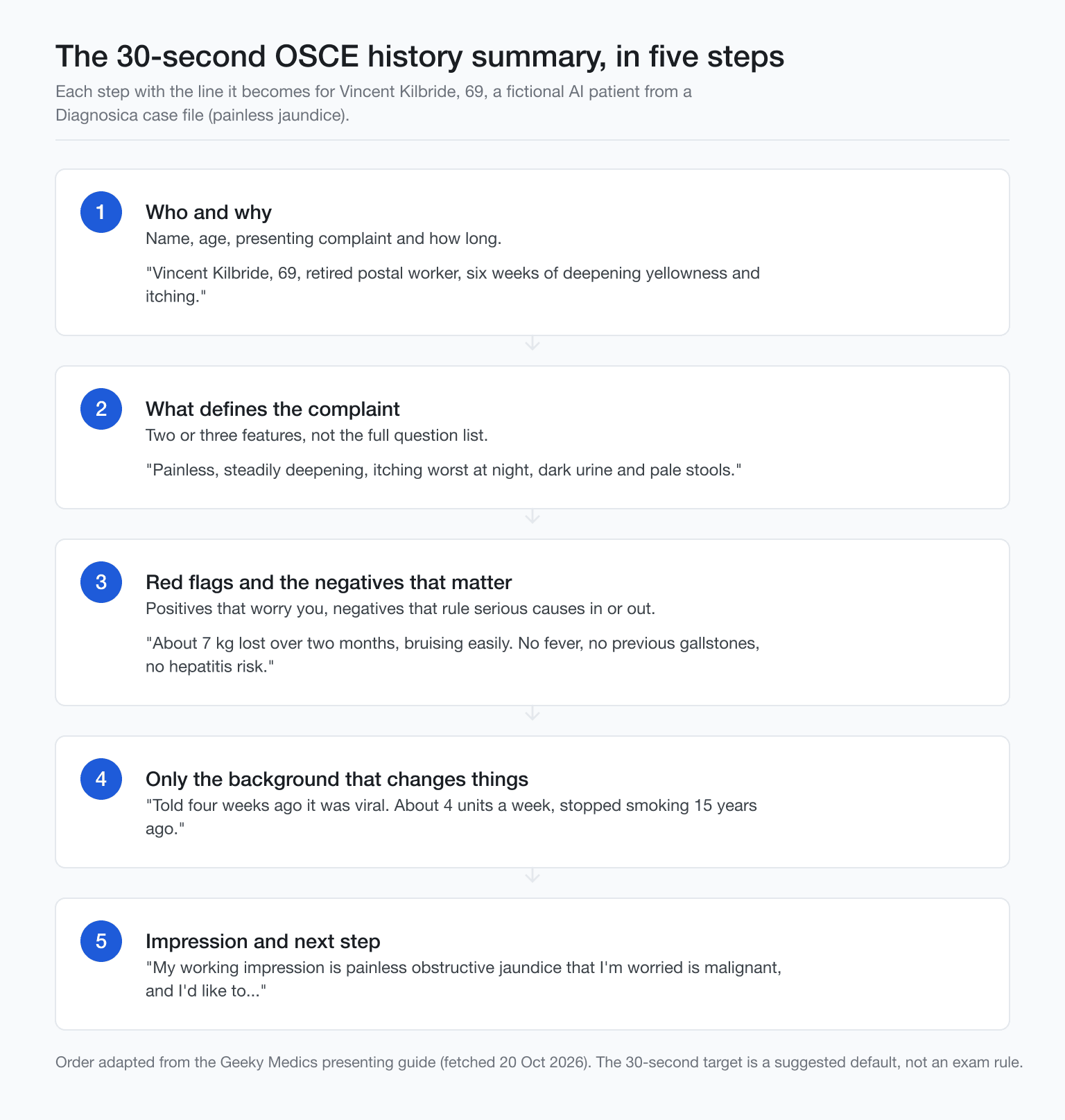
- One-liner: "This is [Name], [Age], with [Presenting complaint] for [Duration], with [Key past history if relevant]."
- Defining features: "Features, [Onset], [Character and radiation], [Severity or pattern], [Associated symptoms], [Triggers or relievers]."
- Red flags and negatives: "Red flags, [X]. Important negatives, [Y] against [Dangerous causes]."
- Background that changes risk: "Background, [Alcohol], [Smoking], [Past episodes], [Meds or exposures], [Family or travel risks]."
- Impression and next step: "My working impression is [Diagnosis] because [Two strongest points]. I'd like to [Investigation or examination] and [Action you want] now."
For a 1 to 2 minute version, expand the same spine. Add the patient's ideas, concerns and expectations, one or two systems review positives that actually change your differential, and the social context that alters risk, access to care, or discharge safety.
This only works if your history was focused, see focused history taking.
Two worked summaries from real case files
These two worked OSCE history summaries come from two fictional AI patients in Diagnosica's case library, each case written and signed off by a doctor, so you can see the script applied. They're short on prose and heavy on signal, and show a 30 second focus.
Vincent Kilbride, 69: painless jaundice
"Mr Vincent Kilbride, 69, has six weeks of painless jaundice that began in the eyes then the skin, with generalised itch worse at night. His urine is dark like tea and his stools are pale and greasy. He's unintentionally lost about 7 kilograms over two months with poor appetite. No fevers, no right upper quadrant pain, and no prior gallstones or pancreatitis. No hepatitis risks and no regular medicines. His observations are normal. He was told four weeks ago it was a virus. My impression is obstructive jaundice that I'm worried is malignant."
Dennis Fletcher, 55: upper abdominal pain
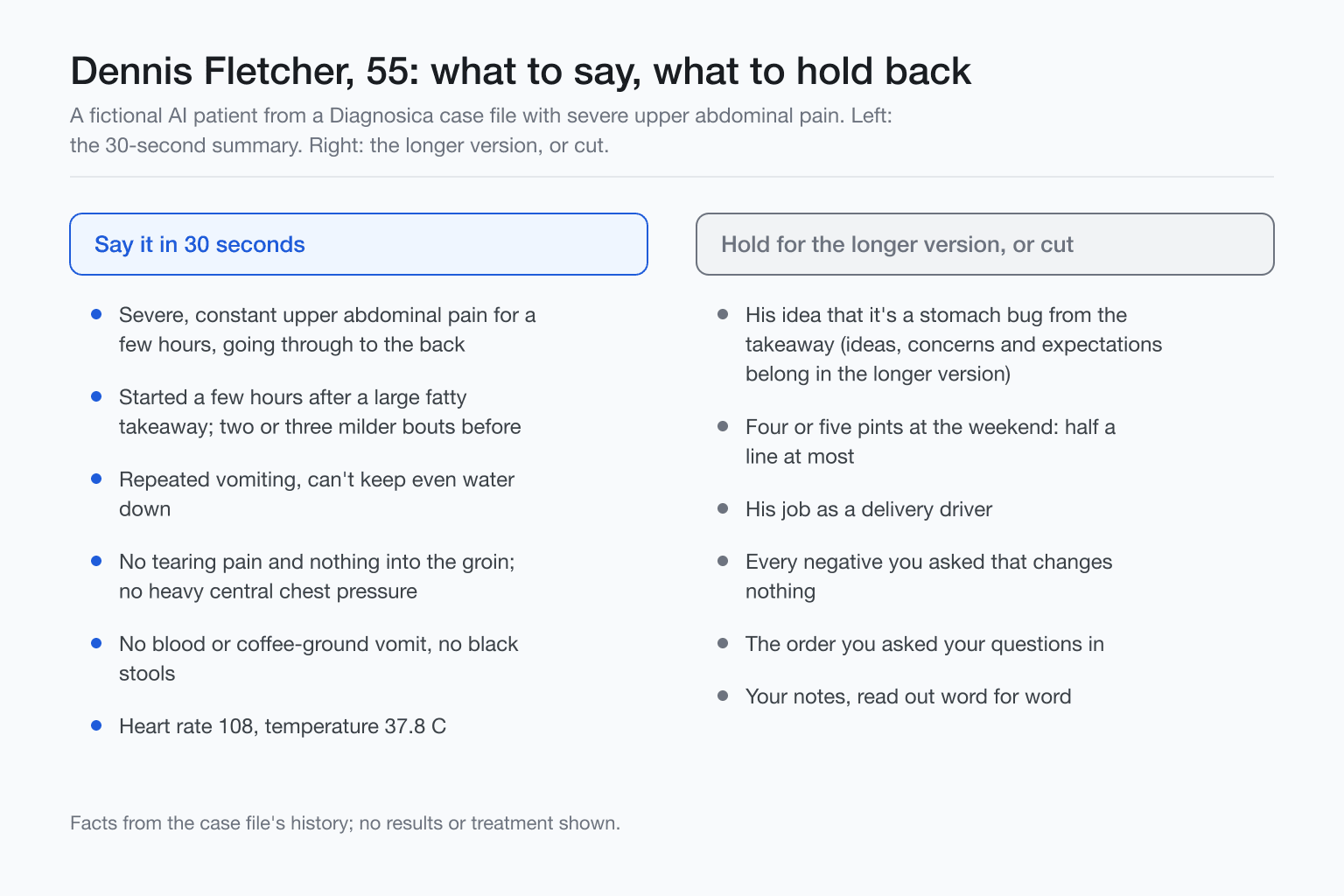
"Mr Dennis Fletcher, 55, has severe constant epigastric pain radiating straight through to the back for a few hours, worse lying flat and a little better sitting forward. It started after a large fatty takeaway, with repeated vomiting and minimal urine. He's had two or three milder similar bouts after fatty food before. He feels feverish, HR 108 and temperature 37.8. No sudden tearing abdominal pain, no heavy central chest pressure, and no blood or coffee-ground vomit. My impression is acute pancreatitis, likely gallstone related."
If you want to try this under mild pressure, take Vincent's or Dennis's history as an AI patient in Diagnosica, then say your 30-second summary out loud yourself: take the history yourself.
What to leave out of an OSCE history summary
An OSCE history summary works when it is ruthless about signal over noise. Compress to what drove your differential and current impression. Give only the positives that support or the negatives that meaningfully rule out, then stop. Everything else lives in your notes, not your mouth.
- Every negative you asked, keep only those that rule a serious cause in or out.
- The order you asked the questions in.
- Normal background that changes nothing.
- Your notes read verbatim.
- Hedged filler, for example, "the patient said that he thinks maybe".
Vincent Kilbride is the poster child for this cut. His 4 units a week and the fact he stopped smoking 15 years ago may earn half a line if you later connect them to risk. His postal-service job does not.
Use red flags and picking pertinent negatives. The Geeky Medics guide backs this approach, warning against long lists of negatives and reading word for word when OSCE time may be 1 to 2 minutes.
What do you say when the examiner asks 'what next?'
The examiner's what-next question after an OSCE history summary wants your working impression, one or two differentials with the key feature for each, and then the categories of next steps. Keep it tight, name why you think what you think, and say what you'd seek next in examination, observations, bloods and imaging, collateral history, and escalation.
For Dennis Fletcher, a 30-second answer could be: "My working impression is acute pancreatitis, given severe constant upper abdominal pain radiating straight through to the back with repeated vomiting after a large fatty meal. Myocardial infarction is less likely with no heavy central chest pressure or radiation to the arm or jaw. Next, I'd examine him, review observations, look at bloods and imaging, and get collateral history if available. I'd let my senior know because he's tachycardic and febrile, heart rate 108 and temperature 37.8 C."
If they interrupt mid-summary, stop immediately, answer the what-next, then offer to finish the final line of your summary if helpful.
If you don't know, say what you'd check rather than guess.
Practising the summary out loud
Practising an OSCE history summary out loud is a speaking skill, not a writing exercise. If you're working on how to summarise a history in an OSCE, the gains come from saying it, timing it, and trimming it. Thirty seconds is a personal target, not an exam rule. Regular repetition builds control.
- Take a history as in the station, then stop.
- Put notes away, close the laptop, no reading.
- Start a timer, give a headline summary, aim for 30 seconds.
- Listen back, cut the least useful sentence.
See practising stations alone.
Diagnosica is an AI clinical simulator for medical students and junior doctors: you take a history from an AI patient by voice or text, order labs and imaging, commit to a diagnosis and management plan, and get a competency scorecard. The patient appears as a video patient. It's free to start, no card needed. Apps on iPhone and Android, plus the web. Built for learners in the UK and beyond, not one country's exam. 136 cases across 18 specialties, every case written and signed off by a doctor. >The scorecard gives a score out of 100 across four areas of 25 points each, history taking, investigations, diagnosis and management. It grades the case but doesn't listen to or mark your spoken summary, so say the summary aloud after the case and check it against the history you took. It doesn't give advice about real patients, and it's not a diagnostic system. Treat every output as educational. >Start a free case
Common questions
How long should an OSCE history summary be?
An OSCE history summary should fit the time you're given, so follow the examiner's instruction. Geeky Medics gives 1 to 2 minutes as an example of limited OSCE time, with a full example around 2 minutes, so prioritise the features that led to your impression and plan. For a 30-second core, give name, age, problem, red flags, a one-line impression, and your intended next step.
Should I include negatives in my summary?
Include negatives in an OSCE history summary only when they meaningfully shift risk, ruling serious causes in or out, or when the examiner asks. In Dennis Fletcher's case, 'no sudden tearing pain' and 'no heavy central chest pressure' help argue against ruptured abdominal aortic aneurysm or myocardial infarction, focusing you on upper abdominal pathology. Skip laundry lists, and don't report negatives you didn't establish.
Can I read from my notes when I summarise?
You can glance at your notes while summarising, but don't read them out line by line. Geeky Medics advises against reading straight off the page and expects you to have a reason for each sentence. Use notes to keep order or anchor a date or number. If you're unsure about a fact, say so and explain why you can't commit.
Is the summary marked separately in the UKMLA CPSA?
Whether the summary is marked separately in the UKMLA CPSA depends on the medical school, since schools set their own CPSA stations and mark sheets. Marking schemes vary, so check your school's guidance and the station brief. Schools differ on this; for a primer on how marking varies, see UKMLA CPSA marking.