Illness Scripts: What They Are and How to Build One

What is an illness script?
An illness script is a compact mental model you use to recognize and reason about a disease during a patient encounter. It links pathophysiology, epidemiology and other contextual factors, plus the symptoms and signs that tend to appear or be conspicuously absent, so you can spot patterns quickly and anticipate how an illness is likely to unfold.
You keep hearing to build them because pattern recognition drives expert performance. In the classic account by Lubarsky and colleagues, illness scripts are "specialized knowledge structures" that help clinicians "recognize patterns and irregularities," and experts differ from novices by "the content and organization of their knowledge base," not memory tricks or generic problem solving.
Scripts are personal. They "become updated and refined through experience and learning," and teachers cannot transfer their scripts, so you have to build your own and tighten them case by case.
In practice, scripts feed your differential by letting you compare a presentation with a few candidate diseases, weigh key and rejecting features, and decide what stays or drops while you're ranking a full differential.
What goes into an illness script?
An illness script is a concise, four-part snapshot for a disease that captures epidemiology and predisposing factors, pathophysiology, time course, and presentation with key and rejecting features. You use it to connect early patient cues to likely diagnoses and to rule in or out look-alikes quickly.
- Epidemiology and predisposing factors: Who gets it? Age, sex, risk factors, exposures like travel or job.
- Pathophysiology: What goes wrong? Mechanism linking cause to findings.
- Time course: How does it unfold? Onset in hours, days, weeks or months, constant or intermittent.
- Presentation, symptoms and signs: What clinches it and what rejects it? Key features you'd see only with this disease, rejecting features you'd definitely not see.
A common student format uses these four components, with key and rejecting features highlighted in the presentation column, see a Connecticut Medicine template. Older literature labeled the nodes enabling conditions, faults, and consequences, a frame that still maps to the list above, see Charlin's 2007 essay.
A script is not a textbook page. Keep each slot to a few features that discriminate between the top two or three look-alikes you confuse in practice, then prune. Features that are absent often matter as much as those that are present.
How to build an illness script from a case: a pulmonary embolism example
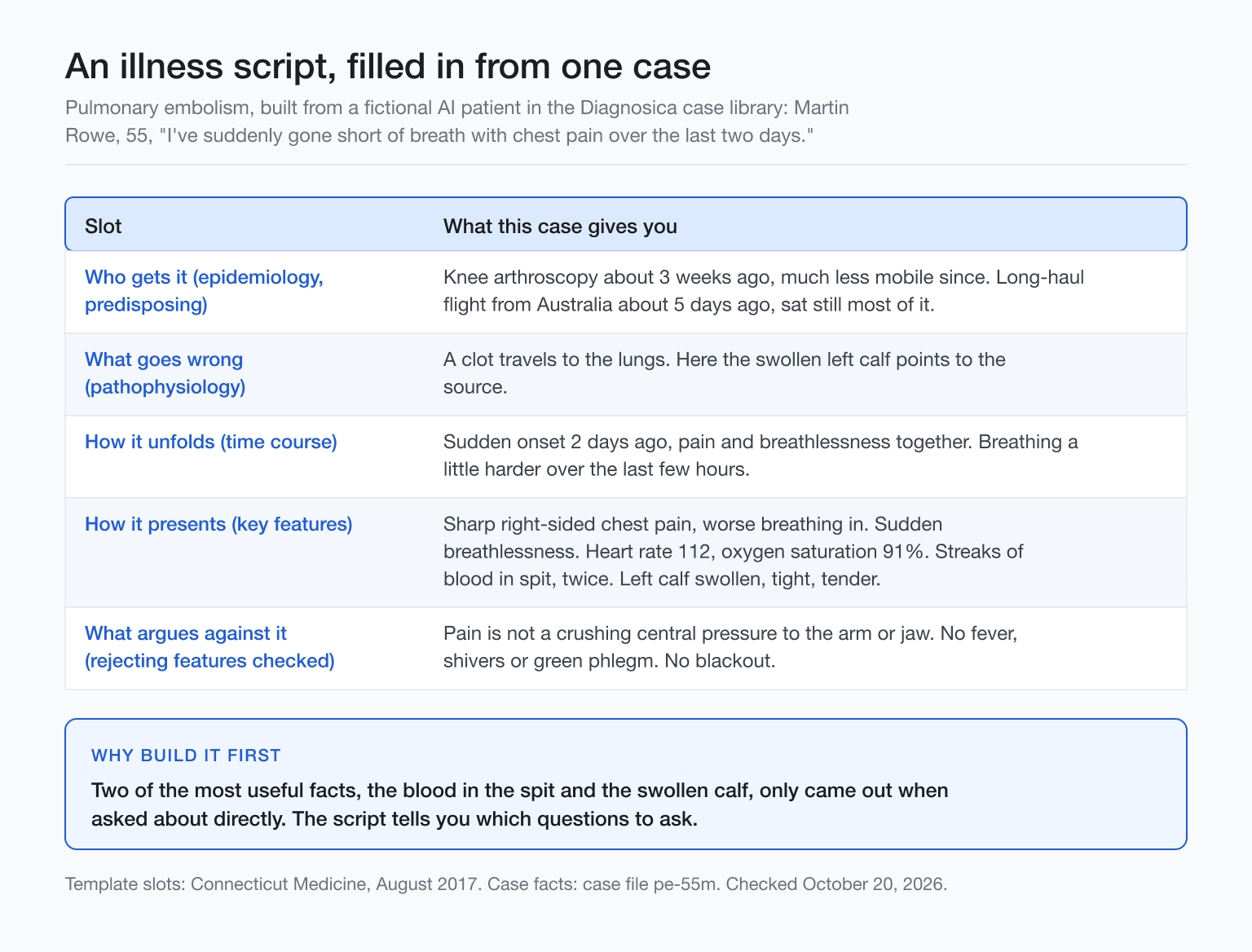
Building an illness script from a case means distilling the minimum facts that define a disease and slotting them into predisposing factors, time course, presentation, and rejecting features. Use a fictional pulmonary embolism case from our library to see how the script directs your questions so you surface the right clues fast, not by luck.
- Opening line and vitals. Martin Rowe, 55, says, "I've suddenly gone short of breath with chest pain over the last two days." Vitals: heart rate 112, respiratory rate 24, blood pressure 120/78, oxygen saturation 91%, temperature 37.1 C.
- Epidemiology and predisposing. Left knee arthroscopy 3 weeks ago with reduced mobility; very long-haul flight from Australia 5 days ago, mostly seated, a major provoking factor for venous thromboembolism.
- Time course. Abrupt onset 2 days ago with chest pain and breathlessness together; breathing harder over the last few hours; exertion worsens it.
- Presentation. Right-sided pleuritic chest pain, sudden breathlessness, two episodes of small blood streaks on cough, and a left calf swollen, tight, tender, and a bit warm for a week.
- Rejecting features you checked. No heavy crushing central pain radiating to arm or jaw, no fever, shivers, or green phlegm; he's frightened it's a heart attack, but the description argues against that.
Two of the most useful facts here, blood in the spit and the swollen calf, only appeared when you asked directly, which is why your illness scripts should drive your history so you know which high-yield doors to open.
To practice the slot-by-slot approach with the AI patient, take this history yourself.
How do two illness scripts separate a differential?
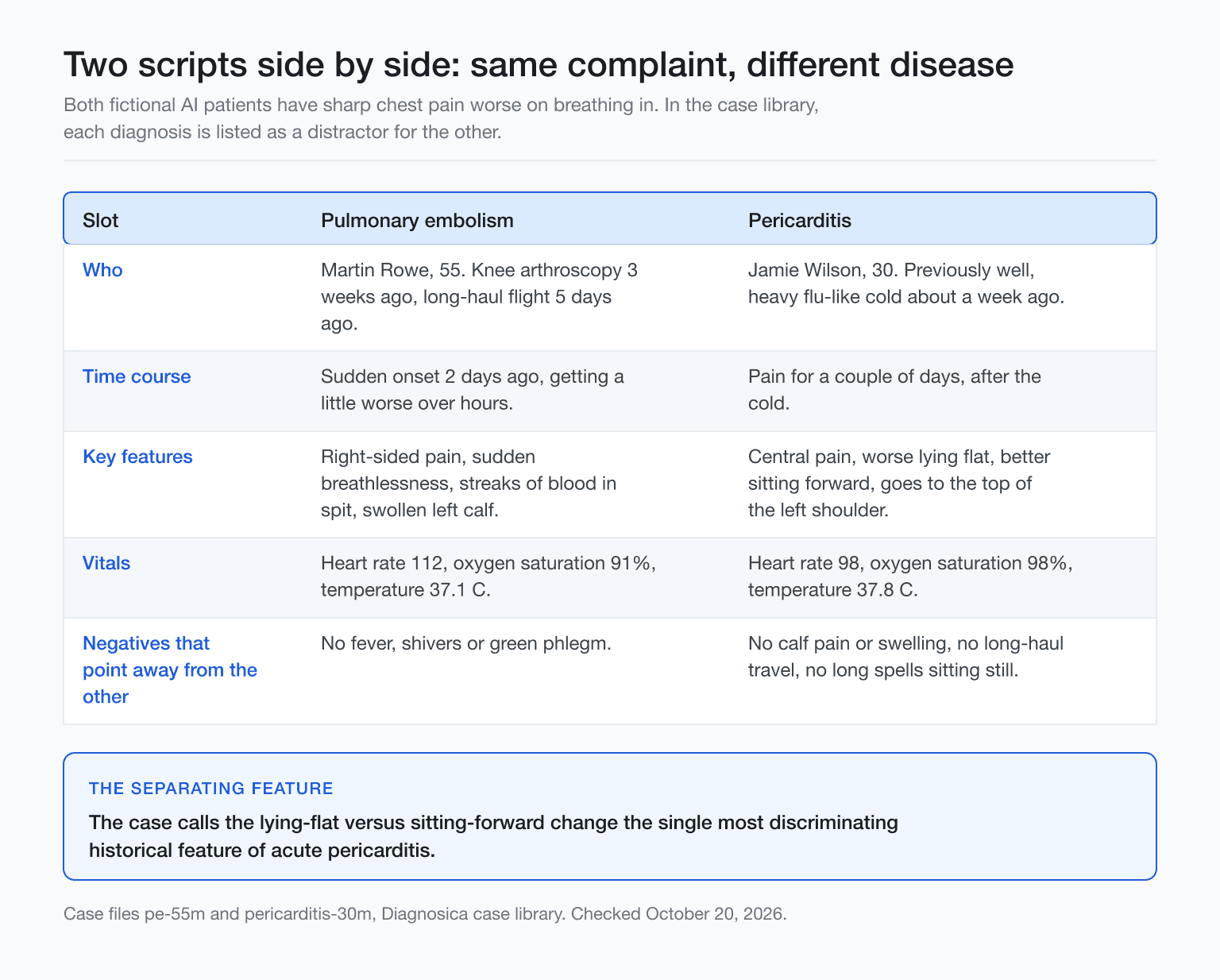
Two illness scripts side by side separate diagnoses that share a chief complaint. With pleuritic chest pain, pulmonary embolism and acute pericarditis can look close, and in our case library each is a distractor for the other. Compare slot by slot before tests.
Who: Martin Rowe, 55, less mobile after arthroscopic left knee surgery 3 weeks ago, flew home from Australia 5 days ago. Jamie Wilson, 30, previously well, had a heavy flu-like cold a week ago.
Time course: Martin's right-sided pleuritic pain and breathlessness began abruptly 2 days ago, worse with exertion. Jamie's sharp pain has been there a couple of days, starting after the viral illness.
Key features: Martin has sudden breathlessness, SpO2 91%, and if asked reports blood-streaked sputum twice and a swollen, warm left calf. Jamie's pain is worse lying flat, better sitting forward, radiates to the top of the left shoulder, temp 37.8 C, SpO2 98%; that positional change is "the single most discriminating historical feature of acute pericarditis".
Each case's negatives are the other's flags. Jamie has no calf swelling, no long-haul travel, and no long spells sitting still, which lowers pulmonary embolism probability and matches the negatives that discriminate. Martin has no fever, shivers, green phlegm, or crushing central pressure to the arm or jaw.
Common mistakes when building illness scripts
The most common mistakes when building illness scripts are copying chapters, skipping rejecting features, building without look-alikes, overfitting to the classic picture, and not testing against cases. Scripts trigger from early cues, so your content has to be compact, discriminating, and resilient to misdirection.
The first mistake is copying the textbook page. A script is a short trigger list, not a summary, so prune and test against clues versus red herrings.
Another miss is skipping rejecting features and other negatives. Use the Connecticut Medicine template to record findings you'd not see if the disease were present, and let absence weigh.
A third trap is building one disease at a time, not against look-alikes. In a fictional giant cell arteritis case, morning shoulder and hip stiffness overlaps with polymyalgia rheumatica, so include jaw ache on chewing, the case's most specific symptom, to separate them.
Fourth, learning only the classic picture. Atypical cases may not trigger your script; define core features, relax the rest, then rehearse edge cases with when scripts look wrong.
Finally, never testing the script against a case. Teachers can't transfer scripts; Lubarsky's group found self-explanation and test-enhanced learning improve retention versus studying alone.
How to practice illness scripts on cases
Practicing illness scripts is running your predictions against cases, then tightening the script where it missed. Lubarsky and colleagues describe scripts that update through experience and help you predict how diseases unfold, and they list self-explanation and test-enhanced learning as strategies that make those predictions sharper.
- Before the case, from the first line, write your top 2 or 3 scripts and what each predicts.
- During the history, ask the questions your scripts predict and check for absences, often as significant as presences.
- After the answer, compare prediction with outcome and rewrite the slot that misled you, one component at a time.
Diagnosica is an AI clinical simulator for medical students and junior doctors: you take a history from an AI patient by voice or text, order labs and imaging, commit to a diagnosis and management plan, and get a competency scorecard. Patients appear as video avatars, it's free to start with no card, it works on iPhone, Android, and the web, learners use it outside the US too, and it isn't built around one exam. Cases have named distractors so you can see which scripts you should have tested, the pulmonary embolism case has 10, and the two-minute quick case gives one line then 5 clues with a guess after each for a daily drill. No physical examination practice here, cases tell you exam findings as facts and you can't elicit them. It doesn't give advice about real patients, and it's not a diagnostic system. Treat every output as educational. For practice structure, see reasoning beyond the textbook.
Common questions
Common questions about illness scripts hit the moment you try to write your first one and freeze. Here are four answers to keep you moving: an illness script example, the core components, how many to make, and how scripts differ from summary statements.
What is an example of an illness script?
An illness script example is a pulmonary embolism script from a fictional case: right-sided chest pain worse on deep breath and sudden breathlessness. Hemoptysis and swollen left calf after knee arthroscopy and a flight; rejecting features: no fever or green sputum, and the pain isn't a crushing central pressure spreading to the arm or jaw.
What are the components of an illness script?
The components of an illness script are pathophysiology, epidemiology, time course, and symptoms and signs. In script theory the nodes are pathophysiological mechanisms, contextual factors, and symptoms and signs, historically called faults, enabling conditions, and consequences. Absent features can matter, and scripts get updated and refined through experience and learning.
How many illness scripts should a medical student make?
The number of illness scripts a medical student should make has no fixed target in our sources, and there is no evidence-based number. Start from the rotation's chief complaints, build look-alike groups, and refine with every case using self-explanation and test-enhanced learning. Teachers can't transfer their scripts, so you have to build your own.
Is an illness script the same as a summary statement?
An illness script and a summary statement are not the same. A summary statement describes this patient in three parts, clinical context, temporal pattern, and key features. An illness script describes the disease, with pathophysiology, epidemiology, time course, and discriminating and rejecting features. You match the patient's summary statement against candidate scripts to judge fit.
Build better scripts Run your pulmonary embolism script against a fictional AI patient, free to start on iPhone, Android or web. Try Diagnosica