SCA Pass Rate: Sittings Since 2023 with RCGP Data

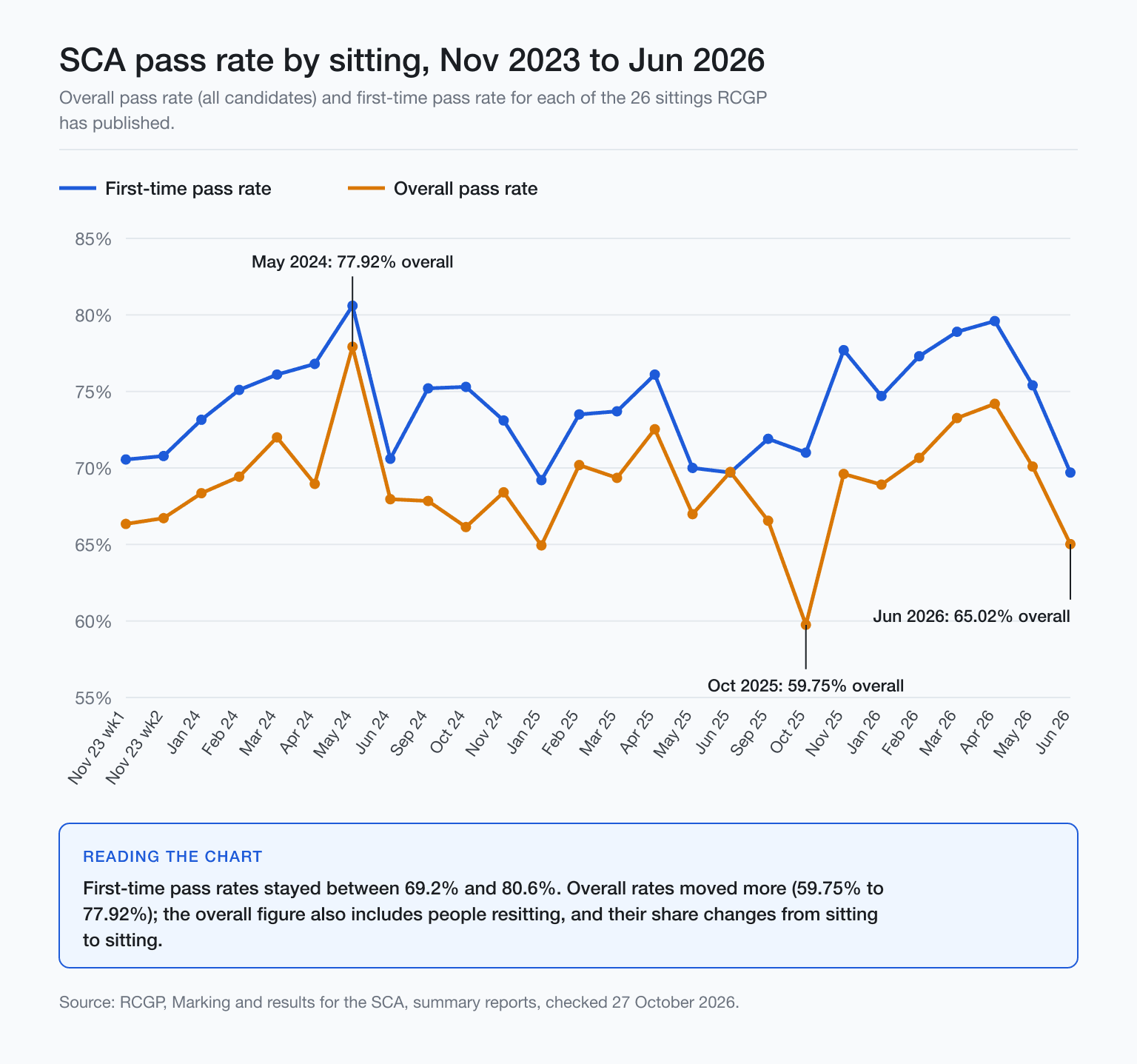
In the June 2026 sitting, 565 of 869 candidates passed the SCA, an overall pass rate of 65.02%. Across 26 sittings, November 2023 to June 2026, rates ranged from 59.75% in October 2025 to 77.92% in May 2024. By qualification the gap is larger, 93.73% of UK graduates passed first attempt in 2024-25 vs 53.64% of international graduates. This page puts every sitting in one table, the first-attempt split, how the pass mark is set, and why rates move, sourced from RCGP's SCA results page.
What is the SCA pass rate?
The SCA pass rate is published by the RCGP in two ways. Per sitting, you’ll see an overall pass rate and a first time pass rate. Per exam year in the annual report, you’ll see first attempt rates by graduate group and an in year cumulative rate.
Across 26 published sittings, there were 12,140 passes from 17,573 sittings, 69.08%. This arithmetic uses RCGP counts and it counts sittings, not unique people, so someone who resat appears twice.
By sitting, the first time pass rate ranged from 69.2% in January 2025 to 80.6% in May 2024.
For the 2024 to 2025 exam year, nine SCA sittings saw 5,094 candidates make 5,998 attempts. The in year cumulative pass rate was 80.45% and the first attempt rate was 72.81%, per the 2024-25 MRCGP annual report.
For 2023 to 2024, the in year cumulative pass rate was 81.18% and the overall first attempt rate was 74.57%.
If you’re practising for SCA-style consultations between sittings, see practising consultations without a partner.
SCA pass rate by sitting, 2023 to 2026
The SCA pass rate by sitting is listed below for all 26 sittings RCGP has published between November 2023 and June 2026. The table shows candidates, passes, overall rate, the share of first-time sitters, and first-time pass rate. All figures are copied from the RCGP marking and results page, checked on 27 October 2026.
Sitting | Candidates | Passed | Overall pass rate | First-time sitters | First-time pass rate |
|---|---|---|---|---|---|
Nov 2023 (week 1, 7-10 Nov) | 508 | 337 | 66.34% | 72.6% | 70.55% |
Nov 2023 (week 2, 14-16 Nov) | 607 | 405 | 66.72% | 86.8% | 70.78% |
Jan 2024 | 613 | 419 | 68.35% | 81.4% | 73.15% |
Feb 2024 | 795 | 552 | 69.43% | 85% | 75.1% |
Mar 2024 | 775 | 558 | 72.00% | 82.58% | 76.10% |
Apr 2024 | 699 | 482 | 68.96% | 78.26% | 76.8% |
May 2024 | 788 | 614 | 77.92% | 72.08% | 80.6% |
Jun 2024 | 796 | 541 | 67.96% | 59.42% | 70.6% |
Sep 2024 | 625 | 424 | 67.84% | 55.52% | 75.2% |
Oct 2024 | 573 | 379 | 66.14% | 57.24% | 75.3% |
Nov 2024 | 611 | 418 | 68.41% | 77.9% | 73.1% |
Jan 2025 | 619 | 402 | 64.94% | 75.6% | 69.2% |
Feb 2025 | 691 | 485 | 70.19% | 84.1% | 73.5% |
Mar 2025 | 672 | 466 | 69.35% | 78.57% | 73.7% |
Apr 2025 | 648 | 470 | 72.53% | 81.33% | 76.1% |
May 2025 | 736 | 493 | 66.98% | 77.45% | 70% |
Jun 2025 | 823 | 574 | 69.74% | 63.3% | 69.7% |
Sep 2025 | 574 | 382 | 66.55% | 54.5% | 71.9% |
Oct 2025 (30 Sep-2 Oct) | 559 | 334 | 59.75% | 54.9% | 71% |
Nov 2025 | 714 | 497 | 69.61% | 68.3% | 77.7% |
Jan 2026 | 521 | 359 | 68.91% | 71.2% | 74.7% |
Feb 2026 | 777 | 549 | 70.66% | 78.8% | 77.3% |
Mar 2026 | 733 | 537 | 73.26% | 78.2% | 78.9% |
Apr 2026 | 585 | 434 | 74.19% | 79.5% | 79.6% |
May 2026 | 662 | 464 | 70.09% | 72.36% | 75.4% |
Jun 2026 (2-5 Jun) | 869 | 565 | 65.02% | 65.7% | 69.7% |
RCGP states the first sitting in November 2023 is "not a straightforward comparison" with the previous RCA exam because the SCA is a new examination. November 2023 was reported as two separate weeks on the RCGP marking and results page.
On 14 November 2023 an IT incident meant 52 candidates were not given results.
Earlier reports included a mean score, 83 or 84 out of 126 for November 2023 to March 2024. Later reports list only the highest mark, which ranged from 112 to 123.5 out of 126.
First-attempt SCA pass rates: UK vs international graduates
First-attempt SCA pass rates show a wide split by training origin. In the 2024-25 exam year, 93.73% of UK graduates passed on their first attempt, against 53.64% of international medical graduates, 72.81% overall. In 2023-24 the figures were 94.28% and 51.56%, 74.57% overall, from the 2023-24 annual report.
- 2024-25: UK graduate women 96.38%, UK graduate men 90.13%; international graduate women 62.68%, international graduate men 44.41%.
- 2023-24: UK graduate women 95.93%, men 92.94%; international graduate women 57.30%, men 44.52%.
- 2024-25 candidates across AKT and SCA: 9,353 unique people, 3,948 UK graduates (42.21%) and 5,405 international graduates (57.79%), qualifying in 111 countries.
- RCGP says differential attainment "cannot be attributed to a single identifiable cause" and results from "multifactorial influences". Place of primary medical qualification is not the same as nationality. UK nationals who studied abroad count as IMGs. RCGP warns that many candidates did not declare sex or ethnicity, so the split by sex is not a full picture.
These are group averages; they say nothing about any individual's chances.
How is the SCA pass mark set?
The SCA pass mark is not fixed per case. RCGP sets each case using borderline regression, then aggregates your marks across 12 cases, so you don’t need to pass a set number of cases. Borderline candidates anchor where the pass line sits, which can vary between cases and sittings.
You sit 12 consultations with simulated patients, professional actors, 12 minutes each, remotely on an online platform, against the standard of a newly qualified GP fit to consult without supervision.
Each case has three domains, data gathering and diagnosis, clinical management and medical complexity, and relating to others, with clinical management and medical complexity weighted more. Domains get clear pass, pass, fail or clear fail, see how OSCE examiners judge performance. Examiners give a global judgement, and borderline regression uses these with the domain marks to set the case pass mark.
You’re marked by 12 different examiners, one per case, and falling short on one case "will not mean you have failed the entire examination".
If you want extra reps at consulting out loud and committing to a diagnosis and plan between sessions with your trainer, you can rehearse a consultation with an AI patient, free to start.
Why do SCA pass rates move between sittings?
SCA pass rates mix first-time sitters and people resitting, and that mix swings by sitting. First-time pass rates have been steadier, roughly 69.2% to 80.6%, while overall rates have ranged further, 59.75% to 77.92%. If you quote one SCA pass rate without the split, you’re comparing different cohorts.
October 2025 had only 54.9% first-time sitters. Their pass rate was 71%, but the overall rate was 59.75%, the lowest so far. Using RCGP’s rounded figures, that implies roughly 46% of resitters passed, our arithmetic, since RCGP doesn’t publish that number.
May 2024 was the opposite pattern, with 72.08% first-time sitters, a first-time pass rate of 80.6%, and an overall rate of 77.92%, the highest.
By June 2026 the first-time share was 65.7%, the first-time pass rate 69.7%, and the overall 65.02%.
Autumn sittings, September and October 2024 and 2025, had the lowest first-time shares, 54.5% to 57.24%.
Because borderline regression sets the pass line per case, a low overall rate isn’t, on its own, evidence that a sitting was harder or that marking changed. Cohort mix matters.
The same pattern, separate sources telling different stories, shows up in other college exams, see how PACES pass rates compare.
When you quote a figure, say whether it’s overall or first-time, and which sitting.
What the SCA numbers mean for how you prepare
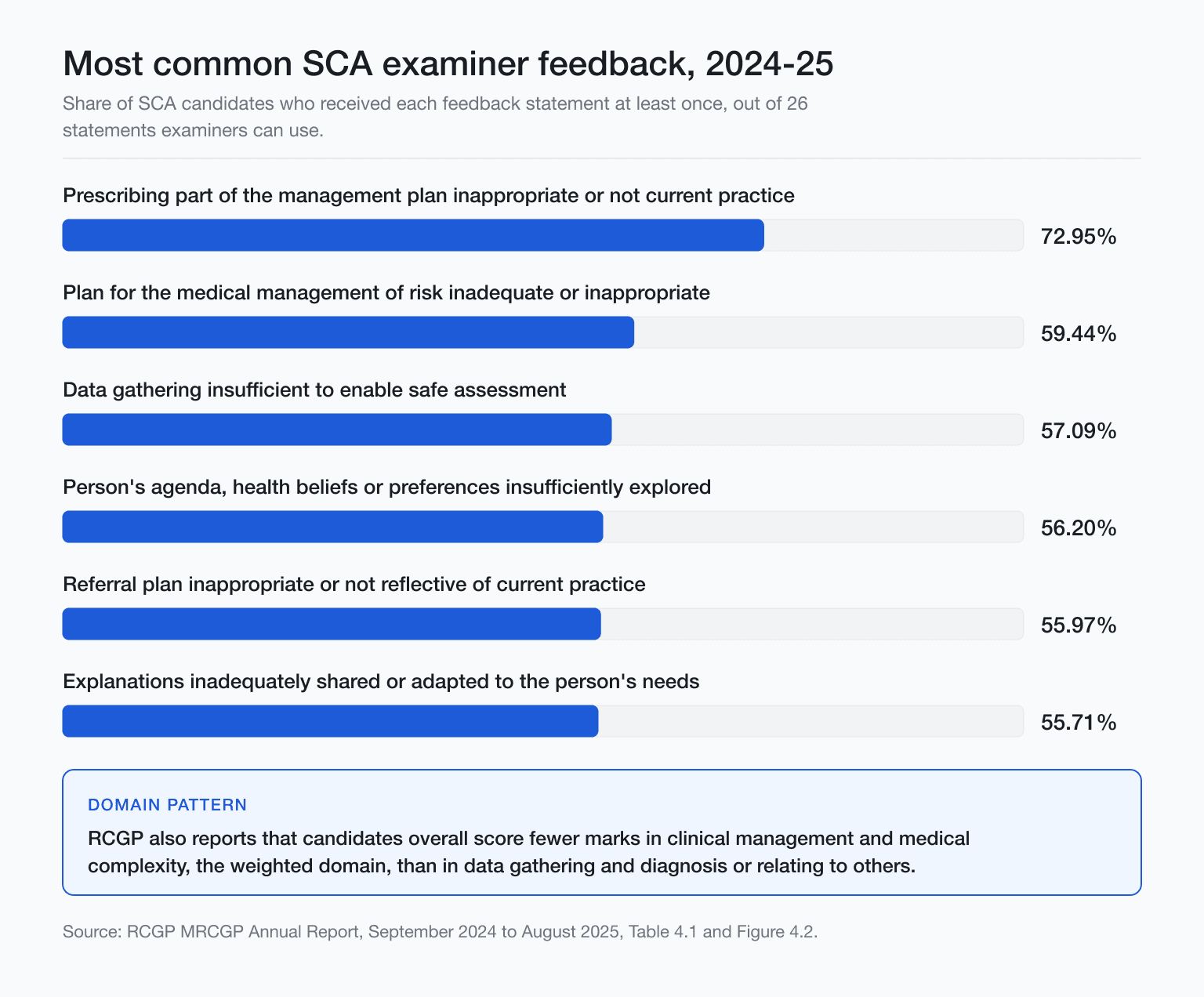
The SCA numbers are most useful for preparation when you look past the pass rate to what examiners wrote. The 2024 to 2025 RCGP annual report lists how often each of 26 feedback statements was given. Those frequencies point to repeatable gaps you can target in practice, especially prescribing, risk management, referrals, data gathering, and exploring the person’s agenda.
Most common statements in 2024-25, percent of candidates who received each at least once:
- Prescribing part of the management plan inappropriate or not reflective of current practice: 72.95%
- Plan for the medical management of risk inadequate or inappropriate: 59.44%
- Data gathering insufficient to enable safe assessment: 57.09%
- The person's agenda, health beliefs and/or preferences insufficiently explored: 56.20%
- Referral plan inappropriate or not reflective of current practice: 55.97%
- Explanations inadequately shared or adapted to the person's needs: 55.71%
RCGP also notes candidates overall score fewer marks in clinical management and medical complexity than in the other two domains.
Start by reviewing your own results feedback with your trainer, as RCGP advises, and discuss resit timing with them.
Work through RCGP's free consultation toolkit, with attention to prescribing decisions, referrals, and shared explanations.
Practise eliciting the person's own agenda, for example by exploring ideas, concerns and expectations.
If a sitting has gone badly, read what a failed OSCE means for general OSCE guidance. It's not SCA specific.
Common questions
How many people pass the SCA on their first attempt?
The SCA first attempt pass rate in 2024 to 2025 was 72.81% across all first time candidates. RCGP reports that UK graduates achieved 93.73% on first attempts, while international graduates achieved 53.64% in the same period. Across all 26 published sittings, first time rates ranged from 69.2% to 80.6%.
Is there a fixed pass mark for the SCA?
The SCA doesn't have a fixed pass mark. RCGP uses borderline regression for each case, then aggregates your marks across all 12 cases to reach the decision. There isn't a set number of cases you must pass. The overall aggregated mark against the standard determines the outcome.
Can you fail one SCA case and still pass?
Yes. RCGP states that not reaching the pass mark on one SCA case doesn't mean you fail the exam, because the aggregated mark across all 12 cases decides the result. The SCA outcome is based on the combined performance, not a pass or fail per individual case.
How long is the SCA?
The SCA lasts for 12 consultations of 12 minutes each, sat remotely from your own GP surgery, and it's marked afterwards by 12 different examiners. SCA marking is conducted after the sitting rather than live, with a separate examiner responsible for each case rather than one examiner for the whole sitting.
Try Diagnosica Diagnosica is an AI clinical simulator for medical students and junior doctors: you take a history from an AI patient by voice or text, order labs and imaging, commit to a diagnosis and management plan, and get a competency scorecard. The patient appears as a video patient. It is free to start with no card, on iPhone, Android and the web, and doctors use it outside the US too. It's not an RCGP product and doesn't replace sessions with your trainer. Start a free case