Collateral History Taking: A Phone Script That Works

What is collateral history taking?
Collateral history taking is defined by ARC West, 3 Oct 2023, as information from someone other than the patient, such as family, friends, carers or health professionals. You use it when the patient can’t give a full account, or to confirm and add to it, across health, social and functional details.
You’re asked to ring a parent or relative. You’ve a phone and headings, but nobody has shown you the words to start, how to check consent, or how to end.
This post gives you: when to take a collateral history, the consent and confidentiality checks before you dial, a phone script, an example of a father describing his seven-month-old baby, and how to write it up.
Scope check, this covers history only, not what to do about any diagnosis. For wider routines, see history practice without a partner.
When do you need a collateral history?
A collateral history is needed whenever the patient can't give the full story themselves, and it also helps when you need the patient's normal, like baseline function, mobility and social set-up. An ARC West summary names dementia as an example, and says knowing the normal helps with diagnosis and ongoing management.
- Baby or young child, the parent is the historian.
- Older adult with dementia or confusion.
- Too unwell or drowsy to give an account.
- Story that doesn't quite add up.
An ARC West summary of a BMJ paper says collateral histories are "commonly either not taken, or taken but not well recorded", with barriers of time, difficulty contacting family and low value placed on it. In a Derby audit, November to December 2024, 30 patients, 87% had events documented; baseline mobility enquiry rose from 10% in 2020 to 70% in 2024, but relatives' concerns appeared in only 37%.
Consent and confidentiality before you dial
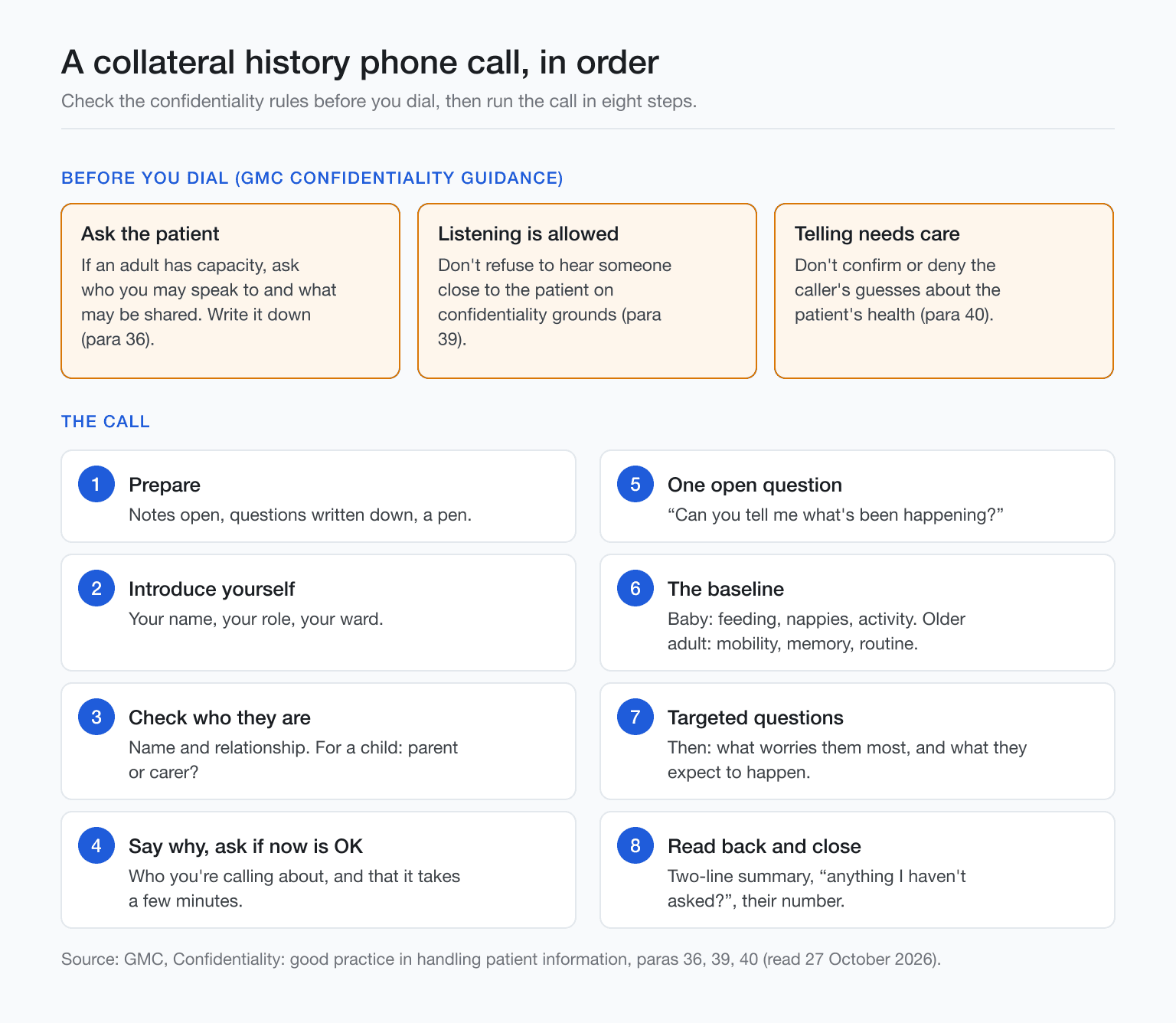
Consent and confidentiality in a collateral history hinge on two acts, listening and telling. Listening to someone close to the patient is not a breach. Telling them anything is where consent bites. Before you ring, be clear what you can hear, and what you cannot say back without the patient's permission.
- If the adult patient has capacity, ask who you can speak to and what can be shared, then write their wishes down (para 36). Presume capacity for these decisions (para 41).
- Do not refuse to listen on confidentiality grounds, the information they give might help the patient's care (para 39).
- Avoid accidental disclosure, for example by confirming or denying the caller's guesses about the patient's health (para 40). You might need to tell the patient what you heard (para 40).
- Relatives, friends or carers have no general right to records or to irrelevant information (para 46).
- For babies and young children, the same duties apply as for adults (0-18 para 43). Inform, where appropriate, those with parental responsibility (0-18 para 43). On the phone, confirm who you're speaking to and their relationship.
Be considerate and responsive to those close to the patient while respecting confidentiality (para 34), and follow local trust policy. The detail sits in the GMC confidentiality guidance and the GMC 0-18 guidance.
The collateral history phone script, line by line
A collateral history phone call works best as a short, ordered call with a set opening, one open question, targeted questions and a read back. The aim is clarity and consent. Use this eight step script to keep it kind, structured and complete, then finish.
- Prepare. Patient notes open, your questions written down, a pen ready.
- Introduce yourself. "Hello, I’m [your name], one of the junior doctors on [ward]."
- Check who you're speaking to. "Could I take your name, how you’re related to the patient, and for a child confirm you’re the parent or carer?"
- Say why you're calling. "I’m calling about [patient’s name], it should take a few minutes, is now a good time to talk?"
- One open question. "To begin, can you tell me what’s been happening?"
- The baseline. "What’s normal day to day, for a baby that’s feeding, nappies, activity, for an older adult mobility, memory, routine?"
- Targeted questions. "I’ve a few specific questions, what worries you most, and what were you expecting to happen?"
- Read back and close. "So to check I’ve got this right: [two-line summary]. Is there anything I haven’t asked that matters, and could I take your number and a good time to call back?"
If they ask how [patient’s name] is, don’t confirm or deny guesses. Say you’ll ensure someone who can update them calls back, and note it. The same rules that keep the call focused apply.
Worked example: a father's account of a seven-month-old
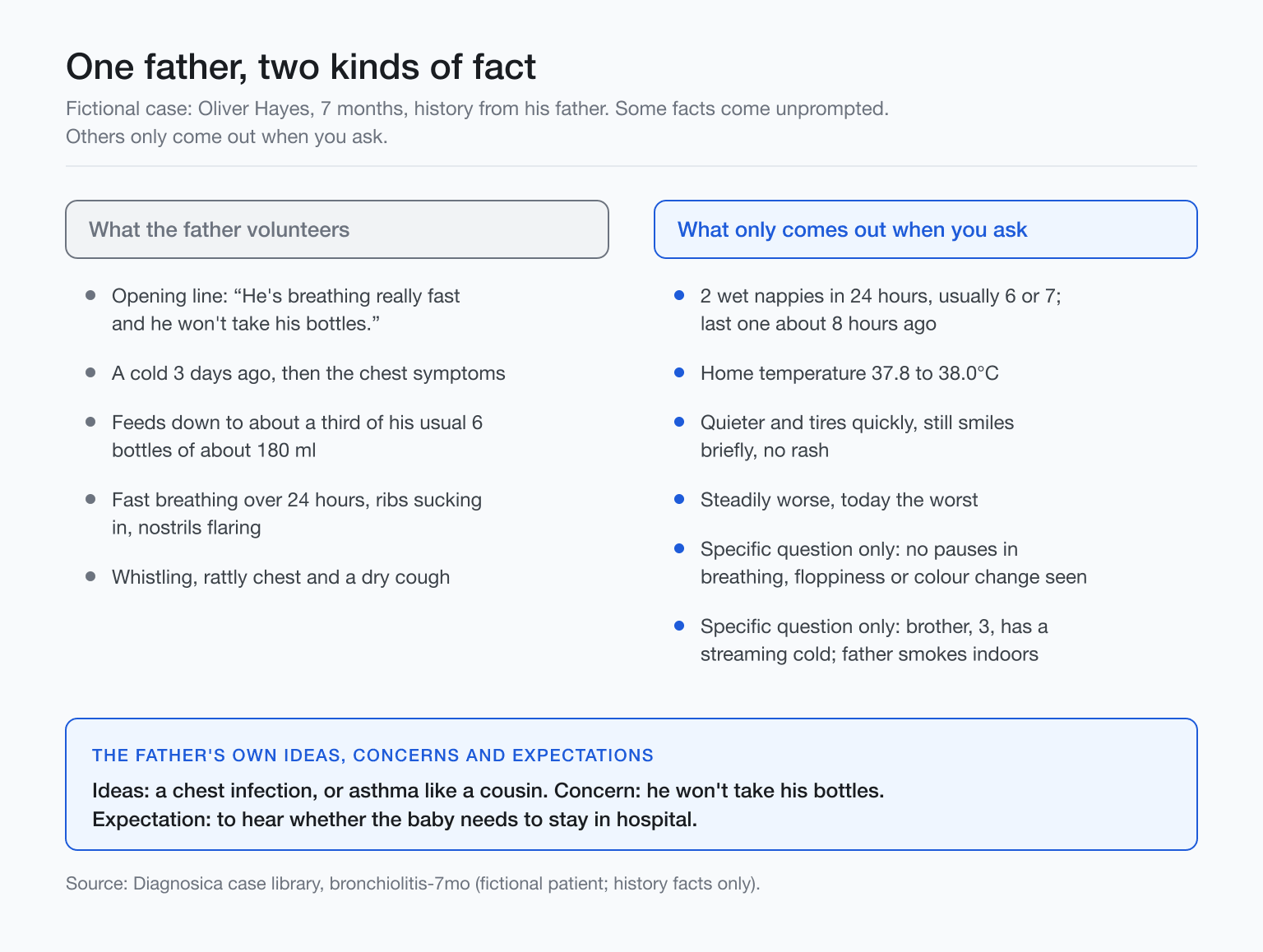
This worked example uses a fictional case from the Diagnosica case library, Oliver Hayes, 7 months, where the history comes from his father. In the case the father is at the bedside, the same questions work down a phone. Some facts the father volunteers, others only come out if you ask, and a few need a specific probe.
"He's breathing really fast and he won't take his bottles, he's had hardly anything since yesterday."
What he volunteers
- A cold 3 days ago then chest symptoms.
- Feeds down to about a third of 6 bottles of about 180 ml.
- Fast breathing with ribs sucking in and nostrils flaring over 24 hours.
- Whistling rattly chest and a dry cough.
What only comes out if you ask
- 2 wet nappies in 24 hours vs usual 6 or 7, last about 8 hours ago and dark.
- Home temperature 37.8 to 38.0°C.
- Quieter, tires quickly, still smiles briefly, no rash.
- Steadily worse, today the worst.
- Hasn't seen him stop breathing or go floppy, pale or blue, "though he has not been watching every single minute" (only on a specific question).
- 3-year-old brother at nursery with a streaming cold, and the father smokes indoors in the evenings (only on a specific question).
His ideas are a chest infection needing antibiotics, or asthma like a cousin. His concern is that he won't take his bottles. His expectation is to be told whether the baby needs to stay in hospital, which sits under the parent's own worries.
You can practise this father's history as a fictional AI patient.
How do you write up a collateral history?
Writing up a collateral history means documenting who said what, so the next person can judge the source and content. ARC West found these histories are often taken but not well recorded. Title it plainly, time stamp it, and quote key phrases where wording matters. You are not reconciling accounts, you are documenting them.
- Date and time.
- Phone call, or in person.
- Name, relationship, contact number.
- Why a collateral account was needed.
- Their account, in their words where it matters.
- Baseline they described.
- Their concerns and expectations.
- Differences from the patient’s account, recorded as differences, not resolved.
- What you told them, and the patient’s recorded wishes about sharing (GMC para 36).
A designated place in the notes and a template helps.
It slots into the admission clerking, and when you're presenting it on rounds, say in one line who gave the history.
Practising a parent's history before the real call
If you're practising a collateral history before the real call, say your first lines out loud, then rehearse the identity and consent check, and finish with a read-back. Do it with a friend playing the parent, or with an AI patient. Aim for calm, short questions, and a closing summary they can correct.
Diagnosica is an AI clinical simulator for medical students and junior doctors: you take a history from an AI patient by voice or text, order labs and imaging, commit to a diagnosis and management plan, and get a competency scorecard. Each patient appears as a video avatar, and in its paediatric cases a parent gives the history, like the father above. It's free to start, no card needed, with apps on iPhone and Android plus the web app. It isn't built for one country's exams. It doesn't simulate a phone line to a relative and it has no physical examination.
It doesn't give advice about real patients, and it's not a diagnostic system. Treat every output as educational.
Start here: Start a free case.
Common questions
Who can give a collateral history?
Family, friends, paid or unpaid carers, and other health professionals can give a collateral history. Choose whoever has direct recent observations of the problem. For a baby, that’s usually a parent. If several people hold pieces, take brief accounts in turn and label each source in your notes so the provenance of every detail stays traceable.
Do you need the patient's consent to take a collateral history?
You don’t need consent to listen to a collateral history, and you shouldn’t refuse a concerned person on confidentiality grounds. Consent matters to what you share back. If the patient is an adult with capacity, ask them first who they want involved before you call. Then keep your side of the call within that agreed scope.
What if the relative's account doesn't match the patient's?
Record both versions and who gave each, don’t pick a winner in the notes. Inconsistencies and reporting bias are known issues with collateral histories, so document the exact words where it matters and keep attribution clear. Your job is to capture the data cleanly now, then discuss differences with the team and the patient in person.
Can I tell the relative how the patient is doing?
You can share only what the patient has agreed you can share. If they lack capacity, it’s reasonable to keep those closest informed of the general condition unless the patient previously indicated otherwise. Avoid confirming or denying guesses or speculation. Keep it general, steer back to the caller’s observations, and follow your local policy on updates.