Signposting in history taking: 20 phrases that work

Signposting in history taking is a short transitional statement that says what you'll ask about next and, ideally, asks permission. Example: "Can I ask next about your ideas and any worries?" This is the consultation skill, not the NHS practice of directing people to services.
If you're losing marks for structure, your station probably sounds like a list of questions. The jumps are abrupt, the patient tightens, and you end up firefighting timing and rapport.
You'll get a clear definition, why it's marked, a 20 phrase bank grouped by transition, and one whole history signposted with a fictional AI patient case. If you're practising solo, see OSCE stations on your own.
What is signposting in history taking?
Signposting in history taking is a short spoken statement that tells the patient what you'll do next. Bradford VTS defines it as "Signposting is a transitional statement that verbally labels what you're planning to do next in the consultation." Used consistently, it smooths transitions and makes your organisation explicit to the patient.
The Calgary-Cambridge guide, developed by Kurtz and Silverman in 1996 and updated in 2003, places signposting inside a teachable consultation structure, described in a 2024 paramedic study.
The Calgary-Cambridge teaching slides outline five stages, initiating the session, gathering information, physical examination, explanation and planning, and closing the session, with two threads throughout, providing structure and building the relationship. They delineate 71 skills. Signposting sits under providing structure as making organisation overt, alongside internal summarising.
Put simply, a signpost looks forward, it tells the patient where you are going next. A summary looks back. Bradford VTS defines summarising as "Summarising is the deliberate step of making an explicit verbal summary to the patient of the information gathered so far."
Why do examiners mark signposting?
Signposting in an OSCE or SCA mark scheme is scored because it makes your structure visible and keeps the patient aligned. In the Calgary-Cambridge guide, it sits under Providing structure, with aims of a flexible but ordered consultation, overt patient involvement in direction and reasons, and efficient use of time.
Bradford VTS says signposting and summarising are explicitly assessed in the SCA's Relating to Others domain in the Bradford VTS phrase bank, and reports that candidates who skip transitions feel abrupt or doctor centred, while those who skip summaries seem not to be listening. Examiners also notice when you jump from history to examination without warning.
Worried it wastes time, especially in a station clocked to the minute. Bradford cites Stewart 1985, where high patient centredness visits ran 8.5 minutes versus 7.8, a 42 second difference, and Roter et al. 1995, which found no increase in consultation length after communication training that included summarising and signposting.
Medical school OSCE mark sheets vary, and schools differ in how they word this, but the intent stays aligned with Calgary-Cambridge's structure thread. For how criteria are framed and grouped, see our examiner mark sheets explained.
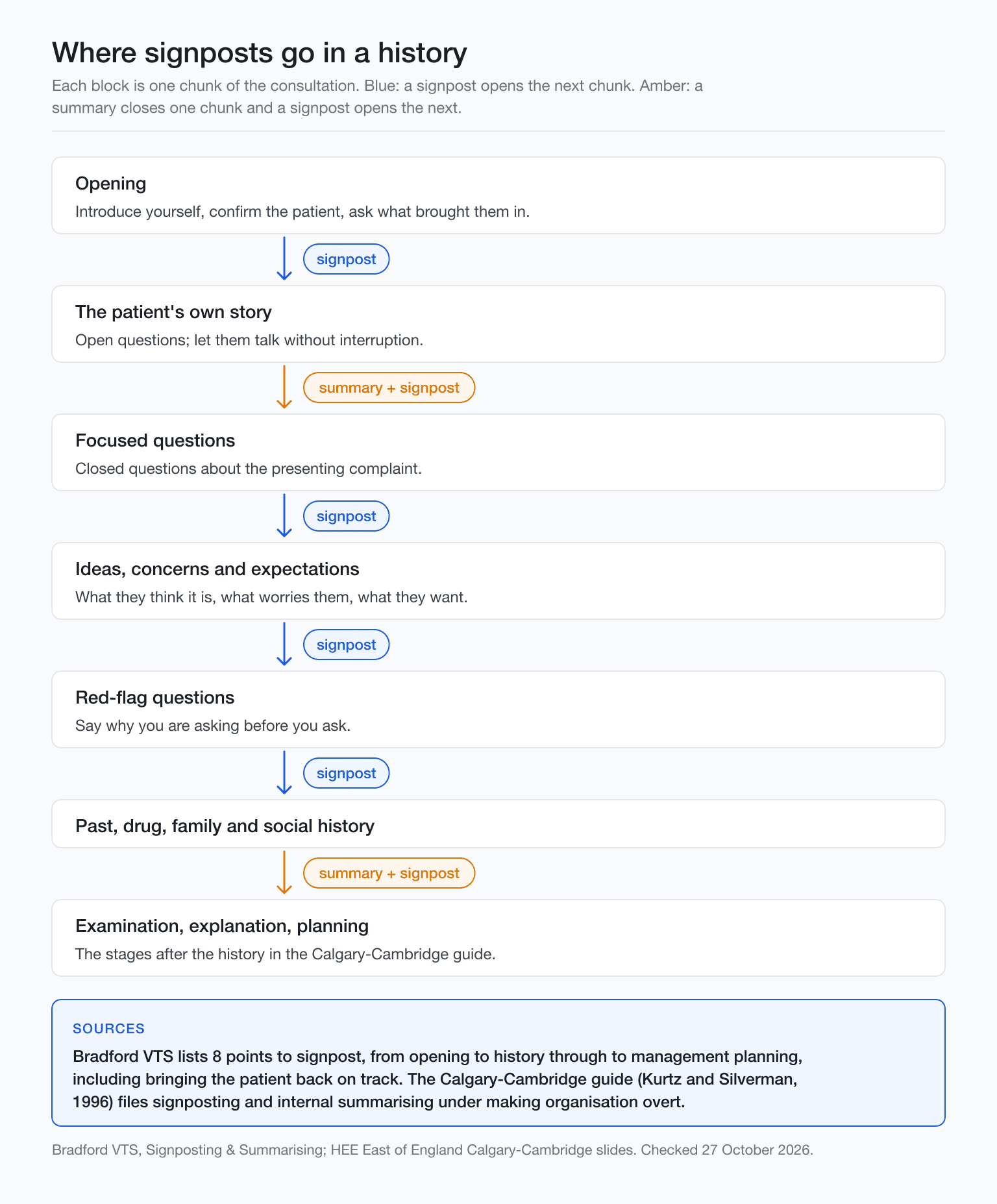
The phrase bank: 20 signposting phrases for every transition
A signposting phrase bank for history taking, organised by the Bradford VTS transitions, is below. These are templates you can adapt into your own voice to label what happens next and invite consent, so your structure is visible to the examiner and kind to the patient.
Bradford VTS reports that "Can I now ask..." scores higher than "I'm going to ask...". For question style, see moving from open to closed.
- Opening and screening: "Shall we start with what's brought you in today?"
- "Can I check your main worries before we go further?"
- "Would it help if we set out what you'd like from today?"
- Open to closed questions: "Can I ask some yes or no questions to pin details down?"
- "Is it alright if I ask some more focused questions now?"
- "Shall I ask a few specific questions to get the timeline clear?"
- Into ideas, concerns and expectations: "Can I ask what you think might be going on?"
- "What's been worrying you most about this?"
- "What were you hoping we could sort out today?"
- Into red flag questions: "Can I check a few safety questions, to rule out anything needing urgent attention?"
- "Is it alright if I ask checks to make sure nothing serious is being missed?"
- Into past medical, drug, family and social history: "Can I ask about your health background, medicines, and family illnesses?"
- "Would you mind if I ask about smoking, alcohol, work, and home?"
- "Can I check allergies and any medical conditions you live with?"
- Bringing the patient back on track: "Shall we park that for a moment, and finish questions about this problem?"
- "Can we come back to that shortly, so I can complete a few key questions?"
- Into examination: "If it's okay, I'd like to examine the area you've described."
- Into explanation and closing: "Can I explain what I think so far, and check it fits your experience?"
- "Shall we talk through next steps and what they might involve?"
- "Before we finish, can I summarise and make sure your questions are answered?"
These are templates, not scripts. Bradford VTS advises adapting them to your own voice and keeping them conversational, not robotic. If you need a safe default during the story, anchor yourself with the ICE questions and use a brief signpost before and after.
Summarising and signposting together
Summarising and signposting work best as a pair in history taking. The summary closes one chunk and confirms shared understanding, the signpost opens the next by saying where you are heading. Do them together to keep structure visible and avoid abrupt shifts. That pairing keeps patients with you and helps examiners credit your organisation.
Bradford VTS defines summarising as "Summarising is the deliberate step of making an explicit verbal summary to the patient of the information gathered so far." They also say symptoms alone are insufficient, include the patient's ideas and concerns. Even if you're running late, they advise spending about 20 seconds on a summary.
Template: "You've had a dry cough for two weeks, worse at night, no fevers you've noticed, and you're worried it could be something on your chest. Have I got that right?" That last line is a Bradford VTS phrase. "Could I ask a few questions about your past health next?"
Good pause points, after the patient's own story, just before ICE, and at the end for the closing summary.
A whole history, signposted: a worked example
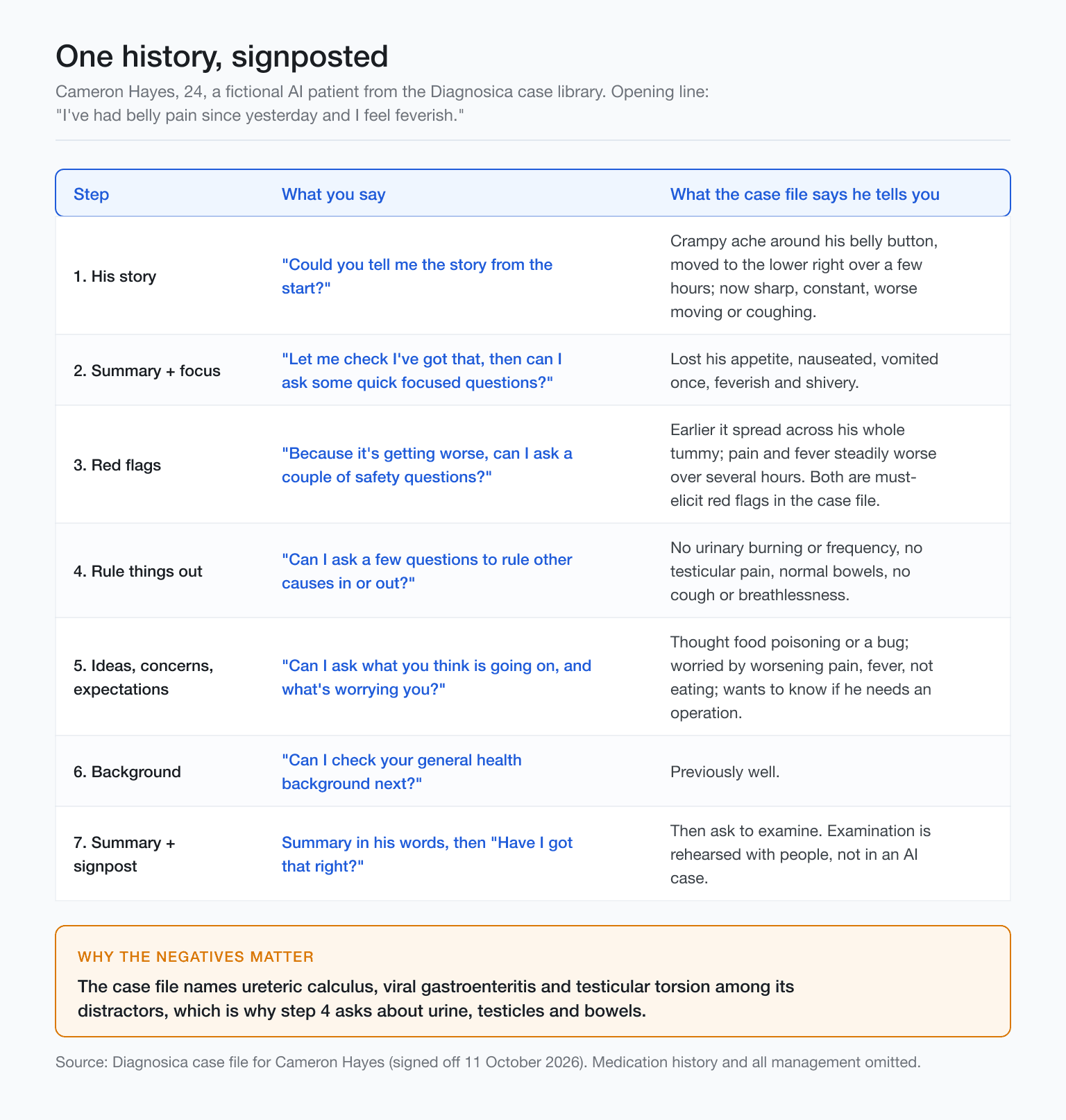
A signposted history worked through one case shows how signposting in history taking sounds when you speak it. Here's a fictional AI patient from Diagnosica's case library, Cameron Hayes, 24, previously well, who opens with "I've had belly pain since yesterday and I feel feverish." The aim is structure you can borrow tomorrow, not a script.
- You: "Could you tell me the story from the start?" He tells you: the pain began around his belly button as a vague, crampy ache, then moved to the lower right side over a few hours; it's now sharp and constant, worse when he moves, coughs or goes over bumps.
- You: "Let me check I've got that, then can I ask some quick focused questions?" He tells you: he's lost his appetite, feels nauseated, vomited once, and feels feverish and shivery.
- You: "Because it's getting worse, can I ask a couple of safety questions?" He tells you: for a while earlier the pain felt like it was spreading across his whole tummy, and his pain and fever have steadily worsened over the last several hours.
- You: "Can I ask a few questions to rule other causes in or out?" He tells you: no burning or frequency passing urine, no testicular pain or swelling, bowels normal with no blood, no cough or breathlessness, and no previous episodes, travel or unwell contacts.
- You: "Can I ask what you think is going on, and what's worrying you?" He tells you: he wondered about food poisoning or a stomach bug; he's worried by worsening right-sided pain, the fever and not eating; he wants the pain sorted and to know whether he needs an operation.
- You: "Can I check your general health background next?" He tells you: he's previously well.
- You: "Pain began by your belly button, moved right, sharp, constant; earlier it spread across your tummy, worsening over hours; off food, sick once, feverish; no urinary symptoms, no testicular pain, normal bowels, no cough or breathlessness; worried about an operation. Have I got that right?" "Would it be alright if I examine your tummy next?" Examination is something you rehearse with people, not here.
The case file lists ureteric calculus, viral gastroenteritis and testicular torsion among its named distractors, which is why those negatives earn their place.
Practise signposting out loud
In Cameron Hayes's appendicitis case, practise signposting from open questions to ICE then red flags. Diagnosica is an AI clinical simulator for medical students and junior doctors: you take a history from an AI patient by voice or text, order labs and imaging, commit to a diagnosis and management plan, and get a competency scorecard. The patient appears as a video avatar, and you can say these to an AI patient who answers back. Free to start with no card needed, iPhone and Android apps, used outside the US. It doesn't practise physical examination.
Mistakes that make signposting sound scripted
Scripted sounding signposting is the reason structure that looks fine on paper feels wooden to the patient and examiner. Signposting in history taking works when it sounds like you, lands at real transitions, and leaves a clear beat for the patient to respond; the delivery errors below cost marks fast.
Announcing instead of asking. Bradford VTS says "Can I now ask..." scores higher than "I'm going to ask...", because asking cues consent and a response.
Repeating the same stock line at every turn. Vary your template and keep it in your voice, as Bradford VTS puts it, "Aim for conversational, not robotic," which also supports a tighter focused history.
Signposting then not pausing for the patient's answer. Leave a beat, since the aim is to invite the patient to think with you and shape the next step.
Summarising symptoms only and skipping the worry. Bradford VTS stresses that a good summary includes symptoms plus ideas and concerns, so name what they think it is and what they fear.
Jumping from history to examination with no warning. Bradford VTS reports examiners notice abrupt jumps, so cue the move first and check they are ready.
Bradford VTS does not warn against too much signposting, and even suggests doing more while you learn, so frequency is not the issue, delivery is.
Common questions
What is an example of signposting in history taking?
An example of signposting in history taking is a brief line that labels the next step. Bradford VTS gives examples such as "Can I now ask what you think might be causing this?" and "We'll come back to that in a moment, but first can I finish these important questions about [main problem]?", which prepare the patient for the change.
How often should you signpost in an OSCE station?
Signposting in an OSCE station should happen at each major transition. Bradford VTS lists eight common transitions, for example moving from open to closed questions or from history to examination. Bradford VTS also advises that "Can I now ask..." scores higher than "I'm going to ask...", so delivery and tone matter more than raw frequency.
Is signposting part of the Calgary-Cambridge model?
Yes. In the Calgary-Cambridge model, signposting sits under Providing structure, with making organisation overt and attending to flow, according to Health Education England East of England slides. The guide delineates 71 skills. Hastings 2024 reports the model was developed by Kurtz and Silverman in 1996 and enhanced in 2003.
Does signposting make a consultation take longer?
Signposting does not meaningfully lengthen consultations. Bradford VTS cites Stewart 1985 showing high patient centred consultations averaged 8.5 minutes versus 7.8 minutes for low, a 42 second difference. Bradford VTS also cites Roter et al. 1995 reporting no increase after communication training that included summarising and signposting, and recommends taking 20 seconds to summarise even when late.
Practise signposting live Practise signposting out loud with an AI patient who answers back. Free to start, no card needed. Start practising