Free Clinical Cases for Medical Students: 11 Places

Where can medical students find free clinical cases?
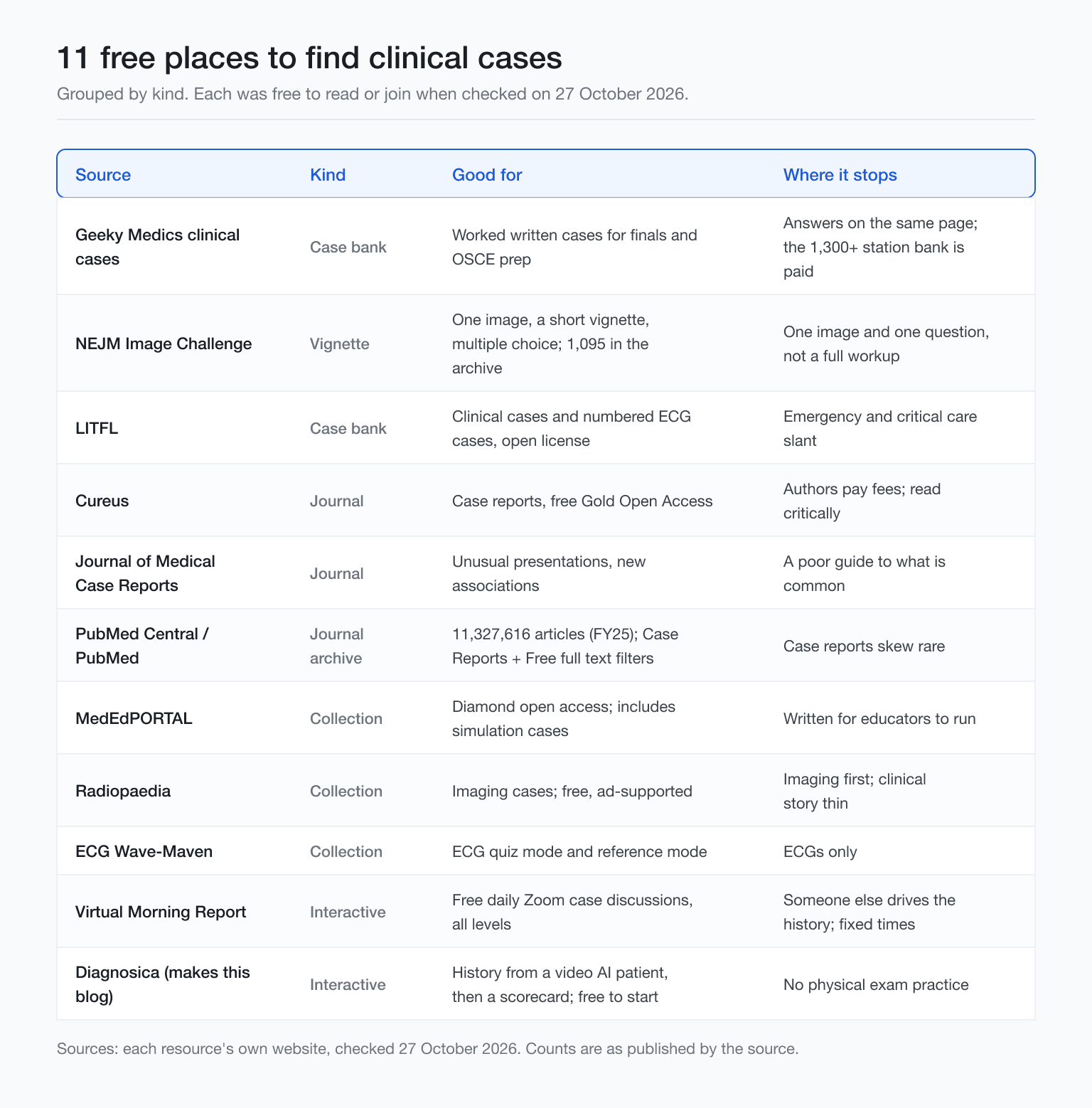
Free clinical cases for medical students come from four kinds of places: written case banks and vignette libraries like Geeky Medics, NEJM Image Challenge, and LITFL; open-access journal case reports like Cureus, Journal of Medical Case Reports, and PubMed Central; university and society collections like MedEdPORTAL, Radiopaedia, and ECG Wave-Maven; and interactive talk-through cases like Clinical Problem Solvers' Virtual Morning Report and Diagnosica. All are free to read or join as of October 2026.
Your rotation starts Monday and you're on a zero budget. You need reps that feel clinical without a paywall, a mix of quick image quizzes and longer worked cases you can practice on a phone between tasks. You don't need another brochure, you need a plan.
The catch is that most free written cases hand you the history and differential. On the wards you're graded on asking for it, not being fed it. The last section shows a repeatable method to turn any written case into conversation practice. Each entry below says who it suits and where it stops.
Written case banks and vignette libraries
Written case banks and vignette libraries are fast ways to practice clinical reasoning for free, especially if you’re hunting for free clinical cases for medical students before rotations. These sites give you templated cases, image prompts, or ECG strips with answer keys. They suit short reps between wards, though they don’t simulate full conversations or let you order tests yourself.
Geeky Medics runs Geeky Medics clinical cases, which open with “Work through the case to reach a diagnosis,” then move through History, Clinical examination findings given as text, Investigations, a differential and final diagnosis, plus management and complications. Good for finals and OSCE-style prep. Where it stops, the answers sit on the same page so it’s easy to peek, and the bigger 1,300+ station bank is a paid product.
The NEJM Image Challenge posts one image with a short vignette and a multiple-choice question each week, then shows the explanation and how readers voted. There are 1,095 challenges in the archive as of October 2026. Great for pattern recognition in 2 minutes. Where it stops, it’s a single image and a single question, not a full workup.
LITFL publishes free Clinical Cases and numbered ECG cases under a Creative Commons license, and its LITFL ECG library is a staple for strip review. Strong fit for EM and ICU rotations and ECG practice. Where it stops, the tilt is emergency and critical care, and some linked courses are paid.
Journal case reports: how do you read one as practice?
Journal case reports are a free way to practice diagnostic reasoning if you treat them as prompts, not as articles to binge. Journal case reports present a concise presentation, the workup, and a discussion you can interrogate stepwise, and as of October 2026 several open-access outlets publish or index them at scale for easy access during rotations.
Cureus publishes case reports as free Gold Open Access and states, “Valuable information should not be hidden behind a paywall.” Authors pay publication fees, so read critically, starting at Cureus.
Journal of Medical Case Reports is open access via BMC on Springer Nature and highlights unexpected or unusual presentations and new associations, which is great for stretching your differential but a poor guide to what’s common on the wards.
PubMed Central is a free full-text archive at the NIH’s National Library of Medicine with 11,327,616 articles available in FY25, and PubMed’s filters make it workable for practice; a “Case Reports” plus “Free full text” search for appendicitis returned 3,221 results on 27 October 2026 in this filtered PubMed search.
- Read only the presentation, then stop.
- Write your differential and the first tests you’d order.
- Read the workup and discussion, then compare line by line.
- Note one pattern you missed and one fact you didn’t know.
Case reports skew rare, that’s why they got published.
If you’d rather ask the questions yourself than read them, you can take a history from an AI patient.
University and society case collections
University and society case collections are free-to-read archives that skew educational over exam-like, which suits a weekend tune up before your first day. You get curated cases with a clear teaching intent. You won’t always get scoring or a simulated patient conversation, but you will get structured reasoning practice and credible source material.
MedEdPORTAL is the AAMC’s MEDLINE-indexed, diamond open-access journal, free worldwide with no fees, and includes simulation cases such as a toxicology simulation case for fourth-year students published 14 October 2026. It suits students who want educator-grade scripts, but it stops short because it’s written to be run by faculty, not solo.
Radiology-heavy week ahead, or you want to read films cold, then check yourself, the Radiopaedia case library is free thanks to supporters and advertisers, with a paid Gold tier that removes third-party ads. It suits image-first learning. It stops where the clinical story thins out, because imaging leads.
ECG Wave-Maven is a self-assessment ECG program sponsored by Harvard Medical School’s Shapiro Institute and Beth Israel Deaconess, with quiz mode, reference mode, and a random case. ECG Wave-Maven loaded with no login form on the page as of October 2026. It stops at ECGs only.
Interactive cases you can talk through
Interactive cases you can talk through are the closest free clinical cases for medical students who want to practice taking a history without a partner. You can either join live case discussions where someone presents an unknown, or run a simulated patient yourself. You won't practice physical exam maneuvers here, and timing differs between live and on-demand.
For live reps, The Clinical Problem Solvers run free daily Zoom sessions at their Virtual Morning Report, where clinicians of all levels discuss clinical unknowns, and you can observe, use the chat, or present. Past sessions sit on their YouTube channel; the tradeoff is someone else drives the history, and you’re tied to fixed times.
Diagnosica makes this blog. Diagnosica is an AI clinical simulator for medical students and junior doctors: you take a history from an AI patient by voice or text, order labs and imaging, commit to a diagnosis and management plan, and get a competency scorecard. The patient appears as a video avatar, it’s free to start with no card needed, works on iPhone, Android and the web, is used by learners outside the US too, and has over 130 cases across 18 specialties, each signed off by a doctor. Stops, no physical exam practice, and “It doesn't give advice about real patients, and it's not a diagnostic system. Treat every output as educational.”
If you want a fuller view of simulators beyond these two, here’s a roundup of free simulators.
How do you turn a written case into practice?
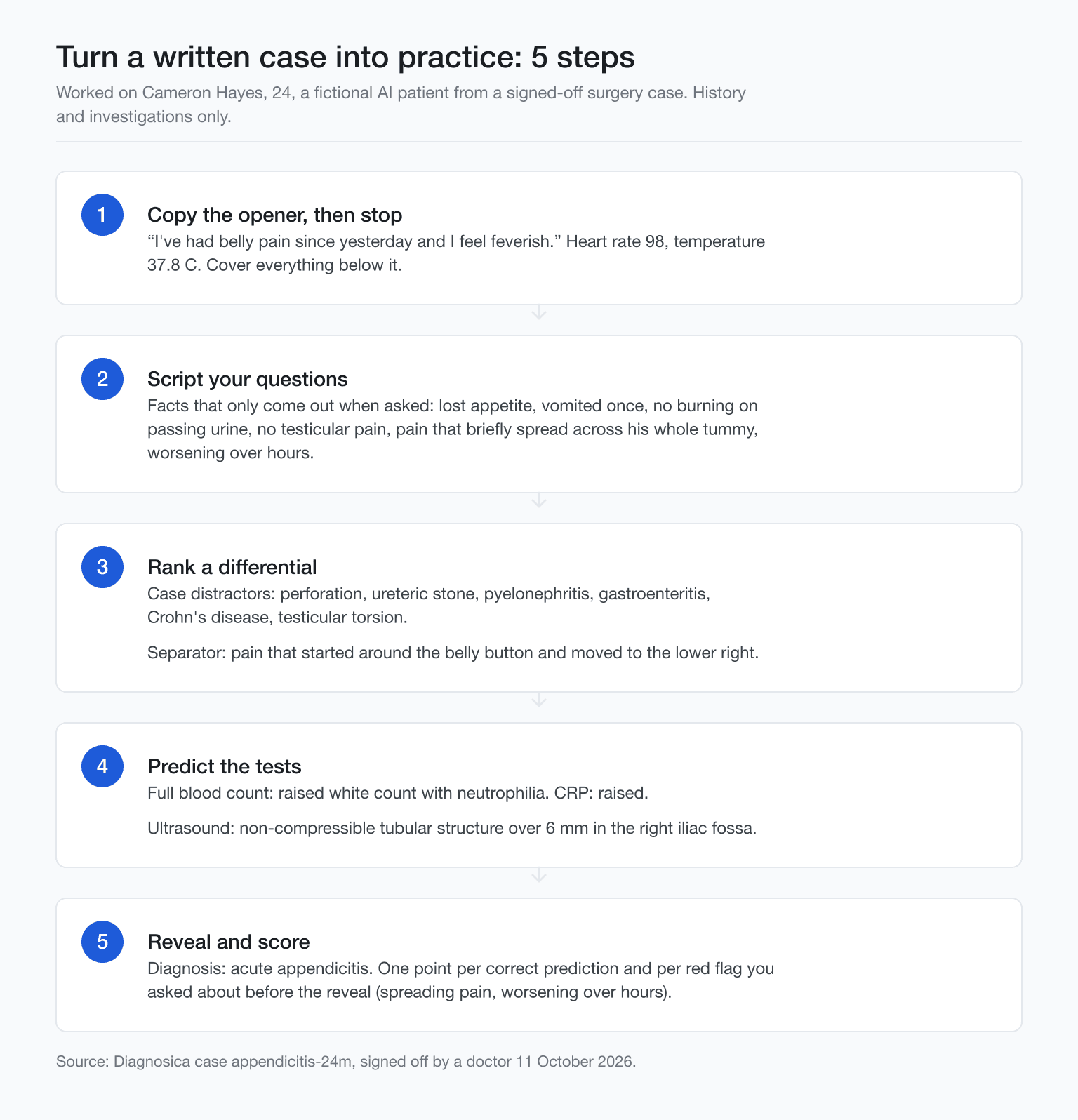
Turning a written case into practice means forcing a decision process before you peek at answers. Here’s a five-step drill on a surgery case with Cameron Hayes, 24, a fictional AI patient, that you can reuse tomorrow: capture the opener, script your questions, rank a differential, predict tests, then reveal and score.
- Copy the opener and vitals before anything else. “I’ve had belly pain since yesterday and I feel feverish.” Heart rate 98 beats per minute, temperature 37.8 C. Stop there. Don’t infer.
- Write the questions you’d ask, then read on and collect what only appears when probed. Lost appetite, vomited once, no urinary burning, no testicular pain, pain briefly spread across his whole tummy, and it’s been worsening over hours. If it helps you organize probes, try writing an illness script.
- Commit a one-sentence ranked differential from the distractor list, then explain the separator. Perforation, ureteric stone, pyelonephritis, gastroenteritis, Crohn’s disease, testicular torsion. The single split, pain that began around the belly button and moved to the lower right is “the single most discriminating historical feature.” Build that list with building a differential from scratch, and stay alert to how distractors mislead you.
- Pick tests and predict results before looking. Full blood count, raised white count with neutrophilia. CRP, raised. Ultrasound abdomen, a non-compressible blind-ending tubular structure over 6 mm in the right iliac fossa. Write the prediction next to each test.
- Reveal and score yourself. Diagnosis, acute appendicitis. Give yourself credit if you actively asked about red flags, the pain spreading across the whole tummy and the steady worsening over hours. Count one point for each prediction and each red flag you secured before the reveal.
Common questions
Are there free clinical vignettes for USMLE-style practice?
Yes, but they’re not board-style banks. The NEJM Image Challenge posts a weekly image with a short vignette and a multiple choice question, with an archive listing 1,095 challenges as of October 2026. Geeky Medics has free text-based clinical cases you can work through end to end. Neither is a true board-style question bank, and a free one isn’t in this list.
Are journal case reports good practice for medical students?
They’re great for reasoning if you use a cover-and-predict method, then verify against the write-up. Open access venues like Cureus and the Journal of Medical Case Reports help, and PubMed Central lists more than 10 million full-text article records. PubMed’s filters showed 3,221 free full-text appendicitis case reports on 27 October 2026. They do skew toward rare or unusual presentations.
Is MedEdPORTAL free for students?
MedEdPORTAL is a MEDLINE-indexed, open-access journal of teaching and learning resources published by the AAMC, and it’s a diamond open-access journal, meaning all publications are freely available worldwide with no submission or publication fees. It includes simulation cases written for educators to run, such as curricula and workshops.
What's the difference between a case bank and a virtual patient?
A case bank hands you the history and exam as fixed text, then you analyze and answer. A virtual patient makes you ask questions to obtain the history, pick investigations, commit to a diagnosis and plan, then see feedback. If you want more options on your phone, here are free study apps worth installing.
Practice patient interviewing on demand Practice the asking part of a case with a fictional AI patient on video, using voice or text, with a scorecard after each case. Free to start, no card, on iPhone, Android or web. Start a case free