How to Recognise a Sick Patient: The End-of-Bed Look
You recognise a sick patient by looking first, the end-of-the-bed look, then running ABCDE, reading the observation trend rather than one number, and acting on your worry by calling for help early. That sequence works at 3am as well as at midday.
3am. A nurse says, 'he just doesn't look right.' You haven't met him.
This post gives you a working end-of-the-bed look, where NEWS2 fits into it, three Diagnosica case-library patients who looked fine at first, and the exact words to use when you escalate, the deep version of one section from the FY1 survival guide. We stick to recognition and escalation, not treatment, prescribing, or procedures.
How do you recognise a sick patient?
Recognising a sick patient starts with a quick general look, then a structured ABCDE assessment, then a check of the trend in the observations, then early escalation. That sequence lets you spot danger, organise your assessment, apply NEWS2 to support judgement, and move before deterioration narrows safe options.
Resuscitation Council UK (RCUK) says first look at the patient in general to see if they appear unwell. It also says do a complete initial assessment and re-assess regularly. NEWS2 should supplement clinical judgement, not replace it. A worried nurse is information in that judgement, because they hold the recent baseline.
Sick-or-not-sick sequence:
- Look, general impression first.
- ABCDE, complete initial assessment.
- Trend the observations and NEWS2.
- Call early if concerned.
What does the end-of-the-bed look check?
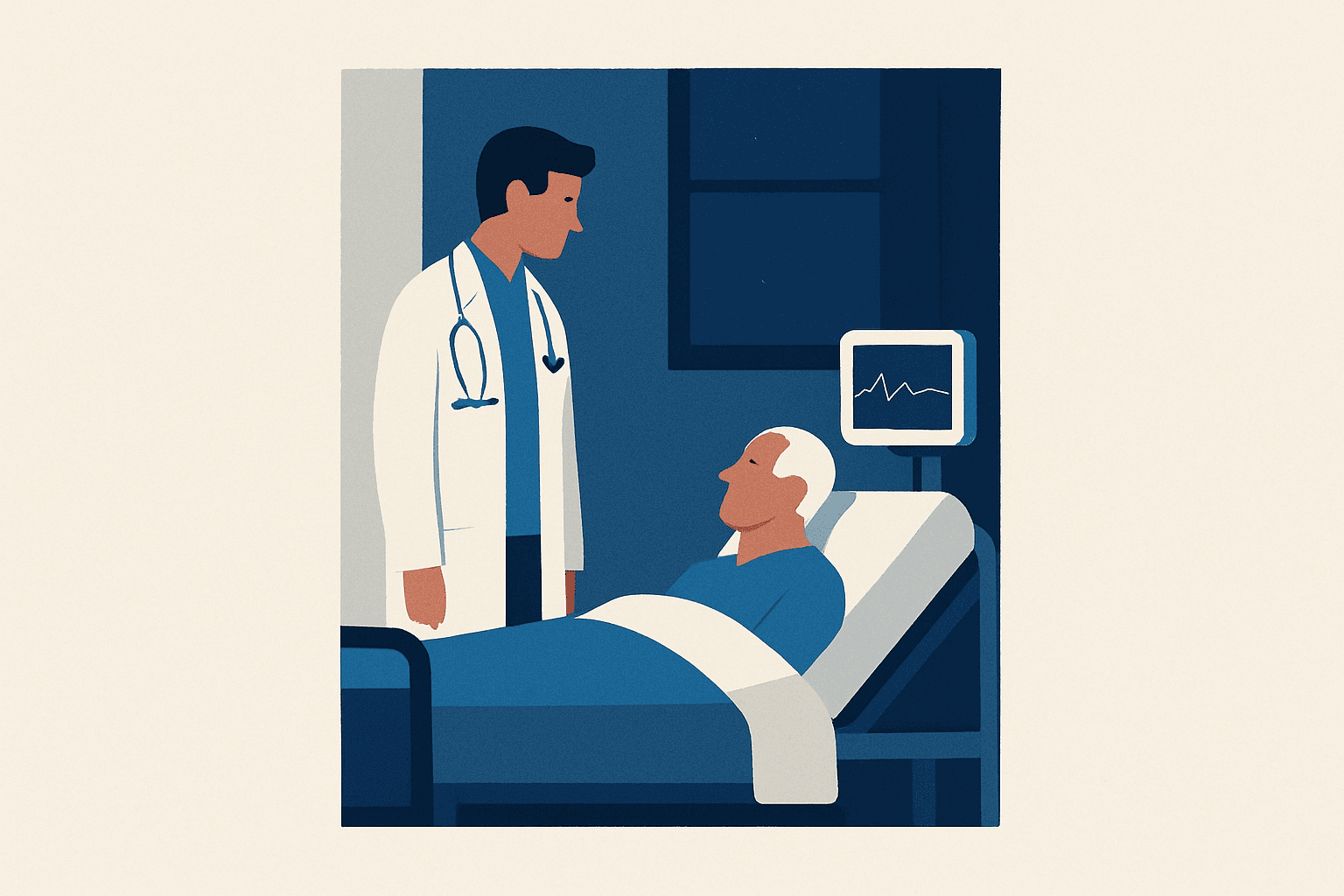
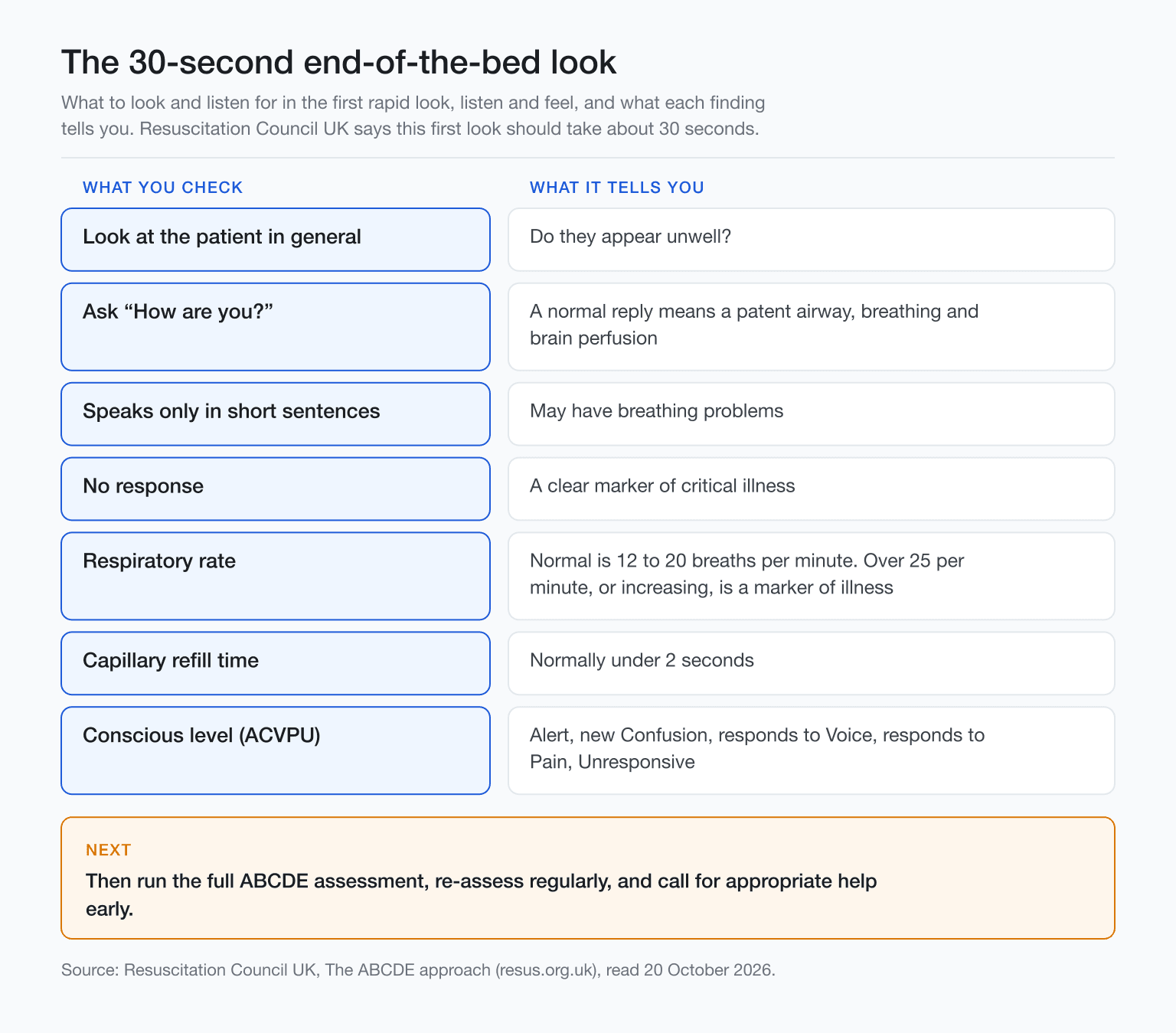
The end-of-the-bed look is the first rapid look, listen and feel. Per Resuscitation Council UK it should take about 30 seconds. It tells you whether the patient appears unwell, whether they can reply normally, and whether there are immediate red flags that warrant urgent help and a structured assessment with the Resuscitation Council UK's ABCDE approach. A 30-second scan often indicates the need for urgent help.
- Ask “How are you?” A normal reply suggests a patent airway, breathing and brain perfusion.
- If the patient speaks only in short sentences, they may have breathing problems, and failure to respond is a clear marker of critical illness.
- Respiratory rate of 12 to 20 breaths per minute is normal, while over 25 per minute, or increasing, is a marker of illness.
- Capillary refill is usually under 2 seconds.
- Use ACVPU for conscious level: Alert, new Confusion, Voice, Pain, Unresponsive.
New confusion is easy to miss in someone you’ve never met. Ask what they were like yesterday.
Why do trends beat a single NEWS2 score?
NEWS2 (the National Early Warning Score 2) from the Royal College of Physicians, dated 19 December 2017 and endorsed by NHS England and NHS Improvement, assigns points to six bedside observations: respiration rate, oxygen saturation, systolic blood pressure, pulse rate, level of consciousness or new confusion, and temperature. It standardises how teams recognise and respond to acute illness, see the RCP's NEWS2 page.
Per the NEWS2 thresholds chart, risk and response trigger at these levels:
- Aggregate 0 to 4 is low clinical risk with a ward-based response.
- A score of 3 in any single parameter is a red score with an urgent ward-based response and at least hourly monitoring.
- Aggregate 5 to 6 is the key threshold for urgent response.
- An aggregate of 7 or more is high risk with an urgent or emergency response and continuous monitoring.
Trends beat a single NEWS2 score because a number is a snapshot. The RCP page says NEWS2 should supplement clinical judgement, so you need trajectory as well as tally. RCUK calls an increasing respiratory rate a marker of illness and tells you to re-assess regularly. Read the chart sideways. What was it four hours ago, and is the respiratory rate creeping up while the blood pressure drifts down.
Practise trends before nights Practise reading a patient's story and observations on an AI patient before a real shift, free to start, no card needed. Start a case free
Three patients who looked fine at first
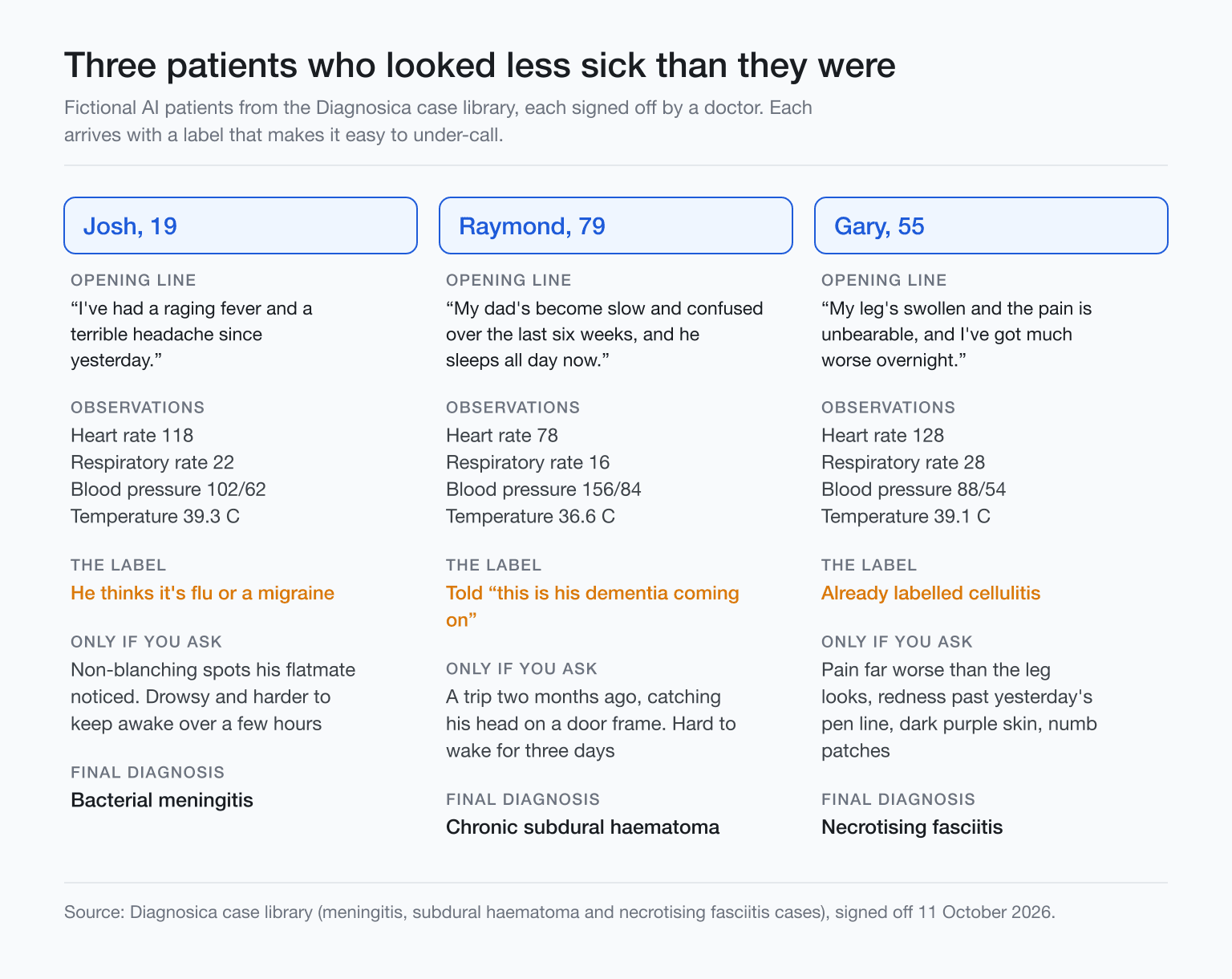
Three patients from the Diagnosica case library are fictional AI patients, each written and signed off by a doctor, and each had a reason to look less sick than they were at first: a young man who thinks it's flu, an older man whose decline was blamed on dementia, and a man already labelled cellulitis.
Josh, 19: flu, or something worse
Josh says, "I've had a raging fever and a terrible headache since yesterday." His observations are heart rate 118, respiratory rate 22, blood pressure 102 over 62, temperature 39.3 C. He thinks it’s flu or a migraine. Ask about his skin and you hear about non-blanching purple spots and a flatmate struggling to keep him awake. Run through the meningitis case, final diagnosis: bacterial meningitis.
Raymond, 79: "it's just his dementia"
Raymond’s son says, "My dad's become slow and confused over the last six weeks, and he sleeps all day now." Observations are heart rate 78, respiratory rate 16, blood pressure 156 over 84, temperature 36.6 C. Labelled "it’s just his dementia." Ask about trips and slips, the son recalls a head knock two months ago. See diseases behind misleading labels, final diagnosis: chronic subdural haematoma.
Gary, 55: the cellulitis that wasn't
Gary says, "My leg's swollen and the pain is unbearable, and I've got much worse overnight." Observations are heart rate 128, respiratory rate 28, blood pressure 88 over 54, temperature 39.1 C. Already labelled cellulitis and worse. Ask about progression and you hear pain out of proportion, dark purple patches with blood blisters, and numb areas. See the necrotising fasciitis case, final diagnosis: necrotising fasciitis.
When should you escalate, and what do you say?
Escalating a sick patient starts at the end of the bed. Resuscitation Council UK says recognise when you will need extra help and call for appropriate help early. NEWS2 Chart 4 builds escalation in: a score of 3 in any single parameter prompts medical review, a total of 5 or more needs urgent assessment by a clinician or team with acute illness competencies, and 7 or more means immediate notification at least at specialist registrar level and emergency critical care assessment.
When you call, say the worry first. Then use a format. Resuscitation Council UK names SBAR and RSVP as workable structures.
- Situation: I am worried this patient looks acutely unwell and is deteriorating.
- Background: He came in earlier with an infection focus and has worsened since the last review.
- Assessment: His respiratory rate has gone up since the last set, his oxygen saturations are lower than his usual, and he is newly confused.
- Recommendation: I would like you to see him now, please, and advise on next steps if you cannot attend immediately.
If the call hits while you are mid assessment, this piece on handling the bleep itself keeps the sequence clear under pressure.
For pattern traps that are easy to miss at night, see overnight diagnoses that hide.
Practising the judgement before it's real
The judgement to recognise a sick patient is built from repetitions. You watch the story, pair it with observations, and add the detail you only get by asking, many times. Over time your brain flags the wrong colour, the wrong phrase, the wrong trend. That reflex starts with safe rehearsal.
Diagnosica is an AI clinical simulator for medical students and junior doctors: you take a history from an AI patient by voice or text, order labs and imaging, commit to a diagnosis and management plan, and get a competency scorecard. Patients appear as video avatars. Free to start, no card needed, with apps on iPhone, Android and web, and it isn't built around one country's exam. Josh, Raymond and Gary are in it, and every case is written and signed off by a doctor. There is no physical examination practice. It doesn't give advice about real patients, and it's not a diagnostic system. Treat every output as educational.
Run a safe rep Run Josh, Raymond or Gary before your next on call to rehearse the end-of-bed look. Start a case free
Common questions
Common questions about recognising a sick patient tend to centre on the end-of-bed look, NEWS2, and when to escalate. This section gives short, exam-grade answers you can use at 3am. NEWS2 is the early warning system used in England, but judgement, reassessment and a clear call for help tie the picture together.
Is a normal NEWS2 score enough to call a patient well?
A normal NEWS2 score is not, on its own, proof a patient is well. NEWS2 should support clinical judgement, and RCUK advises a complete initial assessment with regular re-assessment to follow. Watch trends, because a rising respiratory rate is a marker of illness. Trends matter here.
What is a red score in NEWS2?
A red score in NEWS2 means a score of 3 in any single parameter. That pattern flags low to medium clinical risk with an urgent ward-based response. Minimum monitoring is 1 hourly, and the nurse informs the medical team, who review the patient.
How long should the end-of-the-bed look take?
The end-of-the-bed look should take about 30 seconds. RCUK describes a first rapid look, listen and feel that can often show a need for urgent help. If the patient is awake, ask "How are you?" A normal reply implies patent airway, breathing and brain perfusion. Quick, but meaningful.
What if the observations look fine but the nurse is worried?
A nurse's concern when observations look fine is still clinical data. Raymond Ellis had heart rate 78, respiratory rate 16 and temperature 36.6 C, while his son described six weeks of change and three days of being hard to wake. Re-assess, ask what changed, and call for appropriate help early. Take that seriously.