What to Do After Making a Mistake as a Junior Doctor, Hour 1
What should you do after making a mistake as a junior doctor?
After making a mistake as a junior doctor, first make the patient safe. Tell your senior immediately. Ensure the patient is told honestly and offered a genuine apology, in line with the GMC's professional duty of candour. Write factual, contemporaneous notes. Record the event on your trust's incident system. If unsure about your own position, call your medical defence organisation.
You've just realised. Stomach drop, heat in your face, hands shaking on the keyboard. That surge is common, and it means you care. Breathe. The next few minutes are about actions that keep people safe.
This first hour is process, not punishment. You'll follow steps, call for help early, and log what happened. For everything beyond today, from handover rituals to decision practice you can run on the bus, see the full FY1 survival guide.
The first hour: six steps, in order
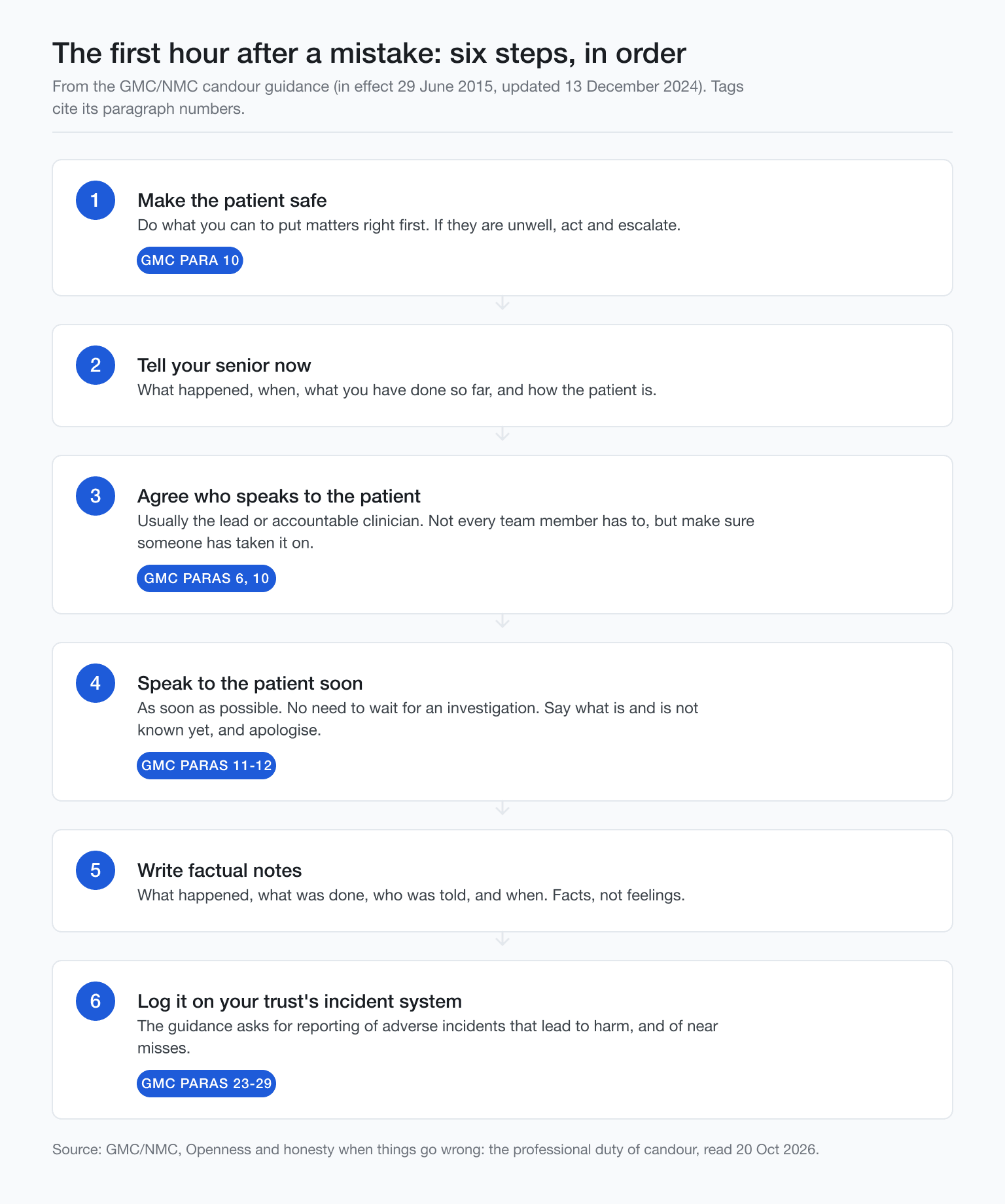
The first hour after a mistake as a junior doctor is about patient safety, candour, and clear records. You don't need the full story before you act, and you don't wait for an investigation to speak. Use this six-step sequence to stabilise care, involve seniors early, and communicate plainly.
- Make the patient safe first. If they're unwell, act and escalate, using spotting the deteriorating patient to guide what you check. Do what you can to put matters right before any conversation.
- Tell your senior now. Say what happened and when, what you've done, and how the patient is now; if parts are unclear, say you're unsure, see how to say you're unsure.
- Agree who speaks to the patient. Usually the lead or accountable clinician holds this. Make sure someone is named and support them.
- Speak to the patient soon. Have the conversation as soon as possible, explain what happened, what is and isn't yet known, likely effects, and apologise.
- Write factual notes. Record what happened, timings, observations, actions, current status, and who was informed with times and plan.
- Log it on your trust's incident system. Report the adverse incident or near miss through your trust's process so the team can learn.
What does the duty of candour mean for an FY1?
The professional duty of candour for an FY1 doctor is a clear expectation to be open and honest when care goes wrong and causes, or might cause, harm or distress. It means telling patients what happened, saying sorry, and supporting them while the team explains consequences and how you'll prevent recurrences. It's about honesty and learning, not blame.
UK regulators set this in joint GMC and NMC guidance, effective 29 June 2015 and last updated 13 December 2024, rooted in a 2014 joint statement by eight regulators. See the professional duty of candour and the full GMC candour guidance.
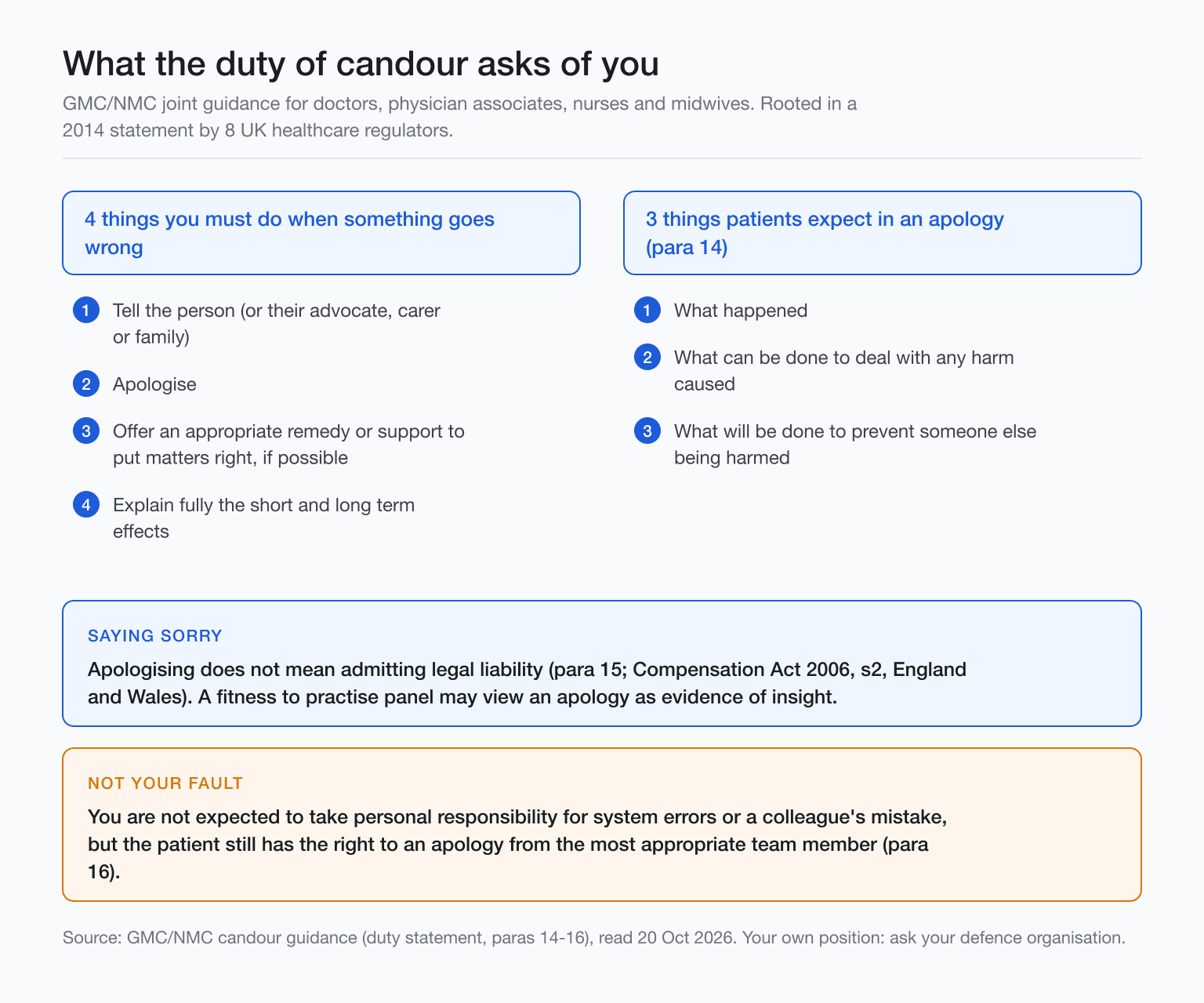
- Tell the person, or their advocate, carer or family, when something has gone wrong.
- Apologise.
- Offer an appropriate remedy or support to put matters right, if possible.
- Explain fully the short and long term effects.
This duty covers incidents that cause, or could cause, harm or distress. It doesn't cover a condition getting worse due to natural progression of illness.
Patients expect three things in an apology, what happened, what can be done to deal with any harm caused, and what will be done to prevent someone else being harmed.
Apologising does not mean admitting legal liability. That's set out in the Compensation Act 2006, section 2, in England and Wales, and NHS Resolution will never refuse cover because an apology was given. A fitness to practise panel may see an apology as evidence of insight.
You're not expected to take personal responsibility for system errors or a colleague's mistake, though the patient still deserves an apology from the most appropriate team member. An apology has value only if it's genuine. Be open with colleagues and your organisation, and take part in reviews.
Where can you rehearse the hard calls before they're real?
Diagnosica is an AI clinical simulator for medical students and junior doctors: you take a history from an AI patient by voice or text, order labs and imaging, commit to a diagnosis and management plan, and get a competency scorecard.
Repetition helps because the first hour is a process you can map, and practising history and decisions out loud makes those moves easier to reach.
The simulator has a video AI patient, it's free to start with no card, and it runs on iPhone, Android and the web. It's used in the UK, Canada, Australia and Ireland, with over 130 cases in 18 specialties, each signed off by a doctor.
Diagnosica won't help you practise breaking bad news or apologising to a patient about an error. "It doesn't give advice about real patients, and it's not a diagnostic system. Treat every output as educational."
If you want a dry run, run a case on an AI patient now.
Incident reports are for learning, not a disciplinary file
An incident report on your trust's incident system is a record to learn from a safety incident and prevent it happening again, it isn't a disciplinary file. Under NHS England's incident framework, which replaced the 2015 Serious Incident Framework, Aim 1 is 'Compassionate engagement and involvement of those affected by patient safety incidents', and a quote from the Healthcare Safety Investigation Branch on NHS England's page says 'a focus on understanding how incidents happen rather than attributing blame or liability'.
GMC guidance expects reporting of incidents that lead to harm and near misses. Medical Protection advises a significant event analysis to identify causes and fix system failures.
Write factually and chronologically. Don't use blame language. Describe context, eg handover, staffing, look alike labels, supervision. Ask your educational or clinical supervisor what happens next locally. Processes differ by trust.
When should you call your medical defence organisation?
Your medical defence organisation (MDO) is the body that provides your indemnity and medicolegal advice, such as the MDU or Medical Protection. You don't need to tell them about every notifiable safety incident, and an apology isn't an admission of guilt; members can ask for candour advice without affecting their subscription, per Medical Protection's candour guide. If a claim arises, report it promptly.
Reasonable prompts to call:
- a complaint
- a claim or solicitor's letter
- a request for a formal statement
- a letter from a coroner or the GMC
- you're unsure what to say
The days after: reflection and getting your nerve back
The days after a clinical mistake as a junior doctor are for steady repair, factual reflection, support, and a return to safe habits. If you're searching what to do after making a mistake as a junior doctor, write what happened, why, and what you'll change, then discuss it with your educational supervisor.
Keep the portfolio entry tight, timeline, contributory factors, impact, learning points, and two concrete actions for upcoming shifts.
Watch for defensive practice, like rechecking observations or ordering tests out of fear when results won't change decisions. Ask what decision each test moves.
BMA counselling and peer support runs 24 hours a day, 7 days a week, 0330 123 1245; free and confidential; open to all doctors and medical students; not an emergency service. Practitioner Health is a free, confidential NHS primary care mental health and addiction service for health and care professionals, 0300 0303 300.
People often trust most the doctors who own errors early; see what good SHOs do differently for the next step.
Common questions
Common questions about mistakes as a junior doctor hit in the first hour, when adrenaline's high and judgement feels shaky. The answers stick to the GMC candour standard and support routes, anchored in what the guidance actually asks and pointing you to who can advise you now. No predictions.
Will I be reported to the GMC for a mistake as an FY1?
Candour means being open when care goes wrong and causes, or could cause, harm or distress. It sits alongside being open with colleagues and your organisation. A fitness to practise panel may see an apology as evidence of insight. For your position, speak to a medical defence organisation, such as MPS or MDU.
Does saying sorry mean admitting it was my fault?
Apologising does not mean admitting liability. That's set in law for England and Wales under section 2 of the Compensation Act 2006. NHS Resolution will never refuse cover because an apology was given. If it wasn't your fault, you're not expected to take personal responsibility.
Do I have to tell the patient about a near miss?
The GMC candour guidance includes a section on being open with patients about near misses, and it encourages reporting near misses through your trust's incident system. Whether to tell a particular patient should be agreed with your senior and follow local policy, so timing, wording and support are planned.
Who should speak to the patient, me or my consultant?
When something has gone wrong, after you do what you can to put matters right, you or someone in the team must speak to the patient. The most appropriate person is usually the lead or accountable clinician. Teams share responsibility, so make sure roles are assigned for each task.
Practise the history and decisions before the hard calls are real. Talk to a video AI patient or type, order investigations, commit to a diagnosis and plan, then review a competency scorecard after every case. Free to start, no card needed. Start a case free.