How to Pre-Round: A Per-Patient Checklist

Pre-rounding is gathering each patient’s overnight events, vital signs and trends, ins and outs, and new labs, then a quick check-in with the nurse and the patient plus a focused exam before team rounds, and turning it into a short, prioritized plan. That is how to pre-round when you start.
You’ll get a per-patient checklist, a two-minute question set, a time budget for 3 vs 6 patients, and how it flows into your presentation. For wider context, see the MS3 survival basics. Readers in the UK will find the UK foundation-year equivalent.
It won’t teach physical examination technique.
What is pre-rounding and how do you do it?
Pre-rounding is the early morning sweep to gather facts and sketch a plan for each inpatient before the full team rounds. One or two trainees pull vitals, labs, and overnight events, do a brief bedside interview and focused exam, then organize problems and asks. The output is a concise, decision ready snapshot.
According to a 2024 Cureus technical report, pre-rounding encompasses all the data gathering and planning about patients, typically by one or two trainees per patient, before rounding as the entire team when medical decisions are made. The same report notes pre-rounding may start at 4 AM or earlier, and usually involves waking the patient for a brief interview and exam.
That report also notes students often get limited guidance on pre-rounding and learn it informally from seniors. A written checklist gives you a default to run tomorrow.
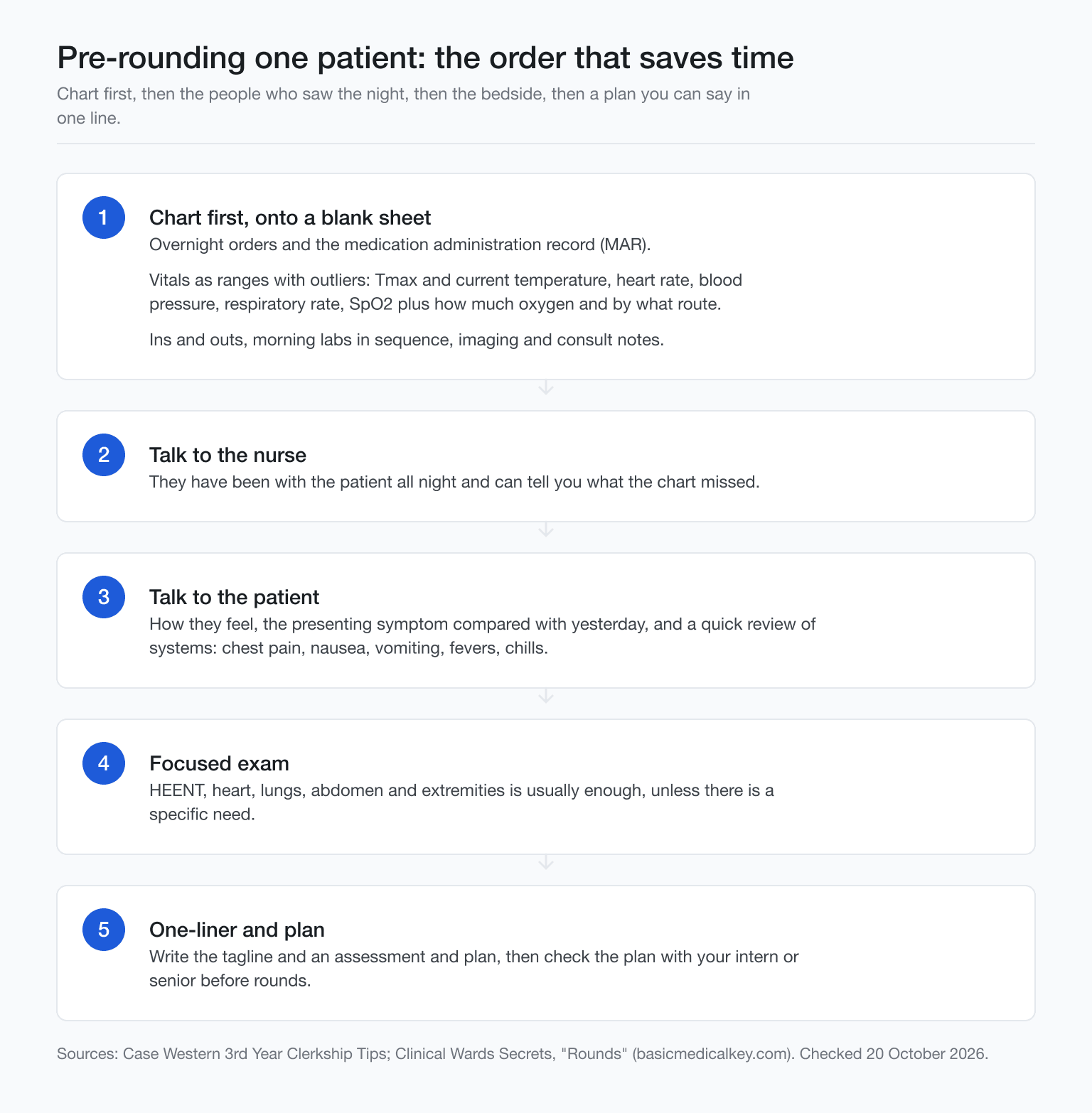
For order, Case Western clerkship tips recommend chart first, then nurse, then patient and focused exam, then check the plan.
The per-patient pre-rounding checklist
A pre-rounding checklist turns 6 a.m. into a repeatable sequence, not a scavenger hunt. If you want to learn how to pre-round tomorrow, use this per-patient flow. It fits interns and MS3s and stays SOAP-friendly. Teams differ, so tweak the order. It keeps your notes and questions aligned before you walk in.
- Overnight events and overnight orders: Check overnight events, new or timed orders, and MAR administrations or omissions.
- Vitals as ranges with outliers: Capture Tmax, current temp, HR and BP ranges with outliers, RR, SpO2, and oxygen flow and route.
- Ins and outs: Pull IV and oral intake, urine, stool, drains, vital for surgical or diuresed patients.
- Labs and imaging: List morning labs sequentially by day; add imaging and relevant consult notes.
- The nurse: Ask the night nurse for overnight changes, concerns, and missing chart context.
- The patient: Ask how they feel now, then a brief systems review tailored to them.
- A focused exam: Do a focused exam, HEENT, heart, lungs, abdomen and extremities is usually enough, per a Clinical Wards Secrets chapter; then give a one-line summary and plan.
The Lesss PAINFUL mnemonic is a Cureus memory aid covering Progress, Autonomy and Ambulation, Ins and outs, Nursing and Needs before discharge, and Follow-up labs and imaging, and its authors say it hasn't been scientifically validated.
What should you ask the patient in two minutes?
The two-minute patient check is the bedside part of pre-rounding. Keep it short and targeted: how they slept and feel now, status of the symptom, a quick screen for chest pain, nausea, vomiting, fevers or chills, plus their main worry.
Say Alan Griffiths, a fictional 68-year-old AI patient from the Diagnosica case library whose history points toward heart failure, is on your list.
- How’s breathing when you walk on the flat? Gradually worse, now limits him; no fever, no green phlegm, no chest pain at rest.
- Any nighttime gasping or extra pillows? Wakes gasping, sleeps on 3 pillows.
- Are your legs or ankles swollen, and does it pit? Worse by evening, pits; tummy tight, bloated.
- Any recent weight gain? About half a stone, about 7 pounds, mostly ankles and middle.
- Any racing or fluttering heartbeats? A couple of episodes with more breathlessness, a must-ask red flag in the case.
Main worry is night-time episodes and swelling; case vitals HR 84, RR 20, BP 138/86, SpO2 95 percent, temp 36.7 C.
You can take his history yourself, with him as an AI patient, and it is a history-taking case, not a rounds simulation: take Alan's history yourself.
How long should pre-rounding take for 3 patients vs 6?
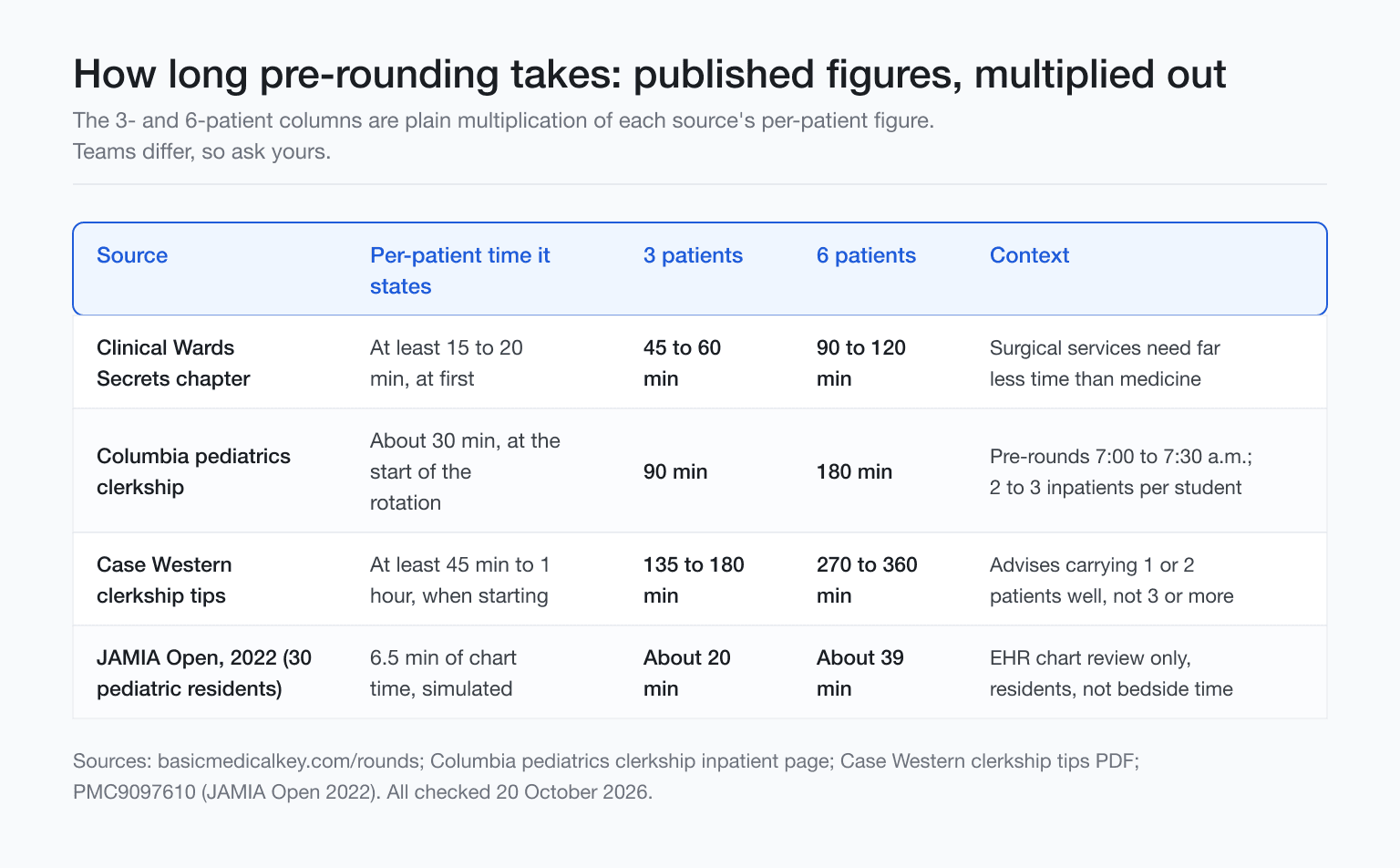
Pre-rounding time for a new student usually ranges from 15 to 20 minutes per patient up to 45 minutes to 1 hour per patient, and teams differ. Multiply by your list size and count back from rounds. Early weeks skew longer. Surgical lists tend to be quicker than medicine. Your intern sets the local standard.
- Columbia's pediatrics clerkship page lists pre-rounds 7:00 to 7:30 a.m., work rounds 7:30 to 9:00 a.m., advises 30 minutes per patient at first, and carrying 2 to 3 inpatients.
- Case Western's clerkship tips recommend 45 minutes to 1 hour per patient when starting, prefer carrying 1 to 2 patients over 3 or more, with rounds roughly 8:00 a.m. to 12:00 p.m.
- The Clinical Wards Secrets chapter suggests at least 15 to 20 minutes per patient at first, and that surgical services usually need far less pre-rounding time than medicine.
- a 2022 JAMIA Open study reported 30 pediatric residents averaged 6.5 minutes per patient over about 12.3 EHR pages during simulated prerounding, which is chart time for residents, not total bedside time for students.
Plain arithmetic from the per-patient figures above:
- 3 patients at 15 to 20 minutes each = 45 to 60 minutes.
- 3 patients at 30 minutes each = 90 minutes.
- 6 patients at 15 to 20 minutes each = 90 to 120 minutes.
Count back from your rounds start time, and ask your intern what time they want you there, because teams and services differ.
Turning pre-round data into your presentation
Pre-round data is the raw material you turn into a SOAP note and a short, focused rounds presentation. The point of pre-rounding is processing time, not box ticking. Columbia’s pediatrics clerkship tells students to present in SOAP order and be ready with bullets if time is short, and a Cureus report says the information can feed a SOAP note or a brief presentation.
Case Western’s advice travels well: open with a clear one line tagline and spend your time on the assessment and plan, saying only what’s pertinent to this hospitalization. Attendings look frustrated when the hook line isn’t stated confidently, and you should confirm the plan with your intern or senior before rounds.
1) One liner: who, why here, hospital day, how sick now. 2) Overnight and subjective: events, symptoms better or worse, new complaints. 3) Objective: vitals ranges and outliers, I/Os, labs that changed, key imaging. 4) Assessment and plan by problem: prioritized, what you recommend, what you need a decision on.
If you want formats to practice, see your morning rounds presentation and drafting the assessment and plan.
Common pre-rounding mistakes
Common pre-rounding mistakes show up predictably when order, context, or synthesis get skipped. Time pressure worsens it. Cureus e75393 reports students often get limited guidance, so borrow defaults from services that teach it plainly and use a repeatable checklist you can adapt to your team and setting. That habit cuts noise and surfaces decisions early.
- Seeing the patient before reading the chart: Case Western’s clerkship tips say chart first onto a blank sheet, then nurse, then patient and exam.
- Skipping the nurse: Basic Medical Key advises talking to nursing staff, who've been with the patient all night and can flag overnight events.
- Reporting a single vital sign instead of the overnight range and outliers: Basic Medical Key expects vitals as ranges with outliers, including Tmax, heart rate range, blood pressure range, respiratory rate, and oxygen delivery.
- Doing a full head-to-toe exam on everyone: Basic Medical Key suggests a focused exam is usually enough for pre-rounding, unless a specific change or question demands more.
- Arriving with data but no plan: Case Western advises crafting a clear tagline and assessment with next steps, since attendings will ask what you think, see questions attendings ask on rounds.
Practicing the patient conversation before your rotation
Diagnosica is an AI clinical simulator for medical students and junior doctors: you take a history from an AI patient by voice or text, order labs and imaging, commit to a diagnosis and management plan, and get a competency scorecard. Each patient appears as a video patient on screen, it's free to start, no card needed, and it runs on iPhone, Android, and the web, with learners outside the US using it too.
It has no rounds or pre-rounding step, no overnight chart, and no physical exam practice, so it rehearses the history-taking and reasoning part of pre-rounding, not the chart review or the exam. It doesn't give advice about real patients, and it's not a diagnostic system. Treat every output as educational.
Before your first day, start a free AI patient case.
Common questions
Common questions about how to pre-round cluster around start times, patient load, who pre-rounds, and note-writing. The specifics vary by hospital and service. Here are concise, source-based answers you can use tonight to plan your morning and avoid scope creep at 6 a.m.
What time do medical students start pre-rounding?
Medical student pre-rounding start time depends on local schedules. Cureus reports pre-rounding may start at 4 a.m. when rounds are early. Columbia's pediatrics clerkship has students begin around 7:00 a.m., with pre-rounds from 7:00 to 7:30. Ask your team directly.
How many patients should an MS3 pre-round on?
MS3 pre-rounding load is set by the team. Columbia advises carrying 2 to 3 inpatients. Case Western's clerkship tips argue it is better to carry 1 or 2 and do them well than 3 or more. Confirm expectations with your resident or attending.
Do interns pre-round too?
Intern pre-rounding expectations vary. Clinical Wards Secrets notes students and even interns typically arrive before rounds. Cureus outlines a pre-rounding mnemonic for students and interns. In a simulated setting, 30 pediatric residents averaged 6.5 minutes per patient and navigated about 12.3 EHR pages.
Should I write my progress note during pre-rounds?
Writing a progress note during pre-rounding is supported by Columbia, which advises trying to write notes during pre-rounds and preparing presentations in SOAP format. Cureus says pre-rounding data can feed portions of a SOAP note or a presentation. Local practice varies, so ask your intern.