OpenEvidence vs UpToDate for Medical Students on Rotations
OpenEvidence vs UpToDate for a medical student comes down to tool type and speed. OpenEvidence is an AI medical search engine. It’s free for verified U.S. healthcare professionals. UpToDate is a paid clinical reference with 13,000+ topics, trainee subscriptions start at $219 a year as of October 2026. Use OpenEvidence for quick questions, UpToDate for full-topic reviews.
This piece sits alongside our roundup of AI tools for clinical rotations. Expect a practical take, where each shines on a busy day and where it stops, plus a simple workflow you’ll try on rounds.
Neither product lets you practice talking to a patient, so if you’d like that, try a free AI patient case.
OpenEvidence vs UpToDate: the short answer
OpenEvidence and UpToDate do different jobs. OpenEvidence is a fast AI answer engine for specific clinical questions and is free for verified U.S. healthcare professionals. UpToDate is a paid reference with 13,000+ clinical topics for reading a condition end to end. Most students will use both, depending on the moment.
For access and use on busy days, read our OpenEvidence student guide for the details you need to get going.
OpenEvidence for quick questions. Open UpToDate when you need an end to end topic read, not when you want fast pointers to sources for a narrow, time-pressed question.
As of October 2026, OpenEvidence is free for verified U.S. healthcare professionals; UpToDate is a paid trainee subscription starting at 219 dollars per year with the same content and features as the professional plan. AMA medical student members get 50 percent off an annual or longer trainee subscription.
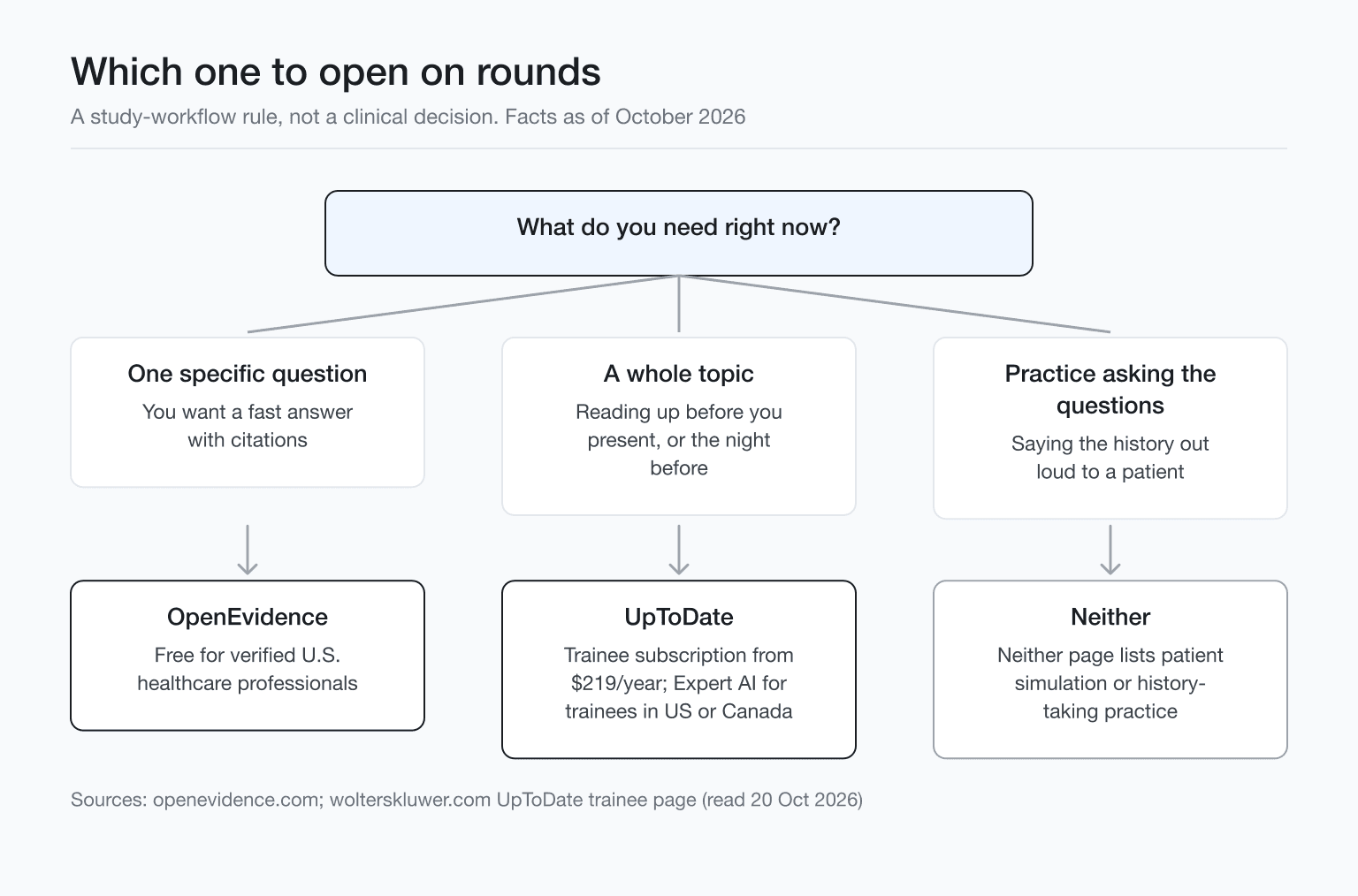
One-line rule: quick question, OpenEvidence. Whole topic, UpToDate.
OpenEvidence vs UpToDate side by side
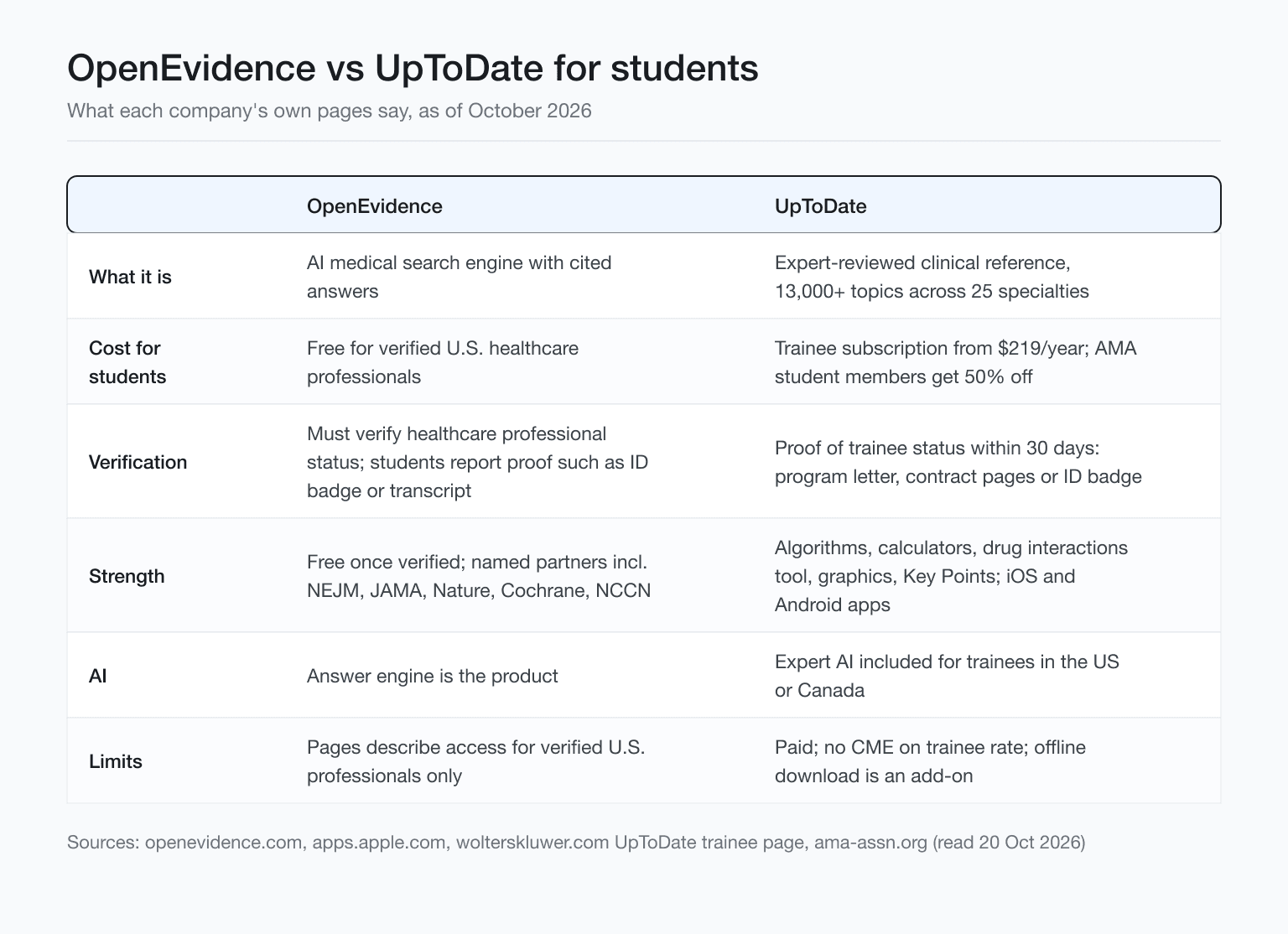
OpenEvidence and UpToDate serve different jobs, so the table below compares what each product states about itself as of October 2026, including student cost, access and verification, best use, and limits. Every cell is taken from each company’s own public page, read in October 2026, using the Source links for verification.
Product | What it is | Cost for students (as of Oct 2026) | Access and verification | Best for | Limits | Source |
|---|---|---|---|---|---|---|
OpenEvidence | AI medical search engine for clinicians. | Free for verified U.S. healthcare professionals. | U.S. healthcare professional verification required before use. | Quick answers to focused clinical questions on rounds. | Positioned for verified U.S. professionals, an answer engine not a textbook. | |
UpToDate | Expert-written clinical reference, 13,000+ topics. | $219/year trainee starting price; AMA student members save 50%. | Proof of trainee status required within 30 days. | Deep, structured topic reviews, algorithms, and graphics. | Paid, no CME on trainee rate, Expert AI only in US or Canada. |
Disclosure: Diagnosica is an AI clinical simulator for medical students and junior doctors, a different kind of tool from both, so we have a stake in study tools; competitor details here come from their public pages, checked on October 20, 2026.
If what you need next is practice with a patient rather than reading, that is a separate tool, and you can start a free practice case at start a free practice case.
What does UpToDate do better?
UpToDate’s main strength is depth, breadth, and structure. As of October 2026, it says it covers 13,000+ clinical topics across 25 specialties, kept continuously updated, and expert-reviewed. When you need the full topic treatment, it reads like a reference you can study from, not a chat.
Depth comes with tools, including clinical algorithms and guides, medical calculators, a drug interactions checker, graphics and videos, Key Points panels, patient education materials, and topic update alerts.
Apps on iOS and Android, plus desktop and web. Trainee subscriptions include Expert AI, a conversational search that shows its reasoning and links back to the UpToDate sections it used. It is available only in the United States or Canada and needs an internet connection.
There’s an official Anki add-on, UpToDate for Anki, that connects flashcards to UpToDate content. The company cites over 30 years of trainee use and a self-reported survey where 97 percent would recommend it.
It costs money, with a trainee starting price of 219 dollars per year as of October 2026, and you must prove trainee status within 30 days or your order is not processed. The trainee rate doesn’t include CME credit. Offline MobileComplete is an add-on, not standard.
If you’re choosing between OpenEvidence and UpToDate, pick UpToDate when you need a structured topic with tools and update tracking. Details are on its trainee subscription page.
What does OpenEvidence do better?
OpenEvidence is free and unlimited for healthcare professionals as of October 2026, and it excels at answering a single, specific clinical question with citations drawn from named sources like NEJM, JAMA and the JAMA Network, Nature and the Nature Portfolio, Cochrane Systematic Reviews, and NCCN Guidelines Treatment Algorithms. That speed plus sourcing is its lane on wards and in call rooms.
Once you’re verified as a U.S. healthcare professional, access is free, helpful when you’re toggling between patients and notes.
Speed is the edge. Ask a narrow question and get a cited answer, useful before rounds or when a resident wants one data point.
Source breadth helps. Partnerships include NCCN, AAP, ACC, ADA, AAFP, NORD, ACOG, AUA, AAO, ACEP and more. They also report over 200 million clinical consultations from U.S. clinicians, self-reported.
On its about page, the company calls it “an AI copilot for doctors” at the point of care and says it is HIPAA compliant and SOC 2 Type II certified.
Where it stops, by design. An answer engine returns what you asked, not the topic you didn’t know to ask about, so context can go missing. You still judge the citations. Access depends on successful verification, from what we can tell.
Can medical students get access, and what about outside the US?
OpenEvidence and UpToDate both require proof you’re a student or a healthcare professional. OpenEvidence is free once you’re verified as a U.S. healthcare professional. UpToDate’s trainee subscription is paid, starting at 219 dollars per year as of October 2026. The access routes differ and the geography limits do too.
On its App Store listing, OpenEvidence says it’s available only to healthcare professionals who verify their status before use, and the title flags NPI Required. That tells you they gate access, even if you’re not prescribing or billing.
Student access details come from schools, not OpenEvidence’s own pages. According to a UMass Chan library note, medical students can sign up with proof of medical student access, and that questions and follow-ups are limited without an account. And a WSU student walkthrough lists name, occupation, medical school, graduation year and month, plus an ID badge photo or transcript, with access described as immediate. These may have changed.
Outside the US, OpenEvidence’s own pages describe free access for verified U.S. healthcare professionals and say nothing about other countries as of October 2026, so check the sign-up flow before you count on it.
UpToDate’s trainee subscription is paid, and they ask for proof such as a signed letter on program letterhead, first and last pages of a current contract, or a legible ID badge with trainee designation and expiration date, received within 30 days or the order isn’t processed. Billing can be 30-day recurring, annual or multi-year.
If you’re an AMA student member, the AMA member discount is 50 percent off an annual or longer trainee subscription.
Geography caveat for features, not access. UpToDate says its trainee Expert AI is available in the United States or Canada as of October 2026. If you rely on that mode, plan around that limit.
A workflow on rounds: which one when
OpenEvidence and UpToDate fill different jobs on rounds. Use OpenEvidence for fast, cited answers to specific bedside or hallway questions. Use UpToDate when you need a full topic read before presenting, and the night before for a structured expert review you can trust for study.
- Before pre-rounds, skim patients and jot one-liners, then follow a pre-rounding routine. As narrow questions arise, ask OpenEvidence and paste the cited blurb to notes, and flag deeper UpToDate reads for after rounds.
- On rounds, if a resident asks a focused question, ask OpenEvidence, share the citation, and keep the decision with your team. If it’s broader, say you’ll pull the UpToDate topic and report back.
- Before presenting or case teaching, open the UpToDate topic for a full read and use Key Points to structure your outline. Bookmark sections or set topic-update alerts to track changes.
- For a new admission at night, start with UpToDate to ground yourself. If you have trainee access in the United States or Canada, UpToDate Expert AI can generate differentials into tables, as of October 2026. Otherwise use OpenEvidence for a cited shortlist.
- To check a claim’s citation, paste it into OpenEvidence to trace the primary source. Tie learning to spaced review with the UpToDate for Anki add-on, plus tips from a third-year survival guide.
Neither one practices the encounter
OpenEvidence and UpToDate are reference tools, and neither page lists patient simulation or history-taking practice as of October 2026. That matters because reading a chest pain topic is not the same as asking the questions out loud, triaging red flags under time pressure, and then committing to a working diagnosis.
Diagnosica is an AI clinical simulator for medical students and junior doctors: you take a history from an AI patient by voice or text, order labs and imaging, commit to a diagnosis and management plan, and get a competency scorecard. The patient appears as a video avatar, it’s free to start, no card needed, and there are apps on iPhone and Android plus the web. It’s used by learners outside the US too, including in the UK, Canada, Australia and Ireland. The library has 136 cases across 18 specialties, and every case is written and signed off by a doctor. There’s no physical examination practice. It doesn't give advice about real patients, and it's not a diagnostic system. Treat every output as educational.
That makes Diagnosica a complement to both references, not a replacement. Use it to practice the encounter, then read properly in UpToDate or get a fast cited answer in OpenEvidence. Some students also rehearse a focused HPI with rehearsing a history with ChatGPT when they want a lighter-weight drill between pages.
Common questions
OpenEvidence and UpToDate answer different needs, and most students will use both. These quick answers cover access, pricing, scope, and limits as of October 2026, so you can pick the right tab fast. Neither practices the patient encounter or history taking, so expectations stay tight.
Is OpenEvidence free for medical students?
OpenEvidence is free and unlimited for healthcare professionals as of October 2026, and its own pages say it’s free for verified U.S. healthcare professionals. Two school pages report medical students can sign up with proof, with fields like name, occupation, school, graduation month and year, plus an ID badge or transcript photo. One described immediate access, with issues flagged within 48 hours.
How much does UpToDate cost for medical students?
UpToDate has a trainee subscription starting price of 219 dollars per year as of October 2026. Trainees choose 30 day recurring billing, annual or multi year terms, plus group options, and students, residents, and fellows get the same content and features as the professional subscription. Proof of trainee status is due within 30 days or the order won’t be processed. Billing is flexible for trainees.
Is OpenEvidence better than UpToDate?
OpenEvidence and UpToDate serve different jobs, not the same one. UpToDate is a paid reference with 13,000 plus clinical topics across 25 specialties, plus clinical algorithms, a drug interactions tool, calculators, graphics and videos, Key Points, and patient education materials, so it suits structured reading. OpenEvidence is an AI medical search engine tuned for fast queries. Many students use both. Neither simulates the patient encounter.
Can I use OpenEvidence outside the US?
OpenEvidence pages describe free access for verified U.S. healthcare professionals and, as of October 2026, don’t state terms for other countries. Nothing we read from product pages confirmed availability elsewhere. From what we can tell, students outside the United States should check the sign up flow to see what options are actually offered. Not always obvious.
Once you’ve read up on a condition, practice the conversation. Meet a video AI patient you can talk to or type with, order labs and imaging, commit to a diagnosis and management plan, then get a competency scorecard. It’s free to start, no card needed. Start a case free on Diagnosica