PLAB 2 Pass Rate by Year, 2021 to 2025 (GMC Data)

The PLAB 2 pass rate was 59.8% in 2025, with 8,787 of 14,689 candidates passing, per the GMC. That's the lowest of 2021 to 2025, down from 69.9% in 2021.
You've booked PLAB 2 and want the real odds, not forum rumours.
This is reference material from GMC pages; nothing here claims any prep tool, including Diagnosica, the AI patient simulator that publishes this blog, changes results, and Diagnosica can't rehearse physical examination or practical skills stations. Below are year by year figures, PLAB 1 beside them, what the data shows and omits, and how marking works.
What is the PLAB 2 pass rate?
In 2025, the PLAB 2 pass rate was 59.8%, with 8,787 passes from 14,689 candidates who sat. That is 10.1 percentage points lower than 2021, when 69.9% passed. These are calendar year totals from the GMC for PLAB 2, presented as pass counts over candidate totals.
Across 2021 to 2025, 72,166 sat and 46,391 passed, a pooled 64.3%. That 64.3% is our arithmetic from the GMC's counts over those five years.
The GMC table reports candidates who sat in each calendar year and doesn't separate first attempts from resits, so it can't tell you a first-attempt pass rate.
That pass rate reflects station by station marking. Each station is scored across three domains, and the cut score varies with difficulty using a borderline regression method, then totals contribute to the overall pass mark. For a plain English explainer, see how OSCE domain marks work.
PLAB 2 pass rate by year, 2021 to 2025
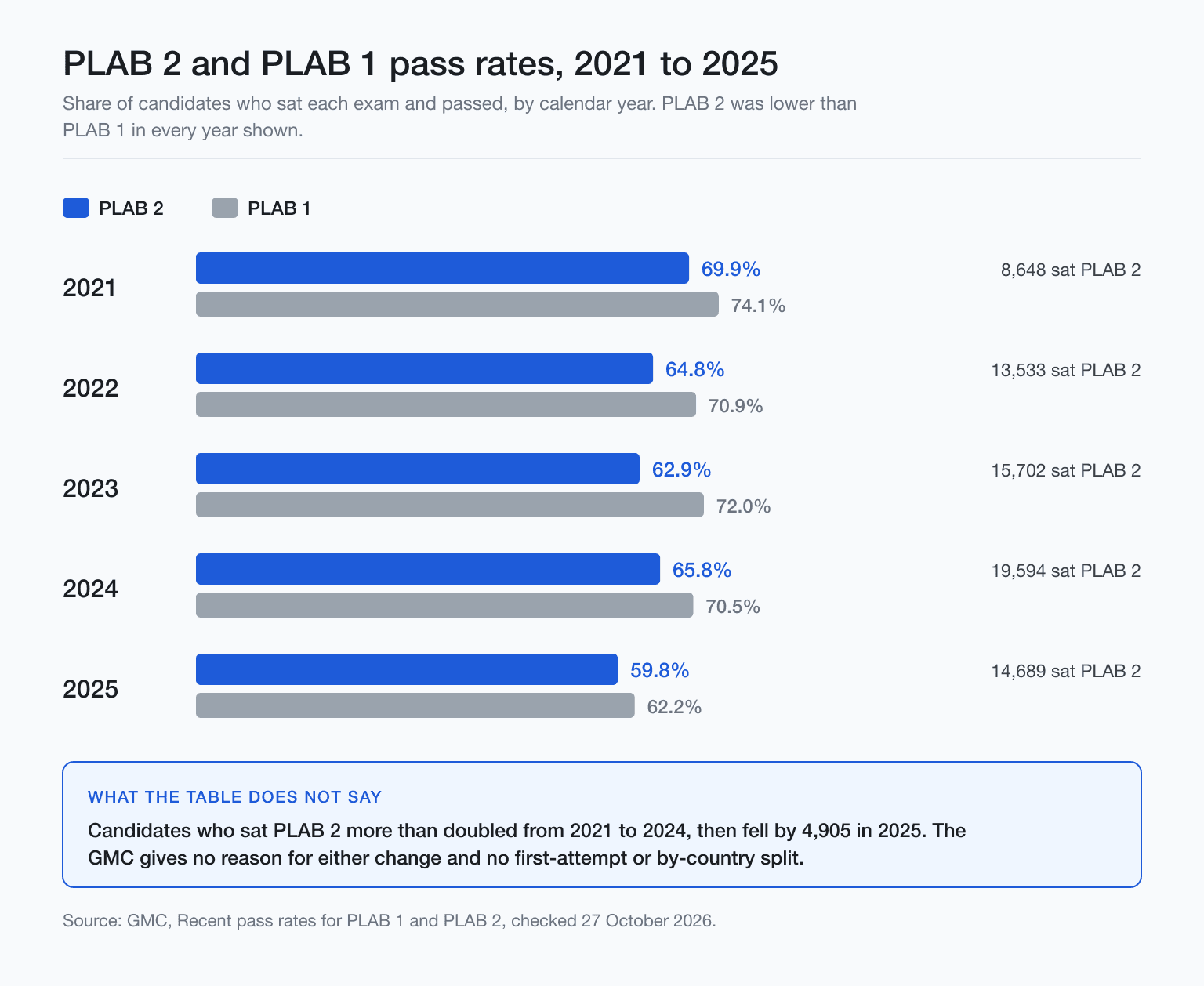
The GMC's PLAB 2 pass rate table for 2021 to 2025 shows a fall from 69.9% in 2021 to 59.8% in 2025. Candidates who sat rose from 8,648 to 19,594 by 2024, then dropped to 14,689 in 2025. These headline rates cover the last five calendar years the GMC publishes.
Year | Candidates who sat | Candidates who passed | Pass rate |
|---|---|---|---|
2021 | 8,648 | 6,043 | 69.9% |
2022 | 13,533 | 8,775 | 64.8% |
2023 | 15,702 | 9,884 | 62.9% |
2024 | 19,594 | 12,902 | 65.8% |
2025 | 14,689 | 8,787 | 59.8% |
These figures come from the GMC's published pass rates. The page labels counts as "Number of candidates who sat" and lists the last five years.
The PLAB 2 pass rate fell in three of the four year on year steps. The one rise was 2023 to 2024, from 62.9% to 65.8%.
2025 is the lowest year shown at 59.8%.
How does the PLAB 1 pass rate compare?
PLAB 1 pass rate in 2025 was 62.2%, with 8,513 passes out of 13,691 candidates who sat. From 2021 to 2024 it stayed above 70% each year, then fell by 8.3 points to 62.2% in 2025. Figures come from the GMC recent pass rates page, last checked on 27 October 2026.
- 2021: 74.1%, 7,728 of 10,431
- 2022: 70.9%, 10,259 of 14,470
- 2023: 72.0%, 15,781 of 21,916
- 2024: 70.5%, 14,849 of 21,058
- 2025: 62.2%, 8,513 of 13,691
PLAB 2's rate sat below PLAB 1's in every year 2021 to 2025, with the widest gap in 2023, 72.0% versus 62.9%, a 9.1 point difference, and the narrowest in 2025, 62.2% versus 59.8%, a 2.4 point difference. Both PLAB 1 and PLAB 2 fell in 2025.
The two tables count different candidate groups in the same calendar year, so they are not a direct conversion rate from PLAB 1 to PLAB 2.
If you're comparing clinical exams more broadly, here's how PACES pass rates compare.
Rehearse the talking stations Practise history taking and explaining out loud with an AI video patient that answers by voice, get a competency scorecard after each case, free to start with no card; it doesn't cover examination or practical stations. Try a case
Why did candidate numbers rise as the pass rate fell?
The GMC's PLAB 2 pass-rate page publishes counts and percentages only, with no explanation for changes between years. The table is labelled Number of candidates who sat, and it doesn't split first attempts from resits. Any reason you read on a forum for why the PLAB 2 pass rate moves is a guess, because the official page doesn't give causes.
From 2021 to 2024, candidates who sat PLAB 2 rose from 8,648 to 19,594, more than doubled, while the PLAB 2 pass rate moved within a 62.9% to 69.9% band. Those are the figures the page lists.
In 2025, fewer candidates sat, 14,689, and the pass rate was the lowest of the five years at 59.8%. A smaller cohort didn't mean an easier year.
What the page doesn't publish matters if you're trying to interpret the trend. There's no split by first attempts versus resits, no breakdown by country of qualification, no test-centre figures, and no commentary on why the rate changes. A rate across everyone who sat can't tell you your own odds.
See the GMC's PLAB reports. Its 2025 annual report, by its own description, reviews how the number of stations needed to pass is set.
How is PLAB 2 marked?
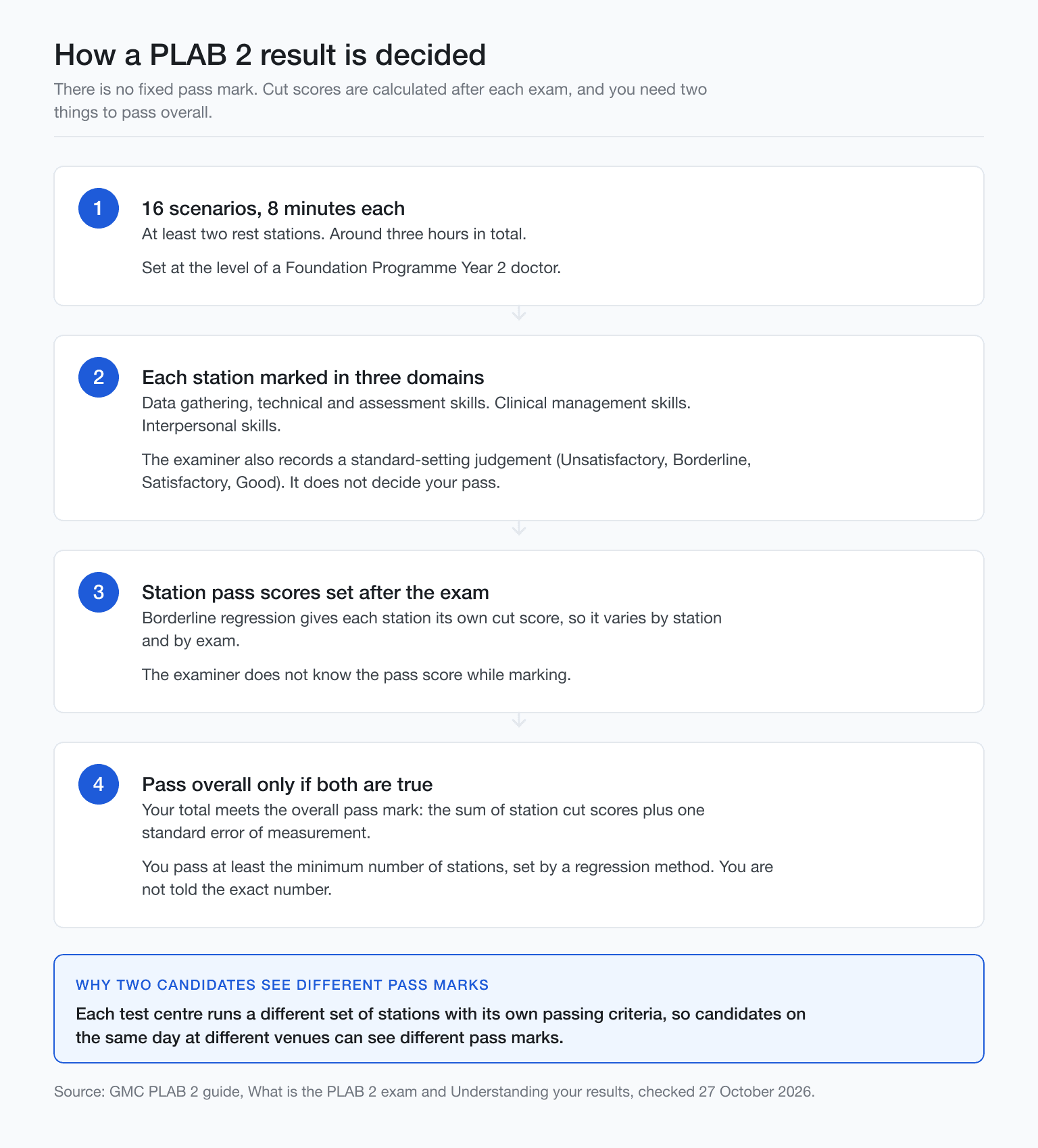
PLAB 2 is a 16 scenario exam, each scenario 8 minutes, with at least two rest stations and a total time around three hours, set at the level expected of a Foundation Programme Year 2 doctor. The format and standard are described in the GMC's PLAB 2 guide.
Each station is marked across three domains:
- Data gathering, technical and assessment skills
- Clinical management skills
- Interpersonal skills
How a pass is decided, step by step:
- In every station the examiner scores the three domains, and also gives a separate standard-setting judgement as Unsatisfactory, Borderline, Satisfactory or Good, which does not itself decide whether you pass the station. See how results are calculated.
- After the exam, the pass score for each station is calculated by borderline regression, so it varies by station and by exam, and the examiner does not know that pass score while observing.
- Your overall pass mark is the sum of the station cut scores plus one standard error of measurement, which creates the overall threshold for that exam.
- You must also pass a minimum number of stations, set by a regression method, and you are not told the exact number the exam requires.
Each test centre runs a different set of stations with distinct passing criteria, so same-day candidates at different venues can see different pass marks.
PLAB 2 is a clinical and professional skills assessment that the GMC says is compliant with the Medical Licensing Assessment requirements, and if you want to compare it with how UK medical schools' version is marked, see the UKMLA CPSA criteria.
Practising the 16 stations
PLAB 2 stations cover 16 scenarios. Most involve a simulated patient, some are telephone consultations, and some test physical examination on a simulated patient, a model, a manikin or a high-fidelity simulator. A subset focus on practical skills, including checking blood pressure, venepuncture, inserting a cannula, and interpreting an ECG.
Every station is marked against the three marking domains.
The clearest map of where performance goes wrong is the GMC's ten feedback statements in your results: Consultation, Issues, Time, Findings, Examination, Diagnosis, Management, Rapport, Listening, Language. Only Examination is about physical examination technique. The rest are structure, priorities, timing, reasoning, rapport, listening and plain language.
Diagnosica is an AI clinical simulator for medical students and junior doctors: you take a history from an AI patient by voice or text, order labs and imaging, commit to a diagnosis and management plan, and get a competency scorecard. The patient appears as a video patient, it's free to start with no card, runs on iPhone, Android and the web, and doctors use it outside the US. It can't rehearse examination, practical skills or manikin stations, it isn't a replacement for a practice partner, and no prep tool can promise a pass. If you're preparing for PLAB 2 alone, use it to rehearse history, reasoning and explanations. Other tools exist too, some with AI patients, and we've rounded them up here: PLAB 2 AI practice tools.
If you want to try one, Start a free case.
Common questions
Is PLAB 2 harder to pass than PLAB 1?
By GMC pass rates, PLAB 2 has had a lower pass rate than PLAB 1 in every year from 2021 to 2025. In 2025 it was 59.8% versus 62.2%. Pass rates measure outcomes, not difficulty, and the cohorts differ between the two exams. In 2023 the gap was wider at 9.1 points, 62.9% for PLAB 2 and 72.0% for PLAB 1.
What was the PLAB 2 pass rate in 2024?
The PLAB 2 pass rate in 2024 was 65.8%, with 12,902 passes out of 19,594 candidates who sat. Across 2021 to 2025 it was the only year-on-year rise, up from 62.9% in 2023. The GMC labels the counts as candidates who sat and doesn't give first-attempt or centre splits on that page.
Is there a fixed PLAB 2 pass mark?
There is no fixed PLAB 2 pass mark. Stations use the borderline regression method, so cut scores vary with station difficulty and the specific exam, and centres can run different station sets with distinct passing criteria. Your overall pass mark is the sum of station cut scores plus one standard error of measurement, and you must also pass a minimum number of stations.
How many times can you sit PLAB 2?
You have four attempts at PLAB 2. After a fourth fail you must apply for a fifth and final attempt, which requires at least 12 months of additional learning, either 12 months of clinical practice or a relevant postgraduate qualification. There are no attempts beyond the fifth, see the GMC's attempt rules. For what to do next, see after a failed attempt.
Does the GMC publish PLAB 2 pass rates by country?
No, the GMC does not publish PLAB 2 pass rates by country on its pass-rate page as checked 27 October 2026. That page lists yearly totals for candidates who sat only, with no first-attempt split, no centre-level figures, and no stated reasons for year-to-year changes.