Family Medicine Rotation Tips: Clinic, Presenting, Shelf
How do you do well on a family medicine rotation?
Do well on a family medicine rotation by seeing your patient first with a plan in mind, presenting briefly in a fixed order, reading up on your own patients the same day, and treating wrong answers as normal. Ask for specific feedback and follow through. These are the family medicine rotation tips that compound fast.
In many programs you're first contact. Get a clean story, think in problems, present findings, a problem list, a differential and management options, then discuss next steps with your preceptor, who usually sees the patient with you.
From UW's clerkship recipe: “10 minutes during lunch looking up your patient’s complaint and reporting back” outperforms hours of solo reading that never gets discussed.
Keep presentations short and organized. That guide wants concise reports focused on the most important details, in one fixed order so you don’t fumble when you’re nervous.
Treat misses as part of the process. Their quote is blunt: “Answering questions wrong is NOT a red flag, but not trying is.” Try, then close the loop with a one-liner you report back.
Year-wide habits live in the core clerkship habits. This post sticks to the clinic visit and the presentation.
How a clinic day runs
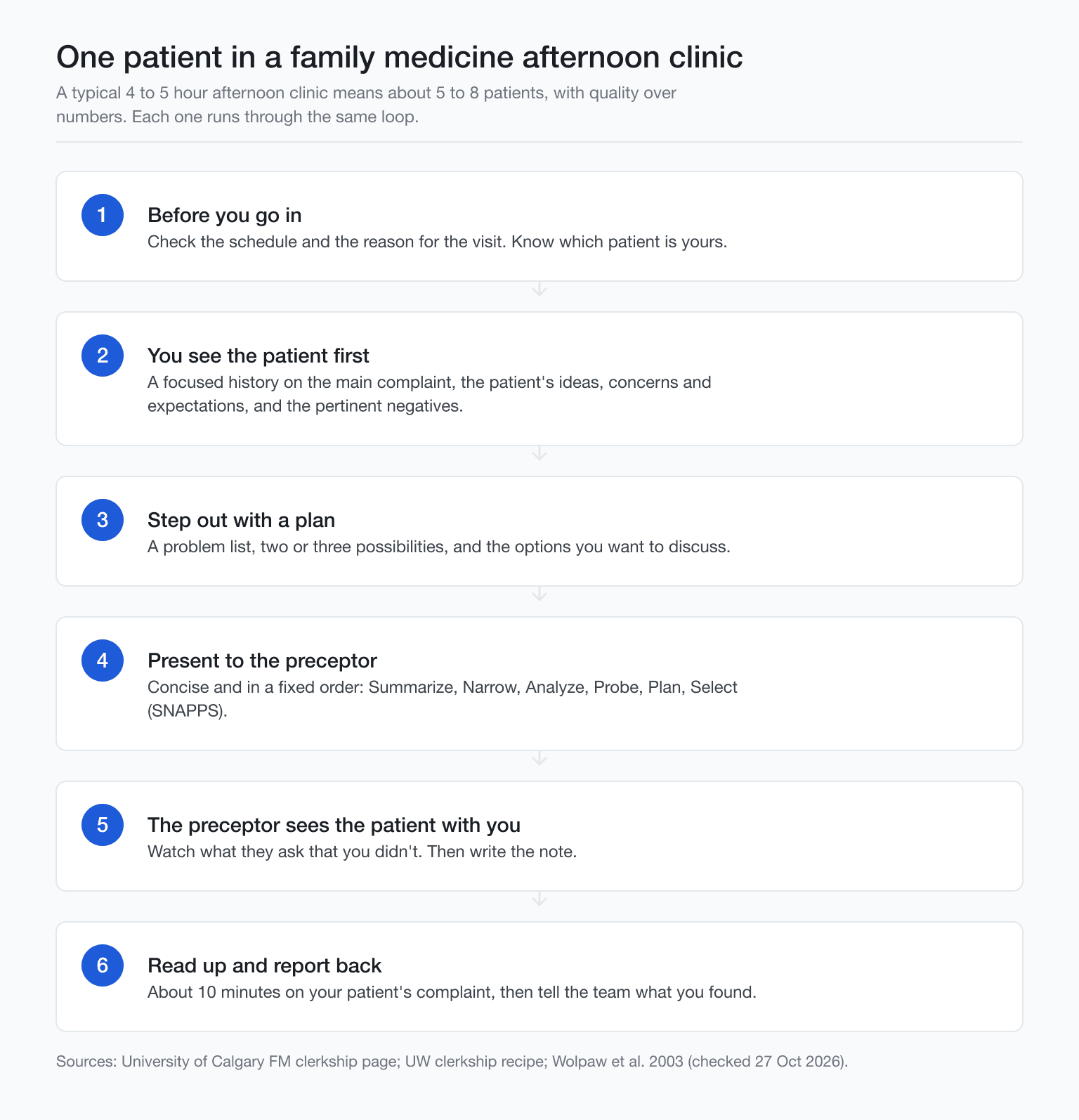
A family medicine clinic day starts with you as first contact for patients, then moves through concise presentations, a joint review with your preceptor, and quick read-ups. Expect about 5 to 8 patients over a 4 to 5 hour afternoon, with quality over numbers, per Calgary's clerkship guidance. Your clerkship’s expectations win if they differ.
- Before clinic. Scan the schedule, skim charts, and set a one-line goal for each first patient, like rule in or rule out one dangerous thing.
- Each patient. Take a focused history, leave with a problem list, a 2 to 3 item differential, and management options to discuss. Present briefly, your preceptor usually sees the patient with you.
- Between patients. Do a 10 minute read-up on the chief complaint and report one take-home, as the UW “Recipe” suggests. If there’s no gap, bank it for lunch or the last slot.
- End of day. Pick one question from today’s patients to read on, and one thing to practice tomorrow. Ask for one concrete piece of feedback.
For a reference model that matches this flow, see Calgary's clerkship guide.
Seeing the patient before your preceptor does
Seeing a patient before your preceptor does is standard in many family medicine clinics, and some programs state you’ll be the first contact for assigned patients. The Calgary FM clerkship says “you will be the first contact, in each case,” then you discuss findings and plans with your preceptor, who usually sees the patient with you, see Calgary FM clerkship.
Walk out of the room with:
- The reason for visit in the patient’s own words.
- A focused history on that complaint.
- The patient’s ideas, concerns and expectations.
- Pertinent negatives that help rule out the dangerous version.
- A problem list, even if it’s one item.
- Two or three possibilities you’re weighing.
- Options you’d like to discuss with your preceptor.
If the patient brings a list, ask which problem matters most today, agree on that focus, and tell your preceptor you set that agenda with the patient.
If you’re unsure what belongs in a focused story for clinic, keep it to one focused history that matches the presenting problem and flags red flags you already excluded.
Rehearse this by taking a concise first-contact history on an AI patient in Diagnosica who opens with six weeks of thirst, then sanity check your differentials and what you’d want to discuss, and you can practice a first-contact history.
How do you present to your preceptor?
Presenting to your family medicine preceptor works best with a standard format. SNAPPS, described by Wolpaw, Wolpaw and Papp in Academic Medicine 2003 and piloted with third-year students and their preceptors, is learner centered, and it's built for outpatient teaching. The UW FM clerkship recipe says oral presentations should be organized and concise; use the SNAPPS model to keep structure when the clinic's moving quickly.
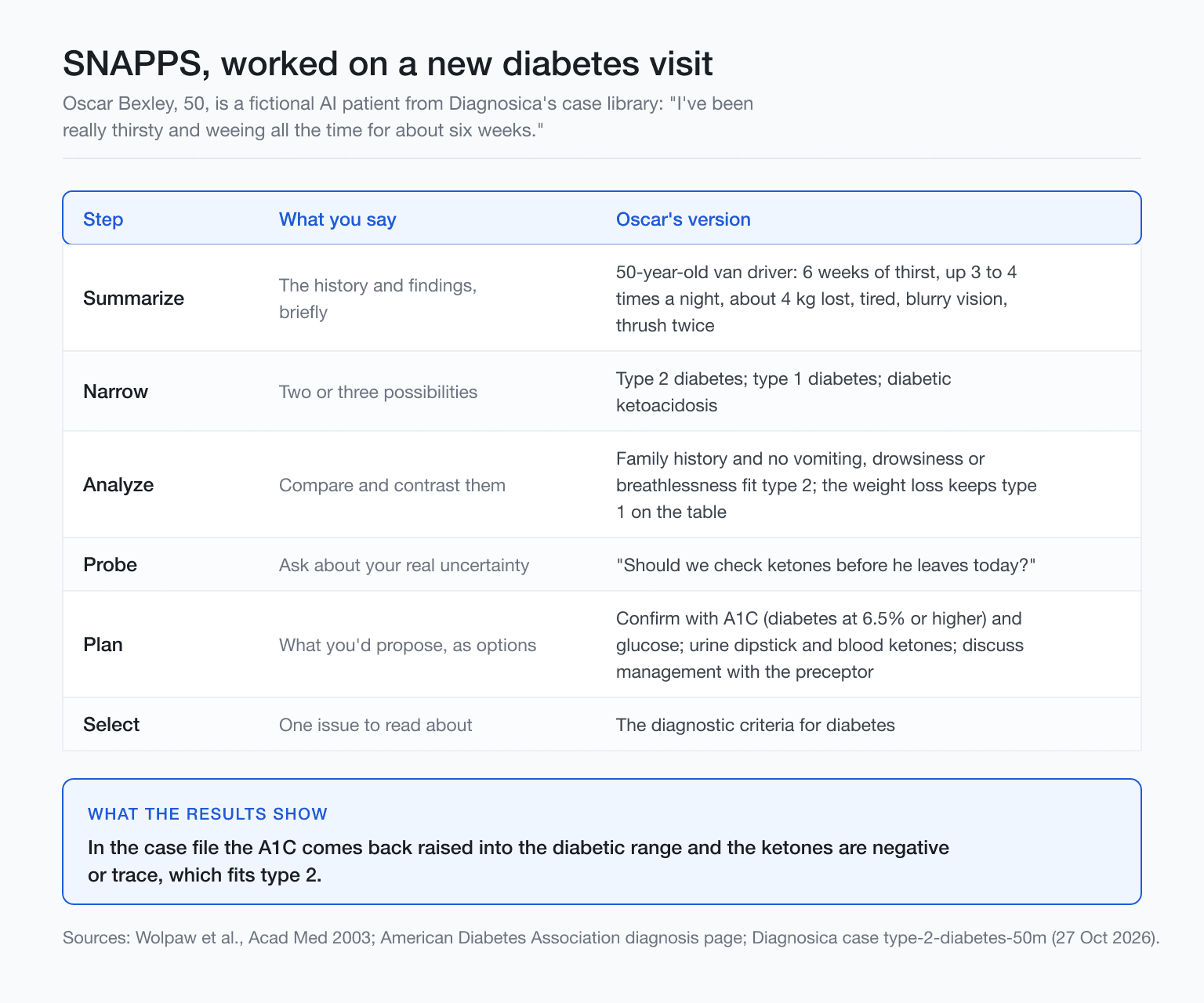
- Summarize who, what, duration, key positives and negatives, and any immediate safety concerns you've addressed.
- Narrow the differential to two or three possibilities, ordered by likelihood.
- Analyze by contrasting those possibilities using discriminating positives and negatives from history and exam.
- Probe your preceptor with your true uncertainty and a focused, decision-shaping question.
- Plan management by outlining your assessment and plan, covering diagnostic confirmation, risk checks, communication, and proposed follow-up.
- Select one case-related learning point you'll read later and link to your decision.
A worked visit: new diabetes
This worked family medicine visit uses a fictional AI patient from Diagnosica's case library, Oscar Bexley, 50, a delivery van driver, to model a first clinic encounter for new diabetes. It shows focused history and a SNAPPS presentation you’ll read to a preceptor without wasted words. Treat it as a reusable template on a busy day.
"I've been really thirsty and weeing all the time for about six weeks."
Pertinent negatives that cut risk now, no vomiting, breathlessness, drowsiness or abdominal pain.
ICE in one line, he thinks he’s run down, stressed, or drinking too much coffee, worries about thirst, weeing, and weight loss, and expects an explanation with something to sort it out.
- Summarize: Oscar Bexley, 50, six weeks of polydipsia and polyuria, nocturia 3 to 4 times, fatigue, intermittent blurry vision, 4 kg weight loss, recurrent thrush, two or three cans of cola a day, father and brother with type 2 diabetes. No red flag symptoms for ketosis.
- Narrow: Type 2 diabetes vs type 1 diabetes vs diabetic ketoacidosis vs diabetes insipidus.
- Analyze: No ketosis features and family history fit type 2, the weight loss keeps type 1 on the table.
- Probe: Unsure whether to check capillary ketones today given the symptoms, can we discuss.
- Plan: Confirm with A1C and glucose, urine dipstick and blood ketones, then talk management options with you.
- Select: I’ll read the ADA’s diagnostic criteria and practice applying them.
The ADA defines diabetes at A1C 6.5 percent or higher, fasting plasma glucose 126 mg/dL or higher, or random plasma glucose 200 mg/dL or higher with symptoms, usually repeated on a second day, see the ADA’s diagnostic cutoffs. In this case file, A1C returns in the diabetic range and ketones are negative or trace.
Studying for the shelf alongside clinic
Studying for the shelf alongside clinic starts with the NBME Family Medicine Modular Subject Exam formats. The family medicine shelf can be Core only with 90 items in 2 hours 15 minutes, Core plus Chronic Care with 100 items in 2 hours 30 minutes, or Core plus Chronic Care plus Musculoskeletal with 110 items in 2 hours 45 minutes.
For official durations, see NBME's timing chart. The chart is dated July 2021, so you’ll confirm the configuration with your clerkship.
NBME’s content is 100% ambulatory. Diagnosis is 40% to 50%, Health maintenance, prevention and surveillance 20% to 25%, Pharmacotherapy, intervention and management 25% to 30%, patients 18 to 65 are 55% to 65%, and Behavioral health and Social sciences are 5% to 10% each, per NBME's content outline.
Use SNAPPS to make clinic drive studying. The Select step, per Wolpaw et al., Academic Medicine 2003, prompts one case-linked learning issue. Pair it with a University of Washington 2019 handout tip, a 10 minute lunch read on your patient’s complaint, then you’ll report back.
- Pick one patient from today, write one specific question you still have.
- Read 10 minutes on that question, add one prevention or screening item for their age.
- Share a one line takeaway with your preceptor tomorrow.
Getting more reps between clinic days
Practice between clinic days matters, because clinic offers few first-contact reps and presentations improve with repetition. Diagnosica is an AI clinical simulator for medical students and junior doctors: you take a history from an AI patient by voice or text, order labs and imaging, commit to a diagnosis and management plan, and get a competency scorecard. Patients are video avatars and it's free to start, no card needed. It runs on iPhone, Android and web, and it's used outside the US. No physical exam practice.
It doesn't give advice about real patients, and it's not a diagnostic system. Treat every output as educational.
On busy weeks, the two-minute quick case gives five clues one at a time and keeps a daily streak going.
Common questions
How long is the family medicine shelf exam?
The family medicine shelf exam on NBME’s modular format runs 90, 100, or 110 multiple choice items, timed at 2 h 15 min, 2 h 30 min, or 2 h 45 min respectively, per the NBME Subject Examination Timing Chart from July 2021. Your school selects Core only, Core plus Chronic Care, or Core plus Chronic Care plus Musculoskeletal.
How many patients will I see in a family medicine clinic?
Clinic volume swings by site. The University of Calgary’s family medicine clerkship says a typical 4 to 5 hour afternoon includes about 5 to 8 patients, with emphasis on quality rather than numbers. That’s a useful benchmark for pacing your day, but schools and preceptors differ.
What if I get the answer wrong in front of my preceptor?
Per the University of Washington’s Recipe for Family Medicine Clerkship Success, most students found being wrong mattered far less than they feared. One quote: “Answering questions wrong is NOT a red flag, but not trying is.” Ask for concrete feedback, don’t get defensive, then look it up and report back, even a 10 minute check at lunch.
Is family medicine different from the surgery or neurology rotation?
Family medicine differs in two big ways. The NBME outline makes the family medicine shelf 100 percent ambulatory. Many clerkships also run first contact clinic visits, for example Calgary has students as the first contact, then discussions with the preceptor who usually sees the patient with you. For rotation specific tactics, see the surgery clerkship version and the neurology clerkship.