How to Review Bloods as an FY1: A Ward Results Checklist
A repeatable results-round routine for FY1s, comparing with baselines, what to act on today versus flag, and phrases to use when you escalate.

How do you review bloods as an FY1?
How to review bloods as an FY1: run the same routine every time. Triage by the sickest patient and the biggest change. Compare each result with that patient’s previous value, not only the reference range. Check the patient and observations behind any abnormal number, document, and escalate anything that alters the next few hours.
Thirty sets before the afternoon, a list in one hand, the bleep going. Here’s a default results-round you can run at pace, four worked results, and the script for escalation, plus the FY1 survival basics.
It covers recognising and escalating, not treating; your local trust guidance governs actions and cut-offs.
The results-round routine
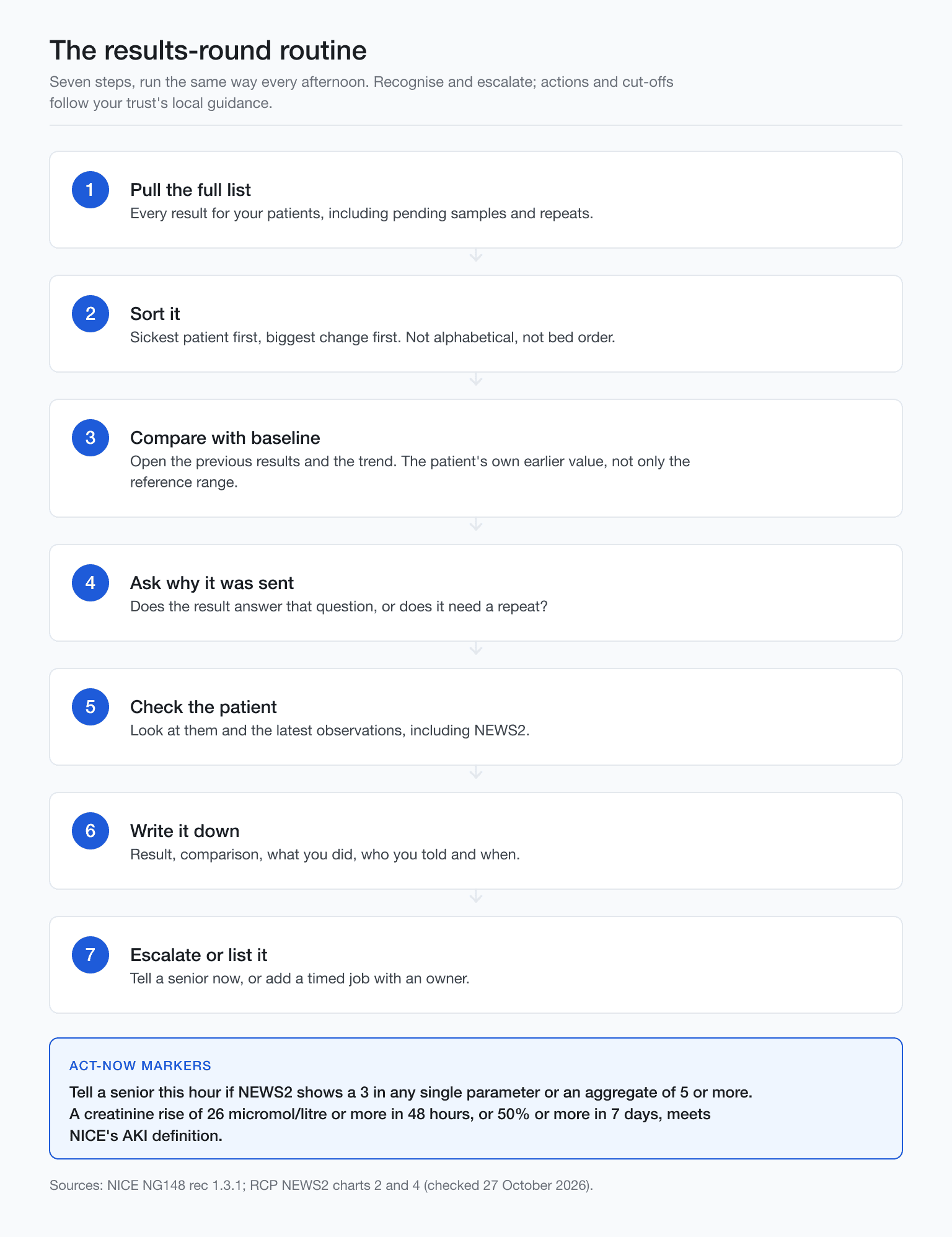
The results-round routine is a fixed way to clear bloods quickly without missing risk. Pull a full list, sort by sickest and by biggest change, compare each abnormal with earlier values, ask what question it answers, check the patient, document actions, and set a timed next step.
- Pull the full results list for your patients, including pending and repeats, from one screen.
- Sort by sickest patient and by biggest change, not alphabetically or by bed order.
- For each abnormal value open previous results and the trend, then compare to the baseline.
- Ask why the test was sent and whether the result answers that question or needs a repeat.
- Check the patient and observations for movement, including mental state, urine output, oxygen needs, and NEWS2.
- Write it down: result, comparison, what you did, who you told, where seen, and agreed follow up.
- Escalate immediately if worried, or add a timed job with owner and deadline, and book review.
Record each action as a timed task on your FY1 jobs list with owner and location, so nothing drops at handover.
Why compare with baseline, not the reference range?
Comparing with baseline keeps you honest: a lab value inside the reference range can still be a big change for that person, and a value outside it can be their normal. Acute kidney injury (AKI) is defined by a creatinine rise of 26 micromol/litre or more in 48 hours, or 50% or more in 7 days, which is tiny next to most ranges.
Those thresholds are from NICE's AKI guideline, NG148.
Douglas Reid, a fictional AI patient, had creatinine 268 micromol/litre against a baseline of 88 three months earlier, about three times baseline. You only know it is acute because someone found the old value.
If there's no previous result in the system, look for one in GP records or other hospital results, and say in the note when you couldn't find one.
Douglas Reid's case is in Diagnosica's library as an AI patient you can take a history from, then order his bloods and see whether you chase the baseline; run his case free.
Four worked results from the case library
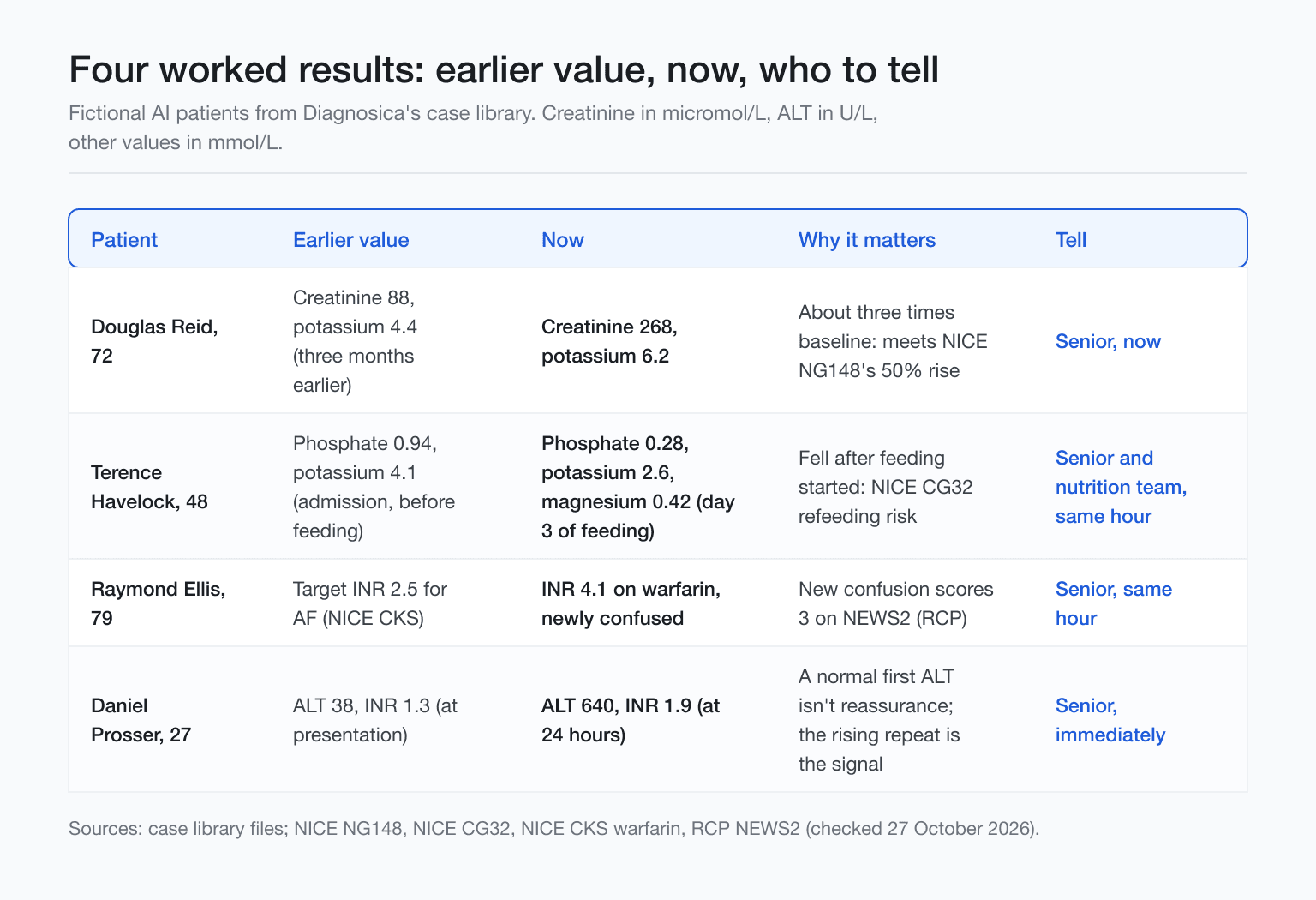
These four worked results come from fictional AI patients in Diagnosica's case library, and every case is reviewed and signed off by a doctor. Each one shows how to compare with the baseline, check the patient, and escalate early. Names and numbers are from the files. Actions here are recognise, check, repeat, document, and tell a senior or the responsible team.
Douglas Reid: a creatinine three times his baseline Creatinine 268 micromol/L against a baseline of 88, about three times higher, meets the NG148 50 percent rise criterion for AKI. Potassium is 6.2, up from 4.4. He’s tachycardic at 108 with a soft 102/58. Recognise this, see him, and tell your senior now. NG148 sets referral triggers, and your trust’s hyperkalaemia guideline sets the cut-offs.
Terence Havelock: electrolytes that fell after feeding started Three days after feeding began he’s weak and breathless. Phosphate fell 0.94 to 0.28, potassium 4.1 to 2.6, magnesium 0.42. Trend against pre-feeding values matters. NICE's refeeding risk criteria classify low potassium, phosphate or magnesium before feeding as high risk, and expect daily phosphate and magnesium if there is refeeding risk. Tell your senior and the nutrition team now.
Raymond Ellis: an INR above target in a confused man On warfarin for AF, his INR is 4.1. NICE CKS warfarin targets state 2.5 is the target for AF and within 0.5 is generally satisfactory. New confusion scores 3 on NEWS2, which needs an urgent ward response. An over-anticoagulated, newly confused older man is a same-hour senior conversation. The case diagnosis was a chronic subdural haematoma.
Daniel Prosser: the normal ALT that wasn't the end of it Possible overdose with normal ALT 38 and INR 1.3 at presentation isn’t reassurance. At 24 hours ALT is 640 and INR 1.9. The rising repeat is what you escalate, immediately. Document the change, recheck observations, and tell your senior now.
Which results should you act on today?
Results to act on today are those that change risk or management this hour. That means a big recent shift from that patient’s baseline, a change that meets NICE’s AKI definition, numbers that match new clinical deterioration, repeats trending the wrong way, or anything your trust flags as critical. Everything else can sit on a named list with a time to review, unless it starts to move.
Act now, tell a senior this hour
- A big change from that patient’s baseline in a key value, like a change that meets NICE’s AKI definition.
- A result that fits a patient who looks unwell, see how sick patients look.
- A NEWS2 rise, see the RCP's NEWS2 thresholds. A single-parameter score of 3 needs urgent ward-based response; aggregate 5 or more is the urgent response threshold.
- A repeat that’s moving the wrong way on serial testing.
- Anything named in your trust’s critical-result policy.
Flag for tomorrow, with a time and an owner
- Small, stable changes in a well patient.
- A result that needs a repeat to confirm before action.
- A result already documented with a plan and timeframe.
If you’re unsure which side a result sits on, treat it as act-now and ask.
Don’t re-send tests that won’t change anything, see bloods nobody needed.
Escalating a result: what to say
Escalating a blood result needs a headline-first call: "Terence Havelock, phosphate 0.28 mmol/L, down from 0.94 on admission; heart rate 124, respiratory rate 28, oxygen saturation 91%; I need an urgent review." Lead with the number and the comparison, then how he is now, then the ask.
Use SBAR. Here is a fill in script using Terence Havelock, a fictional AI patient from Diagnosica's case library; phrasing help is in escalating to a senior.
- Situation: FY1 on [ward]. Terence Havelock, 48. Phosphate 0.28 mmol/L, down from 0.94 on admission.
- Background: Feeding tube started three days ago.
- Assessment: Now HR 124, RR 28, oxygen saturation 91%. Weak and breathless.
- Recommendation: Please see him now, or make a decision on next steps.
Say the number and the old number out loud. "0.28, down from 0.94 before feeding" carries urgency; "his phosphate is low" does not.
Write the time and the name of who you told in the notes. Record it with their role.
Common questions
How long should reviewing bloods take as an FY1?
There isn’t a fixed time in any guideline. Batch results at a set point in your day, then work sickest first. Scan for red flags that change the next few hours, like AKI triggers in NICE NG148 and NEWS2 thresholds. Document, chase missing results, and park stable abnormalities.
What if I can't find a baseline result?
Search other hospital systems and the GP record, then ask patient or family. If you can’t find one, document no baseline available and treat an abnormality as new until shown otherwise. NICE NG148 says a 50% rise "known or presumed" within 7 days counts for AKI detection.
Should an FY1 phone the patient's team about every abnormal result?
No. Results that change the next few hours go to a senior now; the rest go on a list with an owner for ward review. Escalate AKI by NICE NG148, high refeeding risk electrolytes in NICE CG32, or an over target INR with new confusion in the same hour. Local guidance governs actions.
What do I do if I'm bleeped about a blood result?
Go back to the routine. Compare with the patient’s baseline, check NEWS2 observations and see the patient, then decide whether to escalate now or list for review. Document who you informed and what was agreed, and chase missing or repeat samples. For a fuller script, see answering a bleep about bloods.
Practise the results round Diagnosica is an AI clinical simulator for medical students and junior doctors: you take a history from an AI patient by voice or text, order labs and imaging, commit to a diagnosis and management plan, and get a competency scorecard. The patient appears as a video avatar, it’s free to start with no card needed, it runs on iPhone, Android and the web, and doctors use it in the UK and well beyond. The four patients above are cases you can run, ordering bloods and deciding what to chase. Start a case free.