GP Placement Tips Medical Students Can Use, Week by Week
A week-by-week plan to move from sitting in to leading a GP consultation, with checklists for week one, presenting to your GP tutor, and getting feedback.

How do you get the most out of a GP placement?
Getting the most out of a GP placement as a medical student is mostly process. Introduce yourself as a student and check consent every time, sit in with one specific skill to watch, ask early to open consultations, then take histories and see a patient before the GP, present back concisely, and ask for specific feedback each session, all within what your school and tutor allow.
You won’t fix nerves by waiting. Pair a tiny plan for day one with a placement study routine you can keep.
For evidence that active consulting works, Bristol’s 2025-26 Year 1 GP programme had 289 students across 33 practices. Teachers said observed consultations worked best when students were actively involved rather than passive observers, and one started students opening from the second or third session and jumped in when they got stuck. Students asked for more chances to independently lead consultations and get individual feedback. Source: Bristol's 2025-26 GP report. These are early-year students at one school, but the signal is clear.
Week one: sitting in with a purpose
Week one of a GP placement is about sitting in with a purpose. Keep supervision tight, introduce yourself properly, and decide what you’re observing before the first patient. Schools differ on autonomy, so stick to your supervisor’s brief and the GMC rules on consent and supervision.
- Introduce yourself to every patient with your full name, that you are a medical student, and your year. Then ask if they are content to have a student present. The GMC puts this plainly: “Always introduce yourself...” and “check if they are content to have a student present” in the GMC's student guidance.
- Keep your ID badge visible, arrive on time, know who supervises you, and state competence early. The GMC says, “you should only treat patients or give medical advice when you are under the supervision of a registered healthcare professional,” and to “clearly explain your level of competence... so you are not asked to do anything you are not trained to do.”
- Pick one consultation skill to watch per surgery, the opening question, how ICE is asked, or how the GP closes. University of Bristol Year 1 teachers reported that “assigning specific aspects of communication or consultation skills to observe” made observed consultations work better.
How do you move to seeing your own patients?
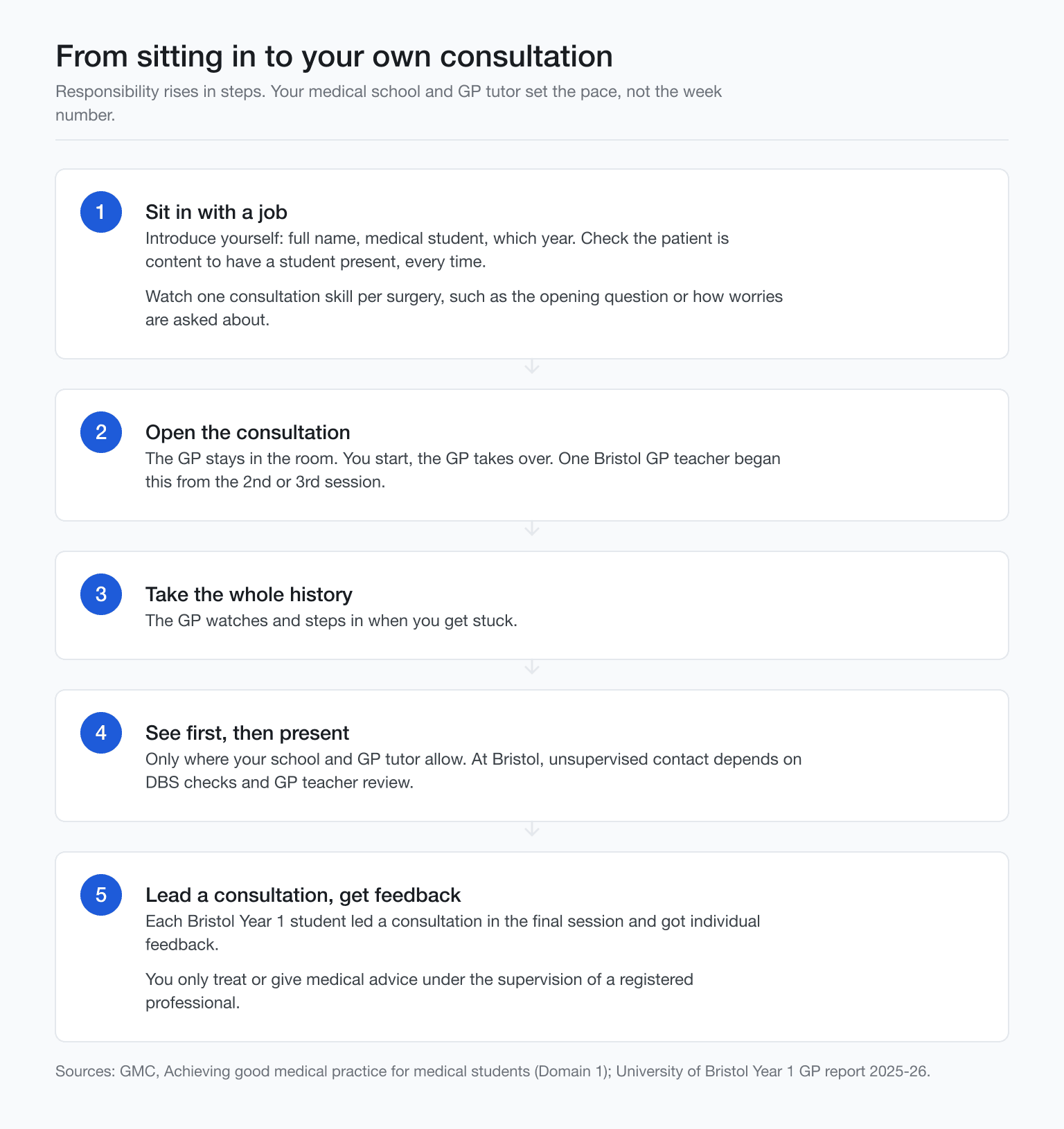
Moving from sitting in to seeing your own patients on a GP placement happens in steps, not one jump. Pace varies by school, tutor and practice. A clear ladder helps you ask for the next rung and stay inside supervision rules.
- Open with the GP in the room, introduce yourself as a medical student, confirm consent, and set a one sentence agenda.
- Take the whole history while the GP watches and steps in if you get stuck. A Bristol Year 1 teacher started this from the 2nd or 3rd session.
- See a patient first and present before the GP joins, only where your school and tutor allow. Agree the plan with the GP before anything is said to the patient.
- Lead a full consultation and get individual feedback. Bristol Year 1 students each did this in their final session with feedback.
Unsupervised contact varies by school. At Bristol it needs completed DBS checks and a GP teacher’s review for individual students. The GMC says you should only treat patients or give medical advice under the supervision of a registered healthcare professional, so you don’t deliver the plan yourself.
In your slot, keep the history tight, see keeping a short history focused.
Rehearse and present Practise seeing a patient first, then presenting. Diagnosica is an AI clinical simulator for medical students and junior doctors: you take a history from an AI patient by voice or text, order labs and imaging, commit to a diagnosis and management plan, and get a competency scorecard. Patients appear as video avatars. It doesn't teach physical examination, and it's practice, not a real patient. Free to start, no card needed, on iPhone, Android and web, used by learners in the UK and well beyond the US. Practise now
A 10-minute consultation, worked through
A GP consultation in the UK is typically short, and a 67-country review reports an average of 9.22 minutes in 2014 data. That short slot is the reality. In the Bristol Year 1 2025-26 report, several GP teachers suggested 30 minute appointments for student-led consultations, so ask early whether yours can be longer.
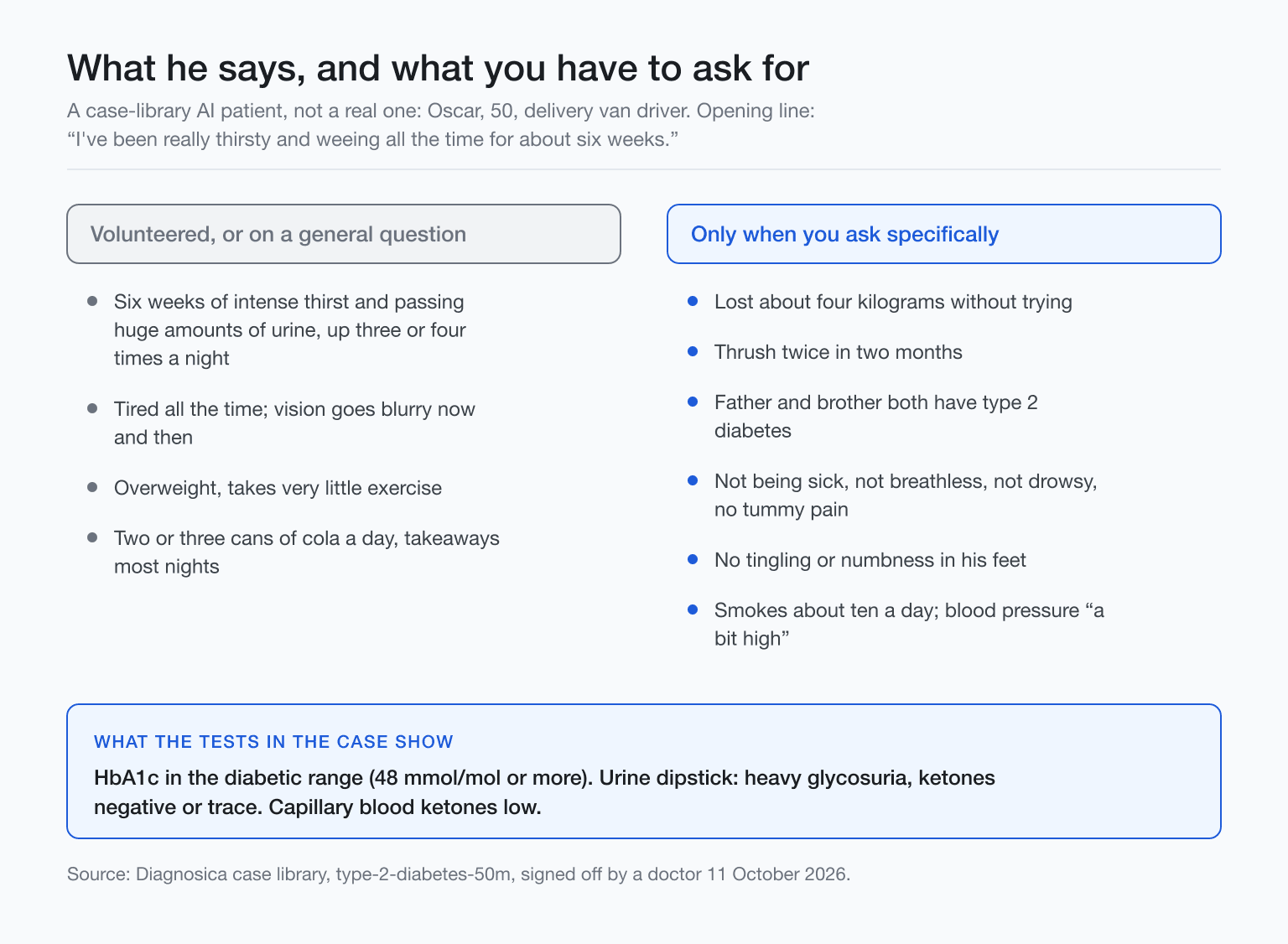
Here is a worked example using a Diagnosica AI case-library patient, not a real patient. Oscar Bexley, 50, delivery van driver, opens with: "I've been really thirsty and weeing all the time for about six weeks."
1) Do introductions and consent under GMC guidance, then let him talk. He reports thirst and passing urine for about six weeks, up three or four times a night, plus tiredness, blurred vision, two or three cans of cola a day, and frequent takeaways.
2) Ask for the patient's ideas and worries using ICE. Ideas: run down, stressed, or drinking too much coffee. Concerns: constant thirst, the weeing, and weight loss. Expectations: an explanation and something to sort it out.
3) Target specifics: about four kilograms of unintentional weight loss, thrush twice in two months, father and brother with type 2 diabetes. No sickness, breathlessness or drowsiness; no tingling or numbness in the feet, no fever, no burning when passing urine. Smokes about ten a day, blood pressure a bit high, no tablets.
4) Order the tests in this case. HbA1c is raised into the diabetic range, 48 mmol/mol or more. Urine dip shows heavy glycosuria with ketones negative or trace. Capillary blood ketones are low.
5) Reason out loud. The case answer is type 2 diabetes, but the distractors are type 1 diabetes, diabetic ketoacidosis, diabetes insipidus, and hyperosmolar hyperglycaemic state. Checking ketones matters, you must consider type 1 or DKA safely before any plan.
How do you present to your GP tutor?
Presenting a patient to your GP tutor is short, built for the gap between patients. Teachers in the Bristol Year 1 report 2025-26 said students struggle to structure history presentations and asked for early practice. Use this five part format to stay crisp.
- One line, age, context, main problem, duration.
- The story, two or three lines on timeline.
- Key positives and negatives, include red flags you asked.
- Ideas, concerns and expectations, in the patient’s words.
- Your impression, what you’d check next, then a question for your tutor.
It mirrors presenting on a ward round.
One line, Oscar Bexley, 50 year old, six weeks of thirst and urinating a lot, up three or four times nightly. Positives, four kilograms weight loss, blurred vision, glycosuria, family history of type 2 diabetes, overweight, two or three cans of cola a day. Negatives, no vomiting, breathlessness or drowsiness, ketones negative to trace, no fever or dysuria, no neuropathic symptoms. ICE, he wondered about stress or coffee, wants an explanation and help. I’m thinking type 2 diabetes, I’d check ketones to consider type 1 or DKA, what would you have asked that I didn’t?
Getting signed off
Getting signed off on a GP placement starts with knowing your school's rules, because paperwork and requirements differ by school and year. Read your handbook in week one, book time for sign-off early, and agree what evidence your tutor wants before clinics fill your diary.
Each session, ask for a specific piece of feedback you can act on next clinic. The GMC expects you to respond constructively, reflect critically, and make an action plan, so frame the ask that way.
In the Year 2 report, students rated “high quality, individualised feedback” 4.47 out of 5, against 4.72 for enjoyment (July 2026). Feedback lands after the fun. So ask for it, don't wait in silence.
Also complete the end of placement questionnaire the GMC lists in its student guidance, because it closes the loop and signals you're serious about supervision and feedback.
For a picture of the first year, see what FY1 looks like.
Common questions
Can medical students see patients alone on a GP placement?
Sometimes, yes, but it depends on your medical school and your GP tutor. At Bristol, unsupervised patient contact remains contingent on completed DBS checks and a GP teacher’s review of appropriateness, and that report covers Year 1 students at one school (Bristol Year 1 report). The GMC says you should only treat or advise under supervision and be clear about your competence (GMC student guidance).
What if a patient doesn't want a student in the room?
You step out without fuss and thank them. The GMC asks you to check every time if a patient is content to have a student present, and to introduce yourself with your name, status and year (GMC practical steps). Use the gap to write up your last patient, read around an upcoming problem, or ask your supervisor a focused question.
How long is a GP appointment in the UK?
A 2017 review of 67 countries reported a UK primary care average of 9.22 minutes in 2014 data, with 8.65 minutes in 2007. Don’t treat that as a rule for your placement. Teachers in one school suggested 30 minutes or two sessions for student-led consultations, to allow feedback and pauses, in the Bristol Year 1 report.
Is a GP placement the same as a US family medicine rotation?
They’re similar because both involve primary care, continuity, and undifferentiated problems, but a GP placement in the UK isn’t the same as a US family medicine rotation. Structures, supervision and documentation differ by country and school. If you’re US bound or curious, read the US family medicine version.
Before your next surgery, rehearse taking a focused history and presenting it using an AI patient case or the two minute quick case. It’s free to start, no card needed. Practise now