Weekend Ward Cover FY1: hour-by-hour guide to triage and NEWS2

Saturday morning, a handover list of patients you've never met. Weekend ward cover as an FY1 means you look after inpatients on wards that aren't your own, with a bleep, fewer doctors around, and a rolling jobs list. Your task is to do what can't wait, spot the deteriorating patient fast, and escalate early.
This is the daytime weekend version, hour by hour: handover, triage, a worked bleep, when to call the registrar, and handing back on Monday. If your rota has nights, read the night shift guide. For core habits and checklists, see the FY1 survival basics.
What does weekend ward cover involve as an FY1?
Weekend ward cover as an FY1 means you hold the bleep for ward jobs on your assigned wards, pick up tasks for all inpatients there, and respond to deteriorations. You're covering patients you didn't clerk, often without their weekday team, so triage and escalation routines matter.
Rotas are set placement by placement, so your post's descriptor is the document that defines the weekend. The West Suffolk placement descriptor says, "Sat, Sun: When on-call, ward cover. All ward jobs for the weekend done by FY1 on-call. This includes management of the critically ill patient on the ward."
In the same document, a different surgical post shows how frequency varies, listing "1 weekend in 9" and a late on-call "13:00 to 20:30" pattern. That's a separate post, not medicine.
Other trusts word their descriptors differently, and local trust guidance for escalation and responses applies to your shift. Check both before you start.
The Saturday morning handover
The Saturday morning handover is where you catch the shape of the day before the bleeps start. Leave it with three things written and obvious: a list of who is sick or worrying, the jobs that must happen before Monday, and who to call, including which registrar is on and how to reach them.
Write each name with ward and bed, plus a direct number for the nurse in charge. Confirm the on call contacts you will use, how the registrar wants to be reached, and what counts as a call now problem versus an update.
- "Who are you most worried about, and why?"
- "Which jobs have to happen today, not Monday?"
- "Any results due back that someone needs to act on?"
- "Who has an escalation plan or ceiling of care documented?"
- "Who is the registrar today and how do I reach them?"
How do you triage a weekend jobs list?
A weekend jobs list sorts into three buckets, fast and without drama: sick now, must happen today, can wait for the weekday team. Sick now means you stop and go. Must happen today means a delay would change something before Monday. Can wait means Monday work you record cleanly, not half started.
Sick now is anyone nurses flag as worrying, or anyone with a rising early warning score. NEWS2 is a Royal College of Physicians system that standardises assessment and response to acute illness, and new confusion alone scores 3. If you're unsure, scan against recognise a sick patient, then escalate early via local pathways. Response sits with trust guidance and your seniors.
Must happen today covers jobs where weekend delay changes something before Monday, like results someone needs to act on, and reviews the nurses have directly requested because the clinical picture has shifted.
Can wait for the weekday team are routine jobs they own, like chronic issues or long-term plans. Write them for Monday rather than half-doing them and leaving no clear trail.
On weekdays you might chase and close everything, but at weekends you're triaging and documenting; for the weekday rhythm, see your weekday jobs list.
You can practise sorting a sick patient from a stable one with an AI patient, free to start: practise a ward call.
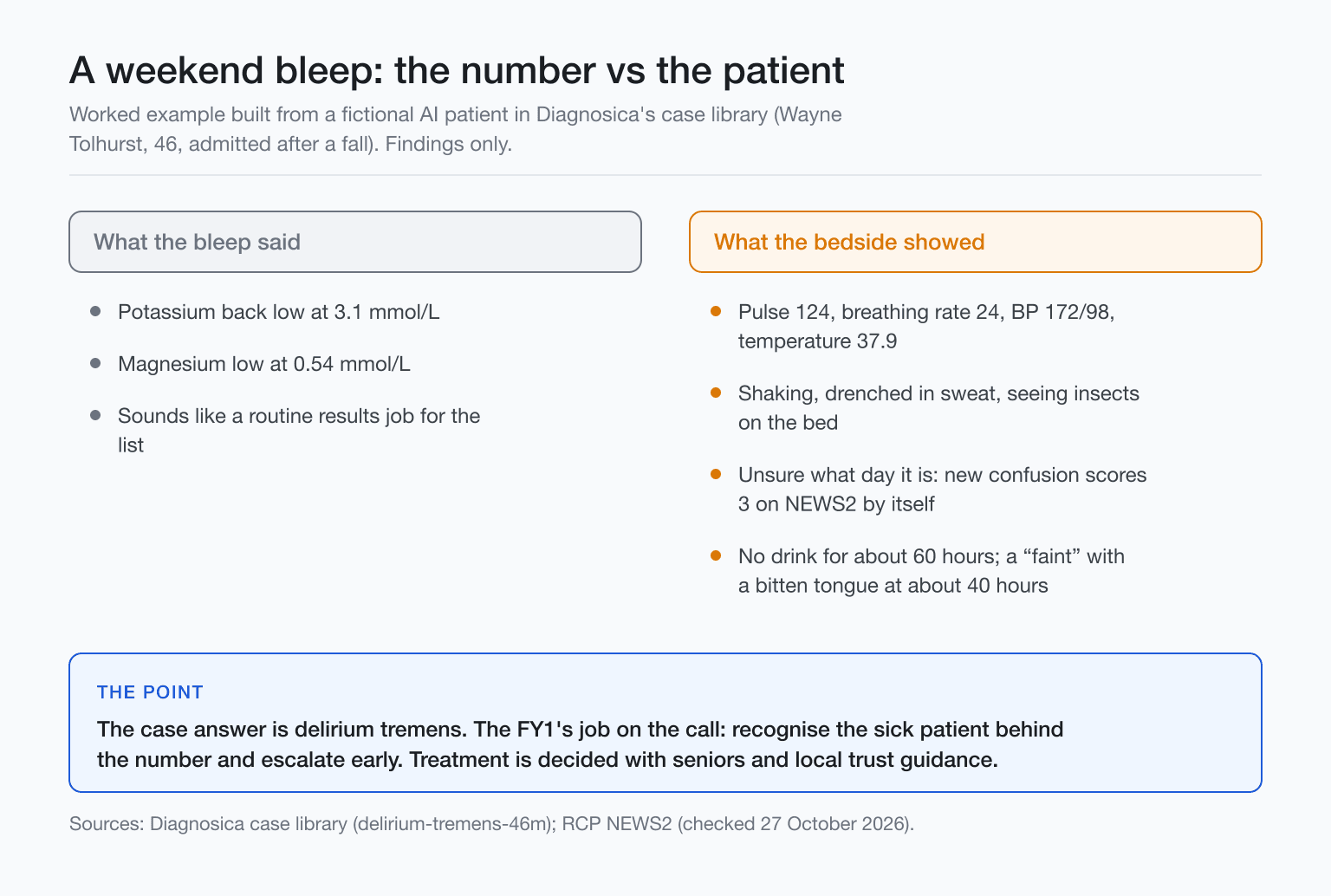
A worked weekend bleep: the low potassium that wasn't the problem
A worked weekend bleep built from a fictional AI patient in Diagnosica's case library: Wayne Tolhurst, 46, admitted after a fall down the stairs. The Saturday call you might get says his potassium is back low at 3.1 mmol/L. You pick up the card and head over.
At the bedside, heart rate 124, respirations 24 a minute, blood pressure 172/98, temperature 37.9. Shaking, drenched in sweat, seeing insects on the bed he believes are real, unsure of the day. Magnesium low at 0.54 mmol/L.
"Get them off, there's things crawling all over this bed, can't you see them?"
History nobody took: no alcohol for about 60 hours, ten to twelve cans of strong lager a day for years, not asked at clerking, and a bitten tongue after a supposed faint about 40 hours after his last drink.
New confusion alone scores 3 on NEWS2, a clear escalation signal.
Diagnosis is delirium tremens. The FY1 task is to recognise it early, escalate, and say why on the phone, while treatment decisions sit with seniors and your local trust guidance.
If you want a quick reset while you walk, skim taking a ward bleep.
When should an FY1 call the registrar at the weekend?
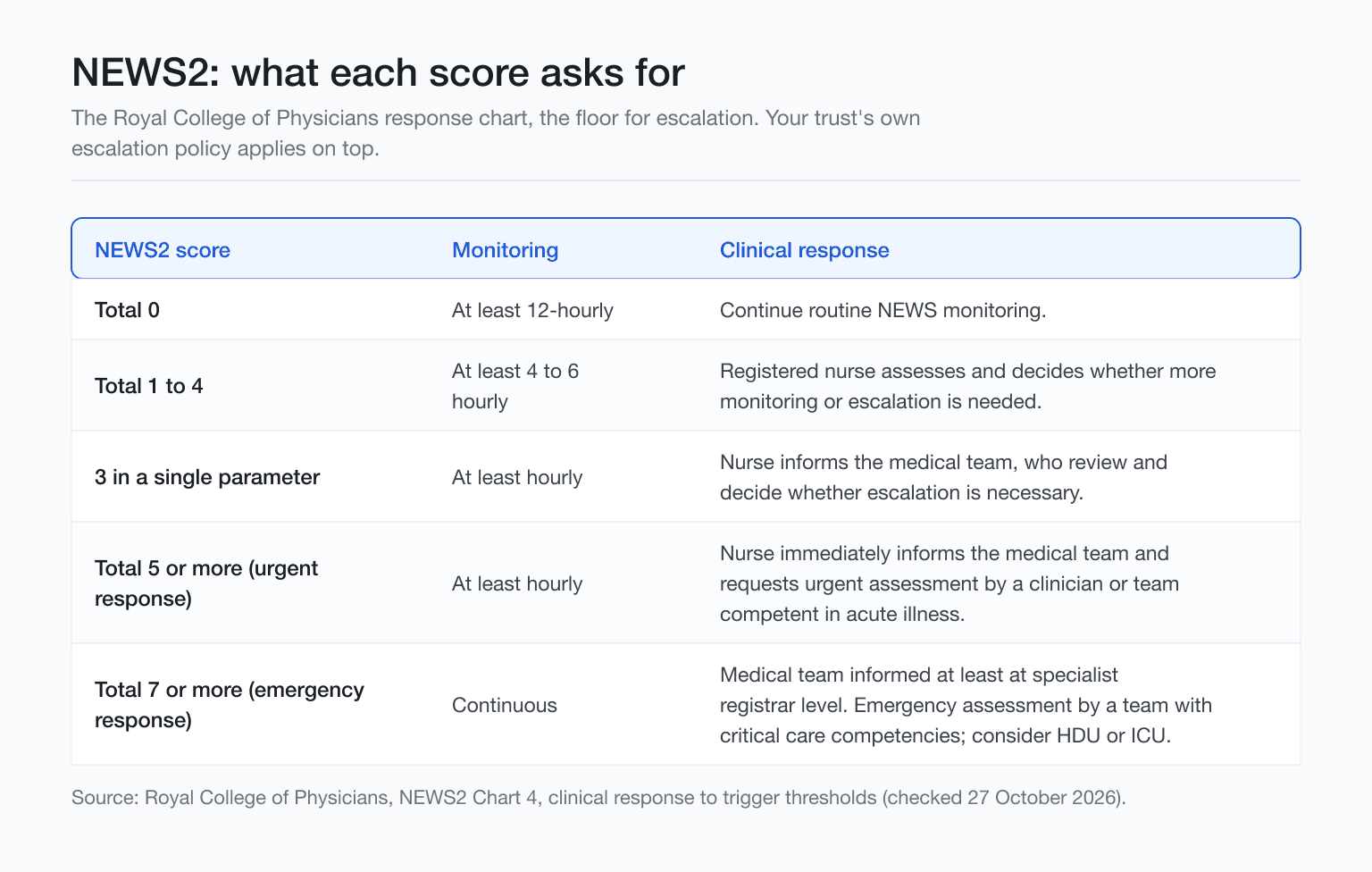
Calling the registrar on a weekend ward cover FY1 shift is for when a patient is sick or you're worried, not when you've finished every test. Use the NEWS2 response chart as the floor for escalation. If the numbers or the picture make you uneasy, call early, then fill in details once help is on the way.
A single parameter scoring 3 needs minimum 1-hourly observations and the registered nurse informs the medical team, who review and decide on escalation. A total of 5 or more is the urgent response threshold, with minimum 1-hourly, immediate informing of the medical team, and an urgent assessment by a clinician or team competent in acute illness. A total of 7 or more is the emergency response threshold, with continuous monitoring, the medical team informed at least at specialist registrar level, and an emergency assessment by a team with critical care competencies. Source: RCP NEWS2 response chart. These are a floor, your trust's escalation policy applies.
A fictional AI patient from Diagnosica's case library, a 58-year-old man with stage 4 kidney disease, says he probably shouldn't have come. Potassium 7.2 mmol/L, sample not haemolysed, pulse 52, ECG with tented T waves and a broadening QRS. Someone who says he's fine can still need the registrar now. Don't wait for a repeat to call.
The NHS SBAR guide is the template, and here's how it sounds for Wayne Tolhurst, a fictional AI patient from Diagnosica's case library: "S: 46-year-old on day 3 post-fall, acutely confused; B: no alcohol since admission; A: HR 124, RR 24, BP 172/98, temp 37.9, sweating, tremor, new confusion; R: I'd like you to come and see him." More on escalating to a senior.
Handing back on Monday
Handing back on Monday means giving the weekday team a clean, factual trail: who changed over the weekend, what you did, what still needs doing, and what you escalated and to whom. They need names, dates and times, not vibes. Write in the notes as events happen, and echo the key points in a handback message so they can pick up care without guessing.
- Who you saw and why, with ward, bed, time, trigger, and what changed.
- Results you acted on, with time, action taken in process terms, and who you informed.
- Jobs you left for the team and why, with timing or service dependencies.
- Anyone you still worry about, why, last review time, and who is already aware or escalating.
Rehearsing the weekend bleep before the weekend
You can't rehearse a real weekend on call as an FY1, but you can rehearse the thinking, spotting the sick patient behind a routine bleep and saying why. Practise the calls, frame risk, and escalate early, tomorrow and every weekend. Diagnosica is an AI clinical simulator for medical students and junior doctors: you take a history from an AI patient by voice or text, order labs and imaging, commit to a diagnosis and management plan, and get a competency scorecard. Each patient appears as a video avatar, it's free to start, no card needed, and there are apps on iPhone and Android, used outside the US too. It doesn't give advice about real patients, and it's not a diagnostic system. Treat every output as educational. No physical examination practice here.
Common questions
Common questions about weekend ward cover for FY1 doctors come up before the first Saturday handover. Here are short, direct answers for use on shift, covering whether it matches being on call, what NEWS2 means on the ward, when to start weekday jobs, and how to escalate if a registrar is unreachable.
Is weekend ward cover the same as being on call?
Weekend ward cover and being on call are labelled differently. At West Suffolk Hospital, the FY1 general internal and geriatric medicine descriptor ties weekend ward cover to being on call, states all ward jobs for the weekend are done by the FY1 on call, and includes management of the critically ill patient on the ward. Check your own placement descriptor and rota, rotas differ by trust.
What does NEWS2 mean for a weekend FY1?
NEWS2 for an FY1 on weekend ward cover is the national system, updated in December 2017, that standardises recognition and escalation of acute illness. A single parameter scoring 3 triggers minimum 1-hourly monitoring and the nurse informs the medical team to review and decide escalation. A total of 5 or more needs an urgent response, and 7 or more needs an emergency response by a team with critical care competencies. Follow local policy.
Should I start routine jobs for the weekday team?
Routine weekday jobs when you're on weekend ward cover should wait unless delay risks harm or blocks a time-dependent pathway set locally. Don't start non-urgent workstreams. Write them for Monday with date, owner if known, and outstanding tasks, and keep the handover list tidy. If you're unsure whether something can wait, ask your senior and document the plan.
What if I can't reach the registrar?
If you can't reach the registrar when you're on weekend ward cover, follow your trust's escalation policy step by step and tell the nurse in charge. Use the emergency route your trust lists when needed. For a NEWS2 total of 7 or more, the chart calls for continuous monitoring and emergency assessment by a team with critical care competencies, with senior involvement.
Practise the weekend bleep Spot the sick patient behind a routine call with an AI patient, free to start, no card needed. Start a case