How to Refer a Patient to Another Specialty (Call Script)

How do you refer a patient to another specialty?
You refer a patient to another specialty by phoning the on-call registrar or using the hospital's referral system, giving a short structured summary of who you are, who the patient is, why you are calling, what you think, and exactly what you are asking for and by when, checking understanding, then documenting the call.
You’re often cold-calling an unfamiliar specialty with minutes to spare and a patient needing a decision. Format beats waffle.
In a survey of 283 junior doctors, only 9.2% felt fully confident, 59% were unsure what to include, and 67.8% had a referral rejected. No surprise some hesitate to pick up the phone.
This gives you a 30-second script, what to have ready, likely questions, how to handle pushback, and what to write after. It’s about making referrals, not receiving them. If you’re brand new, skim our surviving foundation year one piece alongside this.
What to have ready before you pick up the phone
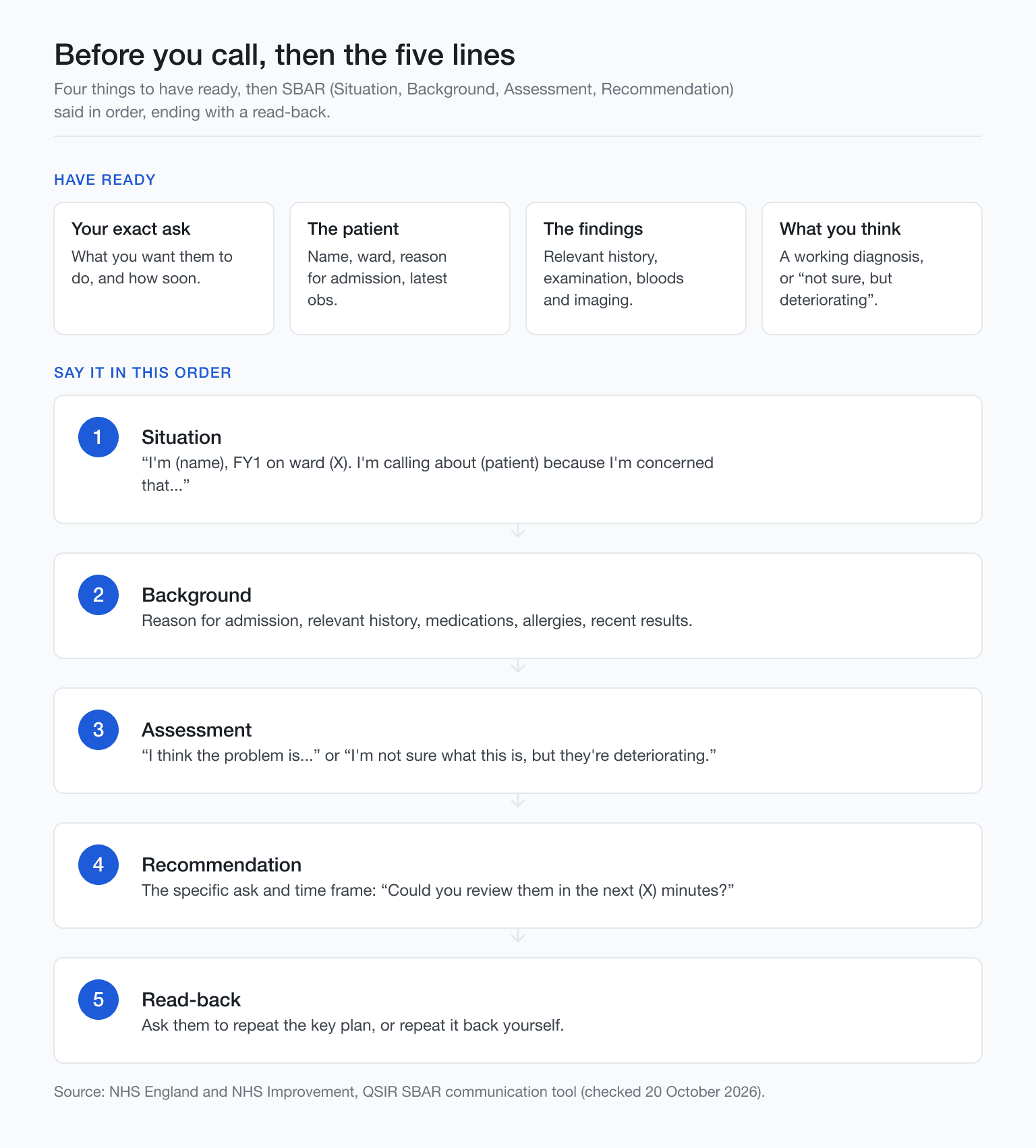
Before you refer a patient to another specialty, have four things ready: the exact action you want and how soon, the patient’s identifiers, location and latest observations, the relevant history, examination findings, bloods and imaging, and your working diagnosis or honest uncertainty. This maps to SBAR’s four parts and helps you make an ask under pressure.
- The exact question or request. Say what you want done, by when, and ask what to do meanwhile.
- The patient’s identifiers, location and latest observations. Name, where they are, and today’s obs, so the registrar can find them and gauge risk.
- The relevant history, examination findings, bloods and imaging. Keep only what changes the decision.
- Your working diagnosis, or the honest version if you have none. “I’m not sure what this is, but he’s deteriorating” is acceptable and useful.
In a survey of 283 UK juniors, 40.6% didn’t know which specialty to contact and 33% were unsure how to contact them. Find the right team and number from your local referral guide or your senior.
It’s the same skill as on the ward-round presenting format.
The 30-second referral script
The 30-second referral script is SBAR, Situation, Background, Assessment, Recommendation, from the NHS tool, compressed into five spoken lines and ending with a read-back. The prompts are set out in NHS England's SBAR tool, which exists to stop hinting and hoping and to make you ask for what you need. Say SBAR, then confirm the plan back.
- Situation: "Hello, it's Dr [Surname], FY[1/2] on [Ward/Unit]. I'm calling about [Full name, age] because of [problem]."
- Background: "Admitted [date] with [reason]; history [diagnoses/procedures/allergies]; meds [headline]; results [labs/imaging if they change the call]."
- Assessment: "Obs [BP, HR, RR, Temp]; exam [key finding]. I think [diagnosis], or I'm not sure but he's deteriorating."
- Recommendation: "Please review in [XX] minutes. Anything to do meanwhile?"
- Read-back: "To confirm, plan is [repeat the key plan], and you're [coming/arranging X] now."
Worked example to a vascular registrar about Derek Aldridge, a fictional AI patient from Diagnosica's case library. The one word that changes the clock is ruptured.
"Hello, it's the FY1 calling about Derek Aldridge, 73, who collapsed with sudden tearing back pain about an hour ago."
"He was labelled a kidney stone; years ago screening said his aorta was a bit wide; hypertensive; ex-smoker; father died of a burst artery in his belly."
"BP 88/54, HR 118; pulsatile, expansile epigastric mass; both legs mottled and cool with a weaker left femoral pulse; I'm worried this is a ruptured abdominal aortic aneurysm."
"Could you come and review him now?"
"So to confirm, the plan is urgent vascular review now, agreed?"
After taking his history yourself, you can rehearse Derek's referral call with the AI patient.
What will the registrar ask you?
The registrar on the receiving team will ask the bits that decide urgency and pathway. Expect SBAR background, including why the patient was admitted, relevant history, medications and allergies, recent bloods or imaging, plus what you think is happening and why. Specialties differ, but under pressure the spine is the same.
Expect questions like:
- Who is the patient, why were they admitted, and why are you calling now.
- What history changes risk, and the admitting diagnosis if known.
- Current medications and allergies, including any anticoagulants.
- The latest relevant blood tests and any recent imaging.
- Your working diagnosis, the review or action you want, and by when.
Worked example. Ronald Baxter is a fictional AI patient in Diagnosica’s case library. He has a cold, painful right leg. Say the side, that onset was four hours ago, which right-sided pulses are absent, that the left leg is warm with normal pulses, sensation and toe movement, an irregular pulse, and atrial fibrillation with a blood thinner advised and never started.
The comparison with the normal left leg and the four-hour timing are facts a surgical registrar can act on. Cold leg alone isn’t.
If you don’t know an answer, say so and say when you’ll have it, rather than guessing.
When the registrar pushes back
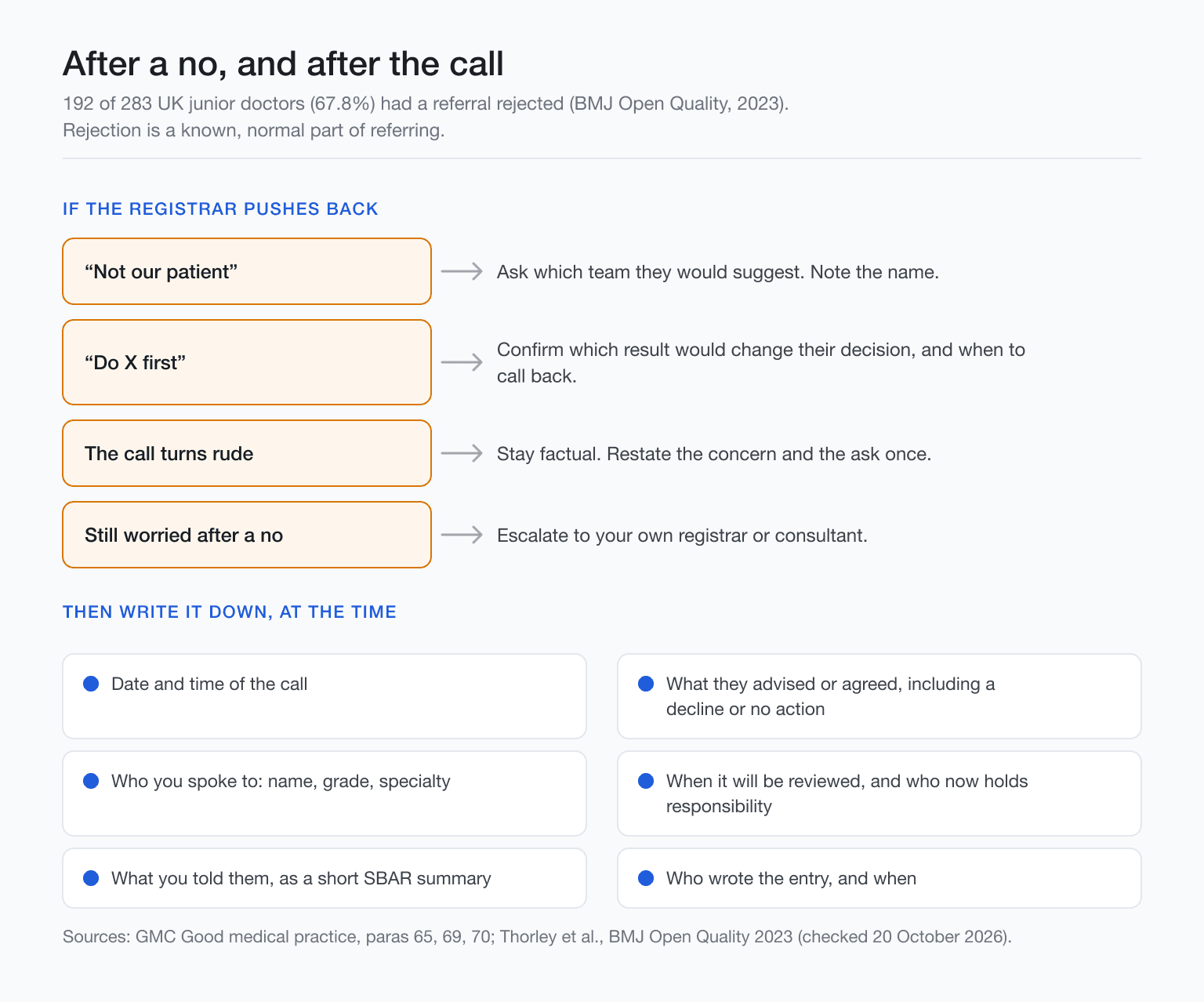
Pushback on a referral is common: BMJ Open Quality 2023’s Doctors Improving Referrals survey found 192 of 283 junior doctors, 67.8%, had a referral rejected. It often means the registrar needs a different detail, a different team, or a clearer ask. Here’s how to keep the call productive and get to a safe next step.
- Not our patient: which team and name to document. “Thanks. Which team should take this, and what name should I document for today’s advice?”
- Get a scan first or do X first: which result changes it, and when to update. “To be clear, which result changes your decision, and when should I call you back?”
- Call goes badly or turns rude: 9.2% reported bullying, belittling or verbal aggression. Stay factual, restate, then tell your senior. “I’m concerned about [concrete risk] and I’m asking for [advice or review today].”
- You’re still worried after a no: escalate to your registrar or consultant. “Thanks for discussing. I remain concerned about [issue], so I’ll speak to my registrar and update you.”
For the other side, read the receiving end as SHO.
What to document after the call
After a referral call, write a short contemporaneous entry in the notes. The GMC's Good medical practice says records must be clear, accurate, contemporaneous and legible, and usually include decisions made and actions agreed, including decisions to take no action. Contemporaneous means at the time, or as soon as possible afterwards.
- Time and date.
- Who you spoke to, name, grade, specialty.
- What you told them, brief SBAR.
- What they advised or agreed, including "declined, suggested team X".
- When they'll review, or when plan review is due.
- Who takes over responsibility, named clinician or team.
- Who wrote the entry and when.
If the plan includes "call back when the result is in", hand over before you go off duty, and check a named clinician or team takes responsibility, which para 65 requires for ongoing care and at handover.
Note-as-you-go helps when you're juggling calls, covered in before you answer bleeps.
Practising the call before it's real
Practising a referral call means saying the five lines out loud about a patient you've actually assessed until the order is automatic. Take one real patient, strip identifiers, and rehearse to a friend or to yourself. Time it. Open with your recommendation and timeframe, then see if the sequence still holds under interruption.
Diagnosica is an AI clinical simulator for medical students and junior doctors: you take a history from an AI patient by voice or text, order labs and imaging, commit to a diagnosis and management plan, and get a competency scorecard. Each patient appears as a video avatar, and it's free to start, no card needed. Apps on iPhone and Android, plus the web app. It isn't built only for one country's exams. It doesn't simulate the call to a registrar and it doesn't include physical examination. What it gives you is a patient to assess, so the referral you then say out loud is grounded in a real history.
It doesn't give advice about real patients, and it's not a diagnostic system. Treat every output as educational.
Try it once before you’re on the phone. Take a history from an AI patient, fictional, with a video avatar, then say your referral out loud and practise the wording you’ll use on your next call. Free to start, no card needed, and you can Start a free case.
Common questions
What is SBAR in a referral?
SBAR in a referral is a four-part prompt from NHS England and NHS Improvement's QSIR programme, covering Situation, Background, Assessment and Recommendation. It reduces hinting and hoping by making you state why you’re calling, facts, what you think, and what you want by when. Finish with a read-back, asking the receiver to repeat key details to confirm understanding.
What if I don't know which specialty to refer to?
If you don't know which specialty to call, say so early and describe the problem rather than guessing a label. In a 283-doctor survey, 115 doctors, 40.6%, didn’t know which specialty to contact. The project's toolkit used a specialty referrals guide with contacts to address this. Use any local guide, ask your senior, and ask which team owns the specific problem.
What should I do if my referral is declined?
If your referral is declined, ask what would change the decision or which team is appropriate, then document the outcome. Rejections were common, 192 of 283 doctors, 67.8%, reported one. If you’re still worried after the call, escalate to your senior for advice and support. Keep the problem front and centre while you organise the next safe step. Proceed safely, not hurriedly.
Do I need to write anything after a referral call?
Yes, after a referral call write a clear, accurate, contemporaneous, legible record. GMC Good medical practice says records should usually include relevant clinical findings, decisions made and actions agreed, including decisions to take no action, and who created the record and when. Include who you spoke to, what was agreed, and any review or handover point.