First Day as an FY1: What to Bring and Expect

You’re worried you won’t know where anything is, you’ll freeze when someone asks you something, or the bleep will go and you’ll stall. Your first day as an FY1 is mostly finding your team, following the ward round and writing down jobs, working the jobs list, then handing over before you go home; nobody expects you to know the systems yet.
This page is about day one only, not the whole year. For rotas, nights, and surviving months two to twelve, see the whole-year FY1 guide.
We’ll walk the day in order, early morning to handover, and give a packing list you can sort tonight. Local induction and arrangements vary by trust, so treat this as a pattern to map to your ward.
What happens on your first day as an FY1?
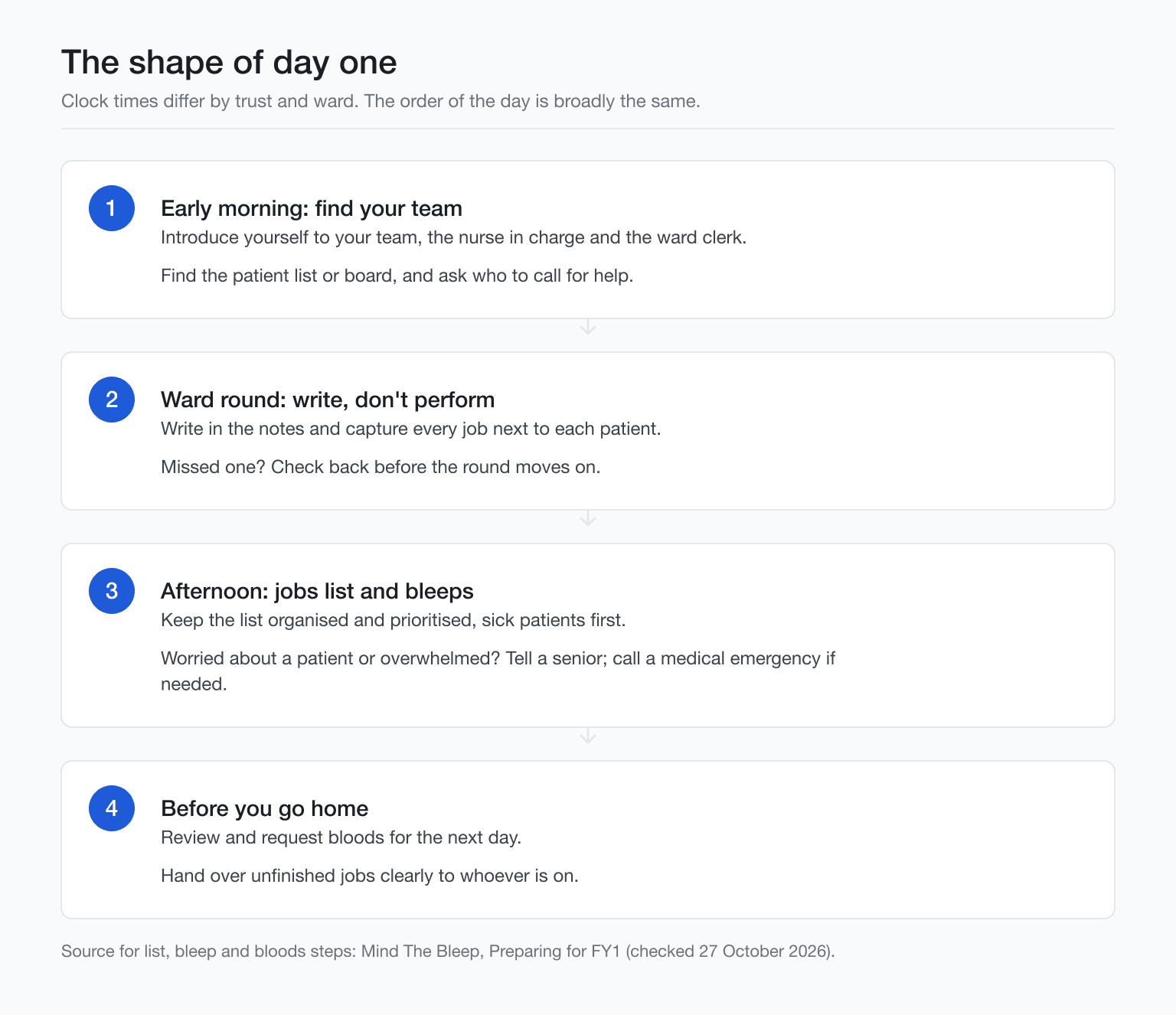
On your first day as an FY1 you arrive in the early morning, find your team, and join the ward round, then build or inherit a jobs list. Through late morning and afternoon you work that list, field team bleeps and calls as directed, chase results, hand over what's left, then leave.
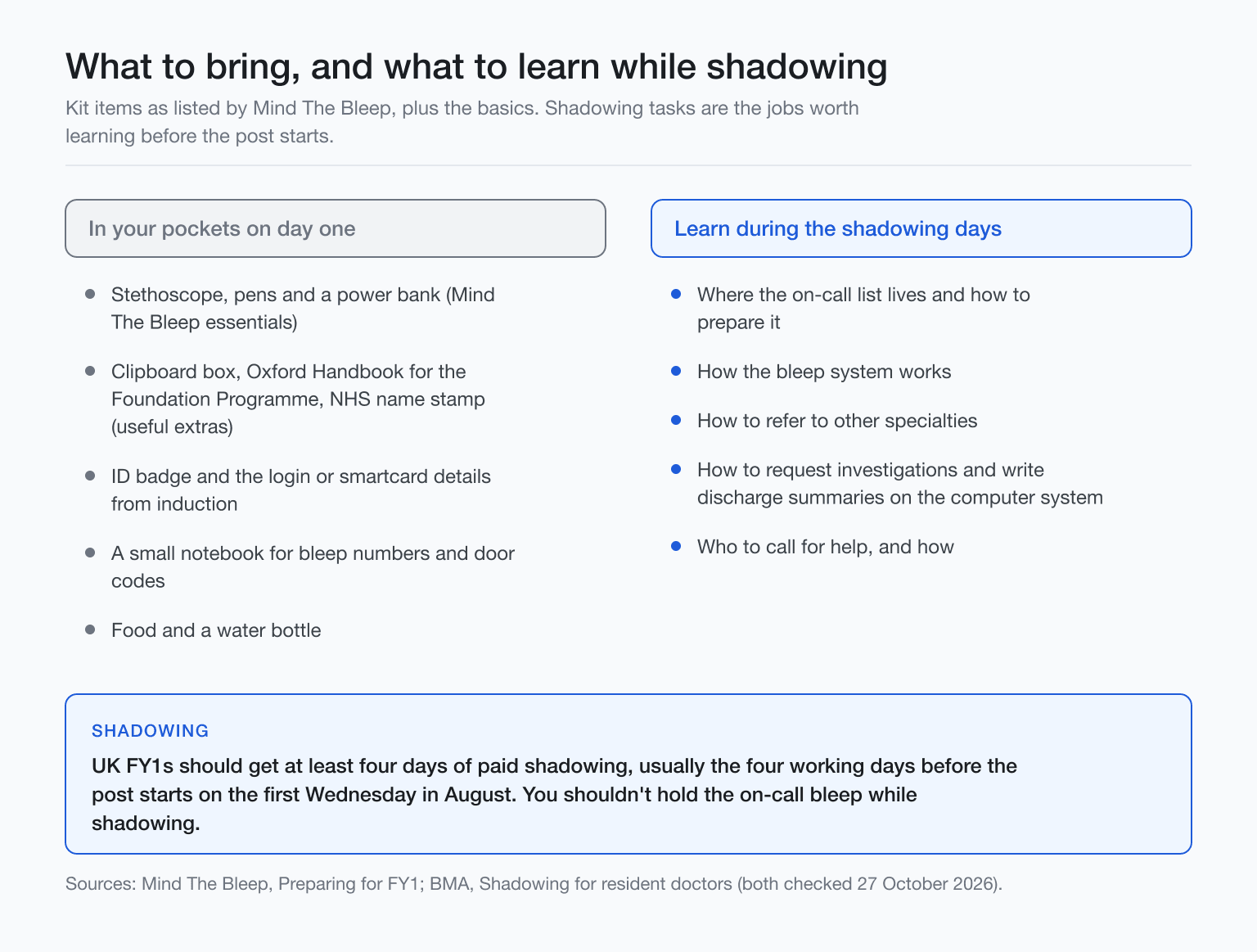
Most UK FY1s arrive having done at least four days of paid shadowing at the basic F1 rate, typically the four working days before a post that starts on the first Wednesday in August, per the BMA guidance on shadowing. You observe a current FY1, learn local processes, and shouldn't hold the on-call bleep or cover for FY1s. There's no nationally agreed contract in England for that period, and trust arrangements vary, so day one is when the jobs are actually yours.
What should you bring on your first day?
What to bring on your first day as an FY1 is a short, functional kit that covers access, notes, power and food. You want items you can carry all day without thinking, and that don't depend on anyone else. Trusts vary, so bring what secures logins and identification.
The first six items are drawn from Mind The Bleep's kit list.
- Stethoscope.
- Two pens that write, plus a spare.
- Power bank for your phone and hospital logins.
- Clipboard box to carry forms and protect papers.
- Oxford Handbook for the Foundation Programme.
- NHS name stamp, where your trust issues and accepts one.
- ID badge and any login or smartcard details from induction.
- Small notebook for bleep numbers, door codes, and extension lists.
- Food you’ll eat and a refillable water bottle.
Keep pockets light, stash bulk in a bag or locker.
Early morning: finding your team and the board
Your first morning as an FY1 starts by getting in a little early, finding the ward and the doctors' office, and introducing yourself by name and role to your team, the nurse in charge, and the ward clerk. Get the team’s patient list or board, ask who to call for help, and where patients are.
In Scotland, shadowing and induction run 4 to 6 days and cover NHS Board induction, the regional Foundation Programme, and first-post workplace induction, per Scotland Deanery's shadowing page; use the morning to fill gaps. Trusts vary, and we could be wrong about yours.
Find where the live list lives, electronic or clipboard. If you can’t find the board, ask the ward clerk. The nurse in charge knows outliers and first contacts.
Confirm the on-call list, how the bleep works, and how to escalate. Jot your registrar’s and site co-ordinator’s numbers, plus where referrals and discharge summaries happen.
Sharpen your one-liner Practise a short, out-loud patient presentation with an AI patient before the first ward round, so you hit the key facts in order and finish with a clear ask. Try a case free
The first ward round
The first ward round on day one as FY1 is about writing notes and capturing jobs, not knowing answers. Write jobs as they’re said, check with registrar or consultant before moving on if you miss one. Say you don’t know and will find out. Mind The Bleep: use a notes proforma, but don’t come early. Be ready to present briefly.
Local routines differ by trust and team. Stand where you can hear, keep a running patient list in the order they’re seen, and if the pace outruns your pen, ask for a moment to finish capturing jobs before the team moves on.
For a primer on flow and roles, here’s what happens on a ward round. If you’re asked for a micro summary, start with who the patient is and why they’re here, then what’s changed and the next steps, and see presenting a patient briefly.
Your first jobs list and first bleep
The FY1 jobs list after the first ward round is your anchor. Mind The Bleep says keep it organised and prioritised, sick patients and time sensitive tasks first, admin later. When the bleep goes, write who called, which patient, what they’re worried about, and give an ETA. If you’re worried or overwhelmed, call a medical emergency and tell your senior.
Use one master list. Capture the patient, location, priority, and the task, plus who asked and their number. Group by bay to save steps. See keeping a jobs list.
When the call comes, get four facts down, who’s calling, patient details, the concern, and a callback or location. Repeat it back to avoid crossed wires, then give a time you’ll attend. Read answering a bleep for a call flow you can use tomorrow.
Escalating is never the wrong first move.
Before you go home
At the end of your first day as an FY1, take five quiet minutes before you walk off the ward. Tie up jobs, set up tomorrow, and make a clean handover. You’ll feel less behind in the morning, and the team covering after you won’t be guessing.
1) Review and request bloods for the next day before you leave, as Mind The Bleep advises. 2) Hand over any unfinished jobs to whoever is on, with clear asks, urgency, and location. 3) Check your rota and confirm your next shift and site. 4) Write down three questions to ask tomorrow, like where things live, who to call for what, and what your consultant likes.
At one trust, 31 of 66 new FY1s replied to one trust's shadowing survey: 85 percent felt shadowing prepared them well and 75 percent felt comfortable contacting a mentor at the start. Small sample, one site. The lesson is simple, find your person to ask.
How do you rehearse before day one?
Rehearsing for the first day as an FY1 splits in two: you can practise saying things out loud, take a focused history, and present a patient in a few lines. The rest is site specific, the IT systems, who to call, and where things live you only learn on the ward.
Diagnosica is an AI clinical simulator for medical students and junior doctors: you take a history from an AI patient by voice or text, order labs and imaging, commit to a diagnosis and management plan, and get a competency scorecard. The patient appears as a video avatar, it's free to start with no card needed, it runs on iPhone, Android and the web at any hour without booking, and learners outside the US use it too, not only American students.
It doesn't give advice about real patients, and it's not a diagnostic system. Treat every output as educational. It can't teach your trust's computer system, the local referral rules, or where the bloods go.
Common questions
When does FY1 start?
FY1 starts on the first Wednesday in August each year. Shadowing usually runs in the working days immediately before, organised locally with a mix of induction, observing a current FY1, and supervised tasks, so expect variation by trust on what you see and how formal the timetable feels.
Do you get paid for FY1 shadowing?
FY1 shadowing is paid, with at least four days at the basic F1 annual salary rate, and a day's pay calculated as the basic salary divided by 261 working days. In England there isn't a nationally agreed contract for the pre-FY1 shadowing period, so pay arrangements and how it's scheduled can vary by trust.
Will you hold the bleep on your first day as an FY1?
Holding the bleep on your first day as an FY1 depends on your rota and your trust's induction plan. During shadowing you shouldn't hold the on-call bleep, and on the first day of the post itself it varies locally, so ask at induction so you know who carries which bleep and when.
Is it normal to feel unprepared on day one?
Feeling unprepared on your first day as an FY1 is common. In one trust's 2021 intake, 85% of 31 respondents felt shadowing prepared them well, which still leaves some who didn't, so treat uncertainty as a signal to ask early and use ward systems and seniors to check your understanding.
Warm up for day one Take a focused history from an AI patient by voice or text, then you'll practise presenting that patient out loud before your first shift, free to start, no card needed. Start a case free