MRCS Part A pass mark: every recent figure and how it's set

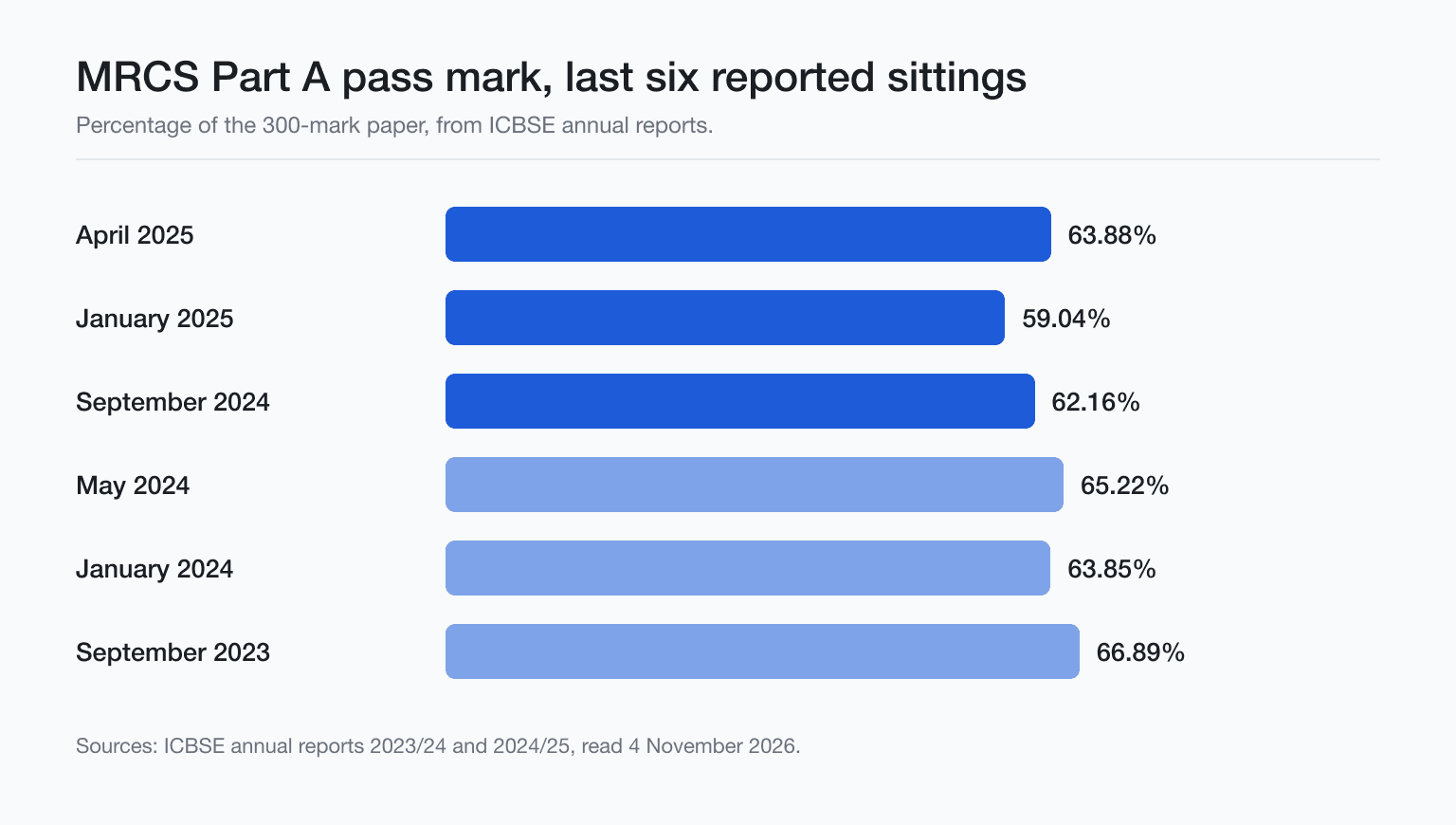
There's no fixed pass mark for MRCS Part A. It moves with each paper's difficulty, was 63.88% in April 2025, and ranged from 59.04% to 66.89% across the six most recent sittings in ICBSE's annual reports.
This page lists each sitting's pass mark and pass rate, how Angoff standard setting works, the 300-mark scale, and what your results include. We also explain why the cut score shifts and what cohort pass rates mean.
Every figure here comes from ICBSE or Royal College documents, checked on 4 November 2026.
Key takeaways
- Two hurdles, minimum competence in each paper and the combined pass mark.
- About 54% passed across six sittings, 12,479 of 23,141 candidates.
- Your results show your score and the score required to pass.
What is the MRCS Part A pass mark?
MRCS Part A pass mark is set after each sitting on the combined score out of 300, so it varies by sitting. You must achieve or exceed that total and meet minimum competence in both papers. Results show your score and the cut score; ICBSE reports list the percentage for each sitting.
Sitting | Pass mark | Candidates | Passed |
|---|---|---|---|
April 2025 | 63.88% | 3,408 | 1,850 (54.28%) |
January 2025 | 59.04% | 3,643 | 2,000 (54.9%) |
September 2024 | 62.16% | 4,321 | 2,347 (54.32%) |
May 2024 | 65.22% | 3,991 | 2,159 (54.1%) |
January 2024 | 63.85% | 3,914 | 2,139 (54.65%) |
September 2023 | 66.89% | 3,864 | 1,984 (51.35%) |
Sources: 2024/25 report and 2023/24 report.
The newest report available is 2024/25, so the most recent sitting with a published pass mark in a report is April 2025. Later sittings aren’t in a published report available on the ICBSE site. Candidates receive the required score with their results.
The 2023/24 report prints failing percentages for January and May 2024 that don’t match its counts, so this table follows the counts.
How is the MRCS Part A pass mark set?
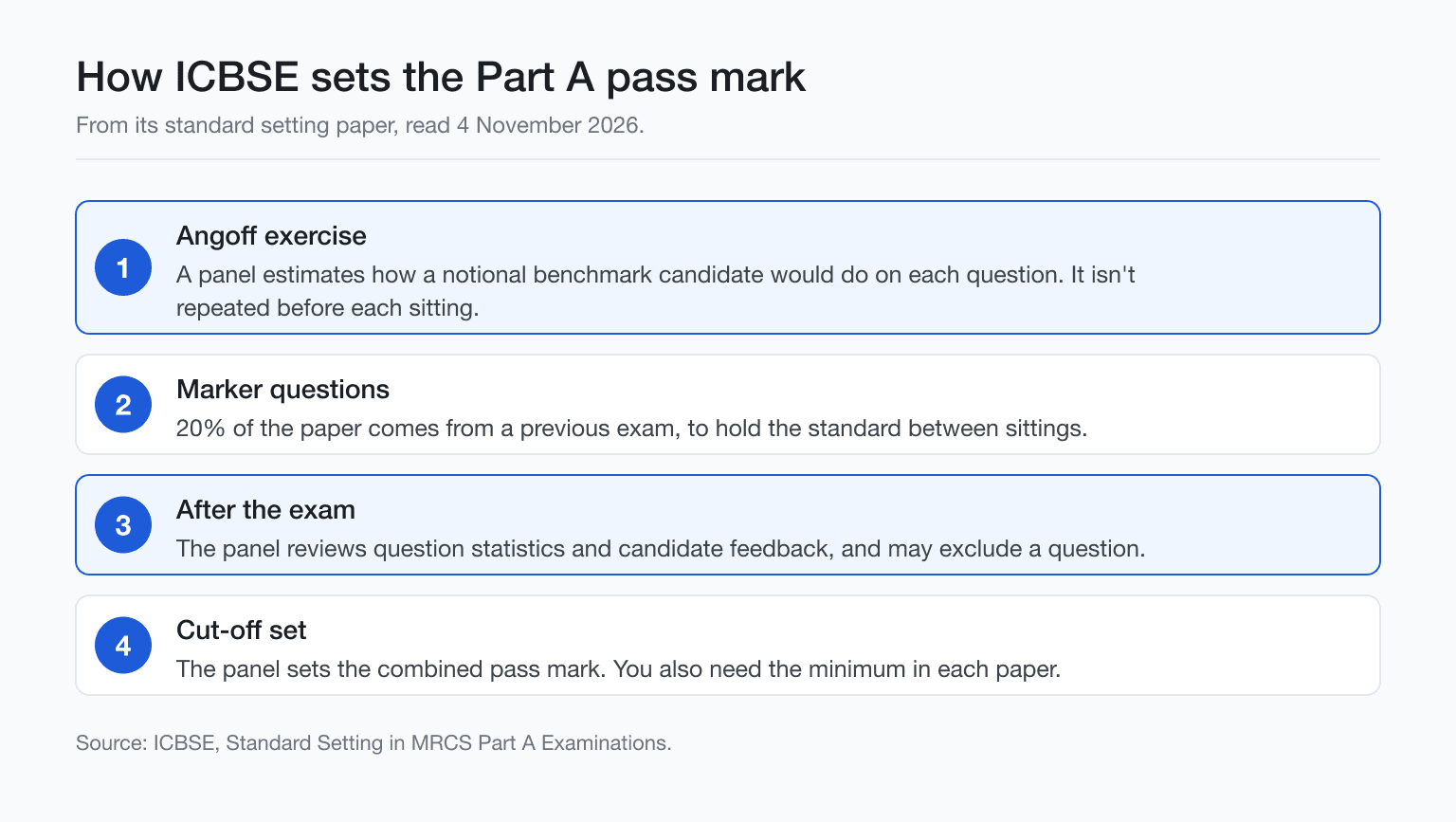
The MRCS Part A pass mark is set using an Angoff procedure, with around 20% marker questions from a previous paper to maintain the standard. A multidisciplinary panel estimates a benchmark candidate's performance, then reviews item statistics and candidate feedback before finalising the cut score for that sitting.
- Convene a panel of surgeons, basic scientists, trainers, trainees and a patient representative.
- Use the Angoff method to set the benchmark standard for the notional borderline candidate.
- Include marker questions, 20% reused items, to anchor and maintain the standard.
- After the exam, review item statistics and feedback, remove flawed questions, then set the cut score.
ICBSE puts it plainly: "As each MRCS Part A exam is different, the pass mark will be different each time." "The standard required to pass the exam remains constant for all MRCS Part A exams." A lower mark reflects a harder paper, not a softer standard, as we read ICBSE's wording. See the standard setting paper.
Do you have to pass each paper separately?
MRCS Part A has two hurdles in every sitting: show a minimum level of competence in each of the two papers, and achieve the pass mark on the combined total. That means meet each paper’s minimum and hit the overall pass mark. A high score in one paper cannot compensate for failing the other minimum.
The MRCS regulations and annual reports don’t print the per paper minimum as a number, so don’t trust any fixed figure online without a source; a strong Paper 1 alone may not be enough. According to the Royal College page, MRCS Part A is a five hour online MCQ on one day, Paper 1 Applied Basic Sciences 3 hours and Paper 2 Principles of Surgery-in-General 2 hours, all candidates sit the same exam at Pearson test centres.
What does the percentage mean in marks?
The MRCS Part A pass mark percentage is applied to a 300 mark scale, so a published percentage converts straight to marks. Across six sittings reported from September 2023 to April 2025, pass marks ran from 59.04% to 66.89%, which equates to about 177 to 201 marks.
Reports also quote measurement error of about 7 to 7.6 marks out of 300, which means scores very near the cut can be noisy. Two candidates straddling the line can be practically indistinguishable 2024/25 report.
Example. On the January 2025 pass mark of 59.04%, that's about 177 of 300; in September 2023, 66.89% was about 201. That's our arithmetic on the published percentages in the 2024/25 report and the 2023/24 report.
What is the MRCS Part A pass rate?
The MRCS Part A pass rate has been slightly over half, ranging from 51.35% to 54.9% across six sittings from September 2023 to April 2025. That equates to between 1,850 and 2,347 passes per sitting out of 3,408 to 4,321 candidates, per ICBSE annual reports.
Across the same six sittings the pass mark moved by nearly 8 percentage points, while the pass rate shifted by under 4 points. That pattern fits ICBSE’s Angoff based process, with marker questions and post exam review, but it does not prove cause.
Figures are from the ICBSE 2023/24 report and 2024/25 report.
Results, attempts and fees
MRCS Part A results arrive by email about four weeks after the exam, with your total score, the score required to pass, and a breakdown by paper and syllabus, plus cohort averages. See the RCS England page and the 2024/25 report.
- Attempts: Six attempts, then one additional attempt on application.
- Fee: £670 at RCS England as of November 2026, check your college.
- Next sittings: 13 January 2027 (deadline 29 October 2026, now passed), 29 April 2027 (deadline 25 February 2027) and 1 September 2027 (deadline 1 July 2027).
- After you pass: You can apply for Part B, then have seven years to pass.
Part A against Part B
MRCS Part A and Part B assess different modes of competence: Part A is a written MCQ paper across two papers on one day, and Part B is the OSCE. Part B uses circuits with their own pass marks.
Diagnosica won't help the MCQ paper directly. For Part B, see how Part B is marked, then rehearse a surgical history and read surgery rotation tips; there is no physical examination practice, and it’s free to start, no card needed.
Common questions
Is the MRCS Part A pass mark 70%?
Not in the six sittings reported here. The highest published pass mark was 66.89% in September 2023, and the lowest 59.04% in January 2025, on a 300 mark scale. See the 2023/24 report and 2024/25 report.
Is the pass mark published before the exam?
No. The pass mark is set after each exam by a standard setting panel that reviews item statistics and candidate feedback, may exclude questions, and maintains the standard with marker questions. See the standard setting paper. Candidates receive their required score with results, see the annual report 2024/25.
How many times can you sit MRCS Part A?
Six attempts are permitted, with a possible seventh on application. This is stated on the Royal College of Surgeons of England MRCS Part A page, which also sets out timings, format and results by email. Check the page for sitting dates and deadlines.
Why does the pass mark change?
Because each paper is different. The Angoff-based standard is constant, but the specific cut score moves to reflect that paper’s difficulty. Around 20 percent are marker questions from a previous exam to maintain the standard, then a panel reviews data and sets the cut-off. See the standard setting process.
For spoken history practice ahead of Part B, not Part A MCQs, Diagnosica is free to start, no card. Try a surgical case free