What is active recall in medical school?

Active recall in medical school means pulling a fact or a diagnosis from memory before checking the source. In a randomized trial, Year 4 students scored 56.0% when quizzed vs 48.8% after reading only, nine months later.
Key takeaways
- Decide: quiz yourself first, reread second.
- Decide: count cases and patients as retrieval, alongside flashcards.
- Next step: try one five-clue case today, commit a guess at every clue.
What is active recall in medical school?
Active recall in medical school is closing your source, producing the answer from memory, then checking it against the text or image. You pose a clear question, commit, then verify. Researchers also call it retrieval practice, and the literature often refers to its effect as the testing effect.
That second read where everything feels familiar can fool you. It doesn't prove you can produce it when a patient is in front of you. In work covered below, repeated studying beat repeated testing at 5 minutes and raised confidence, which explains why rereading feels safe and why it misleads.
Pull a diagnosis from a simulated patient now with a two-minute quick case. Try a two-minute quick case
Active recall methods at a glance
Active recall in medical school is a behavior. Say the answer before you see it, in any format. Flashcards, a blank page, question banks, and cases all count if your brain works before your eyes.
Method | What you retrieve | Read more |
|---|---|---|
Blank page | everything you can write, before opening notes | |
Flashcards | one fact, cued by a prompt | |
Question bank | the answer, before seeing the options | |
Cases | the next question, then diagnosis, as data arrives |
This post focuses on the fourth row, because cases sit closest to the work of a new doctor.
Does active recall work for medical students?
Published evidence supports active recall for medical students: across the three trials below, retrieval beat rereading or reading on delayed tests, with participants drawn from students and residents. The size of the advantage varies by study, but the direction is consistent in course settings and in longer retention intervals.
These medical-education trials pit reading or review against retrieval practice:
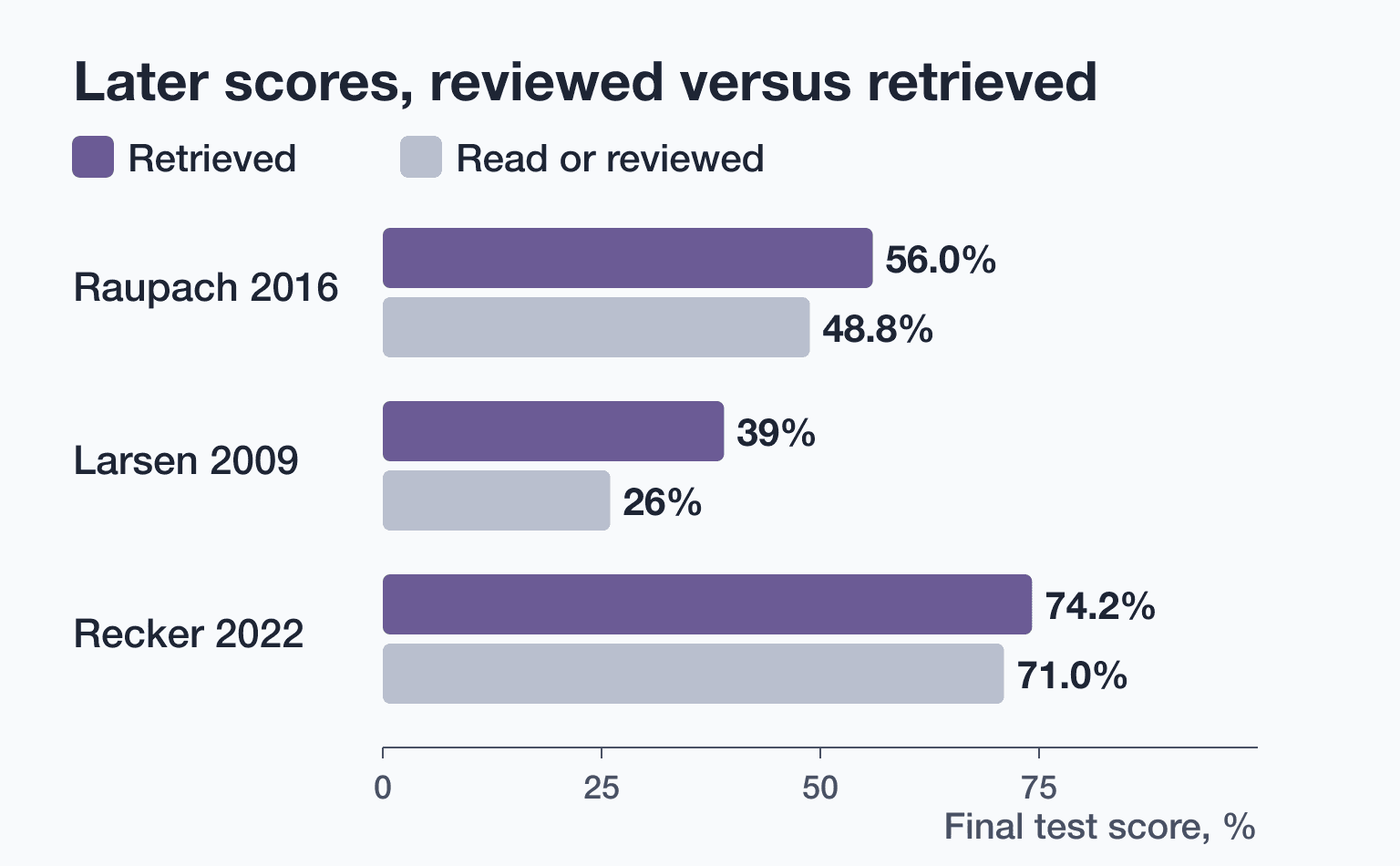
Medical learners in Raupach 2016, Larsen 2009 and Recker 2022; retrieval beat rereading. None tested Diagnosica.
The gap ran from 3.2 points in Recker to 13 points in Larsen, with exact numbers in the table:
Study | Who | Final test | Read or reviewed | Retrieved |
|---|---|---|---|---|
87 Year 4 students | 9 months | 48.8% | 56.0% | |
40 residents | About 6 months | 26% | 39% | |
94 5th-year students | Exit exam | 71.0% | 74.2% |
Raupach is the closest fit, because the same case content was either read as long narratives or broken up with key feature questions. A key feature question asks about the critical decision in a case. The Recker trial wasn't randomized, and its gap was smaller.
In Roediger and Karpicke, 2006, with prose passages, restudy won at 5 minutes, but prior testing gave substantially greater retention on tests 2 days and 1 week later. A 2013 review of 10 techniques rated practice testing high utility and rereading low.
None of these studies tested Diagnosica, and we have no trial of our own quick case.
How to do active recall, step by step
Active recall works when the loop stays tight and you commit before you check. One round has five moves. Protect commit, or the loop collapses into passive review.
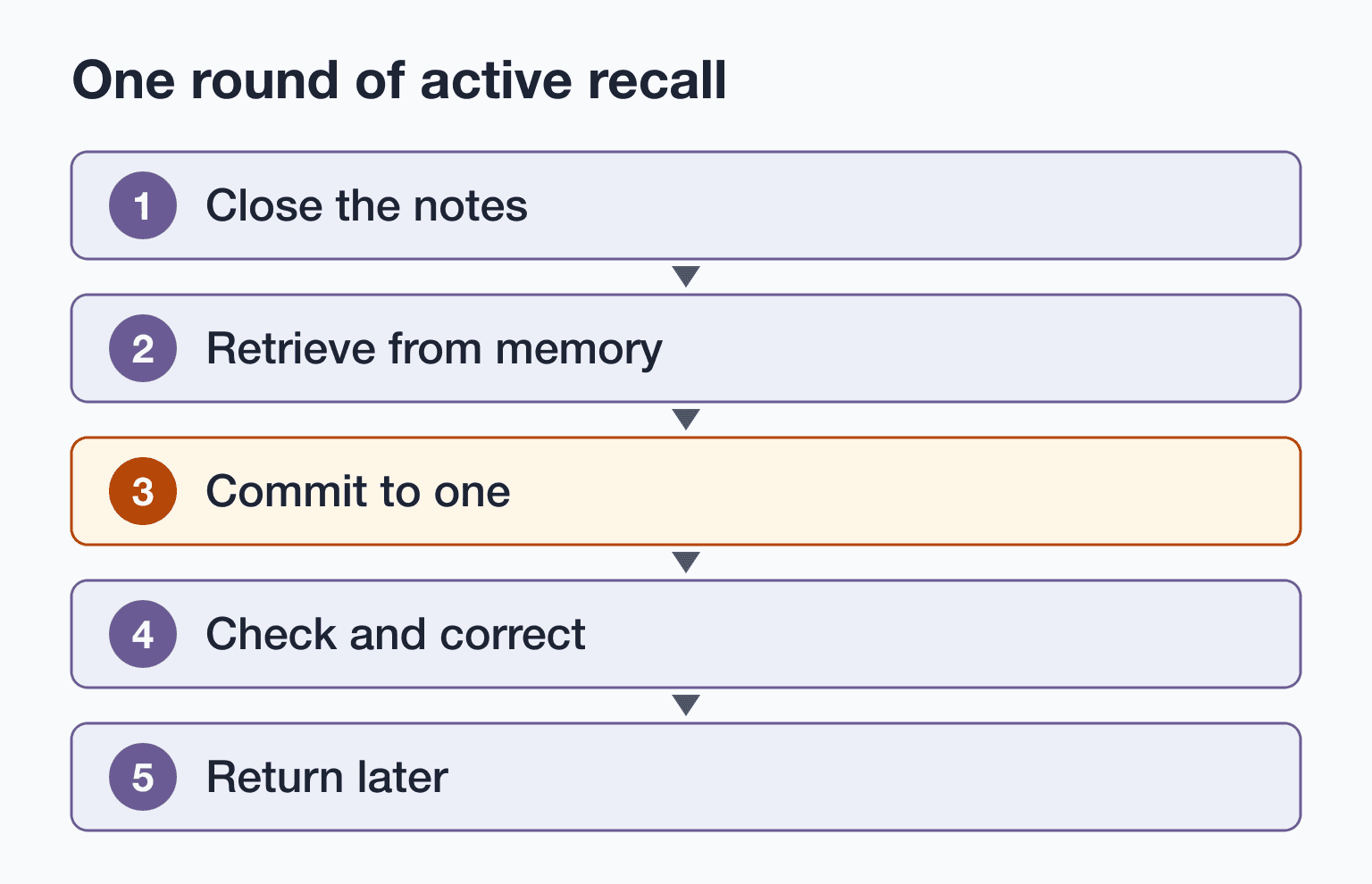
One round of retrieval, with commit as the step to protect.
Run one focused round of retrieval practice in medical school like this:
- Close the notes or cover the page.
- Write or say everything you can produce, before any cue.
- Commit to one answer, even a shaky one.
- Check it against the source and correct the gap.
- Come back to it later, spaced out.
In the Larsen 2009 trial, residents repeated sessions about 2 weeks apart, which is an example, not a rule.
One clue ladder, worked
A simulated patient makes retrieval harder than a card because the cue is a story, and you have to produce the next idea yourself.
See defending your differential list for a quick method.
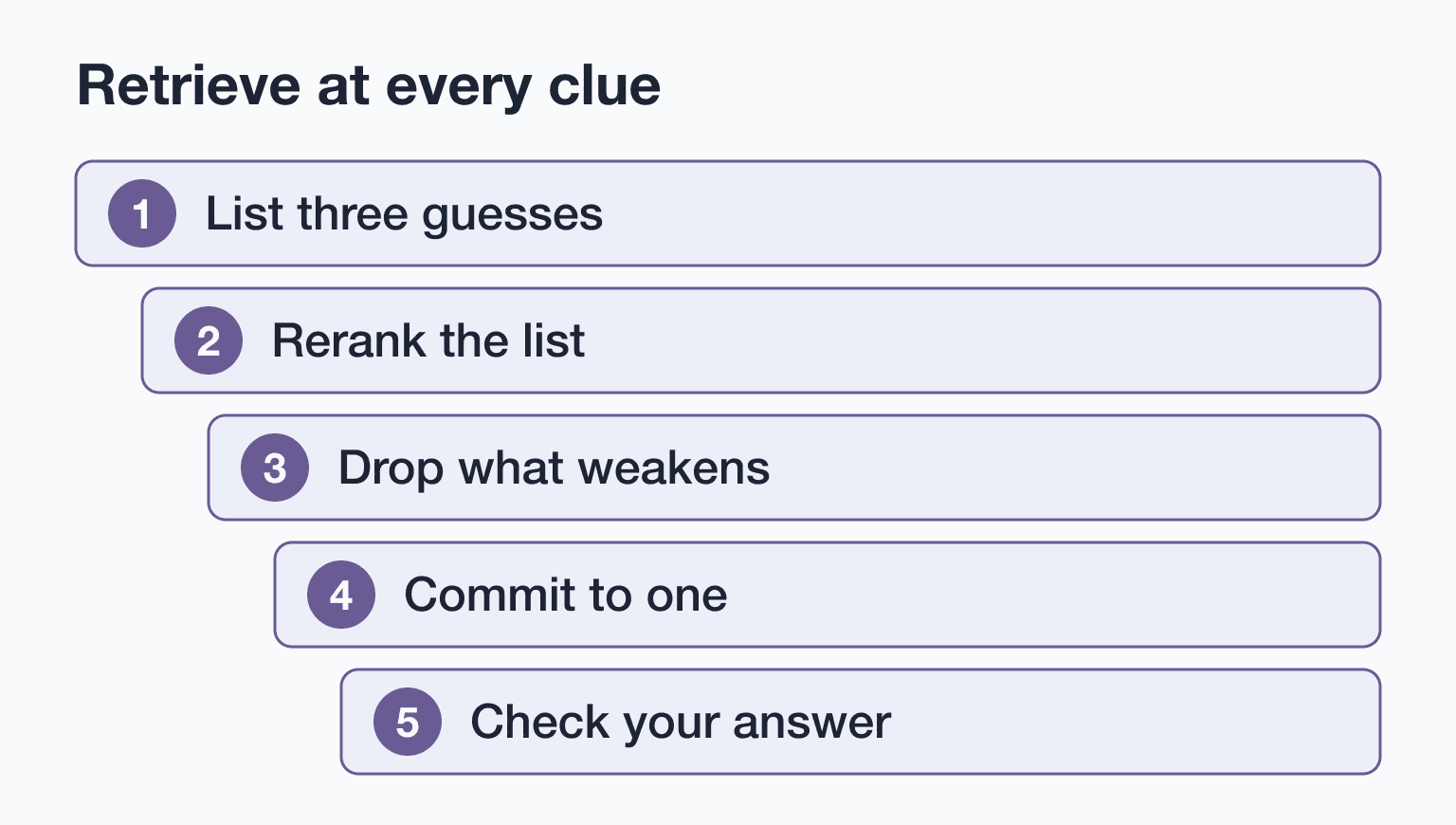
One way to retrieve at each clue of a five-clue case, written by us as a model.
Cover the table below, read clue 1, do its step, then reveal the next row. List three guesses, rerank, drop what weakens, commit to one, check.
A 26-year-old woman, simulated: five clues
Clue | What the case gives you | Retrieve before moving on |
|---|---|---|
1 | A 26-year-old woman has 2 months of fatigue and joint pain in her hands and knees. | List three initial differentials, avoid premature closure. |
2 | She has a facial rash that worsens with sun exposure. Temperature is 37.4°C. | Rerank your list using sun-worsened rash and temperature 37.4°C. |
3 | She has symmetric non-erosive small-joint arthritis and a fixed cheek and nasal bridge rash sparing the nasolabial folds. | Name the guess that weakens; the case's author says rheumatoid arthritis and rosacea both do. |
4 | She also has intermittent low-grade fevers, hair thinning and painless oral ulcers, with no new medications. | Commit to one diagnosis and one must-not-miss alternative. |
5 | ANA is high-titer positive with anti-dsDNA and anti-Smith antibodies and low C3 and C4. | Write your answer down, then check it. |
The diagnosis is left off on purpose so you do the retrieving; check yours against a trusted reference.
Simulated patient. Clues from a Diagnosica quick case. Retrieval prompts written by us as a model, not a learner session.
How Diagnosica helps with this
A two-minute quick case prompts recall via five clues.
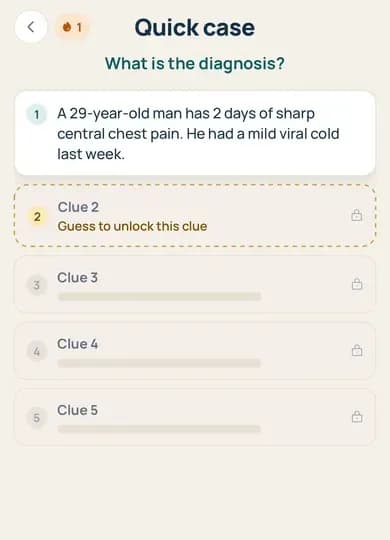
Diagnosica app, quick case, as of October 2026.
- First clue shows, you guess the diagnosis.
- Wrong answers open the next clue.
- On clue 5, final guess, then answer and teaching line.
Simulated patient. Screenshot from Diagnosica, October 2026.
Active recall mistakes and myths
Failures to watch for are recognition over production and trusting how fluent a session felt. In active recall, both can inflate confidence without demonstrating retrieval strength under pressure, so force a commitment before feedback to keep the signal clean.
Fix these four traps to make retrieval practice work in medical school:
- Feeling ready: Restudy raised confidence in the 2006 study, so feelings aren't proof.
- Options first: Per a meta-analysis, recall tests beat recognition; answer before options.
- Skipping the check: Larsen's residents received feedback after each test.
- Mixing up spacing: Recall is how you study, spacing is when you review.
Watch out. Diagnosica isn't a flashcard deck or a spaced-repetition scheduler. For review timing, use a tool built for it such as Anki, which lets you change the timing of reviews.
Where to go next
Tomorrow morning, pick a topic you reread this week and, before opening anything, write from memory, then check the gaps. That is active recall in medical school.
Next reads worth your time: revising for medical finals, a daily study habit, and diagnosis games built on clues.
Keep a daily quick case going, a two-minute round of retrieval from a patient, free to start, no card needed. Start today's quick case