How to revise for medical finals: a 12-week plan

To revise for medical finals, follow a suggested 12-week plan built on one daily loop: question sets for the written paper and spoken histories for the clinical exam.
Key takeaways
- Get your school's written and clinical formats first.
- UK AKT format, two 100-item papers, about 72 seconds an item on average.
- Test yourself instead of rereading; 2009 residents trial, 39% vs 26% 6-month retention.
- A 2-minute daily case over 84 days costs 168 minutes.
What do medical finals test?
Medical finals assess two different things: what you know on paper and what you can do with a patient in front of you. The GMC says schools assess across a broad curriculum, so your school's own papers or clinical exams may sit alongside national ones. Your school decides the format and timing.
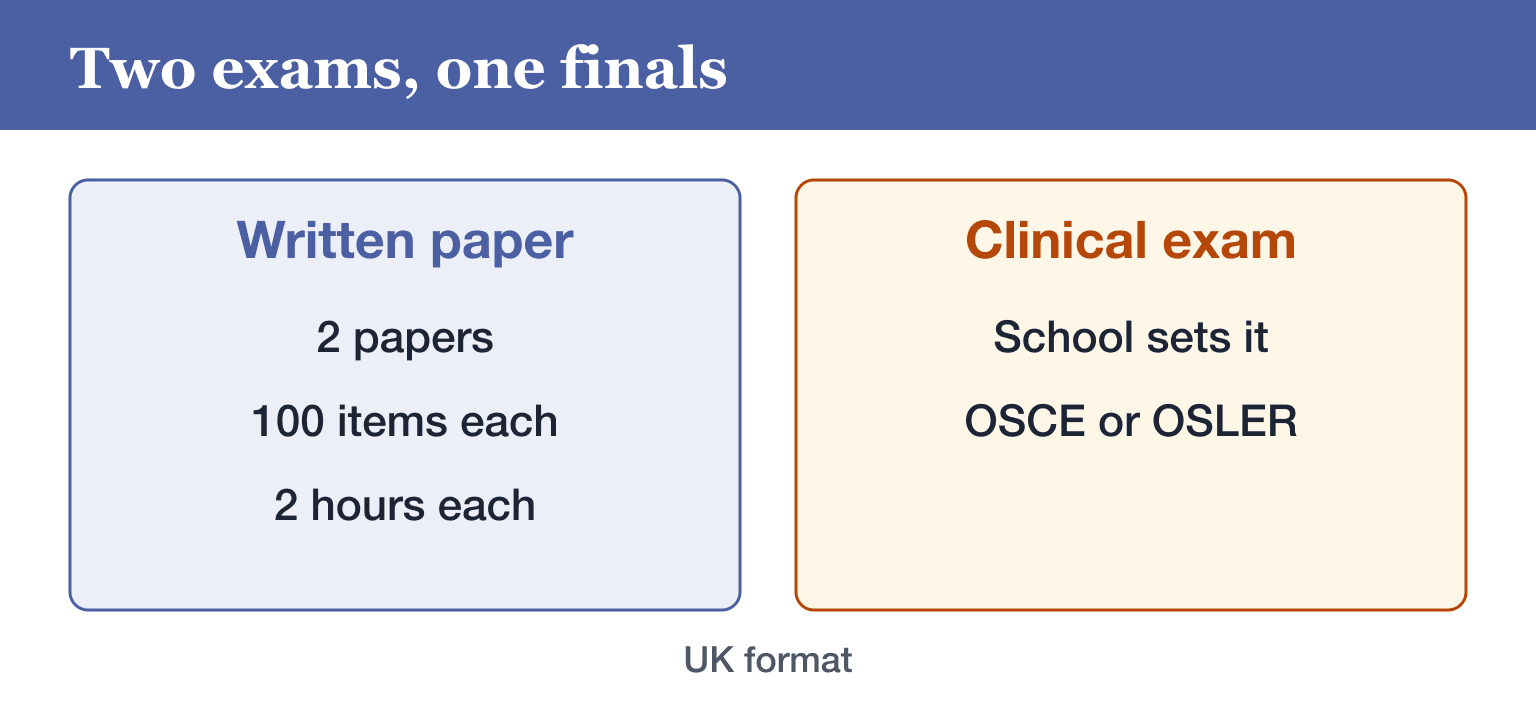
Two written papers and a clinical exam your school sets.
In the UK the written part is the Applied Knowledge Test, two 100-item papers on sequential days, single best answer with five options. Each paper takes two hours and isn't negatively marked, per the Medical Schools Council FAQs. The clinical part, the CPSA, is set and run by your school and may be called an OSCE or OSLER, per the GMC's guide for students.
The GMC also says "you won't need to learn anything beyond what's already covered". Read that as a boundary: your curriculum is the syllabus, not every resource you've bookmarked.
Outside the UK, your school or licensing body sets the format and names, and the plan below still works if you swap in that exam's own official papers. Play one quick case: the smallest loop takes two minutes, try it today.
How long should you revise for medical finals?
We couldn't find an official figure for how long to revise for medical finals, in weeks or daily hours. 12 weeks is our suggestion, long enough to go round the content twice alongside placement, counted back from your school's dates. Treat it as a planning scaffold, not a rule.
Your dates may arrive sooner than you think. Some schools run written finals in the penultimate year, then the AKT that summer, per the Medical Schools Council. Check your handbook and exam calendar now.
On daily hours, same answer, no official number. Protect sleep and breaks. A BMA student column from 2020, one student's opinion, puts it plainly: "you cannot learn it all", and it calls all-nighters a poor trade. One view, not data.
A 12-week medical finals revision plan
The suggested plan has three phases: map, mix and rehearse. It's our suggestion, not a tested schedule, so treat it as scaffolding and move the edges to fit your school's dates and any fixed assessments.
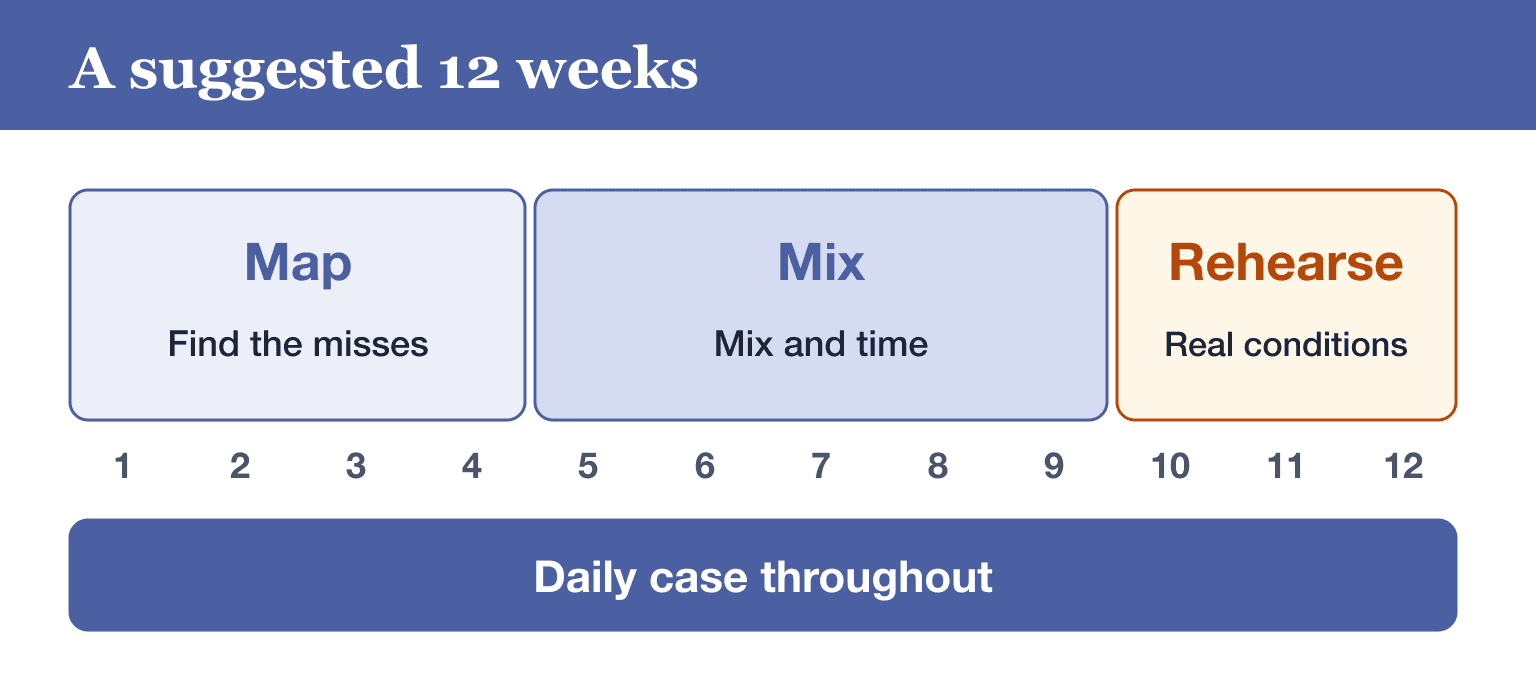
Map, mix, rehearse, with a daily case throughout.
Phase | Weeks | Written paper | Clinical exam |
|---|---|---|---|
Map | Weeks 1 to 4 | untimed question sets by topic, note the misses | one presentation out loud each day, get your school's mark scheme |
Mix | Weeks 5 to 9 | mixed timed sets across topics, revisit old misses | histories out loud against a timer, weekly mock with a friend |
Rehearse | Weeks 10 to 12 | official practice papers timed, misses only after that | your school's format run through in full, including examination with a person |
The content map's presentations give you the topic list: see the MLA content map. The GMC says it's the framework for both AKT and CPSA content, and this version applies from September 2026. Non-UK readers, use your own exam blueprint.
What one revision day looks like
One revision day for medical finals works if you anchor on one presentation and cover both exams, so a day on placement still counts. Do a written set with explanations, say the history out loud, finish with the quick case.
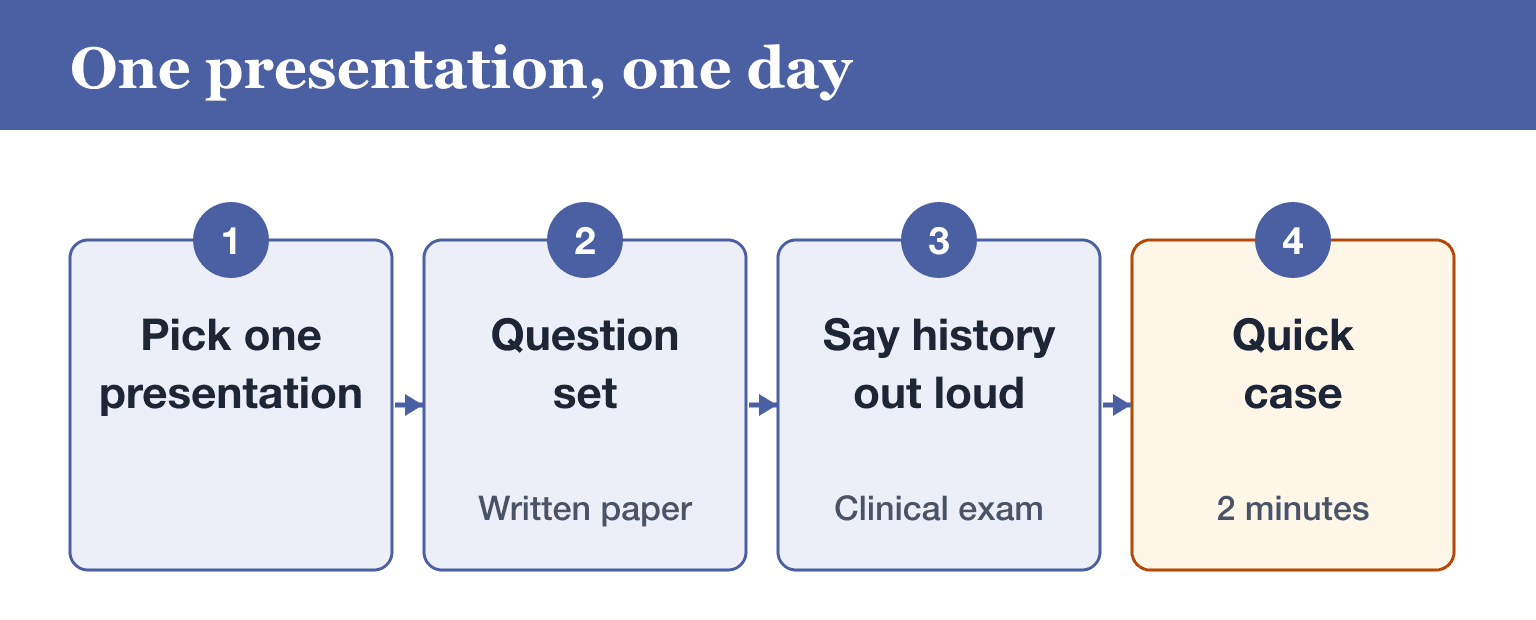
One daily loop linking written questions, spoken history, and a quick case.
Follow the same four steps each day, in order, whatever the presentation is:
- Pick one presentation from the list, say breathlessness.
- Do a question set on it for the written paper, then read every explanation.
- Say that history out loud for the clinical exam, with a timer.
- Play one 2-minute quick case before bed, whichever patient it gives you.
The case is the part you keep on the worst days. Across 12 weeks that's 84 days, and 84 cases at 2 minutes each is 168 minutes, under 3 hours in total. It won't replace revision; its job is keeping the chain going.
Example. Example. Ward-heavy day. No time for a set before the ward, but there is a ten-minute lunch gap to say one breathlessness history out loud somewhere quiet, focusing on structure and clarity. Evening short question set on breathlessness, reading every explanation; then the quick case. A model day, not a real student.
Why do question sets beat rereading?
Question sets beat rereading because retrieving an answer, then getting feedback, sticks longer than reading the same page again. Rereading can feel safer in the moment, but pulling answers from memory, checked against clear explanations, builds recall you can use months later when the exam asks you to decide.
Four sources point the same way:
Study | Who | What it found |
|---|---|---|
40 paediatric and emergency medicine residents | repeated testing with feedback 39% versus 26% for repeated study, after over 6 months | |
95 of 133 students finished | weekly emailed case questions improved end-of-year test scores | |
839 assessments in 317 experiments | the best gap between sessions grows the longer you need to remember | |
10 techniques compared | practice testing and spaced practice rated high utility; rereading and highlighting low |
That feeling has its own evidence: a 2006 memory study found restudying raised students' confidence even though testing gave better recall on delayed tests, which is why rereading feels fine. None of these studied UK finals directly, so treat them as direction, not a promise.
How to split revision between the written paper and clinical exam
Put both exams on the same plan from week one. Each method trains only part of finals, so more questions won't rescue a clinical exam, and spoken practice alone won't cover the written paper.
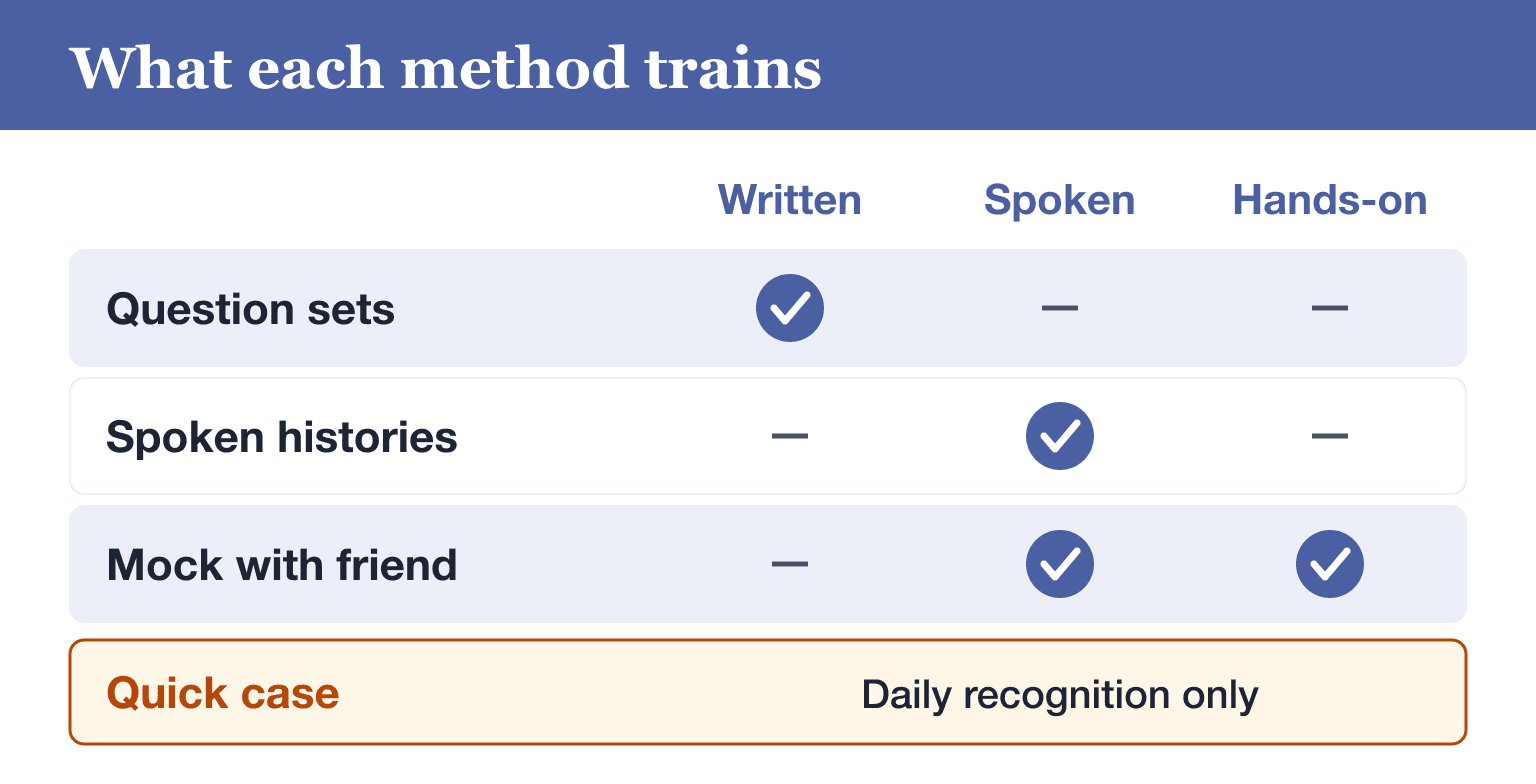
The quick case only gives daily recognition practice; the three methods above it train the exams.
Each method below trains a different part of finals, so plan them together:
- Question sets train you to apply knowledge to written scenarios.
- Spoken histories train timed asking and explaining for the clinical exam.
- Mock with a friend trains the clinical exam, including the hands-on parts.
- Daily quick case keeps diagnosis recognition ticking over, not a bank or mock.
The GMC's Domain 5 of the content map says patients may "describe their symptoms in their own words", and we read that as a reason to practise out loud.
Watch out. Watch out. Physical examination needs people, a friend or a placement. No app, Diagnosica included, can rehearse it, and Diagnosica has no written-paper question bank either.
How Diagnosica helps with this
Keep finals reasoning sharp in 2 minutes, five clues, guess after each.
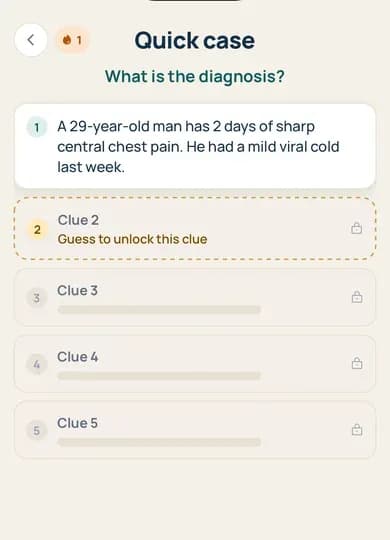
Diagnosica app, quick case screen, as of October 2026.
- Patient opens with one line, your starting clue.
- Each wrong guess opens the next clue, up to five.
- See the answer and a one-line teaching point, streak continues.
Simulated patient. Screenshot from Diagnosica, October 2026.
A sample week: one presentation a day
Build your week around the GMC's presentation list, one presentation a day, so nothing needs deciding at 7pm. Let the order shift around placement demands, and tie cases, questions and revision notes to that day's theme.
The week below takes five presentations from the GMC's presentation list:
Day | Presentation | Clinical block |
|---|---|---|
Mon | Chest pain | history out loud, timed |
Tue | Breathlessness | history out loud, explain to a friend |
Wed | Abdominal pain | history out loud, timed |
Thu | Headache | history out loud, summarise in one breath |
Fri | Confusion (acute and chronic) | history from a relative, out loud |
Sat | Mixed, whatever you missed | mock with a friend, examination included |
Sun | None | off, except the quick case if you want it |
Written question set on the same presentation each weekday, in your question bank of choice (we don't provide one). The list is long and doesn't mean these five are the likeliest, rotate through it.
What if you have fewer than 12 weeks?
With fewer than 12 weeks, keep the daily loop and cut the mapping phase, since rehearsal under real conditions is the part to protect. These splits are our own suggestions, not tested schedules, so bend them to your school's dates and the fixed exam timetable.
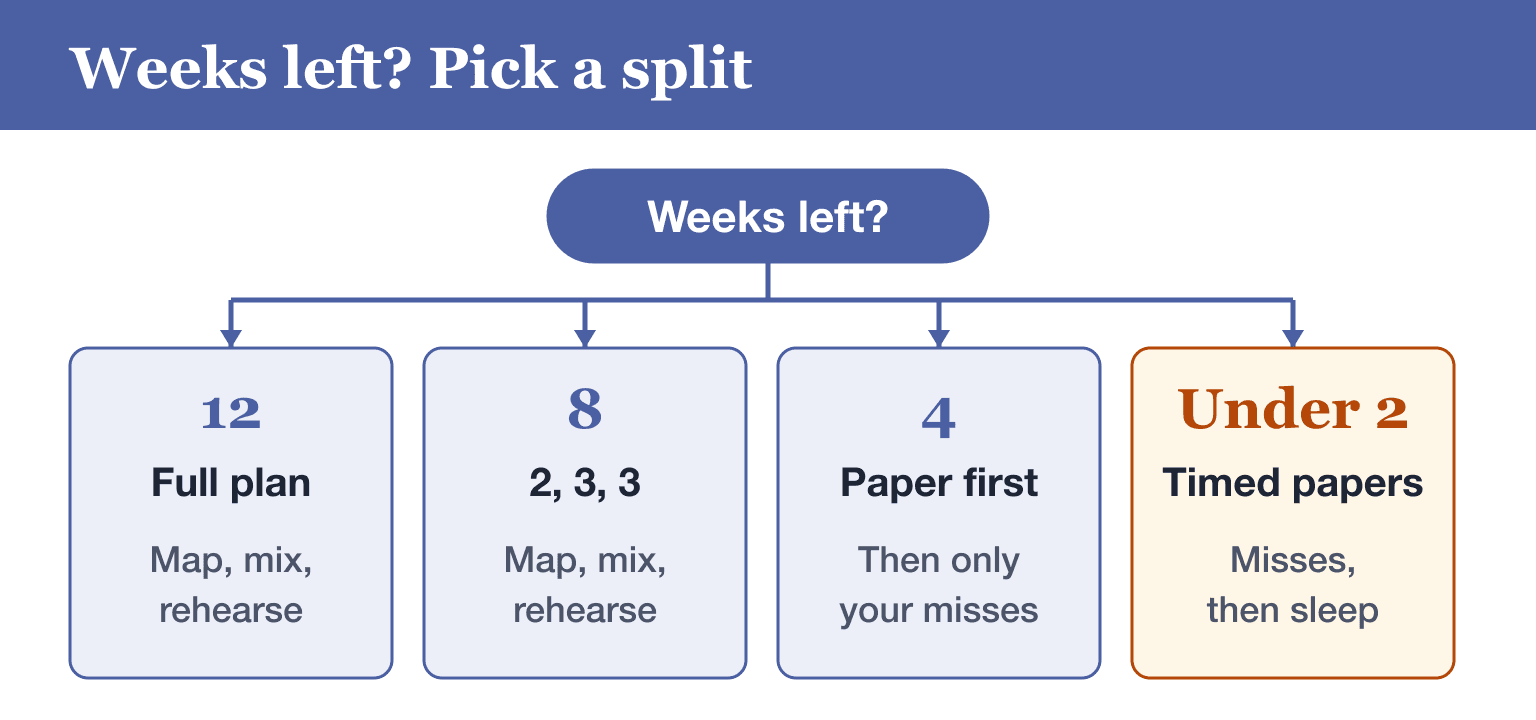
Our suggested splits for 12, 8, 4 and under 2 weeks left, not tested schedules.
Pick the split below that's closest to the time you've got left:
- 8 weeks left: two weeks mapping, three mixing, three rehearsing.
- 4 weeks left: start with the practice paper, then revise only your misses.
- Under 2 weeks: timed papers, misses, sleep, and one run through your school's format.
A bad start isn't a verdict; schools differ, and your school's assessment lead or tutor can tell you about your own arrangements.
How should you use the official practice papers?
Use the official practice papers as a timed rehearsal in the final weeks, sat under exam rules. UK students get a 200-item practice exam split into two 100-item papers, with versions that include answers and justifications. Save them until your notes are settled.
The official practice exam comes from the AKT Exam Board as PDFs, most recently reviewed in September 2026, and two hours over 100 items gives you about 72 seconds an item (our arithmetic).
Do this sequence:
- Sit one paper timed, in one go, using the version without answers.
- Answer every question, because the AKT isn't negatively marked.
- Mark it against the justifications and list your misses by presentation.
- Spend the following days on those misses, then sit the second paper.
Don't chase every new guideline. The Medical Schools Council says the MLA evaluates well-established practice "rather than adherence to the latest clinical guidelines". It's pass or fail, and scores don't form part of the Foundation Programme application, per the same FAQs.
Your medical finals revision map
This page holds the plan for how to revise for medical finals. Each guide below answers one narrower question, so you can go deeper on whichever part worries you most and leave the rest for later.
Guide | What it covers | Level |
|---|---|---|
Planning AKT and CPSA together | Start here | |
What final year demands beyond exams | Start here | |
How the AKT pass standard is set | Core | |
How schools mark the clinical assessment | Core | |
Practising stations before a clinical exam | Core | |
Studying on a ward day | Core | |
Why spaced recall works, how to use it | Going deeper | |
Where AI helps for finals, limits | Going deeper |
Tonight, the smallest piece is enough: start your daily case. For one longer practice, you can also take a full history from an AI patient by voice or text and get a scorecard, which is practice not a prediction of any exam result.