Body Interact alternatives for medical students
Five Body Interact alternatives a student can buy alone are Full Code, CyberPatient's CP OnCall, Sketchy Cases, Neural Consult and Diagnosica. Body Interact's student subscription is €49.99 a month as of 25 November 2026. Checked November 2026.
Diagnosica makes an AI patient simulator, so we have a stake in this comparison. Every competitor detail comes from that company's own public page, checked 25 November 2026. We link it where it appears.
If your school lacks Body Interact access, try a case with a video patient. Voice or text. Free tier, no card needed.
Key takeaways
- Clinical Learning Journey sells to individuals, with a three-day free trial and 150+ scenarios.
- AI conversations are available only to users from licensed institutions, per its App Store page.
- Decide by skill focus; for deteriorating patients, Body Interact patients respond to your decisions.
Body Interact alternatives compared, checked 25 November 2026
Every row below is a product one student can pay for alone. The details are from each company's own page, checked 25 November 2026. Sketchy showed a Black Friday banner that day, so its row shows list prices.
Tool | List price for one student | Free way in | Talking to the patient |
|---|---|---|---|
Body Interact (Clinical Learning Journey) | €49.99 a month or €119.99 every 3 months | three-day trial when you first subscribe | AI conversations by voice or text, beta since 22 April 2026; App Store says licensed institutions only |
Full Code | Pro $11.99 a month or $71.99 a year | free plan, 4 cases, limited Patient AI | keyboard or microphone |
CP OnCall (CyberPatient) | $19 a month, or $49 for 90 days | 3 free cases and 2 AI encounters, no card | AI history taking |
Sketchy Cases | Cases only $19.99 a month or $119.99 for 12 months | 7-day free trial | type or talk |
Neural Consult | Pro $24.99 a month or $224.99 a year, priced by country | free Starter plan, limited case simulations | voice or text |
Diagnosica | Free tier, no card; Standard priced on diagnosica.com | free tier, no card | video patient, voice or text |
Prices and plan details were taken from Body Interact's subscription plans page, Full Code's pricing page, CP OnCall's plans, Sketchy's pricing page, and Neural Consult's pricing section, checked 25 November 2026. Neural Consult's price is the one its page showed that day and changes by country.
What Body Interact does better than any of them
Body Interact does one thing better than any alternative: its patients change with your decisions. You can treat a deteriorating patient and see results in real time. The consequences of choices appear during care.
On Body Interact's homepage, cases span patients from 6 months to 99 years, as of 25 November 2026, and feedback covers communication, assessment and patient management. The same page says patients breathe, speak and react in real time and respond dynamically to students’ decisions.
Since 22 April 2026, patients take open questions, spoken or typed, in beta on Web, Windows and Mac, per its April 2026 announcement. That page says optimised for English and Spanish today, with Android and iOS support to follow.
Diagnosica patients do not deteriorate or respond to treatment, and we have no management simulation.
Watch out. The App Store release notes say AI conversations are "Available only to users from a licensed institution", so a student paying alone should check before subscribing.
What Body Interact gives a student without a school licence
Yes, there is a route for one student: Body Interact offers the Clinical Learning Journey subscription. It has over 150 scenarios, priced at €49.99 a month or €119.99 every three months, as of 25 November 2026.
The homepage Try for free button goes to the app download page, which lists devices and does not say what free includes. The free part is a three-day trial that starts when you first subscribe, as of 25 November 2026. You cancel at least 24 hours before it ends to avoid a charge, per the free trial page.
The US App Store lists in-app purchases as $44.99 monthly and $99.99 quarterly as of 25 November 2026 on its App Store listing. Each patient allows up to 3 attempts as of 25 November 2026. If you want to spend nothing first, see simulators with free tiers.
How Diagnosica helps with this
Talk to a video patient by voice or text, then see rubric scoring.
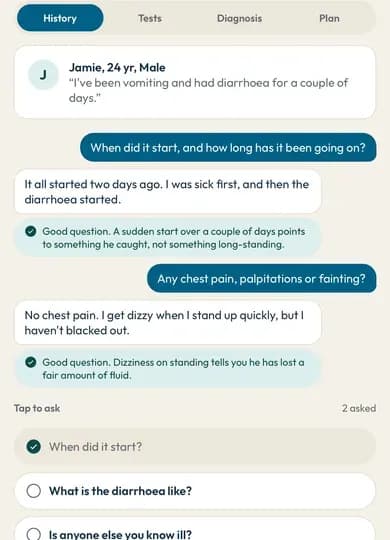
Diagnosica app, guided case history screen, as of November 2026.
- Ask, the simulated patient replies in plain words.
- Green note shows why that question mattered.
- Full cases, ask anything by voice or typing.
Simulated patient. Screenshot from Diagnosica, November 2026.
Pick by what you want to practise
If your school already licenses Body Interact, use that access first. Otherwise, pick by the skill you want reps in. That way each session lines up with the gap you actually need to close.
These are quick picks, each matched to a common practice need:
- Acute management reps: Full Code, 300+ cases across 31 specialties and EMS, checked 25 November 2026, see what Full Code costs.
- The whole encounter: CP OnCall, which lists examination, treatment and scored feedback.
- Shelf and Step 2 cases: Sketchy Cases, type or talk, then propose management, see a full Sketchy price breakdown.
- Notes and cases together: Neural Consult, a voice or text patient beside flashcards.
- Talking to a face: Diagnosica, a video patient you speak or type to.
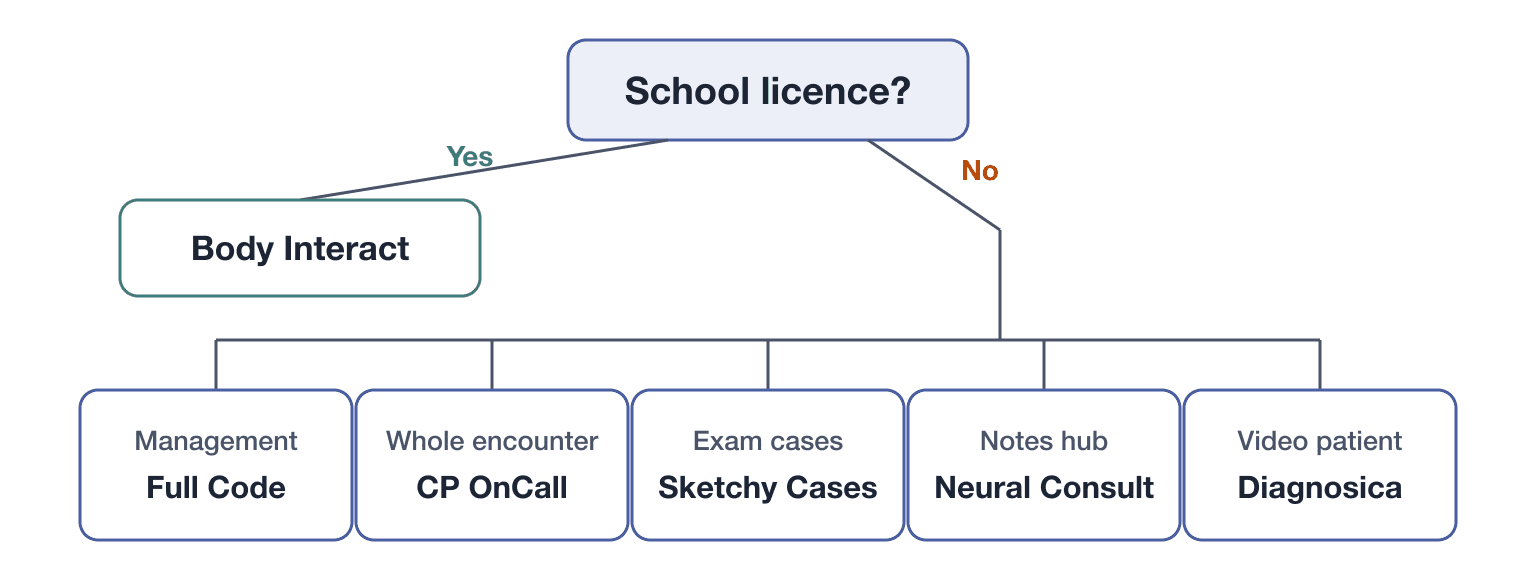
Drawn from each vendor's own page, checked 25 November 2026.
If your school already provides Body Interact, use that. If not, choose by focus. For management, pick Full Code. For the whole encounter, pick CP OnCall. For exam cases, pick Sketchy Cases. For a notes hub, pick Neural Consult. For a video patient, pick Diagnosica.
Want a wider sweep by task and content type? See AI tools sorted by clinical job.
Where Diagnosica fits, and where it doesn't
Diagnosica is for practising a conversation with a video patient by voice or text on web, iPhone or Android. It covers 170+ cases in 18 specialties, checked 25 November 2026. Every case ends with a scorecard marked against a rubric.
Example. Liam opens with "I can't catch my breath, and I've been wheezing since last night." He volunteers only that he can manage a few words at a time; the heavy cold three days ago, the blue inhaler more than ten times since yesterday, and the empty preventer come on question; the hospital stay at 14 and never in intensive care emerge only on a specific probe, marked as a red flag you must elicit.
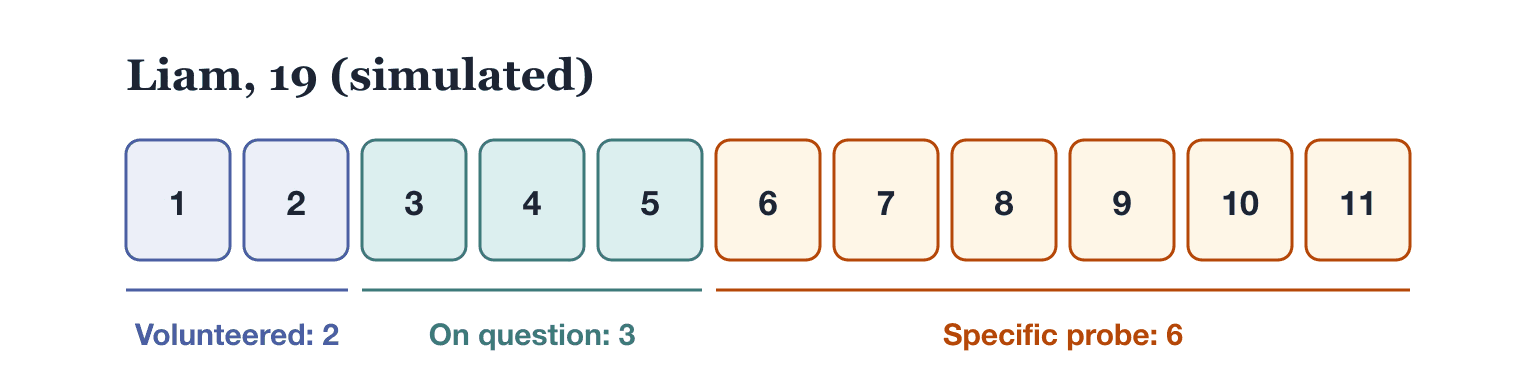
From the simulated case file of Liam Hartley, 19.
Of his 11 history facts, 2 are volunteered and 3 surface on question. Six appear only on a specific probe. That is the skill the case scores against its rubric. If you need a scaffold, use a structured respiratory history while you practise, then taper it.
Liam doesn't get better or worse, whatever you order or prescribe. There's no deteriorating physiology, management simulation or physical examination practice. If you need that, Body Interact, Full Code or CP OnCall fit better. Read how virtual patients differ from actors.
Open the web app, iPhone or Android. Practise a full case on any device. Speak or type, then see your rubric scorecard with teaching points.