Respiratory history taking: structure, questions and one worked case
Respiratory history taking covers the main symptom, a screen for breathlessness, cough, sputum, blood, chest pain and wheeze, then smoking, work, pets, travel and contacts. The NHS advises seeing a GP for a cough more than 3 weeks.
If someone coughs more than a few blood streaks or cannot get words out, call 999. See NHS coughing up blood. This post is exam practice.
Key takeaways
- Ask birth country and past residences for TB risk.
- In Samuel’s simulated case, 8 of 15 facts needed a specific question (case file count).
- Record smoking number per day and years; include passive smoke, work, pets, contacts.
What a respiratory history covers
Keep the standard order, then add a symptom screen and exposure section. Open with the complaint, then cover the five respiratory symptoms, smoking and work exposures, and family and contacts, then medications, allergies and background.
If you need the scaffold, start with the general history structure. Then take this history from an AI patient.
Part | What to ask |
|---|---|
Presenting complaint | Open question, then onset, duration, what makes it worse |
Respiratory symptom screen | Breathlessness, cough and sputum, haemoptysis, chest pain, wheeze, weight, appetite |
Past history and drugs | Inhalers and technique, steroids, ACE inhibitors causing cough, allergies |
Smoking, work and pets | Type and number now and before, passive smoking, jobs, hobbies, pets |
Family history and contacts | TB, asthma, hay fever, eczema, cystic fibrosis |
Source: Patient.info's clinician page, updated 23 September 2024, and work can be the cause so see occupational exposure questions.
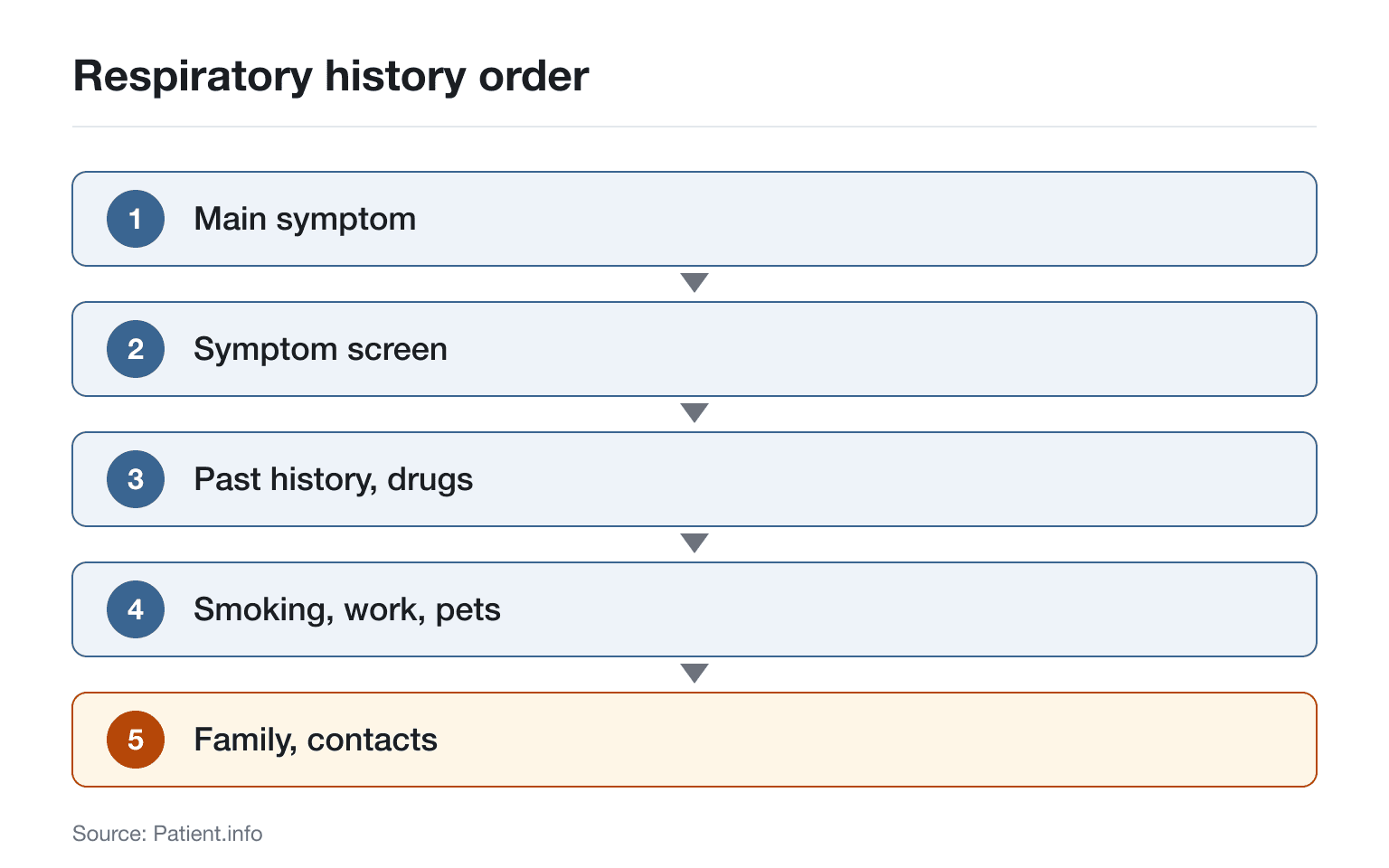
Order from Patient.info respiratory history guidance; adapted for student use.
Work through five parts in order: main symptom, symptom screen, past history and drugs, smoking, work and pets, then family and contacts, following Patient.info's standard structure.
Respiratory history questions, in order
This history works if you start open, then follow the main symptom into depth, and finally sweep symptoms and exposures. Open with a broad invite. Branch by cough or breathlessness. Then cover risks, work, smoking, pets, travel and contacts.
Use this order for an OSCE or ward respiratory history:
- Ask an open question and let them talk.
- Pin down the main symptom, onset, change over time, and duration.
- Screen the other respiratory symptoms (breathlessness, sputum colour and amount, blood, chest pain, wheeze).
- Ask about weight, appetite, fevers and night sweats.
- Take smoking as numbers per day and years, and passive smoking, then work, pets and hobbies.
- Ask where they were born and have lived, and who they live with.
If cough leads, switch to a dedicated cough history. If breathlessness leads, use the breathless patient station to frame your questions fast.
Then practise the investigations: the free chest X-ray quiz uses real films, and the ABG practice questions use real blood gases.
Samuel's history, question by question
Samuel Okafor's history shows a cough, blood and weight loss, but most facts need asking. From the case file tags we counted 15 history facts: 3 volunteered, 4 on a general question, 8 only on a specific question.
Samuel, 40 (simulated): what he said, and what we had to ask
Chip | Question | Answer | Why it mattered |
|---|---|---|---|
Volunteered | How long has the cough been going? | Six weeks, thick phlegm, not clearing. | Cough past three weeks moves beyond post-viral. |
Volunteered | Anything unusual in the phlegm? | Blood streaks in the last few days. | Blood plus weight loss adds TB and lung cancer. |
Asked | Any night sweats? | Drenching, sheets soaked. | Supports TB over simple chest infection. |
Only if asked specifically | Where were you born and lived? | Moved from Nigeria a few years ago. | Per case file, strongest single risk for reactivated TB. |
Only if asked specifically | Who do you live with? | Crowded house, three men to a room, housemate coughing for months. | Symptomatic contact raises spread chance. |
Only if asked specifically | Ever had an HIV test? | Never. | Undiagnosed HIV common in TB, needs testing. |
He also smokes about five a day, which only came out when asked directly
Simulated patient. Case file tb-40m. Questions written by us as a model, not a learner session.
Samuel's answers tighten TB and cancer
The NICE tuberculosis guideline NG33 names country of birth and recent contact as TB risk factors.
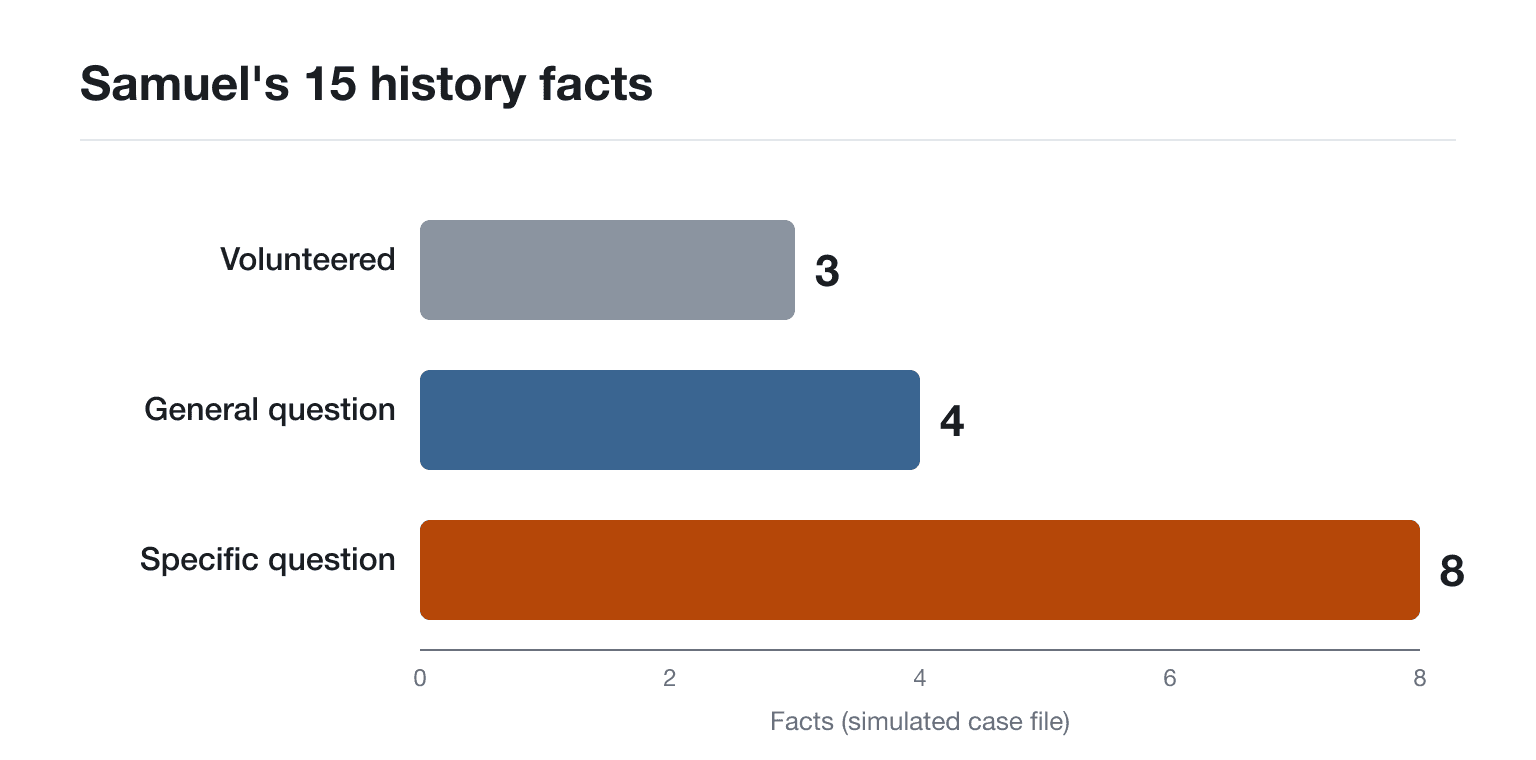
Bars 3 volunteered, 4 on a general question, 8 on a specific question, simulated TB case file (tb-40m.yaml).
In Samuel's simulated case file, 8 of 15 history facts emerged only on specific questions, 3 were volunteered, and 4 surfaced after a general open question.
Example. Samuel is 40, has ever smoked and reports blood in his phlegm. The NICE suspected cancer guideline NG12 (updated 15 April 2026) says refer people aged 40 and over with unexplained haemoptysis on a suspected cancer pathway, so lung cancer stays on the list beside TB.
How Diagnosica helps with this
You ask by voice or typing, the video patient answers only that.
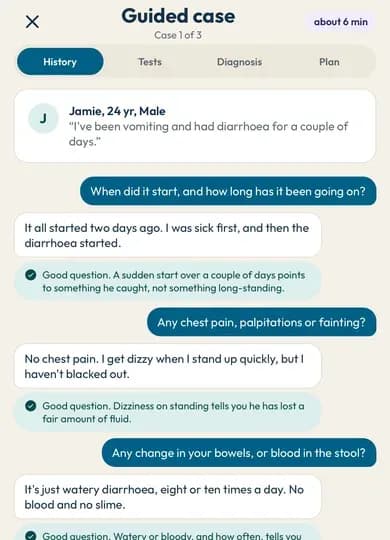
Diagnosica app, guided case history, November 2026, shown with a different simulated patient.
- Tap a suggested respiratory question.
- Each answer shows a short note.
- In full cases ask anything by voice or typing.
Simulated patient. Screenshot from Diagnosica, November 2026.
Red flags in a respiratory history
Red flags in respiratory history taking are escalation cues you should state aloud. In an OSCE, state escalation and destination to earn marks. Thresholds below are from NHS pages checked 18 November 2026, and local trust guidance applies.
When you hear these, name the destination and the urgency:
- Cough over 3 weeks or unexplained weight loss, see a GP (the NHS cough page).
- A few streaks of blood: urgent GP or NHS 111.
- More than a few streaks, or blood with hard breathing or chest pain, call 999.
- Can't get words out, lips or skin blue or grey, sudden confusion, call 999.
- Close contact with someone with TB and symptoms, see a GP (NHS).
These thresholds are set out on the NHS cough page and the NHS breathlessness page, while the NHS tuberculosis page states its review date as 10 September 2026.
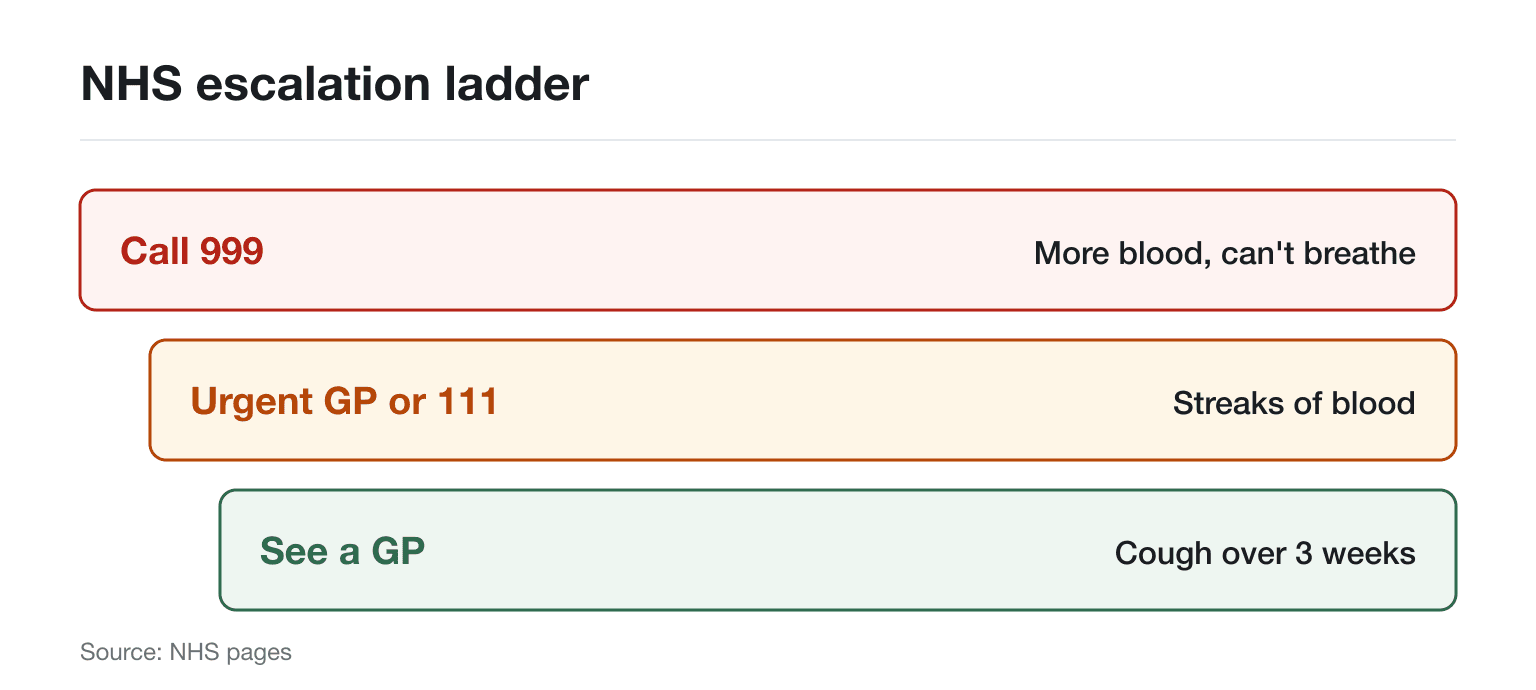
From NHS cough, coughing up blood and breathlessness pages, checked 18 November 2026.
Read the NHS ladder from the bottom: cough over 3 weeks means see a GP, streaks of blood mean urgent GP or NHS 111, more blood, or blood with hard breathing, means call 999.
Common mistakes in a respiratory history OSCE
Common mistakes start with stopping at volunteered symptoms. In Samuel’s case, the country of origin and the housemate with a chronic cough surfaced only when asked directly. The HIV test and the cigarette count did too.
A history that starts and stops at recent trips misses where someone was born and has lived. On the NHS tuberculosis page, higher risk groups include people born in or living where TB is more common, so put a careful travel history early.
Avoid yes or no smoking questions. Patient.info says a smoking history should record type and numbers now and in the past, and to ask about passive smoking. Say the key negatives out loud, then document them, see which negatives to document.
Watch out. Diagnosica covers the history only. There’s no chest examination practice in it, so rehearse inspection and auscultation with a partner.
Practise the respiratory history
Respiratory history taking works best as a habit: let the main symptom lead, screen the rest, then ask about home and work, including where they’ve lived, who they live with, and what they breathe in at work.
If you’re moving system by system, the next one to practise is the cardiovascular history. It pairs neatly when you keep the same opening questions, timeline, screening sweep, and brief exposure and family prompts. You can move between breath and circulation without rebuilding your approach, and you’ll spot patterns faster when the scaffold stays the same. If you want a run now, practise another full history.