ChatGPT for medical students: 6 uses, 4 traps (2026)
ChatGPT for medical students works well for explaining and quizzing, with study mode on all plans, including the $0 Free plan, but output needs checking and can't replace patient practice. Checked November 2026.
Diagnosica makes an AI patient simulator, so we have a stake in this topic. ChatGPT details come from OpenAI's public pages and the published studies linked below, checked November 2026. We didn't run our own test.
Key takeaways
- Start on the $0 Free plan, upgrade only if limits bite.
- Check every reference, since 41 of 59 were fabricated in a February 2023 study.
- Never paste anything that identifies a patient into ChatGPT.
What does ChatGPT cost medical students?
ChatGPT costs $0, $8, $20, or from $100 a month in the US, and study mode is on all four. In plain terms, the Free plan is enough to start, and the same study mode appears on each tier, so you are not locked out of that feature by price.
Plan | Monthly price | Study mode | Deep research | Worth knowing |
|---|---|---|---|---|
Free | $0 | Yes | Limited | Unlimited text chats, subject to abuse guardrails |
Go | $8 | Yes | Limited | May include ads |
Plus | $20 | Yes | Expanded | Expanded memory and context |
Pro | From $100 | Yes | Maximum | Maximum memory and context |
US prices and features from OpenAI's pricing page, checked November 4, 2026.
That page lists no student price as of November 2026. It describes ChatGPT Edu as a plan for universities, so ask whether your school has it. Content training has an opt-out on all four plans, covered under traps.
Nothing on that table lets you question a patient who won't volunteer the answer, which is a separate job.
What do medical students use ChatGPT for?
Medical students use ChatGPT for study and clinical reasoning support. In a sample of 177 US students across 14 schools from August 25 to December 10, 2024, 157 reported using it. The most common academic use was to explain concepts or terminology, reported by 74.5% of users, according to a national survey in JMIR Formative Research.
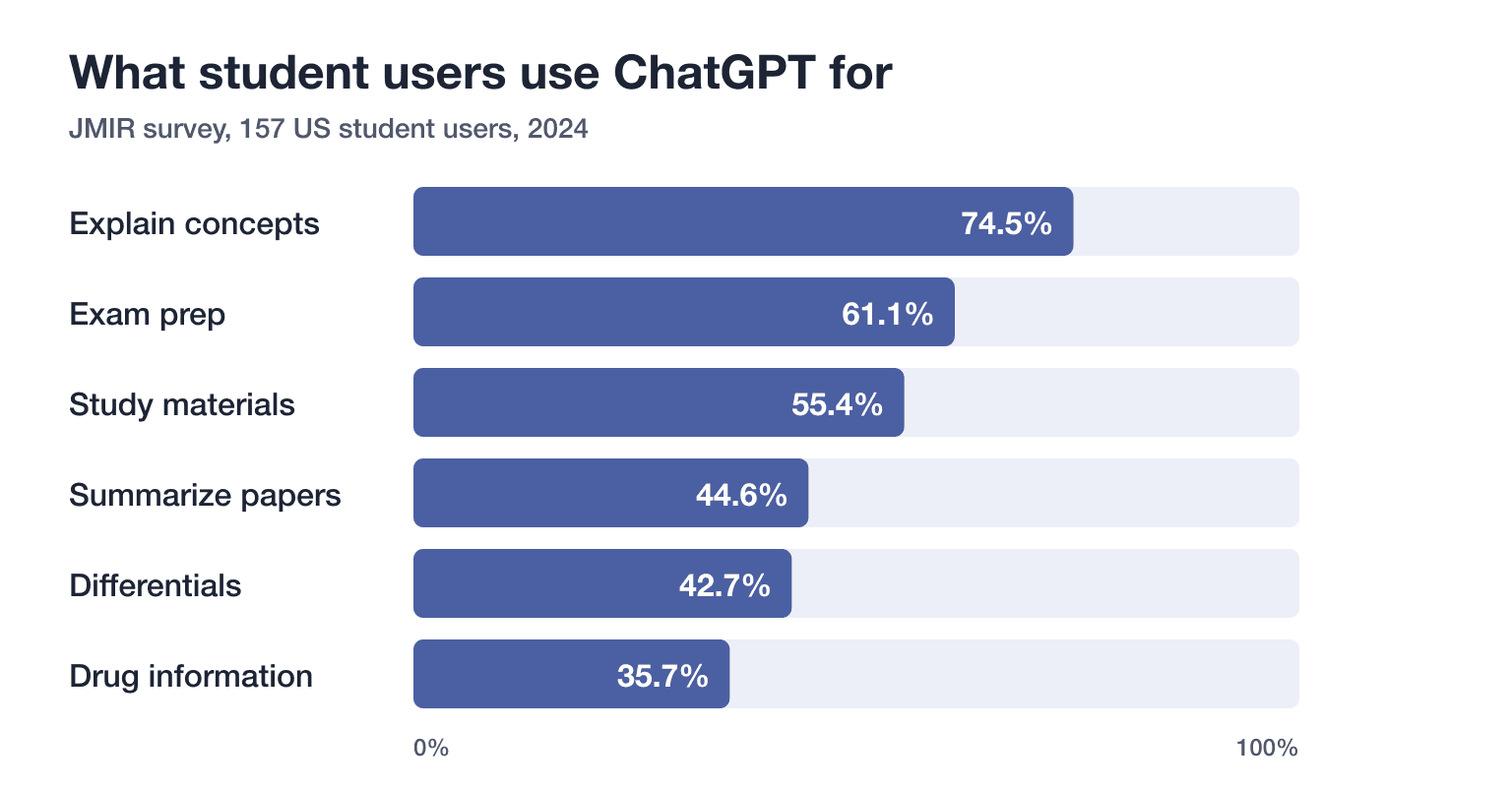
Shares for six academic uses among student users; source: a 2024 multicenter survey.
Use | Share of users | Try this tomorrow |
|---|---|---|
Explain concepts or terminology | 74.5% | Paste a confusing paragraph, ask for a concise explain-it-back. |
Prepare for exams or quizzes | 61.1% | Make 10 recall questions from my notes, show answers at the end. |
Generate study materials | 55.4% | Turn notes into a two-column concept map and short flashcards. |
Summarize research papers | 44.6% | Summarize in 5 bullets; read the methods yourself. |
Generate differential diagnoses | 42.7% | Commit to your own list first, then compare. |
Review drug information | 35.7% | Ask mechanisms and cautions; confirm against a primary reference before relying. |
In the same survey, 90.4% agreed responses were useful. It was self-reported with an estimated 2.3% response rate. Treat it as a signal, not a census, and the sample may overrepresent students already familiar with ChatGPT.
Turn on study mode before you ask anything
ChatGPT study mode helps you learn actively with guiding questions, hints, and self-reflection, instead of just getting an answer. It works through problems step by step and launched July 29, 2025, per OpenAI's study mode launch post.
Set it up in four steps:
- Select Study and learn from tools in ChatGPT.
- Name your topic and level, for example a final-year student revising one topic.
- Answer its guiding questions before asking for the explanation (it combines Socratic questioning, hints and quizzes).
- Ask it to quiz you, then check what you got wrong against your course notes or a textbook.
OpenAI itself warns of "some inconsistent behavior and mistakes across conversations", and you can toggle it off. Pair it with active recall in med school during prep blocks.
How accurate is ChatGPT for medicine?
Published results on ChatGPT’s medical accuracy are mixed and dated. It beat early medical students on clinical reasoning in one 2023 study, and it fabricated most references in another. Neither paper tested today's plans, so treat every answer as a draft, and verify key points.
Study | What it found | The catch |
|---|---|---|
Stanford study (2023) | On 14 clinical reasoning cases it scored 4.2 points above first- and second-year students, and passed 93% of the time versus 85% | Early students, an older version, and it still added false details the researchers called confabulation |
41 of 59 references (69%) were fabricated; experts found major factual errors in 5 of 17 evaluated responses (29%) | An older version, 20 medical questions |
We could be wrong about how far this carries to current versions. We found no way to say from these papers. In the JMIR survey 46.5% cross-checked answers half the time or less.
What ChatGPT doesn't do: make you ask
A real history rewards the question you thought to ask. ChatGPT starts from the question you already have, and even OpenAI pitches study mode as "instead of just getting an answer".
You can set ChatGPT up as a mock patient, and a ChatGPT patient role-play walks through it. You write the case yourself, though, so you already know what's hiding.
Example. Raymond Hale, 68 (simulated patient), opens with "I've been shattered for months and now I'm puffing just going up the stairs." His case file holds 17 history facts: he volunteers 2, gives 3 when asked, and keeps 12 until you probe specifically. Weight loss of about 8 kg waits for a question. His father's bowel cancer and two discarded screening kits wait for a specific one.
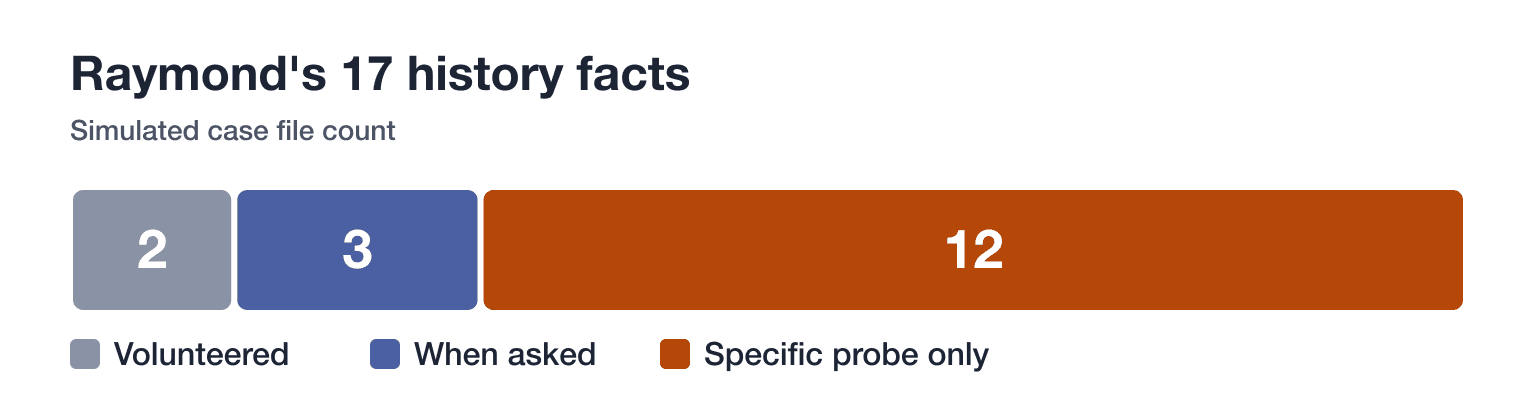
Counts history facts in the Diagnosica case file; the patient is simulated, not real.
That is why the negatives you have to ask are worth drilling.
How Diagnosica helps with this
You ask a video AI patient by voice or text; it answers what you asked.
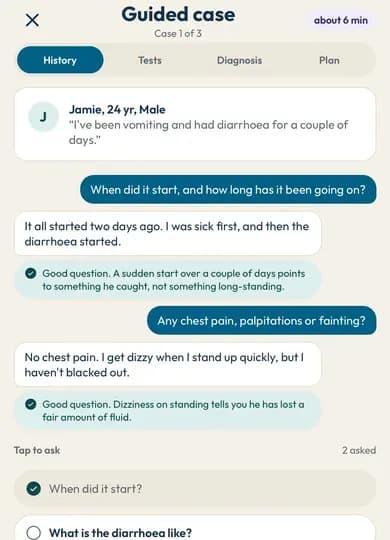
Diagnosica app, guided case history, as of November 2026.
- Your question sits on the right.
- The simulated patient answers only that question.
- A short note says why it helped.
Simulated patient. Screenshot from Diagnosica, November 2026.
Four traps to watch for
ChatGPT has four traps: made-up references, confident errors, patient details, and outsourced thinking. Each has a simple fix, so you can spot the pattern and apply the right guardrail before you rely on an answer.
What each one looks like, and the fix:
- Made-up references: open each paper yourself before citing it.
- Confident errors: check any fact you'd repeat on rounds against a primary source.
- Patient details: see the box below.
- Outsourced thinking: try the question yourself first, and follow your school's rules on assignments.
JMIR reported 46.5% used it to help complete assignments, and 53.7% believed AI would reduce clinical reasoning; belief, not a measured effect.
Watch out. Never paste anything that identifies a patient. The JMIR authors say students "must take caution to deidentify data and protect patient information" and flag HIPAA concerns.
On individual plans OpenAI may use your content to train models; opt out in Settings > Data controls. Temporary chats aren't used for training while temporary, per its data controls help page. Thumbs feedback can send the whole conversation to training after you opt out. None of this makes it fine to paste patient details.
JMIR also found 21.0% used it to help write clinical notes; of those who used it for clinical notes, 57.6% were first or second years, which the authors say may mean some saw it as a theoretical use.
How to choose what to open
Choose what to open by the task in front of you, not the brand. Pick by the job, use ChatGPT for explaining and quizzing, and switch tools when you need cited answers, durable recall, or a patient to question.
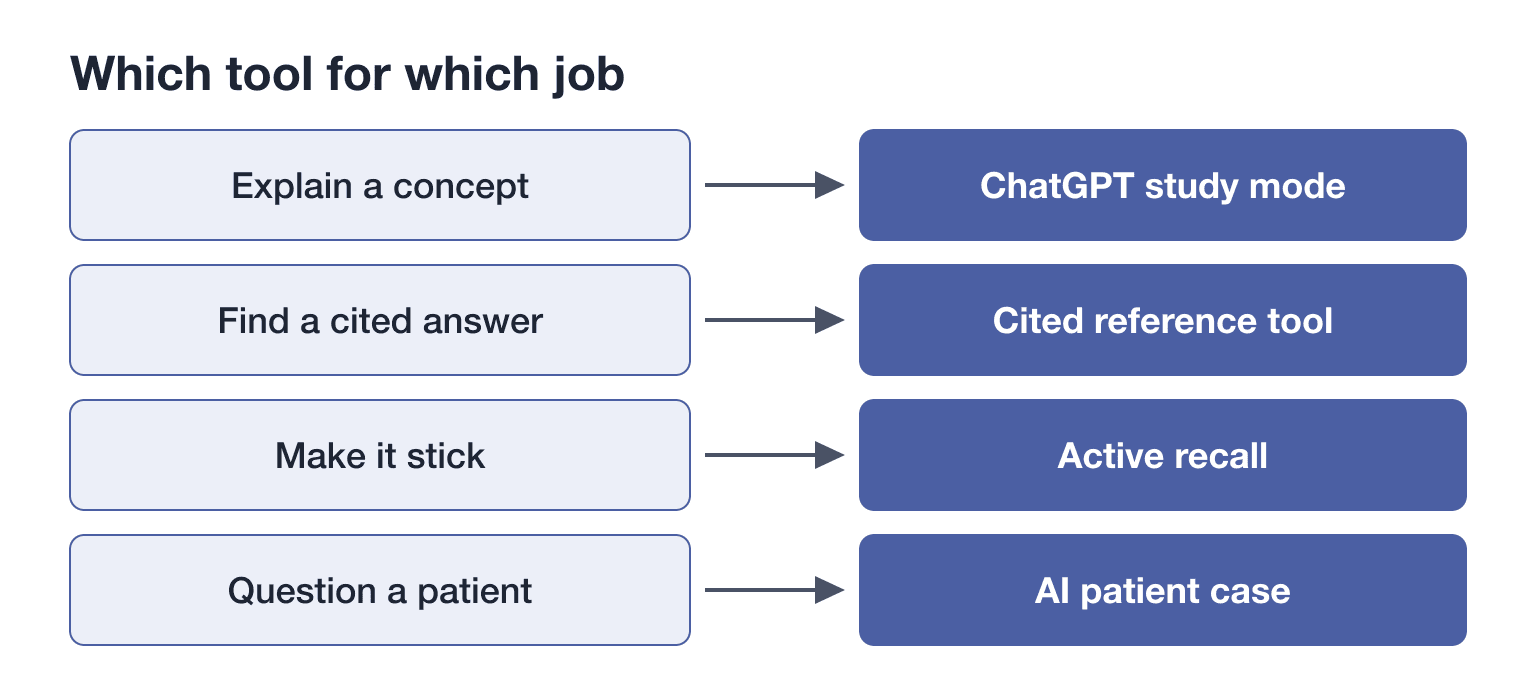
Match the task to the tool you open, not the brand.
Route your next question with this quick fork in the road:
- Need an explanation: use study mode on the Free plan first.
- Need a cited answer: read OpenEvidence and where it fits.
- Need it to stick: start with keeping medicine in memory.
- Comparing more tools: see AI tools beyond ChatGPT.
For the part ChatGPT leaves to you, practice with an AI patient: Diagnosica has 136 cases across 18 specialties, a video patient you talk to by voice or text, a scorecard after each case, and it's free to start, no card needed. It doesn't give advice about real patients, and it's not a diagnostic system.