History taking mnemonics: 7 that hold up in an OSCE

The history taking mnemonics are SOCRATES, OLD CARTS, OPQRST for presenting complaint, SAMPLE, HUJ-THREADS for background, LOCAS DIET for social, ICE for patient view. Our count on one library case found 2 of 3 must-ask red flags unprompted by mnemonics.
Key takeaways
- SOCRATES and OPQRST each prompted 4 of the case's 16 history facts directly.
- Pair a complaint mnemonic with ICE, SAMPLE and LOCAS DIET for the rest.
- Write the red-flag negatives before you walk in.
Do this first: match the mnemonic to the part of the history
Treat history taking mnemonics as checklists for one section, not the whole history. SOCRATES, OLD CARTS and OPQRST are pain-shaped. Background and social sets come later. Start with open questions, then use letters to plug gaps.
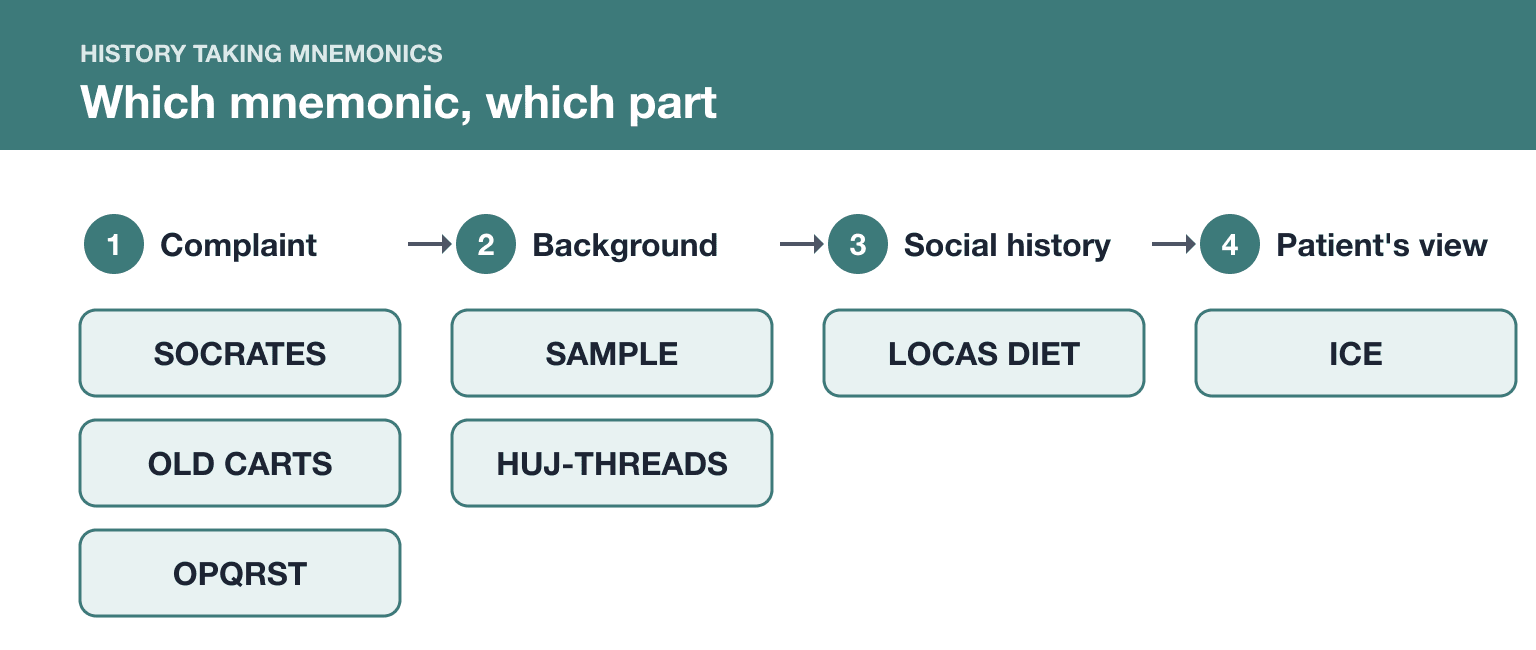
Which part of the history each of the seven mnemonics checks.
Presenting complaint: SOCRATES, OLD CARTS, OPQRST; background: SAMPLE, HUJ-THREADS; social history: LOCAS DIET; the patient's view: ICE.
Start broad, then narrow. Use open questions first, then switch to letters to structure and keep building a focused history on track. The Kent study says SOCRATES targets pain, and inexperienced students use it as a default. Keep it for pain, then take a pain history with an AI patient.
The seven mnemonics and what each letter asks
The seven history taking mnemonics map letters to questions you can ask fast. Use SOCRATES, OLD CARTS, OPQRST for symptom analysis, SAMPLE for first aid context, HUJ-THREADS and LOCAS DIET for background and social, and ICE for the patient’s perspective.
Mnemonic | Letters stand for | Part of the history | Source |
|---|---|---|---|
SOCRATES | Site, Onset, Character, Radiation, Associations, Time course, Exacerbating/relieving, Severity | Pain history | |
OLD CARTS | Onset, Location, Duration, Character, Aggravating/Relieving, Timing, Severity | Symptom history | |
OPQRST | Onset, Provocation or palliation, Quality, Region and radiation, Severity, Time | Pain history | |
SAMPLE | Signs and symptoms, Allergies, Medications, Past history, Last food and drink, Events leading up to the injury | First aid history | |
HUJ-THREADS | Heart attack, Ulcers, Jaundice, TB, High blood pressure, Rheumatic fever, Epilepsy, Anaemia, Diabetes, Stroke | Past medical history | |
LOCAS DIET | Life, Occupation, Children, Alcohol, Smoking, Diet, Exercise, Travel | Social history | same guide |
ICE | ideas, concerns, expectations | End of consultation | same guide |
SAMPLE comes from first aid, and St John calls it a first aid mnemonic of 6 questions. Medical professionals use OPQRST for acute illness, adapted to heart attack symptoms. Letters vary between sources. For example, the consultant physician’s guide reads E as exaggerating and relieving factors and T as timing. For patient perspective, see how to ask ICE.
Worked case: Gary's loin pain run through each mnemonic
Gary Sullivan, 40, a groundworker with left loin pain for two hours. Our count across 16 facts found SOCRATES and OPQRST 4 direct hits each, SOCRATES 4 partials. OPQRST's T catches his previous stone, which SOCRATES lacks; HUJ-THREADS surfaced none.
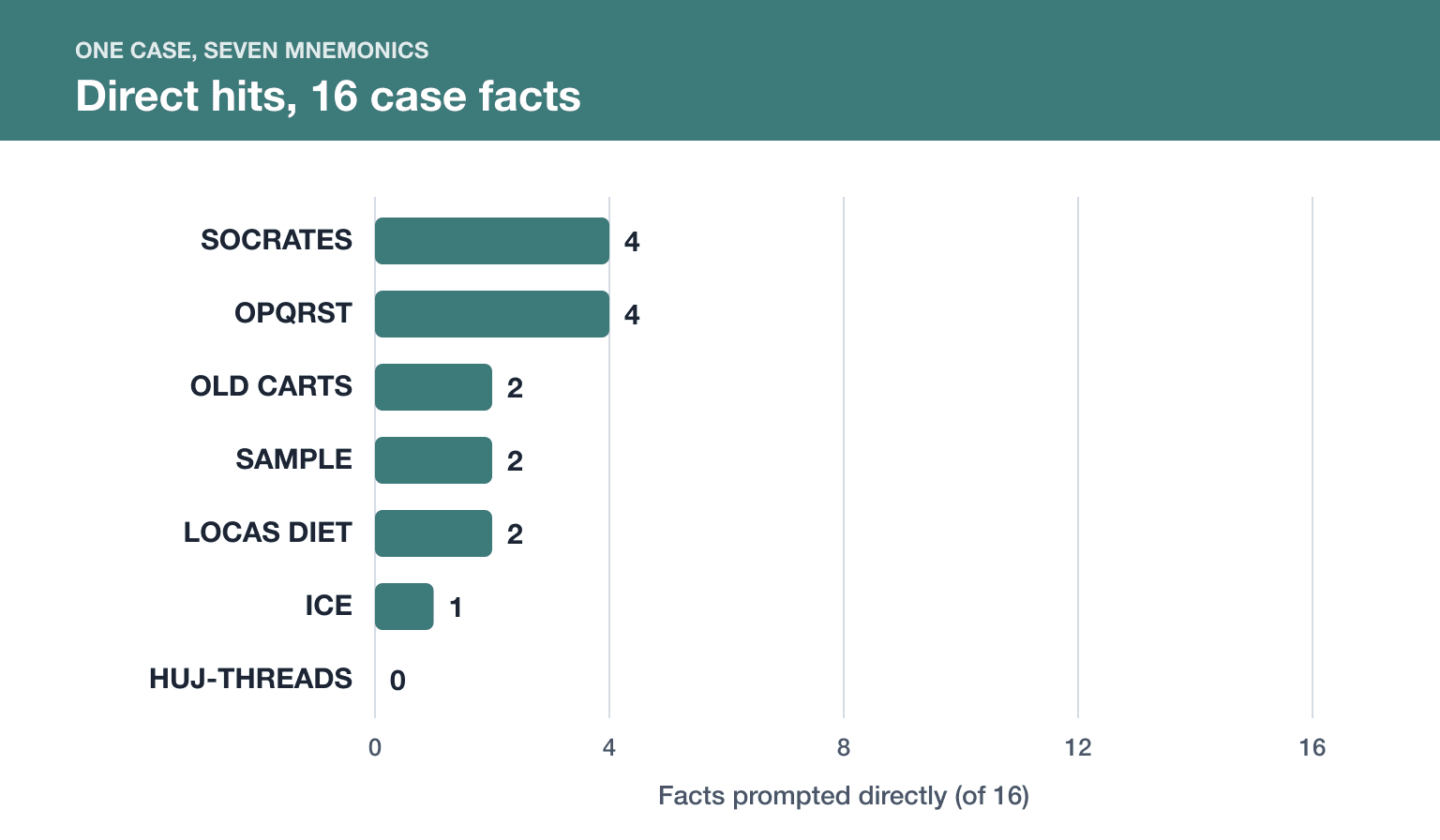
Direct hits out of the case's 16 history facts, by mnemonic. Our count of one case file.
Direct hits from our count: SOCRATES 4, OPQRST 4, OLD CARTS 2, SAMPLE 2, LOCAS DIET 2, ICE 1, HUJ-THREADS 0.
Gary, 40 (simulated): six questions that changed the odds
Chip | Question we asked (letter) | Gary's answer | Why it mattered |
|---|---|---|---|
Volunteered | What's brought you in? (S, O) | "I've got waves of really bad pain in my left side." | Abrupt severe one-sided loin pain is the classic opening of ureteric colic. |
Asked | Does it spread anywhere? (R) | "Yes, round the front to my groin and down into my left testicle." | Loin-to-groin radiation is the single most discriminating feature. |
Asked | What makes it better or worse? (E) | "Nothing helps. I can't get comfortable, I have to keep moving." | Restlessness separates colic from peritonitis, where patients lie still. |
Only if asked specifically | Any change in your urine? (A, if aimed) | "It's gone pink, like it's got blood in it." | Visible blood in the urine supports a stone. |
Only if asked specifically | Has this happened before? (no SOCRATES letter) | "Yes, about two years ago I had something just like it, but not as bad." | A previous stone sharply raises the chance of another. |
Only if asked specifically | Any fever, chills or night sweats? (no letter) | "No fever and I haven't had the shakes." | Rules out an infected blocked kidney, the emergency. |
Five of six surfaced only because a question was asked, three only to a specific probe; next try OPQRST T on previous episodes.
Simulated patient. Case file ureteric-colic-40m. Questions written by us as a model, not a learner session.
What every mnemonic missed: the red-flag negatives
Two of the case's three must-ask red flags fit no letter in any of seven mnemonics, and fever is reachable only through SOCRATES Associations if you aim it there. Across all seven, prompts directly elicit 9 of 16 facts.
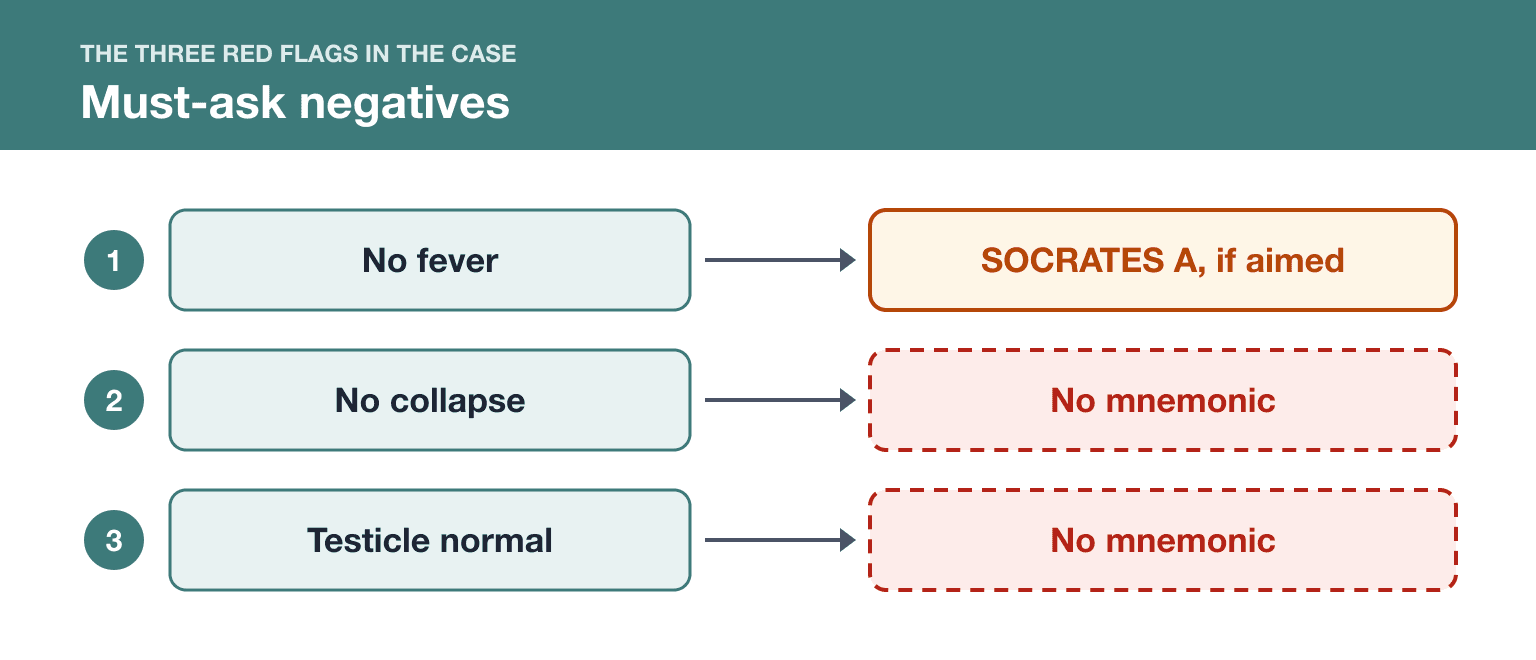
The case's three must-ask negatives and which mnemonic letters reach them.
The case file marks three must-ask red flag negatives: no fever or shivering; no collapse, tearing pain or a throbbing lump in the tummy; a testicle that is not swollen or tender.
These negatives come from the differential, not a checklist; the case file says they exclude an infected obstructed kidney, a leaking abdominal aortic aneurysm and testicular torsion. Across the seven, history taking mnemonics directly prompt 9 of 16 facts, and four are prompted by none, per our count: still passing urine, no collapse, the testicle, normal bowels. Pick your red-flag negatives to ask using a sieve for differentials, then ask each as a closed question.
Watch out. A checklist cannot pick your negatives for you; list the dangerous mimics first, then ask a closed question for each.
In an OSCE, run your pain history mnemonic, add the targeted negatives, then finish with the systems review.
How Diagnosica helps with this
You ask by voice or typing, and the AI patient answers only your questions.
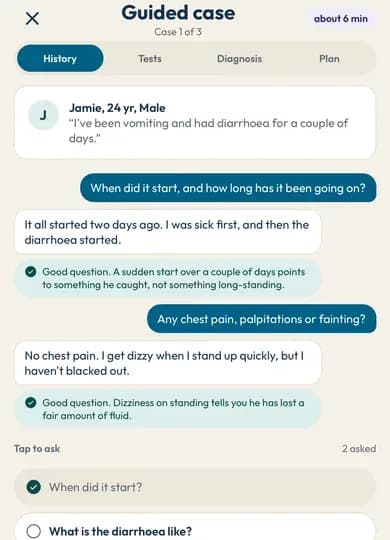
Diagnosica app, history screen, as of November 2026.
- Your question appears on the right.
- The patient's reply appears beneath it.
- A short note explains why that question mattered.
Simulated patient. Screenshot from Diagnosica, November 2026.
Common mistakes with history taking mnemonics
Common mistakes with history taking mnemonics include overusing SOCRATES beyond pain, missing triggers and progression, and trusting checklists for red flags. A Kent study describes these gaps across 23 presentations and 170 units, and also critiques unwarranted radiation.
Watch for these four traps that trip people in OSCE prep, where mnemonics become a crutch instead of prompts to listen first and then target questions:
- SOCRATES everywhere: Designed for pain, SOCRATES became default for inexperienced students in Kent's review.
- Missing dimensions: SOCRATES lacks triggers, function, progression; Kent proposed SSTOP TEACh As Fun too.
- Lead with listening: Ten of sixteen facts need specific, targeted probes in the case file.
- Red flag gaps: Two of three must-ask negatives, in our count, fit no letter.
Practise it: a five-step routine for your next history station
A five-step routine for your next history station keeps you consistent: start open, target gaps with SOCRATES or OPQRST, clear red flags, sweep background with SAMPLE, HUJ-THREADS and LOCAS DIET. Then ICE and summarise. See the full OSCE preparation plan.
- Open with an open question, listen without interruption, and let the patient finish fully.
- Run your complaint mnemonic, SOCRATES or OPQRST, to fill missing dimensions from the presenting problem.
- Ask your red-flag negatives that exclude the top dangerous mimics for this symptom.
- Sweep background with SAMPLE, HUJ-THREADS and LOCAS DIET, and add focused family history.
- Finish with ICE, summarise back succinctly, and ask if anything important was missed.
You can rehearse this on an AI patient at any hour without a partner and see what you missed on the scorecard after the case. It doesn't give advice about real patients, and it's not a diagnostic system. Treat every output as educational. Practise a full history.