Systems review in history taking: which systems, when

A systems review is a brief screen of the body systems the patient hasn't mentioned, and the presenting complaint decides which systems you ask about first. In history taking, Geeky Medics starts with fevers, night sweats, weight change, fatigue.
Key takeaways
- Start with 4 general symptoms first.
- Choose the next systems from the presenting complaint, not a fixed list.
- Neck lump case: 1 of 7 volunteered, six required questions.
What is a systems review in history taking?
A systems review in history taking is a brief symptom screen across other body systems after the presenting complaint. It often picks up forgotten symptoms. It is also called a systemic enquiry or a review of systems. Short and structured, it catches context you might otherwise miss.
Where it sits, practically: after the presenting complaint, history of the presenting complaint, and the rest of the history, then a quick screen to close. For order and prompts, see the focused history order. That keeps you targeted before you open the systems tap.
How big is the list. The Geeky Medics systemic enquiry guide lists nine system headings. The Medistudents history guide names seven main systems. It notes some courses also add ENT and ophthalmology, and says the review gathers a short amount on systems not covered. The lists differ. Nobody reads every question to every patient.
You can ask an AI patient your systems review now, free to start, no card needed.
Let the presenting complaint pick the systems
Which symptoms to screen depends on the presenting complaint and your level of experience; Talley and O'Connor write, "Not all of these questions should be asked of every patient." Use a focused systems review, led by the presenting complaint.
Adjust the detail of systems review history taking to the presenting problem, the patient's age and earlier answers, per the Talley and O'Connor list.
Start with focused screens tied to likely differentials:
If you're worried about | System to screen | Question to ask |
|---|---|---|
haematological malignancy | Haematological | Any lumps in neck, armpits or groin? |
malignancy | General | Lost weight without trying? |
pulmonary embolism | Respiratory | Short of breath, came on suddenly? |
cardiac failure | Cardiovascular | Wake at night short of breath? |
oesophageal cancer | Gastrointestinal | Difficulty swallowing? |
A full interrogation is slow. A 1997 JABFM editorial questioned the case-finding yield of the review of systems and said the focused history has largely replaced the traditional full interrogation taught in medical schools. On the wards this matters even more, for example in a ward clerking or a breathlessness history.
A four-step systems review script
A focused systems review takes four moves you can say aloud in OSCEs and on wards. It keeps you quick and safe, and shows you're systematic without reading a shopping list.
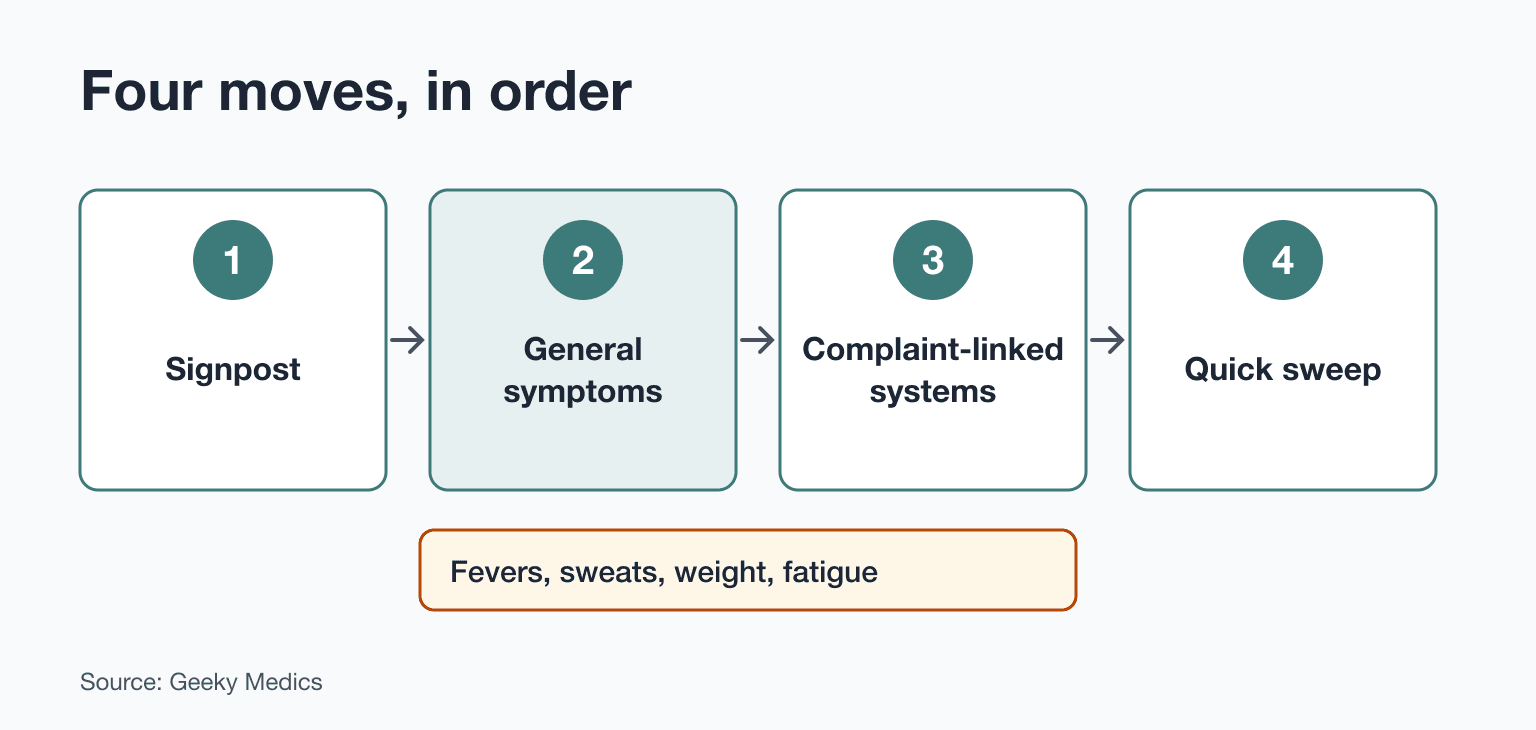
Signpost, ask general symptoms, check complaint-linked systems, then do a quick sweep, using the general symptoms list from Geeky Medics.
Use this default script, then tailor based on the complaint and answers:
- Signpost you're moving on to a few questions about the rest of the body.
- Screen the four general symptoms first, per Geeky Medics: fevers, night sweats, weight change and fatigue.
- Ask the systems your complaint points to, then adjust detail by age and earlier answers, per Talley and O'Connor.
- Sweep remaining systems with one quick question each, and explore any yes, since patients forget details, per Geeky Medics.
Use the main history mnemonics to cue order, but let the complaint set depth. After your systems review, practise summarising back to the patient so omissions surface and you can correct misunderstandings before moving on.
Worked case: the neck lump that needed a systems review
In the library case hodgkin-lymphoma-25m, Thomas Reeve, 25, volunteers only a painless enlarging neck lump. The night sweats, unintentional weight loss and evening fevers appear only if you screen general symptoms. Only the lump was volunteered. Simulated patient.
Thomas, 25 (simulated): what he said, and what we had to ask
Chip | Question | Answer | Why it mattered |
|---|---|---|---|
Volunteered | What brings you in today? | A painless left neck lump for about four weeks, slowly getting bigger. | Sets the presenting complaint and timeline. |
Only if asked specifically | Any night sweats? | Drenching night sweats that soak the sheets, needing T-shirt and bedding changes. | General symptoms screen. |
Only if asked specifically | Any unintentional weight loss? | Lost about four kilos in two months without trying. | General symptoms screen. |
Only if asked specifically | Any fevers or chills? | On and off fevers, feeling hot and shivery in the evenings. | General symptoms screen. |
Only if asked specifically | Any cough or breathlessness? | Mild dry cough and a bit short of breath on stairs. | Respiratory system review. |
Asked | Any itch or skin changes? | Itchy all over, with no rash. | Skin system review. |
From the case file count, only 1 of 7 key findings surfaced unprompted, so ask the general screen early.
Simulated patient. Case file hodgkin-lymphoma-25m. Questions written by us as a model, not a learner session.
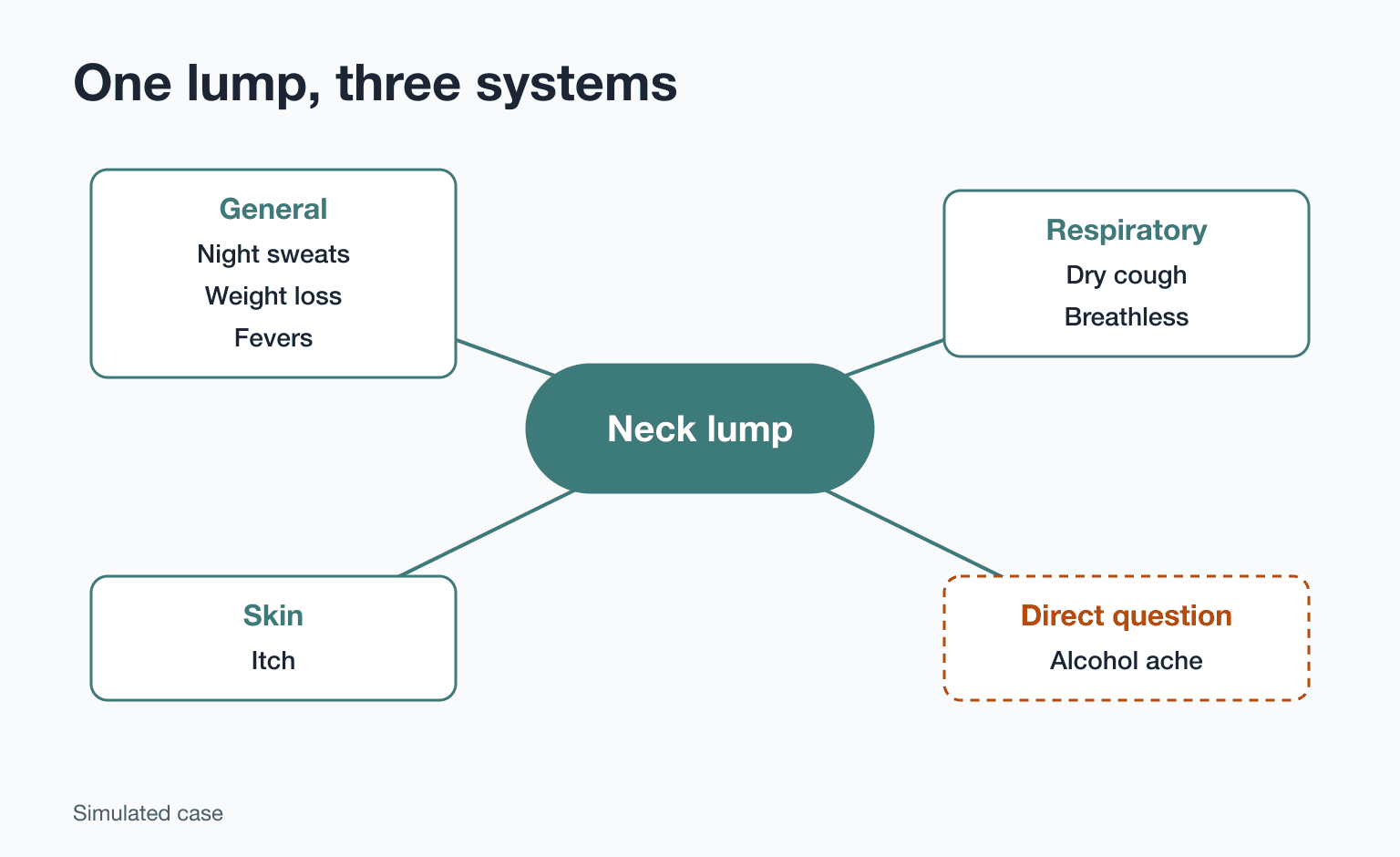
Thomas, 25: General, Respiratory, and Skin checks plus a direct alcohol ache question added context beyond the opening line.
The case file marks 5 findings as must-elicit, including the ache with alcohol, which you only find with a direct question. These match the symptom list on the NHS Hodgkin lymphoma page.

1 of 7 key findings came unprompted, and the other 6 needed a direct question in this simulated case.
Mistakes that hide the diagnosis
In a systems review, the biggest errors are about order and depth, not knowledge. They appear when you stop once the headline seems clear, or spray every questionnaire line at everyone, which hides key positives.
Watch for these four patterns that bury key positives:
- Stopping at the neck lump, since the case marking deducts for missing B symptoms.
- Reading the whole list, since Talley and O'Connor say not every patient needs everything.
- Asking a vague catch-all, since 'any other symptoms' misses drenching sweats without naming them.
- Skipping the odd question, since alcohol-triggered ache appears only with a direct prompt.
Watch out. A yes on the systems review is not a tick box; go back and characterise it, and write down the negatives too. See negatives worth writing down.
Practise a focused systems review
A focused systems review in history taking works if you practise it live: reading lists don't build the habit. Ask out loud to a patient who only answers what you asked. For broader prep see your wider OSCE preparation.
How Diagnosica helps with this
You ask focused questions, the AI patient answers only those.
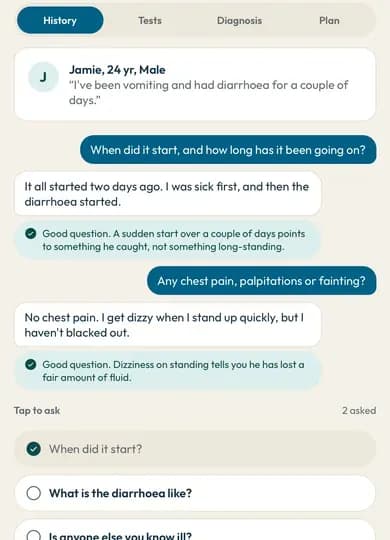
Diagnosica app, guided case history screen, as of October 2026.
- The History tab, where you ask the patient questions
- The patient's reply to a cardio screen
- A note on why the question helped
Simulated patient. Screenshot from Diagnosica, October 2026.
Take a history from an AI patient, free
Use the library to practise a full history, free to start, no card needed. The scorecard shows what you missed. Practise systems review history taking on real-feeling scripts. It doesn't give advice about real patients, and it's not a diagnostic system.